



Nils-Peter Hey was put to the test by circumstances and conditions during an unusual North Atlantic voyage
After two days of safety briefings and provisioning in Reykjavik, Iceland, we were ready to set sail for Horta on the island of Faial in the Azores. It was 17 September, 2025 and my co-skipper, Kay, and I were aboard an aluminium Garcia Exploration 52 expedition yacht, in charge of taking a paying crew of six approximately 1,650 miles in 15 days.
We quickly completed the customs formalities and set off in bright sunshine, heading for the open North Atlantic. We left a small traffic separation zone to starboard and then noticed the swell and wind setting in as we emerged from the land cover of Iceland.
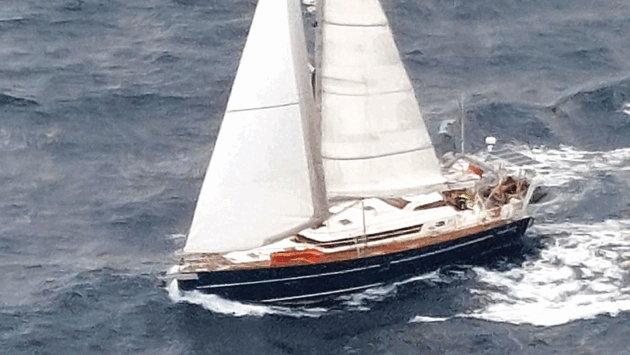
Irish Coastguard helicopter took photos of the yacht as it approached the Irish coast. Photo: gov.ie
The wind picked up faster than expected from almost 0 to 30 knots and so did the Atlantic waves. We discovered that the line for the third reef was pulling through the roller of the other reefs at the boom vang. In order to repair this control line, we had to sail across the waves on a broad reach. It took a while and the Icelandic Coast Guard even radioed to ask if everything was OK with us.
Finally, we set sail again, heading south on the third reef, with the waves astern, into the night. A high-pressure ridge with light winds was forecast, so we left the mainsail heavily reefed and waited until the conditions made a final decision easier.
Storm Gabrielle
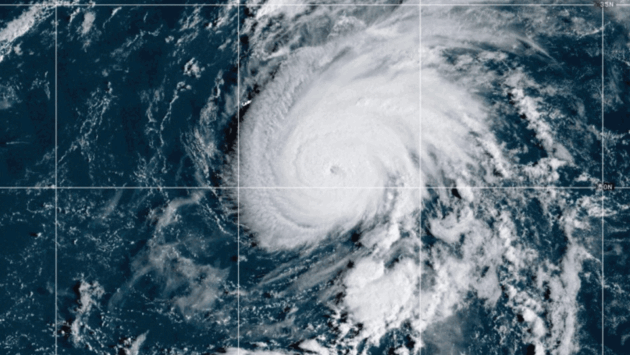
During our second day at sea, it became apparent that the tropical depression that had appeared 800 miles to the east of Barbados was likely to develop into a tropical storm, then a hurricane, then continue on as a severe weather system. Gabrielle, as the storm was named, came to dominate our discussions because, unfortunately, all models predicted that her path would take her towards the Azores, arriving at about the same time as us.
This meant that although she was still 2,000 miles away from us, we were unable to head directly for Horta. Yet at the same time, it was difficult to say what a safe alternative route would look like. There were basically two options: one was to stay in the northern, western part of our route, hoping that Gabrielle would pass south of us.
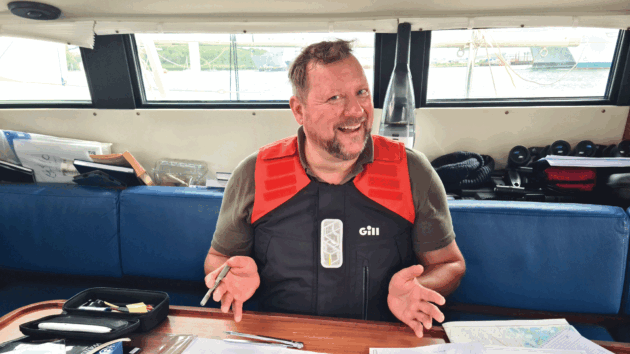
Nils-Peter Hey is an RYA Cruising Instructor with multiple Atlantic crossings under his belt. After numerous deliveries and cruises for different training centres and companies, mainly on the Atlantic and in northern waters, he is now working his way into a career as a mental trainer for sailors. Photo: Nils-Peter Hey
However, this conflicts with statistics, according to which almost all hurricanes eventually move north, and it would mean waiting for days. Alternatively, we could go very far east and hope that the storm would do exactly that – turn north.
So we continued on our general course of 190° and waited to see how the weather was going to affect our journey. At which point, seasickness set in. It affected everyone except Kay and me. After two days of vomiting, things calmed down a bit, but for half the crew there was no lasting relief for their vestibular systems. I got used to cleaning up the vomit in the cockpit, and Kay and I took care of everyone as best we could.
All quiet on the western front
In consultation with Wetterwelt in Kiel, Germany’s most renowned routing office, we decided to work on the eastern option. If necessary, we could head for Galway in Ireland. In this respect, we changed course to 140°, taking us south on the one hand and keeping us within striking distance of the Irish coast on the other, without losing too many miles on our actual destination.
The swell from the north-east, which reached a good four metres, was causing us some trouble. However, it was still of a tolerable and comfortable length. The gusty winds of up to about 35 knots from the NNE helped us to make good progress and brought daily distances of up to 150 miles.
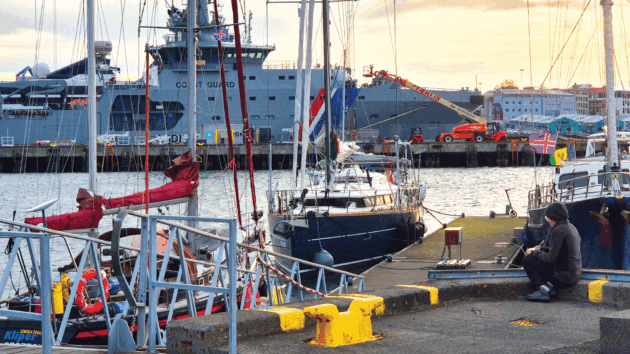
Provisioning at Reykjavik before departure for the Azores. Photo: Nils-Peter Hey
But the owner back at base was not happy about this. He could see his business in the Azores threatened and suddenly started giving us his personal travel recommendations, which he had determined using ChatGPT Professional. I discussed this with the professional weather service, which also had its doubts. As the skipper, I was ultimately responsible for safety, so I decided that we should follow the recommendations of the professional meteorologists.
However, Kay and I felt the pressure of the owner and his chief skipper ashore via Whatsapp. In their opinion, we could sail without any problems along the waypoints provided by the AI model. But neither the weather forecasters nor the weather models could confirm this.
If I headed for the storm and it turned north, I would have to flee back to Ireland. If it turned east, I’d get five-to-six-metre swells and storm-force winds in my face. And that for 10 days or more.
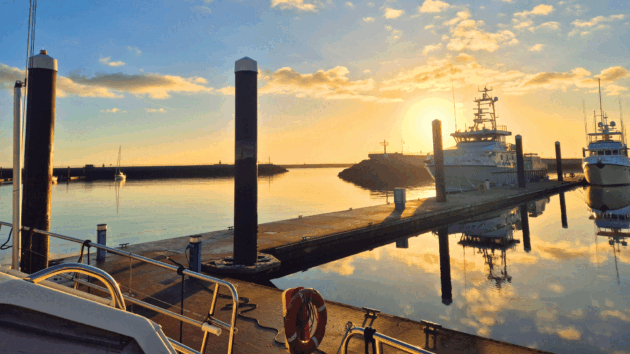
Arrival at Dún Laoghaire. Photo: Nils-Peter Hey
The bottleneck
The problem was that I had people on board who had no experience of the high seas. Although they had been informed about the possible hardships of this difficult passage when the berths were sold, only experienced ocean sailors know the true physical (lack of sleep, seasickness) and psychological strain (length of the voyage, fear) involved. The naive dream of a romantic ocean voyage is just that… a dream.
To make matters worse, one crew member fell ill in a way that caused me concern. As a precaution, I filled out the forms from Medico Cuxhaven for a radio medical consultation.
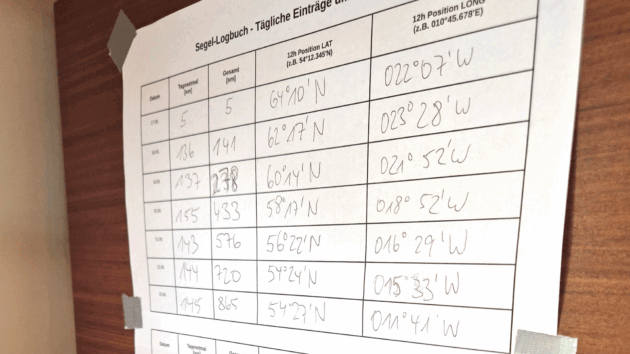
Logging the yacht’s position daily for all the crew to see progress is being made. Photo: Nils-Peter Hey
The whole situation was a decision-making dead end. Continuing at all costs would mean at least tacking against the wind and high swells, still facing the danger of hurricane remnants. It meant our owner might lose money and we had more days ahead of us than we had provisions on board. It’s impossible to imagine what that would have done to the crew. With professionals on board, we could have planned differently.
The alternative was to sail to Galway to replace or supplement the crew, or in the worst case, continue with fewer people when the weather window was more favourable. So we informed the owner, which triggered an angry response: we were accused of being pathetic and told we would be dismissed if we didn’t ‘see it through’.
In view of this, Kay and I decided to hand over the ship to another crew in Galway. Given the state of trust, it did not seem possible to continue in a position of responsibility. Having ridden out the high-pressure ridge, we found ourselves facing a strong, stable polar front blowing near gale-force south to southwesterly winds, so we set a course for Galway, which meant sailing close-hauled to the south-east.
That’s already difficult with the somewhat pot-bellied Garcia Exploration 52 when reefed. To make matters worse, there was a loud SNAP! and the staysail (jib on the inner forestay) came down on the stay.
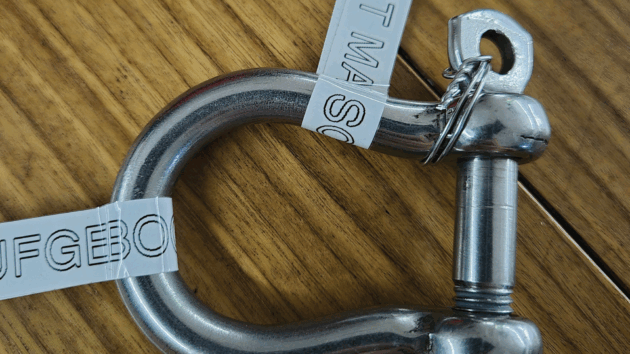
Securing the shackle pin with wire would have saved this crew two full days at sea. Photo: Nils-Peter Hey
The conditions were too rough for a quick repair at sea, and climbing the mast was not an option. However, we managed to roll up the sail and secure it provisionally. Without the staysail, we couldn’t sail close to the wind. So the solution was to bear away and sail around Northern Ireland to Dublin. Four days instead of two.
With the wind behind us, we broke the 180-mile daily run. The atmosphere on board improved as we entered European territorial waters. An Irish Coast Guard helicopter circled us and requested permission by radio to photograph us. We later received the photos and videos by email.
The rest of the journey was uneventful. After around 1,200 miles from Reykjavik, we reached the marina at Dún Laoghaire on a Thursday evening in fine weather. We had arranged to hand over the boat to the owner north of Dublin in Malahide. However, the marina is only accessible during a narrow window at high tide, which we had to time precisely. So we enjoyed a Guinness to celebrate our arrival and then moved the boat again the next day.
The expedition yacht adventure business had thrilled me for a few years now and taken me to amazing places. It was our last trip in this setting and after months of negotiations, Kay and I got paid in full and received a positive letter of reference.
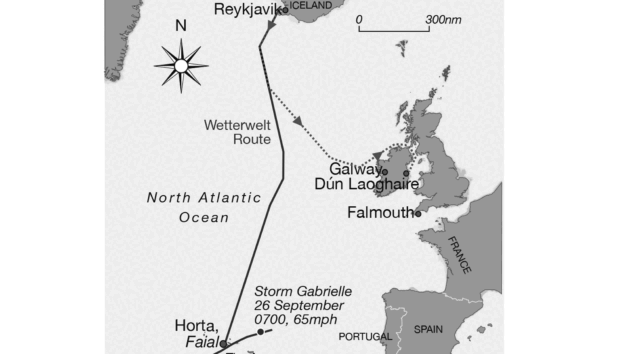
The route.
Lessons Learnt
Details matter
‘Torpedoes for 20,000 Reichsmarks, but all we need is 50 pfennigs worth of old wire!’ is a famous quote from the German war film Das Boot. The saying applies here too. We traced the broken staysail halyard back to an un-moused shackle. As skipper, I should have checked that myself before leaving harbour.
Reality trumps romance
Inexperienced crew members often have a romanticised view of sailing and adventure. Again, as skipper, I could have taken a stand before setting off. Weak crew members put a strain on the skipper and the rest of the crew. It sounds mean, but it’s true.
Ignore armchair analysts
Shouting from the sidelines disrupts healthy decision-making. Those who are not on board cannot assess what it’s like on board.
Judgement beats AI
ChatGPT is not routing software. Even though AI is on everyone’s lips, there is currently no official approval to trust a large language model for routing questions. It is still humans who have to make the decisions.
Skippers are sovereign
Skippers must be able to make their nautical decisions without external pressure. Yes, yacht transfers are also subject to economic and scheduling constraints, but pressuring sailing personnel into making poor decisions can quickly become even more expensive.
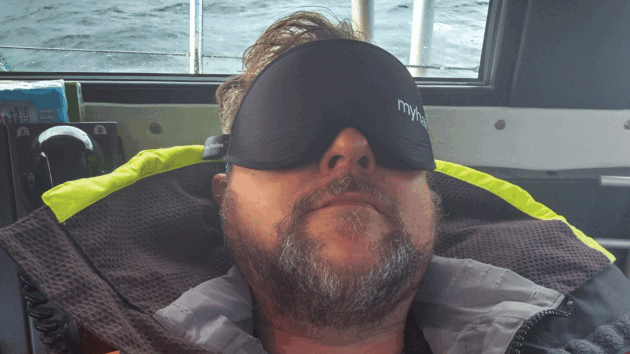
Even the skipper needs to get some rest at some point. Photo: Nils-Peter Hey
Safety first
‘Safety first’ must not be a mere platitude. Sometimes, as a skipper, you have to make unpopular decisions where no one knows whether there was ever any real danger. In the end, the saying applies: ‘There are bold pilots and old pilots. But there are no old, bold pilots’.
Article continues below…

Broken mast in the North Atlantic: one solo sailor’s story
They say bad things happen in threes. Sailing solo in the North Atlantic, Rob Henshall loses windvane self steering, then…
The ultimate school run: 53 children, 3 dogs, and a 3,000-mile Atlantic adventure
The dream of crossing the Atlantic never fades and hundreds of sailors successfully sailed from Las Palmas to Grenada with…
The other side of the story… The yacht’s owners respond to Nils-Peter Hey:
We are somewhat surprised by the content of the report and also by the fact that this essentially internal matter is now being made public. In this respect, we will not comment further on Mr Hey’s statements here. Ultimately, this would simply result in two different versions of events, from which the interested reader could then choose one.
Regardless of this, we wish to state in the strongest possible terms that, as a long-standing organiser of exclusive sailing trips, we have at no time prioritised any business interests over the safety of our guests and crew. At the heart of the matter were differing views on the feasibility of the leg to the Azores.
We were, and remain, of the opinion that the passage could have been undertaken safely, both in terms of the equipment (boat, gear etc) and the crew. Especially as the option of a crew change in Ireland was clearly available as an alternative.
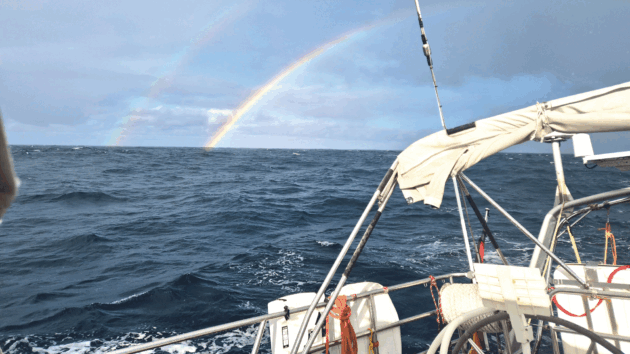
Rainbows astern – an adventure for some but seasickness for others made for hard sailing. Photo: Nils-Peter Hey
The use of AI weather models and forecasts is in no way at odds with good seamanship. Indeed, the use of AI to compare and analyse weather models
is extremely useful and is currently revolutionising meteorology. While traditional models are based on complex physical equations, AI models ‘learn’ from historical data.
Here is an analysis of why this approach is so advantageous and where its limitations lie:
1. Enormous speed and cost-effectiveness
Traditional numerical weather prediction (NWP) models, such as those from the ECMWF (European Centre for Medium-Range Weather Forecasts) or the GFS (Global Forecast System created by US National Oceanic and Atmospheric Administration), require massive supercomputers and take hours to complete a single calculation.
- The AI advantage: a trained model such as GraphCast (Google DeepMind) or Pangu-Weather (Huawei) can generate a 10-day forecast in less than a minute on
a standard desktop PC. - Comparability: AI allows hundreds of scenarios (ensembles) to be calculated simultaneously, enabling the probability of specific weather events to be compared much faster than could be achieved with physical models.
2. Pattern recognition and error correction
AI systems excel at identifying systematic errors in classical models.
■ Model interpretability: An AI can weight the outputs of different models (eg. ICON, GFS, ECMWF). If it learns that model A often overestimates rainfall in northwesterly conditions, it automatically corrects the combined forecast.
■ Local precision: AI can break down large-scale forecasts (‘downscaling’) to local conditions (topography, urban climate), which is often too computationally intensive for classical models.
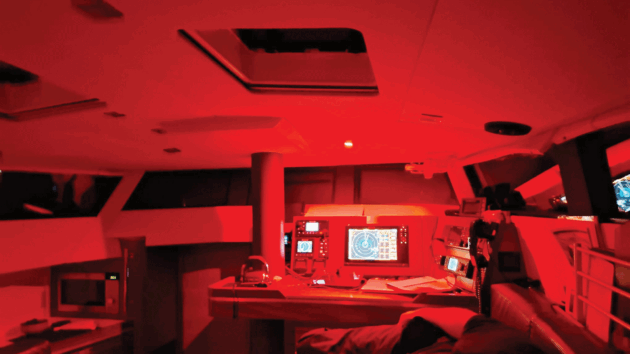
Night-vision red glow at the chart table. Photo: Nils-Peter Hey
3. Comparison of predictive performance
Current benchmarks (as of 2025/2026) paint an interesting picture:
AI forecasting vs Traditional
- Traditional models (physics-based)
- Computing time – High (hours on supercomputers)
- Physical understanding – Fully integrated
- Availability – Mostly government/institutional
- AI models (data-driven)
- Computing time – Extremely low (seconds/minutes)
- Physical understanding – Indirect (learned solely from data)
- Availability – Increasingly via tech giants (Google, NVIDIA)
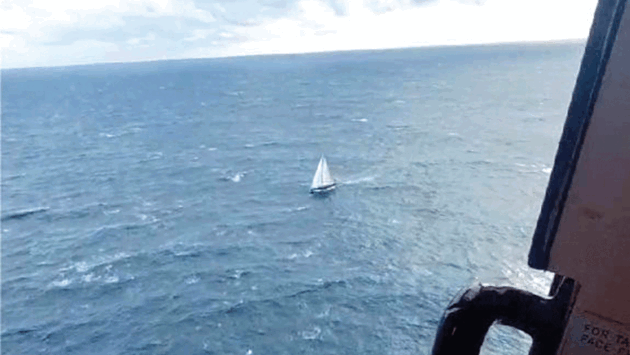
Aerial perspective from the coastguard helicopter. Photo: Nils-Peter Hey
What are the risks?
Although using AI for comparison purposes makes sense, there are, of course, some critical issues:
- The ‘black box’: AI is often unable to explain why it predicts a particular outcome. In a traditional model, a meteorologist can see the physical cause (for example, a drop in pressure); with AI, they only see the result.
- Data dependency: AI is only as good as the historical data it has been trained on. In the face of entirely new climate conditions (due to climate change) that have never been recorded before, the AI could become inaccurate.
- Conclusion: It’s all about the mix! Today, it is less a case of ‘either/or’ and more of a ‘hybrid approach’. Weather services primarily use AI as an ‘ensemble manager’ to compare the vast amounts of data from different models and identify the most likely outcome.
However, physical models remain indispensable for short-term warnings of extreme thunderstorms or gusts of wind, as they directly calculate the dynamics of the atmosphere. And that is exactly how we handle it. Anything else would be negligent.
Enjoyed reading this?
A subscription to Yachting Monthly magazine costs around 40% less than the cover price, so you can save money compared to buying single issues.
Print and digital editions are available through Magazines Direct – where you can also find the latest deals.
YM is packed with information to help you get the most from your time on the water.
-
-
- Take your seamanship to the next level with tips, advice and skills from our experts
- Impartial in-depth reviews of the latest yachts and equipment
- Cruising guides to help you reach those dream destinations
-
Follow us on Facebook, Twitter and Instagram.
Note: We may earn a commission when you buy through links on our site, at no extra cost to you. This doesn’t affect our editorial independence.