



Hundreds of sailors successfully crossed the Atlantic in December as the ARC rally celebrates 40 years
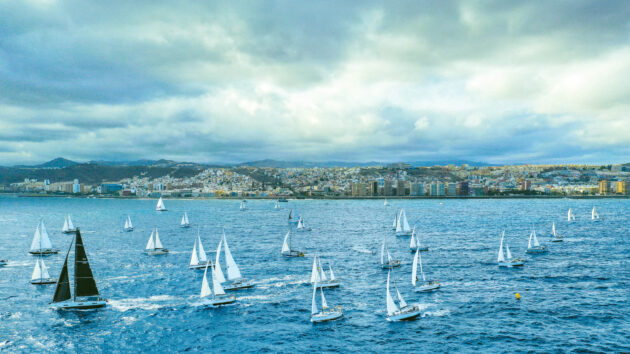
The dream of crossing the Atlantic never fades and hundreds of sailors successfully sailed from Las Palmas to Grenada with the ARC+ in December, with the leading boats making a quick crossing in sparkling conditions while the later arrivals were hit by heavy squalls, gusting over 50 knots.
More than 400 sailors in 84 boats from 26 countries set sail on 9 November with the 13th ARC+ rally from Las Palmas, bound 850 miles south to Mindelo in the Cape Verde islands. After a week in Mindelo, the fleet departed on 21 November to sail the remaining 2,150 miles across the Atlantic to the stunning Caribbean island of Grenada.
The first leg from Las Palmas to Mindelo saw very light winds and many yachts had to motor to keep up the average speed of 5 knots required to keep to the schedule. The second leg from Mindelo saw the beginning and end of the fleet – 28 catamarans, 54 monohulls and two trimarans – experience quite different weather conditions. The bigger boats at the front of the fleet appeared to have an easier journey, running ahead of many of the weather systems, sailing in steady 20-25 knot breezes and 3m waves with plenty of time for swimming and fishing.
‘Sailing conditions for the leg from Cape Verde have been good with reasonable wind conditions,’ said World Cruising Club director Paul Tetlow. ‘There have been a few breakages and there have been some challenges for certain boats, but overall it’s been a good year and most of the boats have been able to help solve their own problems. So that’s all great news. Since arriving in Grenada, the fleet has been enjoying some nice parties.’
The first boat to arrive at Port Louis Marina at St George’s was Enjoy the Silence, an Outremer 55 catamaran, making landfall amid jubilant celebrations on the dock after ten days and four hours at sea – over a day faster than the first yacht over the line a year earlier.
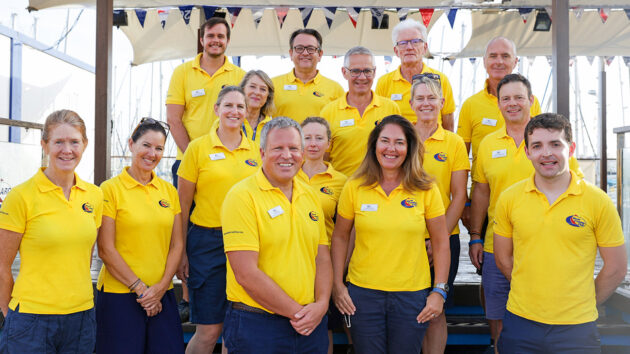
The ‘yellow shirts’ of the WCC team, with Paul Tetlow centre
Two days later, the first family boat arrived, Dawnbreaker, a 2002 Kanter 64 skippered by Karl Nerman from Sweden. Father Lars passed his beloved boat to his son and the three generations sailed together with Karl’s wife Anna and their three young children.
The first doublehanded team were also very fast, reaching Grenada after 13 days and 14 hours. Linn Eve and Anders Krogholm from Norway sailed on Eveline, a Jeanneau Sun Odyssey 50DS. There were nine yachts sailing with a double-handed crew.
By contrast, the later arrivals braved lightning and tropical storms with squalls, and there were two difficult situations where the steering and the rigging failed.
Some sailors listening to the ARC chat found it hard to believe the difference in conditions. ‘It was like we were in a different ocean at times,’ says Ann Macneill, skipper of Rustler 36, Restless of Stornoway, the smallest boat in the fleet. ‘There are people swimming in the sea and fishing. A 20-knot gust was forecast. We were like, only 20 knots – that is not a gust. We have had 36 knots continuously for a week with gusts up to 48 knots.’
Weather forecasting, tracking depressions on the radar, and then avoiding them were key to having a smooth crossing. The larger and faster boats were able to outrun some of the more difficult weather systems.
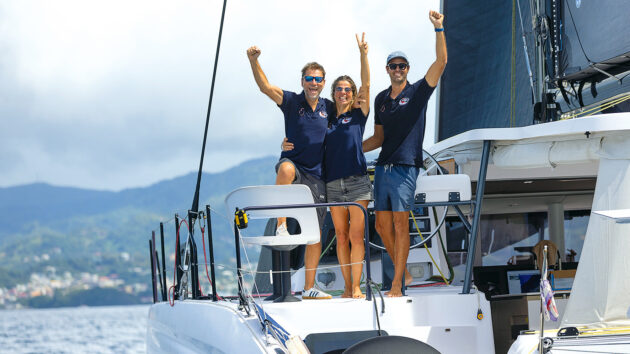
Enjoy the Silence, an Outremer 55, was first to cross with the ARC+. Photo: WCC Arthur Daniel
Many boats took Predict Wind and other weather sources in addition to the forecasts sent out daily by the World Cruising Club. Some skippers took the GRIB files and ran them through different forms of AI then compared them to see which way the weather systems were tracking.
Living your dreams
The joy of fulfilling your dreams was undiminished with the fleet thrilled to have successfully crossed the Atlantic.
One couple chose to celebrate by getting married in a beautiful ceremony aboard the Hungarian Windelo 50 catamaran Beyond I shortly after arrival at Port Louis Marina.
Owner-skipper Endre Eölyüs officiated at the wedding of school friend and crew member Botond and his fiancée Edit, who had flown across the Atlantic, in a truly memorable moment. The end of the voyage became the beginning of a marriage. Friends and family mingled with new friends from the ARC+ to celebrate as the sun set.
Over 20 families undertook the crossing, with families tending to prefer the ARC+ route with a week-long stopover in Mindelo to the straight run to St Lucia from Las Palmas with the main ARC rally. There were 53 children and three dogs aboard 23 yachts in the fleet, as well as three dogs.
Article continues below…
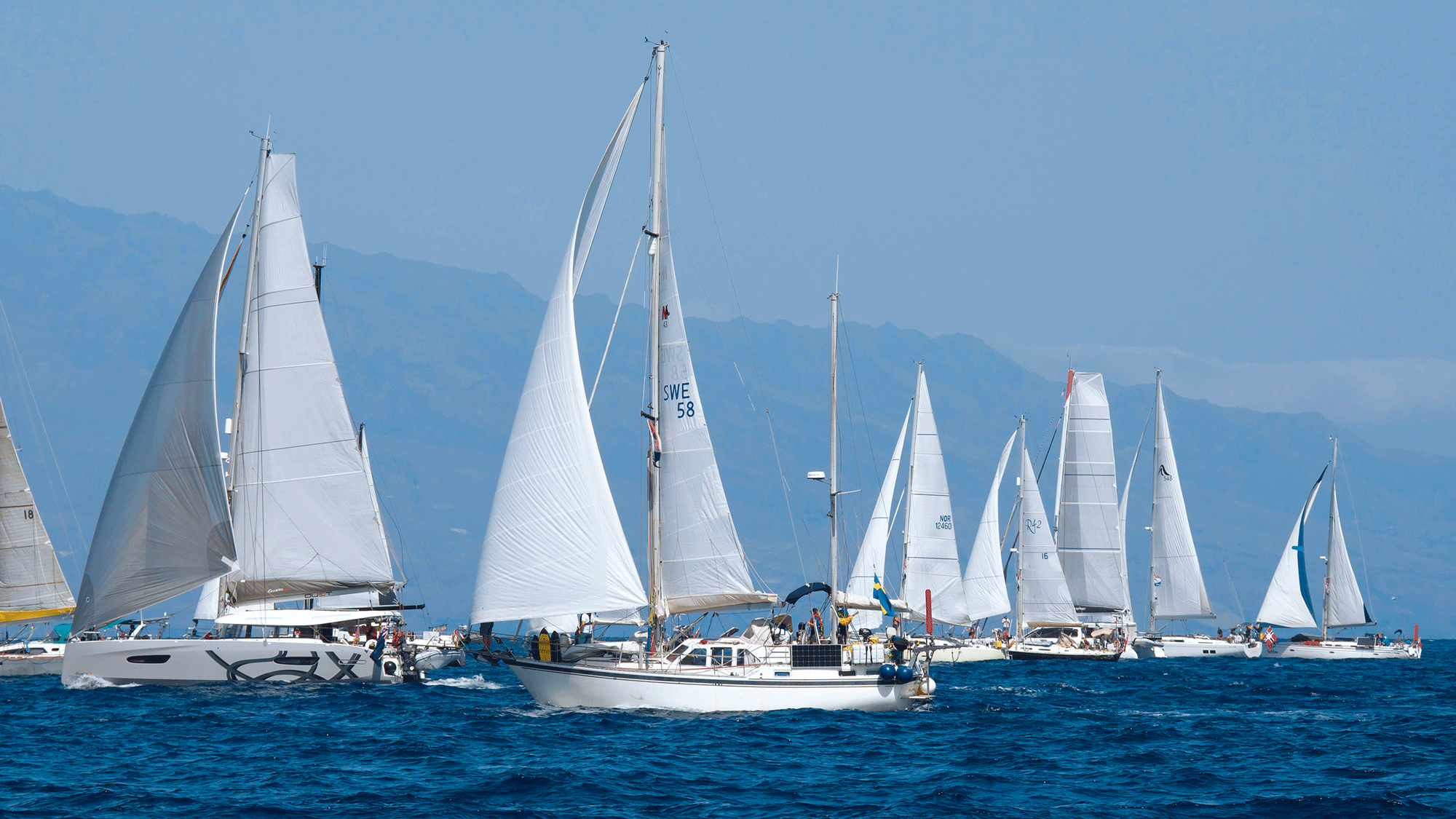
ARC vs ARC+: Which Atlantic Rally is Right for Your Ocean Crossing?
Crossing the Atlantic in sailing yachts has been done for decades by those of an independent mindset; they just needed…
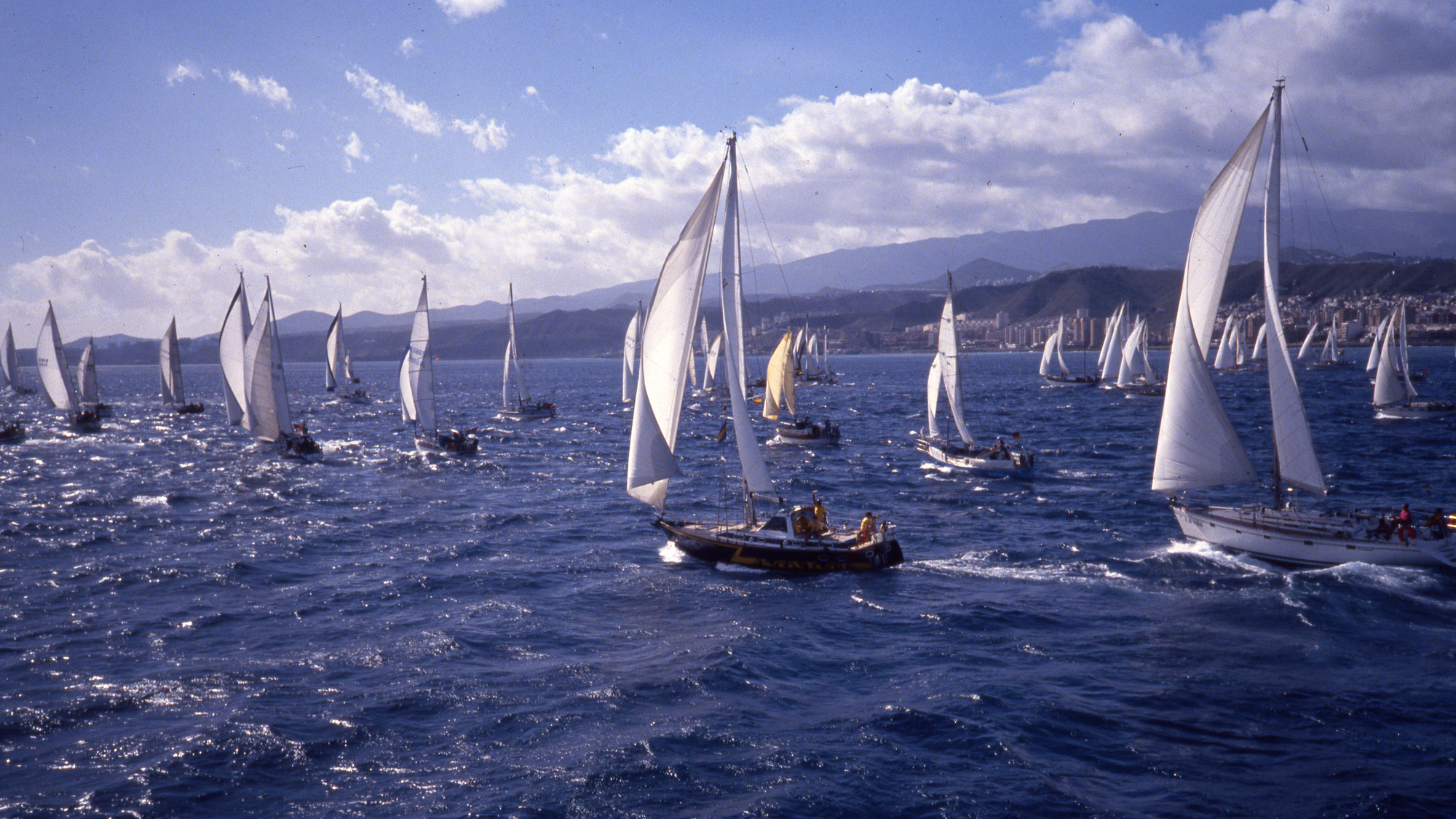
Inside ARC 2025: New 24/7 broadcasts bring the iconic rally to a global audience
Around 900 participants from over 30 different countries are expected to set off from Las Palmas, Gran Canaria for the…
Several yachts with families aboard will now join the World ARC, which set sail from St. Lucia in January, and cruise through the Panama Canal to the Pacific and then on around the world. Many families had planned the Atlantic crossing significantly in advance, renting or selling their houses and organising remote schooling and working.
During the crossing the fleet kept in touch with updated reports on WhatsApp, with many yachts now having installed Starlink. The kids took turns giving positions over the VHF radio before the distances between the boats became too great. There were also quizzes and hours of chatter about weather, routes and how many fish were caught.
Drinks in the middle of the ocean
Mexican skipper Gabriel Sidauy Smeke, aboard 16m Lagoon 52F catamaran Ruaj, scheduled a meet up for drinks mid Atlantic with fellow countryman Pedro Ponce and crew aboard Mojitos, a 15m Leopard 50 catamaran. Gabriel is sailing with his wife Victoria and three children: Moises (15), Nathalie (12) and Mayer (7).
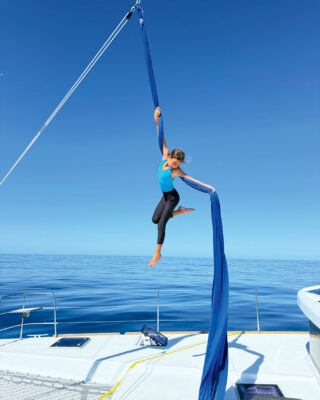
Nathalie practises her aerial skills aboard Ruaj while crossing the Atlantic. Photo: Gabriel Sidauy Smeke
‘Our friends on the other Mexican boat, Mojitos, were close to us. Sometimes we passed them, sometimes they passed us. So we called them up and said, “Let’s have some beers in the middle of the ocean.” We passed the beers back and forth on a line. It was fantastic.’
For Gabriel, crossing the Atlantic and sailing around the world is a dream that has been three years in the making, including selling the family home and organising home schooling and remote working for himself.
‘Around a year ago we decided that we wanted to sail around the world. We had zero sailing experience. We just bought the boat back in June and started sailing and learning every day. It has been a fantastic experience. We started our journey in Montenegro, then we did Croatia, Italy, Spain, Gibraltar, Las Palmas, Cape Verde and now Grenada. I think it was a great decision. The most important part is that each of us is a member of a team and each of us has a special role.’
Moises adds: ‘I think that it is an incredible lifestyle. Every day you have different challenges. Some days you wake up in a paradise place and some days in the middle of nowhere. It is really cool.’
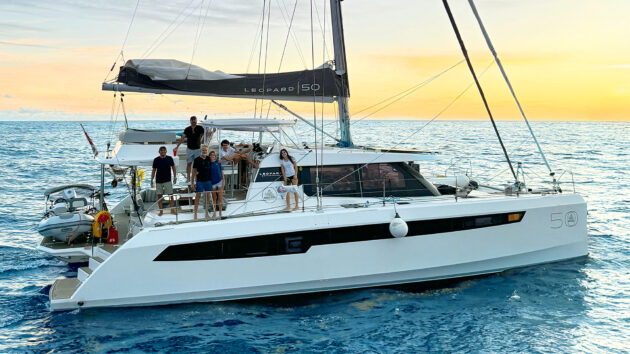
Drinks are shared mid ocean between the crews of Mojitos (pictured) and Ruaj. Photo: WCC Arthur Daniel
During the crossing, Nathalie practised her aerial silks from the rigging. She also loved looking at the stars at night. ‘Getting this once-in-a-lifetime experience is incredible,’ she said. ‘I love spending time with my family – [we have] more time than we do at home.’
The family are planning on continuing their sailing to explore the world. ‘Once we have started, we need to continue,’ said Gabriel. ‘We don’t have a home. It is a break.’
Fast cruising
One of the fastest smaller boats was the 12.8m Lala Salama from Gosport. Winner of Cruising Division C, the Southerly 42RST made the crossing in 14 days.
‘We had twin headsails out on the same forestay, the same runner, but no main. We made good speed,’ said skipper Keith Hooker. ‘We have a lifting keel and we got half a knot of extra speed with the keel up.
‘Our set-up worked well for us. Keeping the two genoas out at night was the game changer. We were keeping up with the larger boats. We had no chafe. The only thing that had broken until a day and a half before we landed was the soap dispenser. Closer to Grenada, the autopilot failed at night so we had to hand steer. We had a spare so we changed it. It only took an hour and a half.
‘The four-man crew took three-hour single watches at night between 1900 and 0700. We had a meal at 1800, breakfast at 0900 and we all had lunch together. We had fresh food that was precooked and we defrosted it along the way. We also caught five Mahi Mahi fish.’
Keith’s wife will now join them and they will sail up the Caribbean chain to the British Virgin Islands. They will then return to Antigua where the boat will be shipped home in May.
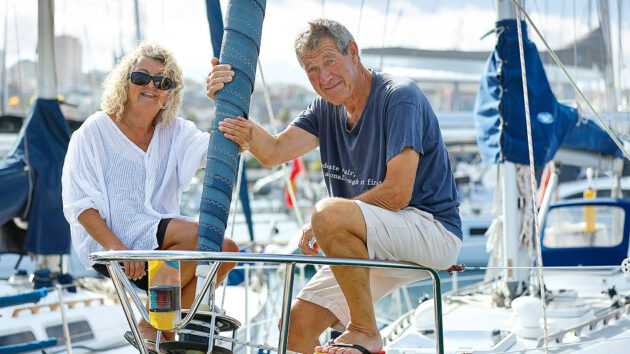
Ann and Tim on Restless of Stornoway, Phot: Kaspar Strub
Big waves, no horizon
The smallest boat in the fleet, Restless of Stornoway, a Rustler 36, sailed by Scots couple Ann Macneill and Tim Wright had a more challenging time, completing the crossing in 2.5 weeks, often deliberately slowing the boat down in high seas.
The first week was quiet but in week two, the wind picked up and the waves rose to five metres and were steep. ‘It was nearly always 36 knots, and we were usually doing six or seven. And the waves were very big. When we started surfing down the waves at nine knots, we reduced sail.
‘It’s the first time I remember actually being in a cockpit that’s high as you’re going down a wave and you’re looking down the wave. I thought, Oh, we don’t like this. So we slowed everything down to seven knots.
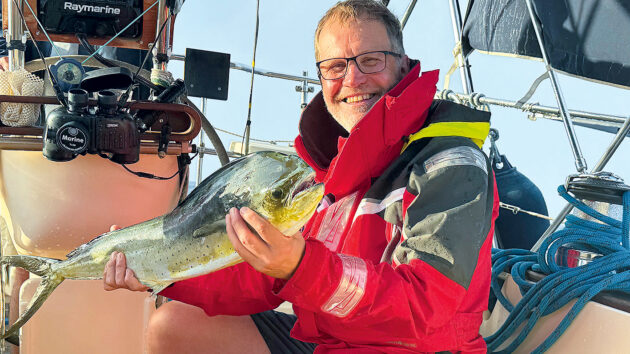
Tasty dinner aboard Slowmotion
Solitary times at the helm
‘The thing is in a small boat with a low freeboard, you’re in the water, you’re always looking up at the waves. When the waves were at their biggest, we had no horizon. I mean, you’re standing up and you can just see waves and waves. That’s it. Blinkers on, just look ahead. They look better rolling away than they do behind you.
‘It was pretty tough for five solid days in that weather, doing three hours on, three hours off. Essentially, you’re always on your own in the cockpit.’
Ann and Tim did three-hour watches around the clock, until week three, which was fortunately calmer, when they were tired and shortened the watches to 2.5 hours.
This is the second crossing for Ann and Tim, who sailed with the ARC+ in 2021/22. ‘It was very challenging this time, much more so than last, due to the weather,’ said Ann. ‘My recollection of squalls from the first crossing in 2021 is it might get a bit breezy for a couple of minutes, and you might get some rain,’ recounts Tim.
‘Well, we got caught in two squalls, which changed my perception. First of all, the rain was absolutely biblical. It was hammering down. And secondly, the wind. Yes, it did get up to 48 knots. Not just for a minute or two, but for 45 minutes.’
Ann adds: ‘And all these ARC chats, they say, “If there’s a rain shower, get your shower gel out and have an in-cockpit shower.” In fact, your boat’s shaking to bits. You think there’s 48 knots of wind. It may be raining, but the last thing I’m going to do is get the shower gel out. I think I’ll try to stay alive.’
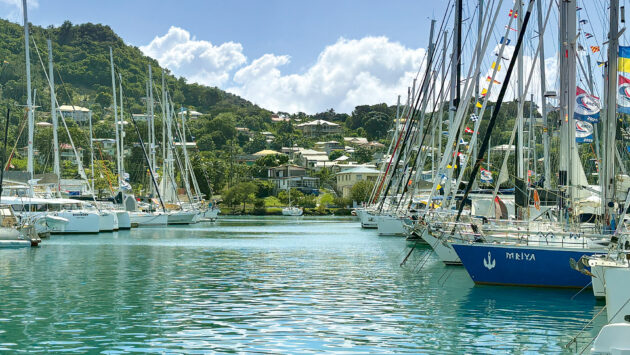
Port Louis Marina, St George’s, Grenada, hosts the arrival of the ARC+ fleet. Photo: Heather Prentice
When lightning strikes
Rustler 36 Restless sailed through three lightning storms. Ann put the EPIRB and the Satphone in the oven for protection.
‘We became concerned about earthing the boat. Our electrics are earthed through the hull to the anode but we took an extra precaution and earthed the backstay onto the monitor windvane to try and increase the chances, if we get hit, of having some way for the lightning to get off the boat. We took some electrical cable and used jubilee clips to attach it to the backstay and the windvane, which has the paddle going into the sea.
‘This may not stand up to scrutiny, but when you’re at sea and there’s a lot of lightning around, you’re a bit desperate and you think, what can we do? It’s a very frightening situation. The lightning is looking for something to conduct it and your mast is the only little thing.’
Prior to the crossing, Ann and Tim installed a downwind rig with two headsails – one on a furler and one on an inner forestay – and two poles. The furler sails are a 140% genoa and a 110% genoa, both cut quite high for good visibility and so that the sail doesn’t dip in the water when the boat rolls. There is a blade sail on the inner forestay. The windvane steering copes much better with being pulled along rather than being pushed on.
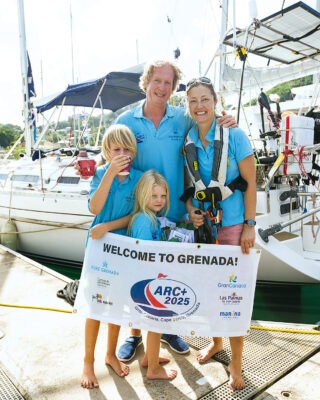
The Ellis family got through partial rig failure to arrive safely
Restless performed well, clocking 150 miles one day, with the windvane comfortably helming the boat. ‘The boat is phenomenal, honestly. She slipped through that big ocean fantastically. We felt a little bit afraid, but never unsafe because the boat is just designed for oceans.’
Sailing double-handed meant the couple were keenly focused on safety, with a rule that nobody could leave the cockpit without waking the other person up.
Strict safety rules
‘I said to Tim, if either of us fall off this boat, we will never pick the other one up. First of all, we’re downwind with two polled-out headsails. Stopping the boat is going to be crazy single-handed. And honestly, with a 28hp engine, we would struggle to motor back at all. There was no way we’d pick each other up. And we were acutely aware of that.’
In the middle of the Atlantic, Ann and Tim had a visitor for a couple of days – a night heron needing a rest. ‘He sat all night on the foredeck, his wee pink body rocking and rolling.’ Tim fed him the flying fish that landed on the deck and, restored, he flew away after that. ‘My heart went out to him,’ said Ann.
The couple now plan to cruise the Caribbean, taking the Viking route home, sailing north from the British Virgin Islandsc to Bermuda, New York, Canada, Iceland and home (Oban).
With strong winds, heavy squalls, lightning and waves up to 5m during the latter part of the crossing, several boats had issues; leaks, failing autopilots, watermakers, power systems and ripped sails.
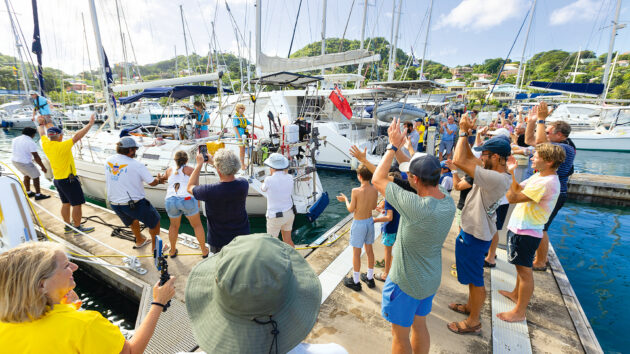
A warm welcome for Canopus on arrival. Photo: WCC Arthur Daniel
In one of the most dramatic stories of the ARC+ where the fleet held a collective breath, the Ellis family aboard Moody 44 Canopus battled to keep their rig up after two shrouds broke, with over 500 miles to go to Grenada.
RYA Ocean Yachtmaster skipper Vicky, a writer for YM, was sailing with her husband Laurie and their two children Saskia (5) and Jasper (9), and had to manage the crisis while keeping the children busy and safe.
Broken shrouds
Luckily Vicky is a highly experienced commercial skipper who had previously won an ARC rally on a Swan 53, helmed in the Clipper round-the-world race and skippered yachts for the Ellen MacArthur Cancer Trust.
The family had just over 500 miles to go and were sailing under jib only in ‘stellar’ conditions, with 20-knot winds, gusting 30 knots, as the tradewinds kicked in and 3m to 5m breaking waves. The rigging had been redone in time for the ARC and fully inspected prior to the crossing.
‘We broke two records that day – surfing down a wave at 15.3 knots, and we sailed 166 miles in 24 hours,’ recalls Vicky. The port shroud sheared just before 0100 on day 14 while Laurie was on watch. ‘There was just a sudden massive bang. It was the same tone as a rifle going off. Initially, I thought we’d hit something. There was no doubt in the world that something had gone wrong.’
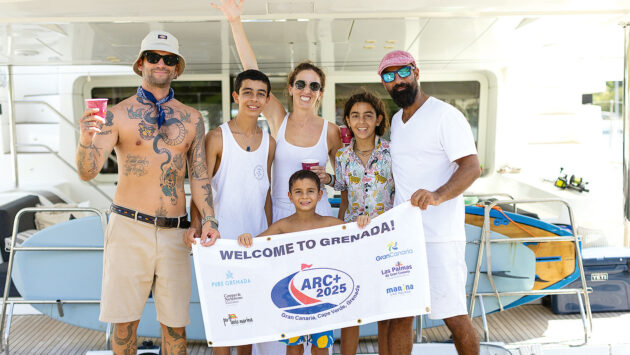
The Ruaj crew happy to arrive. Photo: WCC Arthur Daniel
A tapping noise against the side of the hull next to the chart table alerted Laurie and he quickly realised a loop of wire was dragging in the water.
He quickly woke Vicky. As she climbed the companionway steps, she saw Laurie ‘like some Greek mythological being, wrestling this snake of wire in the cockpit.’
The middle intermediate shroud, just underneath the upper spreaders, had broken on the port side at the mast.
‘I thought, as long as we don’t lose the cap shrouds, we just need to keep going and we’ll be fine,’ said Vicky. ‘Let’s go under engine. Let’s keep the rig up. I didn’t know whether the same problems were true for the other shrouds.’
Vicky didn’t consider immediately dropping the sails – only a small jib was up – having already experienced a faulty rig. ‘It’s sometimes best to leave the sails where they are and get everything secure first. Racing in Antigua once, a boat careered into the back of us and took the backstay off. Your instinct is to take down the sails, but you’ve got to stop and think about the mechanics of it.
‘The only reason the rig stayed up that time was because we had the mainsheet tight on. Sometimes the sails might be the only thing keeping the mast up.’
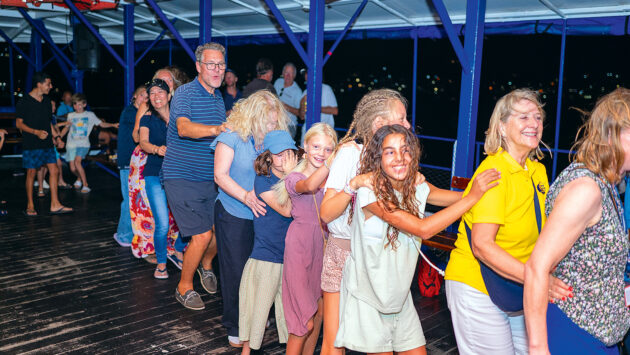
ARC+ crews celebrate their arrival in Grenada on a sunset cruise
Speedily securing the rig
Vicky secured the rig within an hour. Most spinnaker halyards run outside the mast, but on the Moody the Dyneema halyard runs inside to about 12in from the top. ‘I ran that down to the chainplate where the shroud had snapped off. I ran everything else out, and I got the running backstays into commission,’ she explains.
Vicky and Laurie were still concerned that the lateral movement of the rig was still too much, so they moved the backstays to the midship cleats and lashed them securely with Dyneema.
‘I knew the other shroud was going to go eventually because the section of the mast it supported was panting, and the sea state was hideous,’ says Vicky.
‘My plan was if the engine conked out was to then run the mainsail up as far as the first set of spreaders. The first set of spreaders was fully supported. The main up to the third reef probably would have been okay.’
The couple alerted the Maritime Rescue Co-ordination Centre (MRCC) in Fort de France, Martinique, and notified the rest of the ARC+ fleet.
The opposite shroud went later that afternoon, around 1500, and they again secured the rig. At this point, it was necessary to have some serious conversations with the children about what might happen if the mast came down and how they might have to get into the liferaft.
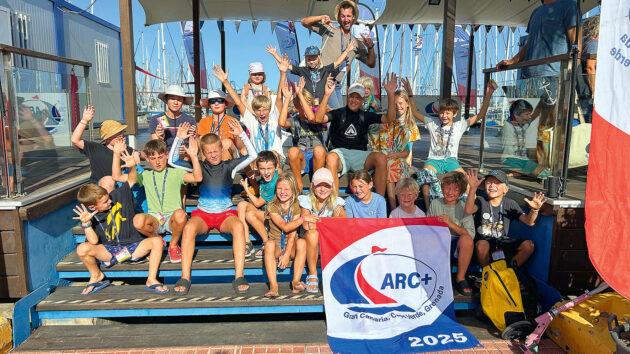
53 children were aboard the 84 yachts that took part in this year’s ARC+. Photo: WCC
‘It is quite a thing to have to explain to your children which teddy they can take in a liferaft,’ said Laurie.
Watergaw, a Southerly 135, and Fortuitous, a Moody 42, offered to take the children, but Vicky and Laurie deemed it too dangerous. ‘It was a lovely offer,’ said Vicky. ‘We’re a safe boat, and we’re a solid boat, and we’re better as a family unit.
I’m happier with the kids under my watch, and we kept them down below most of the time.’
The question now was, did they have enough fuel to motor all the way? The ARC requires that you have fuel to motor 500 miles but by 1700 they had already been motoring for 12 hours, said Vicky.
Chip and Sue Ogilvie, aboard Fortuitous, stood by and offered to transfer fuel. As night falls quickly in the Caribbean, the skippers decided to wait until the next morning to be sure of a safe transfer.
At first light, Sue and Chip prepared a 200ft floating line and attached four diesel containers with two empty water cans at either end to floats.
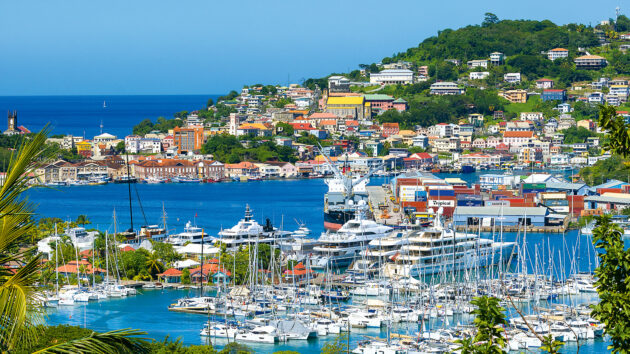
Port Louis Marina in Grenada makes a great base from which to start exploring the Caribbean
Mid-sea fuel transfer
‘Conducting a fuel transfer at sea sounds straightforward, but when you have waves over 3m and strong winds it’s impossible to get boats close to each other safely,’ said Sue. ‘We decided the only safe way was to drop the containers in the water on a 200ft floating rope. We got as close to their boat as we dared and thankfully, the cans all floated well.’
After a few attempts, Vicky was able to reverse close enough for Laurie to hook the line and haul them out of the water.
‘It was a difficult thing to do as both of our boats were pitching backwards and forwards at the mercy of the sea, under engine and without our sails up,’ said Sue.
Rather than put the fuel straight into the tanks, Canopus kept the cans stowed in the cockpit until the Ogilvies were close enough to land that they wouldn’t need them back.
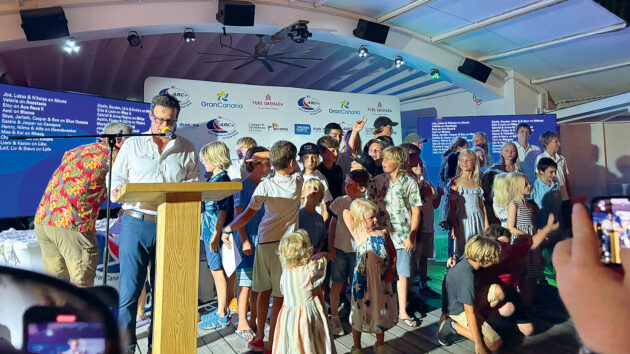
Prizes for all the children who crossed with the ARC+. Photo: Heather Prentice
No regrets
Fortunately, the rig stayed up for the remainder of the voyage and both yachts made it safely to Grenada. After a rest and repairs in Grenada, the family plans to continue cruising up through the Caribbean to Florida, where they’ll ship Canopus back to Italy in the spring.
At the ARC+ prize-giving ceremony in Grenada, the Ellis family won the Adversity award for overcoming their significant challenge, and Fortuitous received the Spirit of the ARC+ Rally award.
‘I’m personally very proud of what we accomplished and how we did it together,’ Laurie reflected the next day. ‘Knowing what we know today, would we do it differently? I don’t think so – we chose our path, prepared well and have got this far together. We wanted a family blue-water trip to broaden ourselves and have adventures together – this was just the lot that we were handed.’
Enjoyed reading this?
A subscription to Yachting Monthly magazine costs around 40% less than the cover price, so you can save money compared to buying single issues.
Print and digital editions are available through Magazines Direct – where you can also find the latest deals.
YM is packed with information to help you get the most from your time on the water.
-
-
- Take your seamanship to the next level with tips, advice and skills from our experts
- Impartial in-depth reviews of the latest yachts and equipment
- Cruising guides to help you reach those dream destinations
-
Follow us on Facebook, Twitter and Instagram.
Note: We may earn a commission when you buy through links on our site, at no extra cost to you. This doesn’t affect our editorial independence.