


Every month Yachting Monthly's resident expert, Rachael Sprot answers a readers question. This month it's all about pinching upwind
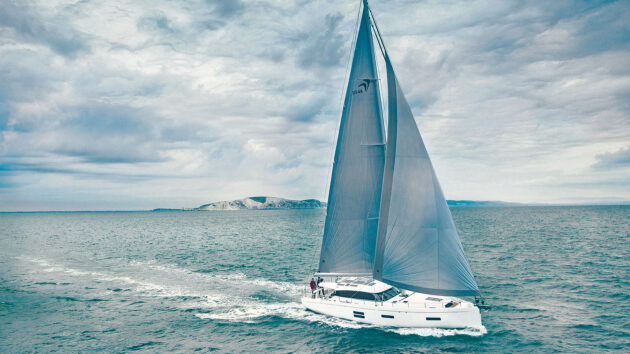
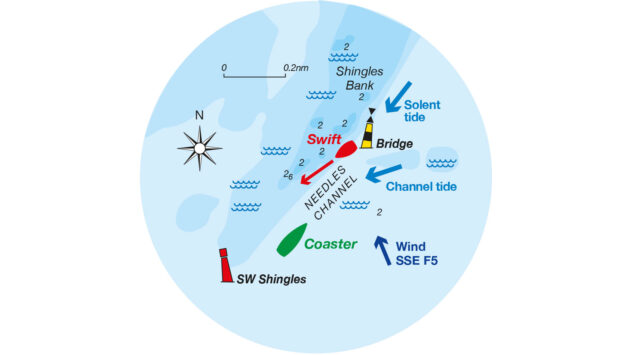
Mark and Tanya are heading south- west down the Needles Channel in their Beneteau 40.7, Swift. They’ve been close-hauled in a SSE’ly Force 5 with the ebb tide helping them along.
They’ve just passed Bridge west cardinal when Mark notices the projected ground track isn’t clearing the last port mark, SW Shingles, and is actually clipping the 2m contour around the end of the Shingles Bank. There’s a height of tide of 1.5m, but the sea state is short and uncomfortable.
There’s also a coaster approaching the start of the channel. Swift has one reef and a partially furled genoa and is fairly hard pressed in the gusts. Mark thinks they should tack and that they’d clear ahead of the coaster. Tanya’s helming and thinks this would put them too close. She’d rather pinch up to clear the end of the bank. What should they do?
To pinch or not to pinch
This scenario needs rapid decision making. The Needles Channel is only 100m or so wide at this point so there’s little room for error. What they’ve probably encountered is the change in the set of the tide at the seaward end of the channel where the SW flow of the Solent is replaced by the main east-west set of the Channel pushing unsuspecting yachts towards the Shingles Bank.
The location of the banks and their heights change considerably, and I wouldn’t risk sailing over them despite the height of tide, so they do need to avoid them somehow. Pinching up to avoid a hazard to leeward is high-risk: point too high and you stall the boat and don’t have enough power to tack.
This might necessitate a bear away to build speed, putting you exactly on the area you were trying to avoid in the first place.
Even if a manageable boat speed can be maintained, the leeway increases, so a five-degree improvement on the heading rarely registers as much of a gain over the ground. On top of that, an unfavourable wind shift could mean tacking at an even less convenient moment.
In my opinion, pinching only really works in a few circumstances: fairly flat water so that the boat can carry her way; steady wind; and the right amount of canvas so as to maintain power but minimise leeway. In sheltered waters pointing up for a few boat lengths to clear a mark can be a useful technique, but that’s about the only time I’d employ it. In all other circumstances sailing efficiently upwind is the best approach.
Article continues below…

How do you navigate a drying channel when the charts disagree?
Tim and Josh have found a space for their Bowman 40, Artemis, which has a 1.5m draught, at Treluggan Boatyard…

What to do if someone anchors too close to your boat?
Clara, Fi and Ahmed are cruising north Brittany on Clara’s Rival 34, Grace. Clara is a recently-qualified Coastal Skipper, and…
Mark and Tanya have a partially furled genoa which will be compromising pointing. The distance to clear the banks is too far for Swift to carry her way, especially in the short chop of the Needles Channel.
In this scenario I’d favour a quick tack to cross ahead of the coaster. The channel is so narrow here that it won’t take long to cross. If this feels too close for comfort, the conservative option is to tack and immediately bear away, reaching back the way they’ve come and waiting for the ship to clear through.
The mainsheet needs to be eased promptly through the tack to avoid rounding up. Whilst this wouldn’t be the most efficient action, it’s probably the safest.
If tacking out really isn’t an option, engine-assisted pinching can be a useful get-out-of-jail card, but they’ll need plenty of power and the sails probably won’t like it. They might need to furl the headsail in as they do it and motor-sail until they’re in clear water.
In most cases the risks of pinching outweigh the benefits. It may look like a promising option from the helm, but there’s usually a hidden cost in increased leeway and an all-out stall makes what was already a marginal situation much worse.
For close quarters boat handling under sail, boat speed is essential in order to maintain steerage. If in doubt, choose tacking over pinching every time.
Enjoyed reading this?
A subscription to Yachting Monthly magazine costs around 40% less than the cover price, so you can save money compared to buying single issues.
Print and digital editions are available through Magazines Direct – where you can also find the latest deals.
YM is packed with information to help you get the most from your time on the water.
-
-
- Take your seamanship to the next level with tips, advice and skills from our experts
- Impartial in-depth reviews of the latest yachts and equipment
- Cruising guides to help you reach those dream destinations
-
Follow us on Facebook, Twitter and Instagram.
Note: We may earn a commission when you buy through links on our site, at no extra cost to you. This doesn’t affect our editorial independence.