



Every month Yachting Monthly's resident expert, Rachael Sprot answers a readers sailing question. This month, what to do if someone anchors too close?

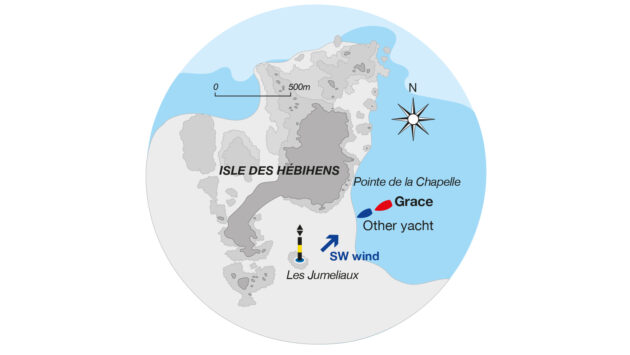
Clara, Fi and Ahmed are cruising north Brittany on Clara’s Rival 34, Grace.
Clara is a recently-qualified Coastal Skipper, and Fi and Ahmed, who are both more experienced sailors, are supporting her along the way. They’re anchored in Les Hébihens, a popular anchorage six miles west of Saint-Malo.
It’s mid-afternoon and they return from a trip ashore to settle in for the night. When they left, they had plenty of swinging room in the busy, capacious anchorage. However, on return they find a local yacht has anchored quite close upwind and begun an elaborate late lunch. The other vessel is anchored on warp. Grace has 50m of chain out to take account for an 11m HW depth and 8m tidal range. The SW Force 3 is due to become light and variable overnight. HW is 1800.
Clara speaks some French and asks them to move but the skipper of the other vessel says their anchor is well set, and that they reversed hard against it and didn’t reach Grace. Clara is unsure what to do. Fi thinks they’re fine where they are but that they could put out more chain to drop back. They don’t have a windlass, so moving is a hassle. Ahmed isn’t convinced and thinks they should reset further off. Who’s right?
What to do if someone anchors too close to your boat?
This is a classic anchoring scenario. When another vessel has anchored too close upwind it’s a very difficult situation to resolve without one party moving. Anchoring etiquette dictates that it is the arriving vessel which is responsible for keeping clear.
In reality, there’s no way to enforce this and negotiations can be fraught, especially in another country. Clara needs to decide whether she’s happy with the distance between the vessels and be prepared to move if not.
The chances are that the upwind boat, aware of their mistake, hasn’t put out enough scope, especially with such a large tidal range. This makes them more likely to drag into Grace around HW. Since this falls at 1800, Clara and her crew can monitor how well the other vessel is holding. With low water falling overnight and conditions easing, they’re less likely to drag during the early hours.
However, dragging isn’t the only possible cause of an anchoring collision. One boat is anchored on warp, the other on chain, which means that their swinging circles and relative positions could be very different, even for similar types of yacht. Boats anchored on warp wander around much more, and much less predictably than those on chain.
Furthermore, the huge tidal range will change how they’re sitting, as some of the chain and warp are taken up, or relinquished, through the cycle.
Whilst the conditions are due to ease off overnight, this doesn’t necessarily reduce the chances of an impact – in light airs boats at anchor or on swinging moorings have less to align them, and they may well drift towards each other. Chain is a key element of the anchoring system – it adds weight and provides a damping effect to any movement – and it’s just as important in light winds as it is in strong winds.
Grace is likely to pull forwards towards her anchor when the wind eases under the tension of the chain, but the other vessel will have a looser tether. At low water, there’ll be even more scope for them to come together.
Fi’s suggestion of putting out more chain isn’t a bad one, it could buy them 10-20m whilst the southwesterly wind is blowing. In light and variable winds overnight though, the boats could well change orientation making Grace the upwind vessel and exacerbating, rather than remedying the situation.
There are times when there’s a good argument for staying put in an imperfect anchorage – if the anchor took several attempts to set and is now holding well, or equally if it’s already dark and the anchorage is full with few alternatives nearby. There are plenty of scenarios when the risks of moving could outweigh those of staying, and ways to manage a marginal anchorage. However, in a big, sandy bay like Les Hébihens, there’s a relatively easy solution – move further out.
It may be a hassle now, but it’s much more of a hassle at 0200. It will, if nothing else, give them a better night’s sleep.
Enjoyed reading this?
A subscription to Yachting Monthly magazine costs around 40% less than the cover price, so you can save money compared to buying single issues.
Print and digital editions are available through Magazines Direct – where you can also find the latest deals.
YM is packed with information to help you get the most from your time on the water.
-
-
- Take your seamanship to the next level with tips, advice and skills from our experts
- Impartial in-depth reviews of the latest yachts and equipment
- Cruising guides to help you reach those dream destinations
-
Follow us on Facebook, Twitter and Instagram.
Note: We may earn a commission when you buy through links on our site, at no extra cost to you. This doesn’t affect our editorial independence.