



After a lifetime of working on other people's boats, Gunnar Christensen is sailing on his own terms. Here's how he's preparing for the 2026 Golden Globe Race
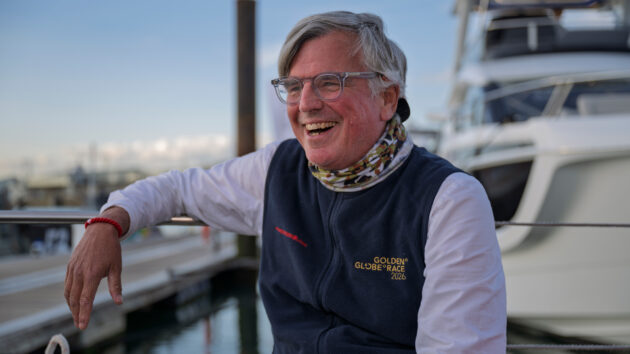
‘All I’ve done my whole life, is work in the service of others on their boats,’ says skipper Gunnar Christensen.
Now in his late 50s, ‘I’ve realised I’ve never done any sailing in my own terms. It’s time I go on an adventure.’
Find out how the Golden Globe Race is helping him reclaim his passion for sailing as he prepares to sail around the world solo, non-stop, and unassisted.
A working sailor
Gunnar Christensen has 8 Atlantic crossings under his belt, not to mention 40 years of experience working in the Caribbean and Mediterranean.
When we spoke, he was waiting to move a 130 foot expedition yacht for which he is Relief Captain.
After years of maritime work, he reflects, ‘I did fall out of love with it. It can become a bit of a job.’
Hoping for an adventure of his own, he hemmed and hawed about entering the Global Solo Challenge on a close-to-gifted Baltic 42 he brought up from Jamaica until a friend and client suggested the Golden Globe Race, offering to pay half the entry fee.
‘I had never really considered the GGR because I didn’t have the boat for it, and I don’t have the means just to go sailing,’ Christensen says.
But once the idea had been planted, it proved impossible to shake.
‘The sailing people know’
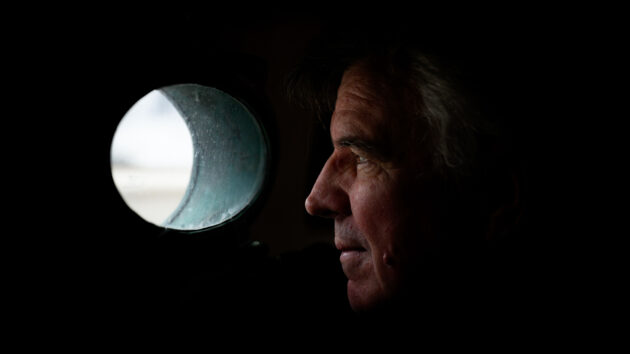
Gunnar Christensen pictured onboard Pumpkin ahead of the 2026 Golden Globe Race. Photo by Jason Ludlow
‘What’s great about the Golden Globe Race is that it’s the sailing that people know,’ Christensen reflects. ‘These are boats most people can wrap their head around.’
‘I’m not a curmudgeon, I think foiling technology is amazing. But it’s spaceships. In the Vendée or the Volvo 70, you’re pushing buttons. You’re not so worried about weather, because you’re going fast enough to skirt it.
In the Golden Globe, we’re old school. We take what we get.’
He wonders if there isn’t a fatigue response to super high tech, commercialised races.
‘I remember the America’s Cup when it was Mom and Pop players. It really was low key, and now it’s a huge business. Just look at SailGP. The GGR brings it back down to earth.’
Finding Pumpkin in Trinidad, ‘the land of broken dreams’
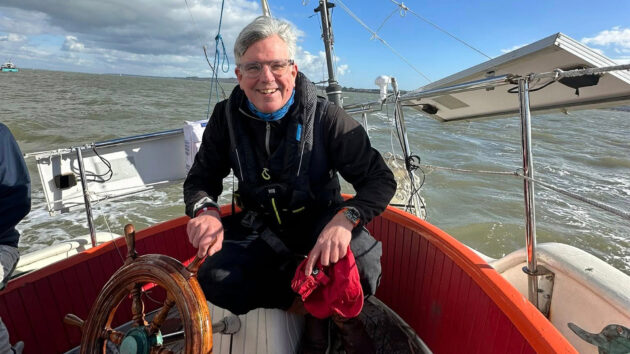
Gunnar Christensen pictured onboard Pumpkin ahead of the 2026 Golden Globe Race. Photo by Jason Ludlow
Christensen found his GGR boat, a Hans Christian 34 double-ender he calls Pumpkin instead of Pompoen to avoid confusion with ‘pan pan’, in Trinidad, on a tip from a former editor of Yachting Magazine.
‘Trinidad is kind of the land of broken dreams for boats. People get down there and then fly home. They forget about their boats for a few years and then sell them for cheap.’
He purchased Pumpkin in June 2024, just at the start of hurricane season.
At the time, he was working full time for Southerly Yachts. Using leave, he spent five days getting the boat into shape.
The first was spent ‘getting bird crap off ‘, the second getting the sails up, the third fixing up the engine. On day four, he went for an hour-long test sail. The fifth day he cleared customs, threw some food onboard, and set off.
‘Yeah,’ he laughs. ‘I don’t recommend that.’
Refitting Pumpkin for the Golden Globe Race
For someone used to running yachts up to 180 feet and sailing vessels over 100 feet, preparing a Golden Globe boat is easy pickings.
‘It’s not rocket science for me to get a 34 foot, fairly simple boat ready. It’s actually a little easier than a lot of projects I’ve done. There’s a lot to think about safety wise, but this is what I do for a living.’
Christensen is happy with his choice of boat, though he admits he’d have opted for a Saltram Saga (sailed by fellow entrants Mara Løvenskiold, Pat Lawless, and Andrew Ritchie) if given the opportunity.
In the 2026 GGR, ‘There’s at least three or four of us with Bob Perry double enders. They’re not slow boats, and they’re solid in heavy seas.
Going down the Atlantic, I probably won’t be as competitive as the lighter boats, like a Rustler 36, but my boat is close to a metre longer, and waterline length equals speed.’
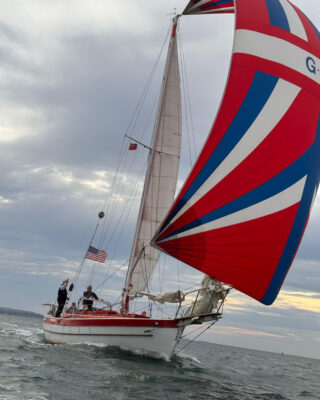
Gunnar Christensen pictured onboard Pumpkin ahead of the 2026 Golden Globe Race. Photo by Jason Ludlow
Pumpkin is currently hauled out and waiting on a new mast, some rewiring, engine servicing, and all new batteries.
Christensen has made some modifications, including a zippered cockpit enclosure he calls ‘the egg,’ originally made by Alan Lilly White for his Biscay 36.
‘The big thing for me is being able to get in and out of the cockpit quickly, without taking storm boards out and opening the hatch. With the egg, I can keep an eye on everything while staying dry.
And because I have a large second rudder for my primary wind vane, I also have lines that lead into that enclosure, so I have that secondary way of steering down big waves.’
Lymington and the RNLI
‘Here in Lymington I’ve got a great team, and a great infrastructure for getting stuff done,’ Christensen says. ‘Most other skippers aren’t as lucky to be in that position.’
He credits the vibrant local maritime community with rekindling his desire to go sailing.
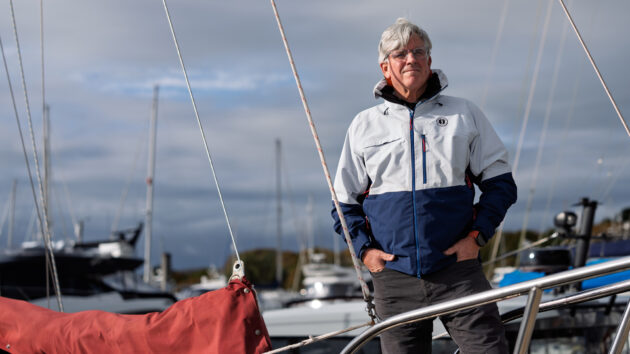
Gunnar Christensen pictured onboard Pumpkin ahead of the 2026 Golden Globe Race. Photo by Jason Ludlow
In Lymington, he also still works full time on yachts doing refits, building boats, racing, running racing boats, and even volunteering with the RNLI.
Rescue experience is a leg up when it comes to the Golden Globe Race, Christensen says, as it gives him existing proficiency in medical care and sea survival and a bank of case studies to draw from.
‘A lot of the issues I’ve seen happen when people push the boat too hard, and you don’t even necessarily go faster,’ he notes.
Like many other entrants, he’s also been carefully studying previous editions.
The main takeaway?
Take two full windvanes and plenty of spare parts.
‘People don’t talk enough about provisions,’ he adds.
Onboard, he means to take 200 days of freeze dried expedition food from a company that works with offshore rowers and Vendée globe entrants.
He’ll supplement the rest with French canned food to bring variety without adding too much extra weight on board.
‘We’ve worked out the calories for me, how much I need. But it’s quite expensive,’ he laughs. ‘Just for 200 days of freeze dry, it’s 8000 pounds.
That’s my big fundraiser right now, is working on getting enough money so I can actually pay for the food.’
Sailing for Seafarers Mental Health
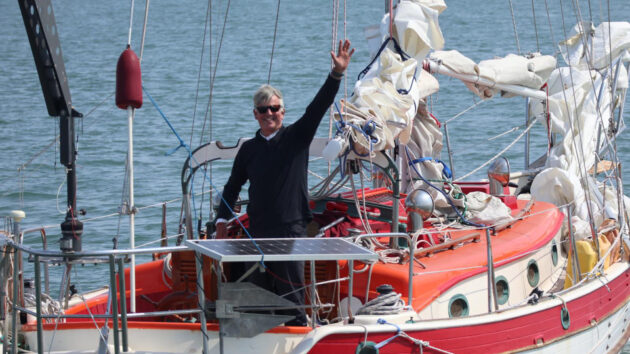
Gunnar Christensen pictured onboard Pumpkin ahead of the 2026 Golden Globe Race. Photo by Jason Ludlow
Christensen’s main GGR backer is new charity Seafarers Mental Health, which concentrates on first aid for commercial sailors.
‘These crews spend a long time, years sometimes, on these commercial vessels, and there’s a mental aspect that’s not being taken care of,’ he says. ‘It’s an issue that doesn’t get much attention.’
The sponsor, who previously owned a shipping company, purchased Pumpkin off Christensen at a fair market price to help him cover race costs.
Once the GGR is over, the boat will keep sailing on behalf of the charity to raise awareness for the issue and hopefully enter future editions of the race.
While his Golden Globe Race entry has garnered little interest from his UK yacht club, ‘The yacht club where I grew up and learned to sail in Maine, of which my uncle was also a member, is also a big backer.’
Christensen credits this support with keeping him not only motivated but accountable.
‘I used to think I could just drop out in Cape Town if I needed to, but it has been so monumental getting everything ready and so many people have been helping me, including my team and my backer. I can’t let them down.’
‘And if I’m ever feeling down or lonely, just knowing that there is somebody who’s wondering where I am every second, even though I can’t communicate with them, will give me some real heart.’
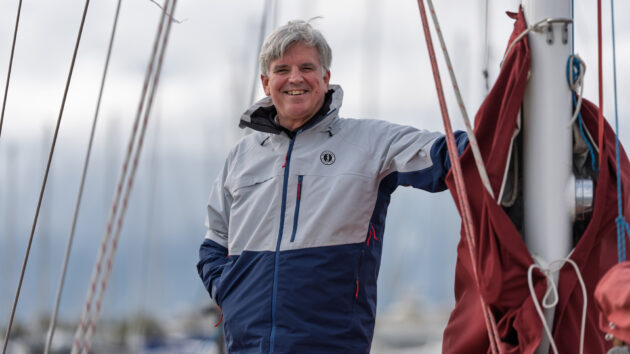
Gunnar Christensen pictured onboard Pumpkin ahead of the 2026 Golden Globe Race. Photo by Jason Ludlow
Gunnar Christensen shares his storm tactics
The Vane sail
‘It’s really small handkerchief of a sail, even smaller than the storm jib,’ he explains.
‘When it’s really, really blowing, rather than going bare poles, the vane sail will push the bow down so you don’t go broadside. That’s where then people roll and lose their mast, like happened to Susie Goodall and Abhilash Tony.’
Secondary rudder
Pumpkin came with a Scanmar Autohelm that’s no longer in production.
‘That’s where I might have a bit of a edge. I can steer the big secondary rudder on my Scanmar Autohelm from within my enclosure, either with my feet or my hands.’
With this extra rudder, ‘It’s only when you start bashing into the bottom of the trough of the wave that you need to start thinking about slowing yourself down. Then you maybe put some warps out.’
‘Although Moitessier didn’t do that,’ he adds. ‘He was a big fan of just go as fast as you can, run with it.’
He was also sold a Hydrovane at the Southampton Boat Show. He planned to replace the Scanmar with it until a comment from Jean-Luc Van Den Heede (winner of 2018 edition) changed his mind.
‘We talked about how Mark Sinclair (Captain Coconut) had added a rudder like that to steer down waves in big, heavy seas in the Southern Ocean, and Jean Luc said ‘If I were you, I’d keep that’.
So I still bought the Hydrovane but I had it mounted off-centre, to keep the wooden vane.’
Quick facts: Gunnar Christensen / Pumpkin (Hans Christian 34)
Sail Plan?
When I bought the boat, the boom had been shortened by over a meter– that’s a lot for a 34 foot boat.
Some people I spoke to said that if I was getting a new rig and a new boom, I needed to go back to the original boom size. But the boat steers so absolutely perfectly.
It has been around the world already with the Scanmar wind vane and with this configuration. I’m not changing a thing. Otherwise, it’s a standard cutter rig.
I’m adding running backstays and going with three deep reefs rather than four reefs, and keeping the reefing at the mast. I don’t like having all the lines coming aft. In my experience, you always have to go up anyways, something always catches.
I did add two cabin top winches, which I was missing for running a spinnaker.
The stay, I’m keeping on a boom. It’s a nice option to be able to boom out the stay with a preventer downwind, and if it’s really blowing, I’d probably put a reef in the stay over putting up a storm jib.
And because it’s such a heavy boat, you almost always need something on the forward stay anyways. So I’ll always have a little bit of sail going out there just for the drive.
The boom is a bit of a liability, just because it can bang around and hit you when you’re up there, but I think it’s worth it. It’s kind of old school, but it keeps a lot of shape in, and makes it really easy to reef the stay.
Furler or hank on?
This boat never had roller furling, so I’m adding it just on the outer stay.
I’ll have a Genoa that I can furl in and then I’m also using Kirsten Neuschafer’s set up.
She had twin Yankees that would roll up in one, but her sail was just one sail. I’m having two twin Yankees, but I can roller reef them if I want.
So downwind, when I’m not running a spinnaker and it’s quite windy in the Southern Ocean or the Indian Ocean, I can pull out the two poles, two Yankees, and if a squall comes or the wind pipes up, I can easily reef both of those in with a roller furler, reducing the sail quite quickly.
Self-steering set up?
I’ll use the existing Scanmar Autohelm, and keep the Hydrovane mounted for emergency use.
Antifouling?
I’d like to say it’s a secret, but anyone who’s done their research for this race will look and see what Jean-Luc VDH did and go with that.
Luckily, before I bought it my boat was taken down to the epoxy bare hull, so it’s nice and smooth. It only had a couple coats of international bottom grain, so I put a primer over that, and I’ve gone with three coats of a harder, ablative paint from Sea Jet paint.
I’ve put on three coats now, plus a primer, and I’m going to go back in the water next week.
In June, maybe even early July, I’ll do a quick haul out and do another coat or two of the paint I have on now, and then do two coats of a very ablative, softer paint made by Sea Jet as well.
The idea is it’ll probably wear off by the Indian Ocean, but by then you’re through where you’ll have a lot of the growth in the mid latitudes, around the equator, where a lot of people have their issues.
Sailing Inspirations:
Two and a half years ago, when I announced I was doing this, a fellow here at the Yacht Club suggested this book by Les Powles called Solitaire Spirit.
He was in Lymington, and built a boat in the late 70s, a 34 footer. And without knowing anything about sailing, he went out.
He left Lymington non stop, solo, around the world, back to Lymington, and without much fanfare, he did it two or three times, which is awesome. He lived to be 96.
I’m also inspired by Dodge Morgan, the first American to sail solo non stop around the world, and American solo sailor and author Jerome Rand of Sailing Into Oblivion.
My uncle was also a huge inspiration. He was in the Merchant Marines as an officer on the deck of a large commercial vessel. In his time off, he’d be doing crazy sailing all around the world.
In my teens, he would drag me off to go do all these great races, like the Marblehead to Halifax Ocean Race and the Gulf of Maine series. So I got exposed to that whole offshore racing thing at an early age, sailing to Bermuda.
Unfortunately he died in a skiing accident when I was 16 years old, but I always think back to how wonderful he was, and what an inspiration he remains.
Three unexpected items you’ll take onboard:
- Guitar
- 100 bootleg Grateful Dead tapes
- My uncle’s sextant. It’s a beautiful C. Plath Sextant that he’d had since the early 1970s. It really means a lot to me, because it’s the sextant I’ve used since I was 16 years old, and I kind of lost touch with it. It was at a friend’s house where I used to live in Maine, and luckily he still had it. He just shipped it to me last month.
Enjoyed reading this profile of Golden Globe Race skipper Gunnar Christensen?
A subscription to Yachting Monthly magazine costs around 40% less than the cover price, so you can save money compared to buying single issues.
Print and digital editions are available through Magazines Direct – where you can also find the latest deals.
YM is packed with information to help you get the most from your time on the water.
-
-
- Take your seamanship to the next level with tips, advice and skills from our experts
- Impartial in-depth reviews of the latest yachts and equipment
- Cruising guides to help you reach those dream destinations
-
Follow us on Facebook, Twitter and Instagram.
Note: We may earn a commission when you buy through links on our site, at no extra cost to you. This doesn’t affect our editorial independence.