


Learning how to free a fouled propeller from fishing lines can prevent a catastrophic shipwreck during a cruise.
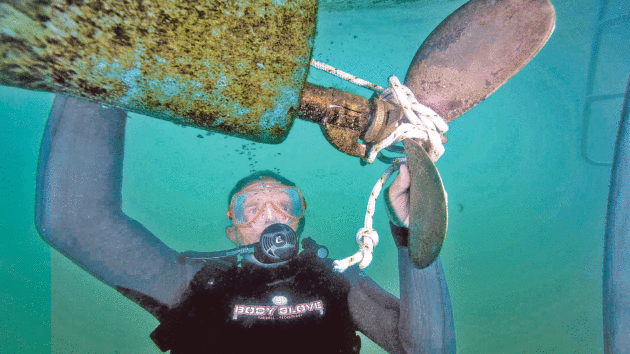
Whether snagged suddenly in the middle of a channel, or a drifting target for shipping, or close to a lee shore, it’s a stressful situation and one that requires a calm head.
Some lobster pots are better marked these days, though clearly many still aren’t. In the UK it is still common for fishing gear to be marked with small buoys or unmarked plastic containers, either on lines that are too short, dragging the float beneath the surface, or on long floating pickup lines that can extend metres upwind or uptide of the visible marker.
Some areas are well known for extensive fishing gear, and extra vigilance is called for, but sometimes, especially at night, it can just be down to bad luck.
In many instances, however, the rope caught around the propeller is your own. Never start the engine without looking for loose ends over the side. In particular, check when leaving a berth or towing a dinghy.
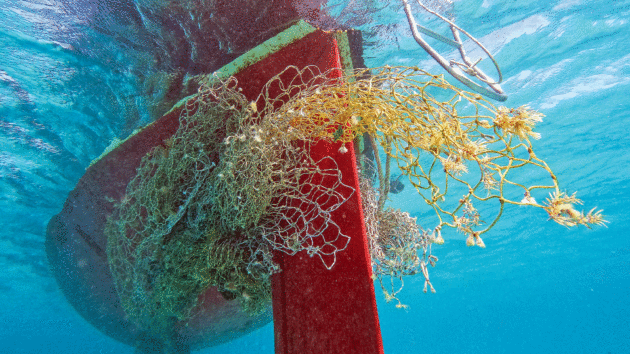
A prop entanglement can be a serious safety issue and isn’t helped by poorly marked or abandoned fishing gear.
It’s a worrying moment when an engine slows or judders to a halt. There can be other clues too – for example, a tendency for the vessel to stray to one side or for the engine to sound not quite right and perhaps overheat or vibrate.
If conditions allow and the rudder is unaffected, a yacht has the advantage that it can be sailed into port, even dragging a modest length of light line. If your manoeuvrability is limited or you don’t have secondary propulsion, it’s a good idea to radio the marina or harbour authority who may prefer to send out a tow.
Assessing the situation
As soon as you have diagnosed or guessed a fouled prop, you need to assess the situation. Which way are you drifting? Are there any obstacles you need to fend off? Then think about how conditions are likely to change. If the weather is deteriorating or it’s getting dark, you will probably take different decisions than you would have done in benign conditions on a calm, sunny morning.
If you can, anchor the boat or pick up a mooring buoy if you’re still in harbour while you still have steerage, as having a stationary boat removes one worry.
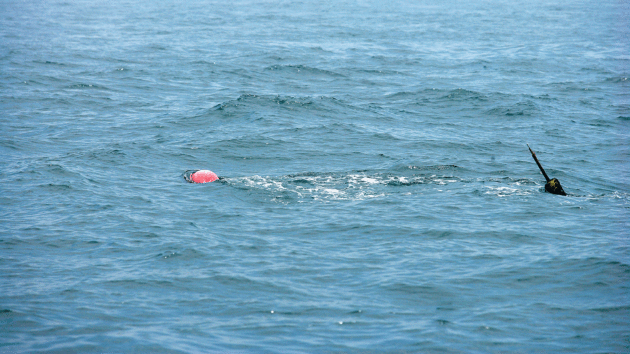
Fishing gear can be next to impossible to spot. Photo: Graham Snook / Yachting Monthly
Few boats will carry the day shapes or lights for ‘vessel not under command’ (two black balls or two red lights, both in a vertical line). In poor visibility, one prolonged blast followed by two short blasts is the correct sound signal. An anchor light will be better than nothing too.
The next step is to advise the Coastguard of your situation. If you’re in danger, or a danger to shipping, the Coastguard may alert the RNLI.
Alternatively, if you’re not in any danger, a commercial breakdown service, such as Sea Start, which covers the English Channel, may be able to clear the prop or offer a tow to the nearest port.
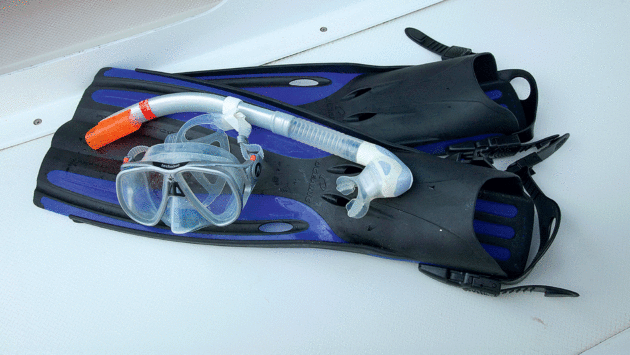
Keep snorkel and fins on the boat for fun, but it’s also a lot easier to swim on the hull with these than without. Photo: Stuart Anthony / Alamy Stock Photo
Drifting or anchored?
If the boat’s anchored by a line, you need to take pressure off the part that’s tangled – either the prop or the rudder. Drop your sails and, using a boat hook, grappling hook or small anchor, locate the line and bring it up to the boat.
Next, tie the line off on a cleat – a mooring line with a rolling hitch onto the fishing gear can help here. This may take some effort if there is wind and tide so be careful not to drop the boat hook. Do not cut the line at this point unless you know you have steerage and propulsion, as then you will have a drifting boat, which is more dangerous.
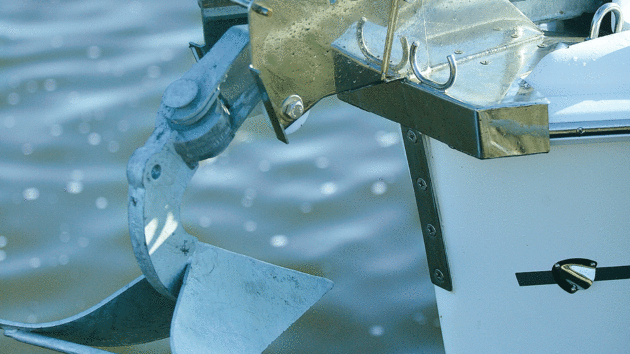
Have the anchor ready to drop. If you can prevent yourself drifting, it’s one less thing to worry about. Photo: Graham Snook / Yachting Monthly
Clearance
Before you go anywhere near the prop, be sure to remove the keys from the engine so your crew doesn’t accidentally start it. Even then, have a first-aid kit handy because even stationary props are sharp. If you have sailing gloves, wear them.
Solutions vary for disentangling props, and if you can stay in the boat that’s by far the best option. If you’ve sucked one of your own ropes into the prop – a jib sheet or halyard, for example – you may be able to unwind it by hand-turning the propeller slowly in the opposite direction. This can be done on shaft-drive boats from inside the boat with the engine in neutral; manually turn the prop shaft in reverse as this may unwind the offending lines.
If you can’t reach the prop, try the ‘dry’ method first. Restart the engine in neutral, then go astern just for a second before slipping back to neutral. If this doesn’t free it, try going ahead.
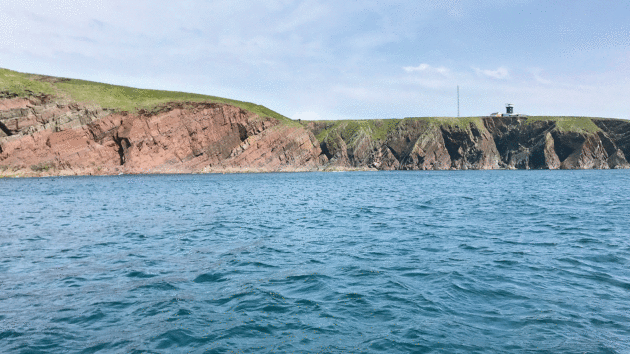
Assess whether you are close to a lee shore or other hazards. Photo: Graham Snook / Yachting Monthly
Note, only do this if you’re drifting; if you’re anchored by the line it’ll make the situation worse. Hopefully, whatever has wound its way around will start to work free, or if you have a rope-cutter device fitted to the prop shaft that will do the job for you.
If you feel things are improving, run for a few more seconds each time but if it keeps stalling you have a serious problem and will need to call for help.
In severe cases, the rope (especially polypropylene commonly used by fishermen for its buoyancy and low cost) can melt into a hard ball and may need a hacksaw or other knife to clear. Even if you do clear the prop, bear in mind that there may still be damage that needs attention when you get to port.
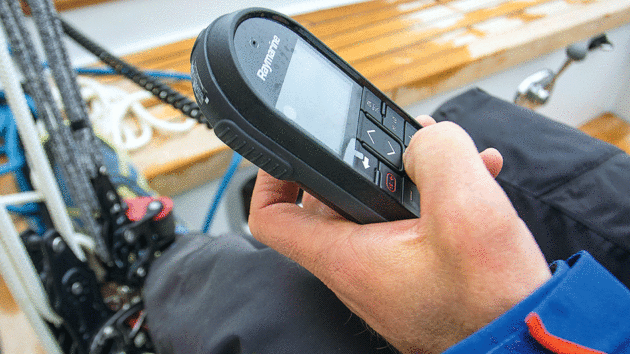
Let the Coastguard know the situation, even if you don’t need help yet
Hand-clearance
You may be able to clear a prop by leaning over the boat with a knife attached to a boat hook or long-handled hull scrub brush. Gaffer tape and cable-ties will keep it secure. Mark the handle so you know which way the blade edge is pointing. Ensure you’re tethered on and wearing a lifejacket. Have a crew keep a lookout while you lean over the bathing platform or the quarter, depending on the shape of the boat’s stern and prop location.
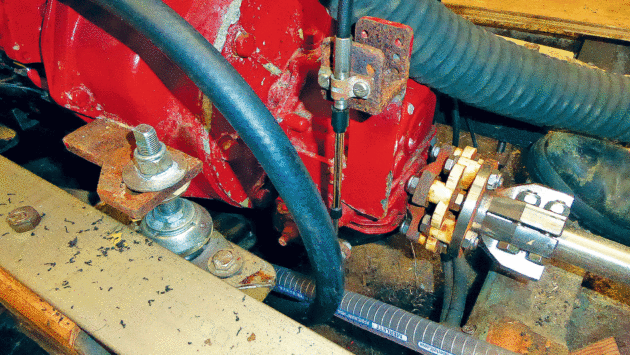
On shaft-drive boats it may be possible to turn the prop by hand to unwind the offending line Photo: Motor Boat & Yachting
Locate the rudder with the boat hook as the propeller will be just ahead of it. Slide the pole in as horizontally as possible so that you can push the blade down onto the rope (cutting downward is usually easier than cutting up). Using a sawing action, try and cut off as much as possible and keep removing any debris from the water. Retry the engine to see if drive is restored.
For better access, you can try tying a tender or paddleboard alongside, though this can be a struggle in anything other than calm water.
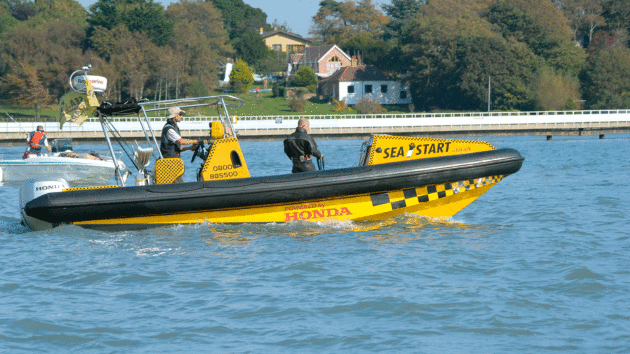
For non-urgent help, services like Sea Start or local harbour launches can help you clear the prop or tow you into harbour. Photo: Martin Brayley / Alamy Stock Photo
Overboard
Diving under the boat should be the very last resort. There are many sharp, hard parts on the underside of a boat that can injure you, not to mention the risk of entanglement, hypothermia and cutting yourself with the knife. It should only be done in sheltered water. The risk of head injury and fatality from the stern falling on you is too high to attempt it in open water.
If you do decide to enter the water, you should be fit, healthy, and used to swimming in the sea, and using the intended equipment.
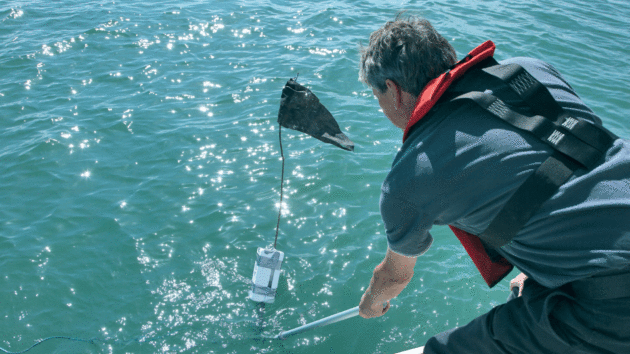
You may be able to clear the line from on deck. Attach the line to take the weight off the prop. Photo: Motor Boats Monthly – IPC Media
Keep fins, a snorkel and mask on board, as well as a wetsuit. Not only will a wetsuit guard against cuts and bruises, but it will keep you warm (in UK waters, opt for the thickest you can find). Any kind of breathing apparatus adds complexity, and requires scuba diving training to understand the risks, even if retailers tell you otherwise.
Keep a line on your cutting tool, lest you drop it. A wrist lanyard is an option, but make sure it’s loose enough that if the blade gets stuck you can wriggle free. Most sailors will have a multitool, sailing or Swiss Army knife on board, but a breadknife or hacksaw will probably be more effective.
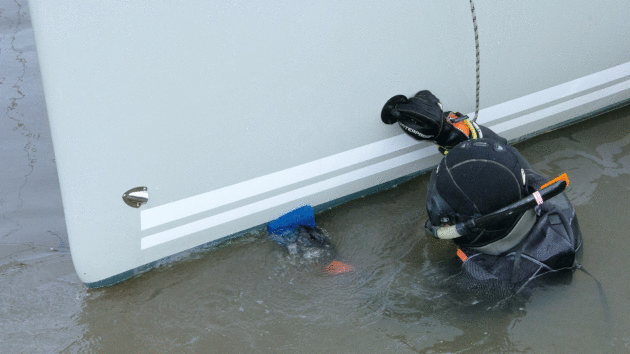
A car dent-puller(sucker) can give you enough purchase to hold your position on the hull
Check list
- Do not enter the water in any kind of waves. Being struck by the boat’s stern can kill
- Have a ladder or boarding steps deployed prior to entering the water
- Use mask, snorkel and ideally fins
- Wear gloves and a wetsuit for protection
- A car dent-puller (a large rubber sucker) can help you hold position on the hull
- Have a crew member on standby
- Potentially fix a ‘mermaid line’ with a float attached for the diver to hold
- Engine off and ignition key removed – ensure crew are all aware there is a diver in the water
- Scan for nearby hazards before entering the water
- Use a sharp knife with a serrated blade, ideally with a blunt end to avoid accidentally stabbing yourself
- In daylight, display code flag A
- At night, display appropriate lights for the vessel, along with a bright light
- Monitor for approaching traffic and be prepared to radio if necessary or signal visually if necessary
- Alert authorities with a Pan-Pan call
- Where water temperature dictates, use a wetsuit, which will likely mean a weight belt is also required
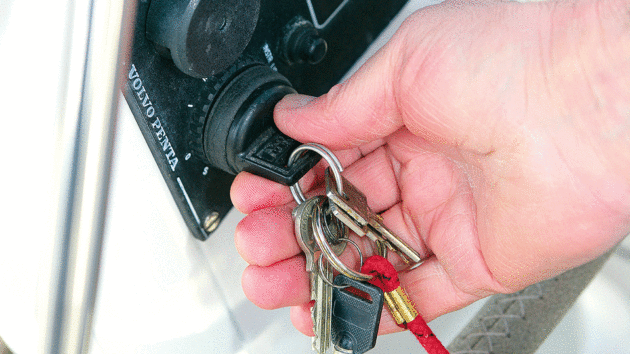
Remove the key from the ignition, or shut off the starter battery, before going anywhere near the prop. Photo: Graham Snook / Yachting Monthly
Check for damage
If you’ve managed to untangle your prop it’s still really important to check the hull. Water ingress or loss of the prop shaft can be catastrophic. A fouled prop can strip gears in the gearbox or even rip the engine from its mounts. You’d have to be really unlucky for your prop shaft to fall out at sea – but it does happen.
Make sure you have a hardwood bung that fits the prop shaft’s exit hole – ideally secured with a lanyard next to the stern gland. It’s a good idea to have the boat surveyed to check the prop, shaft, P-bracket and bearings, saildrive membrane, prop shaft connections, mounts, gearbox and clutch function.
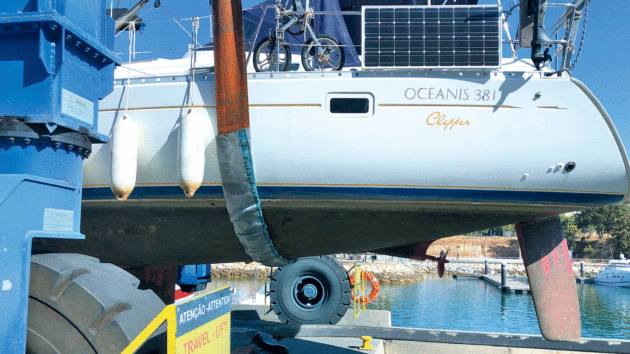
It may be worth getting the boat lifted to clear the prop and check for damage.
Article continues below…
What to do when your yacht hits a rock under autopilot
Emma and Karl are cruising the Outer Hebrides aboard their Sweden 390, Vision. They put the boat on autopilot after…
Beginner’s guide to drying anchorages
With life pulled in too many directions we’ve come to the conclusion that any window of opportunity must be buttered…
Prevention
Rope cutters
As the old adage goes, prevention is better than cure, and prop rope cutters can certainly limit the damage or prevent a wrap altogether. These have been around commercially since the early 1980s and there are three types: disc, scissor and shaver. The disc cutter, also known as a rotary cutter, is mounted on the prop shaft and as the propeller spins, so does the disc, its sharp edges slicing through any tangled rope or debris.
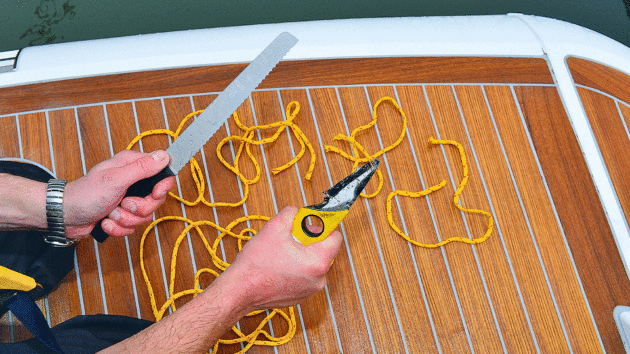
The knife needs to be very sharp and ideally serrated. Failing that, a hacksaw may do better. Photo: Motor Boat & Yachting
Scissor rope cutters have two or more blades that operate in a scissor-like action. When they meet resistance such as a rope or fishing net, the rotation of the prop shaft forces them to close and cut the debris.
Rope cutters are made from stainless steel or titanium and can be retrofitted by anyone with good DIY skills, though the boat needs to be out of the water. Many designs can be fitted without removing the prop but you’ll need to drill into the shaft to attach the cutter. For specialist information, try companies such as Darglow Engineering (darglow.co.uk) and R&D Marine (randdmarine.com).
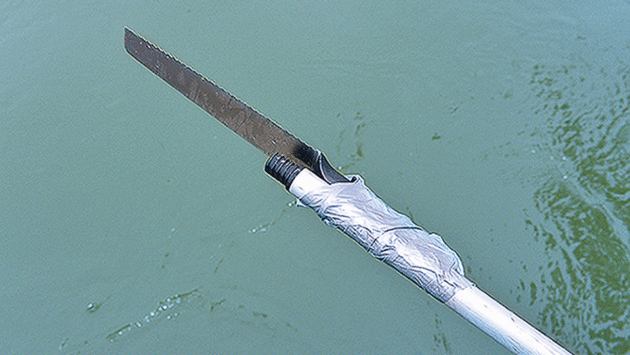
A sturdy serrated knife on a pole may be enough to clear it, but this is a less-than-ideal solution.
Shaver rope cutters – used by the RNLI – are small fixed blades mounted on the block attached to the P-bracket. A cylinder slides over the shaft and attaches to the front boss of the prop. Debris is forced between the blades and the prop and as the blade spins, the rope is gradually shaved through.
Time for the axe
If you are snagged, does a knife lashed to a boat hook do any good? Seldom, in our experience, writes Norman Kean. It’s not rigid enough, and too many people have been hurt, even killed, by going overboard with a knife in rough water.
To deal with fouled propellers, the old RNLI lifeboats used to carry a device known as a Tudor Axe. It was a shaped slab of stainless steel, 5mm thick and about 280mm across, with scalloped cutting blades all round and a hook sharpened on the inside and outside edges. When needed, it was screwed into the end of a pole.
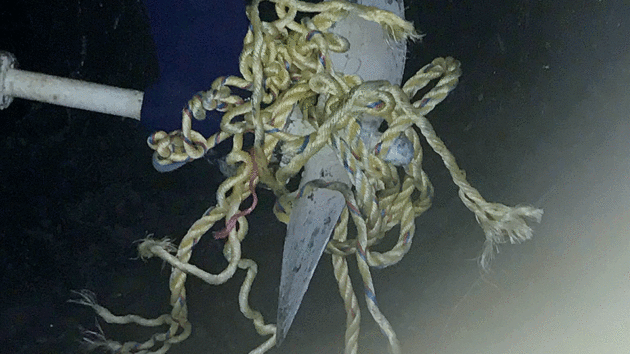
Cheap polypropylene rope can melt under strain, forming an almost solid mass
Such a device can be easily made up by any machine shop, and the pole could also be a boat hook, a deck scrubber or a dinghy oar. An added shackle enables a line to be attached.
A small throwing grapnel on a stout line completes the gear. Use the grapnel to snare the fouling line and winch it in so that it’s visible and within reach of the Axe.
If sawing at it fails, bring the sharp hook to bear, and if necessary winch in the axe line while keeping firm hold of the pole, because when the pot line parts, the Axe will tend to fly home, shredding sails and crew on its way.
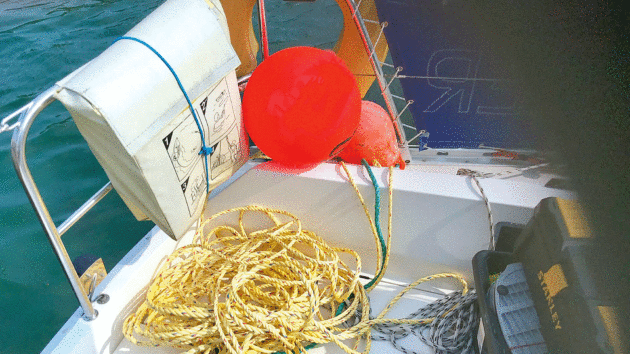
If you manage to clear the prop, make sure you’ve got all of the line, and then take stock
When not in use, the Axe needs to be muffled in a protective wooden or leather case, and when mounted, its connection to the pole must be absolutely rigid.
Another nifty trick for grappling a fouling line under the boat is to carry a short length of chain with rope spliced into each end of it. Drop the chain bight over the bow and sweep it aft to catch the submerged pot line.
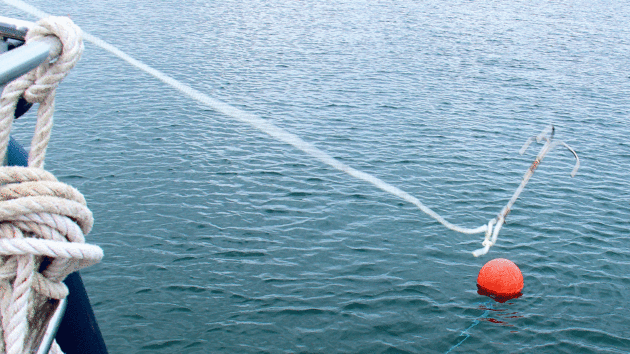
1. Use a grappling hook to get the offending line on deck. It’s much stronger than a boat hook
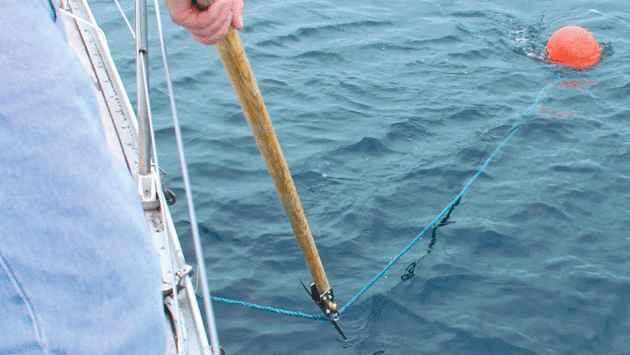
2. Push down rather than pull to cut a line
Case Study: Lee-shore shipwreck
While the new Cruising Association campaign is focusing on the correct marking of static fishing gear, other causes of propeller entanglement can be just as dangerous, often resulting not only in loss of propulsion, but also of steering, making it impossible for a yacht to sail itself to safety.
A discarded trawl net which wrapped around the propeller, rudder and keel of the Jeanneau Sun Odyssey 42i Inish Ceinn, was the ‘root cause’ of the yacht’s grounding and subsequent loss in June 2023, according to the Marine Casualty Investigation Board (MCIB).
The yacht had just been refitted and undergone successful sea trials before its final voyage.
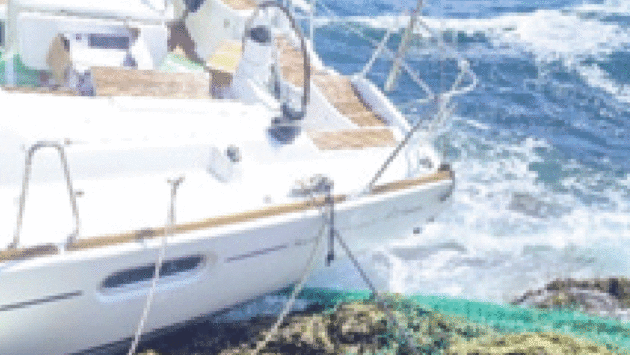
Jeanneau Sun Odyssey 42i Inish Ceinn was wrecked after the prop fouled on trawl nets. Photo: MCIB
The skipper, who is a Yachtmaster Offshore and sailing instructor, and the four crew, left Baltimore in Ireland on 6 June 2023 for a short trip to Cape Clear Island; all on board were wearing lifejackets. The weather at the time was a Force 3-4, with an easterly wind.
According to the MCIB report, Inish Ceinn was sailing under mainsail, and an experienced crew member was on the bow as bowman to look out for pot buoys, as this area of the coast is well known as a lobster fishing area.
The yacht was sailing at 5 knots when at around 1430, the skipper felt the yacht slow down rapidly and turn in the wind. The crew could see nothing in the water so the decision was made to start the engine and the propeller was engaged.
A vibration was then felt and a burning smell was noticed; the skipper immediately stopped the engine and the mainsail was furled, but the yacht was immobilised as the skipper couldn’t turn the wheel and rudder.
The wind and tide began quickly pushing Inish Ceinn towards the shore, and the skipper tried the engine again but the propeller was fouled. As the anchor was being prepared, the Jeanneau Sun Odyssey 42i hit a submerged rock.
‘The Skipper decided not to use the anchor as the vessel would then go stern-on to the rocks. The vessel sat beam- on to the rocks and the persons onboard (except the Skipper) jumped off onto the rocks and held a rope to try and keep the vessel from banging off the rocks as far as possible,’ stated MCIB investigators.
The skipper used the VHF radio to make a Mayday call, which was acknowledged by a local boat and relayed to the Valentia Coast Guard.
With a rising tide and onshore wind, Inish Ceinn was being pushed onto the rocks, and the skipper decided to abandon the yacht. As he climbed onto the rocks, he saw a bright green trawl net wrapped around the boat’s bulb keel, rudder and propeller.
The skipper and crew were rescued from the rocks by the crew of the Baltimore Lifeboat; a rescue helicopter also monitored proceedings from the air but was not required to participate.
The skipper and the RNLI crew discussed towing Inish Ceinn off the rocks, but it was decided the risk of the lifeboat being fouled by the same trawl net was too great. By this stage, the Jeanneau Sun Odyssey 42i was holed and had started to break up; the boat sank half an hour later.
The MCIB concluded that once the trawl net had wrapped around the propeller, causing the clutch to burn, there was ‘very little anyone onboard could do in this situation.’ It also noted that because the trawl net was green, it would have been ‘very hard to see’ in the 1-1.5m waves, and there were no buoys or markers to make it visible.
Under EU regulations, every trawl net must be tagged and all lost trawl nets must be reported so a navigation warning can be issued to seafarers. No warning or report had been made about the green trawl net, which was not tagged; there were also no warnings in place for the area Inish Ceinn was sailing in.
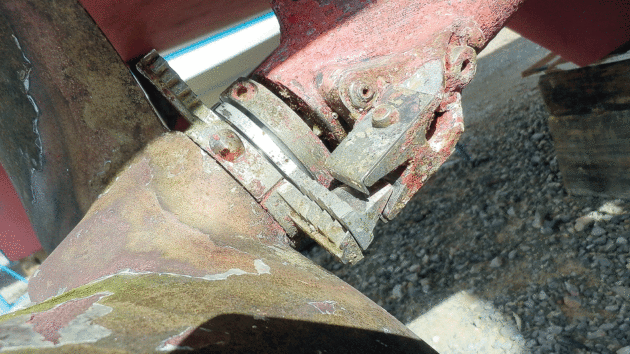
A scissor-type rope cutter for cutting ropes on the prop
Campaign for safer marking
Since 2017, the RNLI has reported 1,400 entanglement-related call-outs due to floating debris and static fishing gear. But this is believed to be only a fraction of the actual cases, as many sailors will attempt to resolve the entanglement themselves rather than report it.
The Cruising Association (CA) is relaunching a campaign for all static fishing gear to be safely marked, and the Royal Institute of Navigation, Practical Boat Owner, Yachting Monthly and the Westerly Owners’ Association are part of the alliance calling for change.
Marked Gear = Safe Gear aims to:
■ Raise awareness of the risks posed by poorly marked static fishing gear
■ Collect and publish incident data on poorly marked static fishing gear
■ Highlight high-risk locations of poorly marked static fishing gear
■ Work constructively with fishing and boating communities
■ Advocate for enforceable Government regulation of poorly marked static
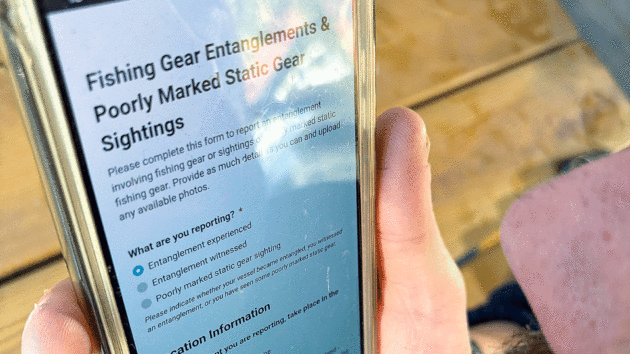
Sailors are encouraged to report poorly marked gear and entanglements on the RYA’s online form.
Fishing gear
A new online reporting form has been launched to record all sightings of unmarked, poorly-marked or lost static fishing gear, including lobster pots and creels, and any cases of entanglement, whether you were directly involved, witnessed an incident or are reporting an incident that occurred over the last year. These are being recorded to clearly identify high-risk areas.
The data will also be used to build evidence to provide a strong enough case for change.
The RYA Fishing Gear Reporting form asks for location, date, time, weather conditions and type of fishing gear. It also allows for photo uploads. So, if you see it, report it.
■ rya.org.uk/water-safety/fishing-gear-incident-reporting-form
What’s the situation in other countries?
Norman Kean compares the situation in other countries:
In EU inshore waters, buoys must be durably tagged with the number of the fishing vessel. EU does not recognise pot lines as a hazard to navigation. Enforcement is patchy or non-existent.
In Iceland, fishermen who lay booby-traps of floating line are fined and have their gear confiscated, because everybody agrees this is stupid and dangerous.
In the Faroes too, seamanship prevails. On our local beach, I recently found a two-foot buoy, fairly weedy but clearly marked HELLUKLETTUR KG472, with a phone number and traces of reflective tape.
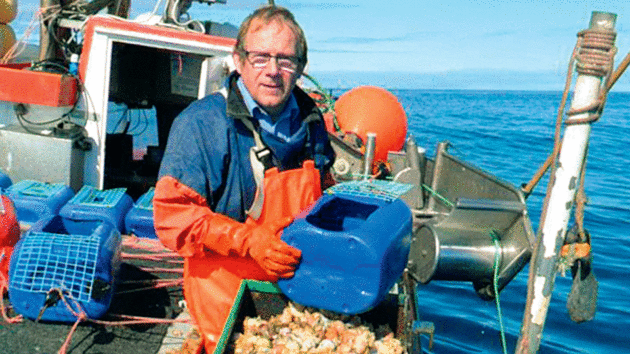
Hjalmar Zachariassen, the Faroese fisherman who Norman was able to contact after he found his damaged fishing gear in Ireland.
It was the work of a moment on Google to find that the owner of this buoy, and the 10m boat that lost it, is Hjalmar Zachariassen from the Faroese island of Borðoy. The buoy was instantly traceable, and much bigger and more visible than a typical Irish one.
Our experience cruising France and Spain suggests a relatively orderly picture. The pilot book says that off the French coast south of Noirmoutier, buoys are connected by surface lines with small floats. We’ve seen two such set-ups, but that’s all. Otherwise, the lines seem to go straight down to the pots. Buoys at each end of the same string of pots are often the same distinct colour.
In Australia, a weight of at least 500g (1lb) must be attached at least 5m below a pot buoy.
In the USA, Chesapeake Bay is crowded with both leisure craft and crab pots, but the buoys can bump along a hull without the risk of fouling, because by law the lines must be weighted, and they hang straight down.
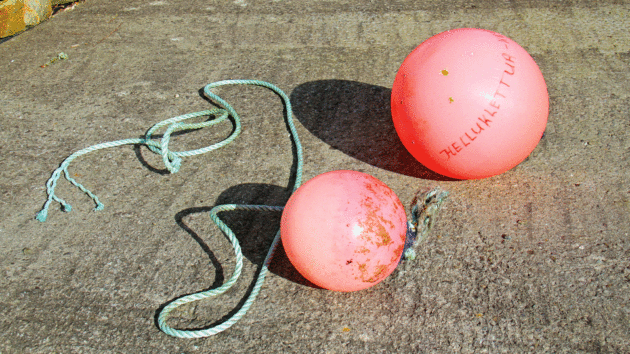
The buoy was large, bright and clearly marked, with a pick-up buoy on a short line
Fair enough, there are almost no tidal streams, whereas here, two buoys must often be tied in tandem. But the cord between them need be no more than
1m long and 6mm diameter, and it need not float.
The two buoys are obviously connected, there’s little chance of inadvertently sailing between them, propeller-mounted cutters stand a chance of doing their job, the cord is easier to cut, and it may even break under the strain of holding a fouled boat.
Enjoyed reading this?
A subscription to Yachting Monthly magazine costs around 40% less than the cover price, so you can save money compared to buying single issues.
Print and digital editions are available through Magazines Direct – where you can also find the latest deals.
YM is packed with information to help you get the most from your time on the water.
-
-
- Take your seamanship to the next level with tips, advice and skills from our experts
- Impartial in-depth reviews of the latest yachts and equipment
- Cruising guides to help you reach those dream destinations
-
Follow us on Facebook, Twitter and Instagram.
Note: We may earn a commission when you buy through links on our site, at no extra cost to you. This doesn’t affect our editorial independence.