




When a Yachting Monthly reader questions the need for pyrotechnic flares, our resident expert, Rachael Sprot, explains the pros and cons
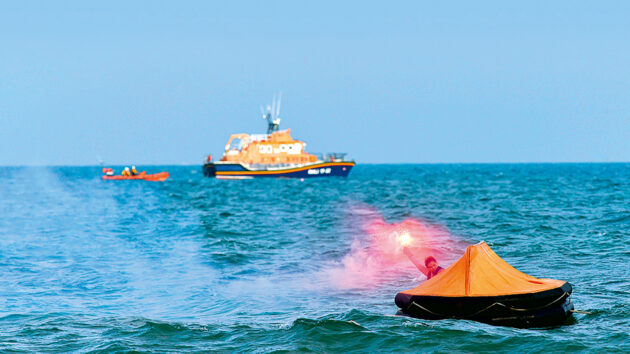
Sarah and Jan co-own Audax, a Hanse 348 based in Plymouth for cruising the West Country and northern France. They carry an offshore flare pack which has four parachute flares, four red handheld flares and two buoyant smoke signals. However, the flares have expired, and Sarah and Jan can’t decide whether to replace them or not.
Sarah thinks that flares still have a role to play in emergency communications, Jan feels that they’d be better served by an LED device. A replacement flare pack is about £200 and will last for around four years.
An electronic flare is £100-£150.
They already have a GPS-enabled EPIRB and VHF DSC radio. Do they need flares too?
Should you still choose pyrotechnic flares?
There have been several major accidents involving flares in recent times, including a fatality aboard a Dutch yacht when a parachute flare, operated as per instructions, exploded immediately, fatally injuring the person holding it.
They’re also becoming increasingly difficult to dispose of, and alternative methods of distress signalling are becoming cheaper and more sophisticated. It’s not surprising that people are beginning to wonder whether they’re worth replacing.
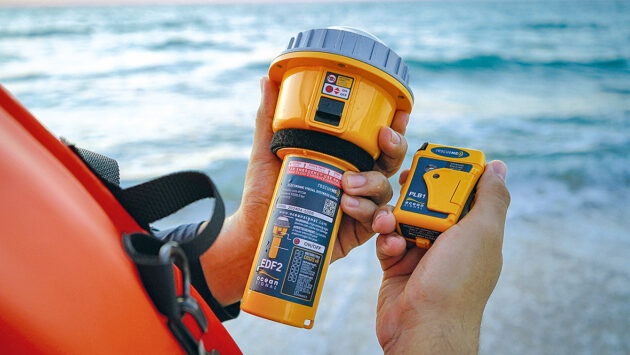
However, this question is really about what distress signalling is needed, and not just whether to carry flares.
Currently, SOLAS regulations require all pleasure craft over 13.7m (45ft) to carry them, so for larger boats there is no debate, and commercially operated vessels (eg. charter boats and sailing schools) are required to carry them.
However, non-commercial vessels under 45ft are free to decide for themselves which kit to carry.
Distress signals need to fulfil two functions: alerting and locating. They need to do this relative to the cruising range. In Audax’s case, this means both inshore and offshore. Since communications are essential systems, some redundancy in case of equipment failure is also important.
The DSC VHF will both alert and, as long as it has a GPS input, locate the sender to those within range. Almost all of the Channel lies within GMDSS Sea Area A1, which means that a VHF alert from a VHF antenna mounted a minimum 4m above sea level should reach a coast station. Failing that, the EPIRB will provide coverage mid-Channel, both alerting and locating the casualty to the authorities.
On top of this, they’ll almost certainly still be within VHF range of some commercial shipping even mid-Channel, which could either relay a distress message to the coastguard, or respond to a coastguard’s report of an EPIRB alert in their vicinity. This isn’t a remote cruising ground miles from help.
Article continues below…
What to do when your yacht hits a rock under autopilot
Emma and Karl are cruising the Outer Hebrides aboard their Sweden 390, Vision. They put the boat on autopilot after…
The furler has jammed and the wind is building: What do you do?
Helen and Mark sail their Halberg Rassy 34, Gemini, in the Bristol Channel. They’ve left Padstow at high water at…
On the redundancy front, the EPIRB will still work even if the VHF doesn’t (such as a swamping and power outage).
However, I would argue that there are some scenarios when a visual signal remains valuable. Abandoning to the liferaft is one such example, where Sarah and Jan will be much less visible on radar and by eye, especially at night.
In this instance, they would want something to help a rescue party – already alerted either by a VHF DSC distress call made prior to abandoning ship or by the coastguard receiving their EPIRB alert – to locate them.
This is where flares come in. Modern LED ‘flares’ (known as Electronic Visual Distress Signals – EVDS) are getting brighter, but YM and PBO tests found they don’t yet compete with the all-round intensity of a traditional pyrotechnic flare. However, if the rescue party is in the right vicinity and already looking for you, they could be a useful location aid, especially as they won’t burn out after 60 seconds – some last up to six hours.
There will be some scenarios which are better served by a traditional flare – for example, the use of orange smoke for a helicopter transfer by day – but that needs to be weighed against the risks of handling pyrotechnics in the first place.
Distress communications have evolved considerably since the days when flares were an indispensable part of the inventory. Are they really essential, or are we holding on to an out-of-date technology? For the passages that Sarah and Jan are doing, I’d be happy to make the switch away from pyrotechnics. However, the decision will be a personal one, and they could always supplement a smaller number of traditional flares with an EVDS to cover all bases.
Enjoyed reading this?
A subscription to Yachting Monthly magazine costs around 40% less than the cover price, so you can save money compared to buying single issues.
Print and digital editions are available through Magazines Direct – where you can also find the latest deals.
YM is packed with information to help you get the most from your time on the water.
-
-
- Take your seamanship to the next level with tips, advice and skills from our experts
- Impartial in-depth reviews of the latest yachts and equipment
- Cruising guides to help you reach those dream destinations
-
Follow us on Facebook, Twitter and Instagram.
Note: We may earn a commission when you buy through links on our site, at no extra cost to you. This doesn’t affect our editorial independence.