



A converted 1911 fishing vessel, Rely is a family yacht that demands extra commitment. But what do you get in return? Nic Compton went to Salcombe to find out.
Half-Zulu: Sailing and reviewing a former 1911 fishing vessel in Salcombe


When Vicky Blackburn and fiancé Tom Crowe decided to sail around the British Isles earlier this year (2026), they had a choice of two boats: a 32ft strip-planked wooden yawl built in 1992, or a big, heavy 115-year-old fishing boat that the family had owned for 30 years.
The smaller, newer boat would have been the sensible option, but then sailing isn’t always about being sensible. For Vicky, who has sailed on the family’s 1911 Zulu Rely since she was a baby, the older boat was the obvious choice.
‘I’ve grown up on her, so this feels like a home,’ she says. ‘And she’s so seaworthy. We took her to St Malo last year, and that made me realise she’s built for long distances. I was amazed at the amount of miles we covered and how quickly she did it. You might not think a boat of this age and size would do that very well, but she does.
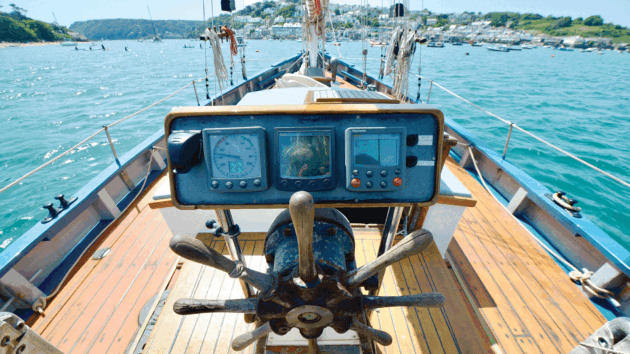
The wheel is thought to date from Rely’s days as a pilot vessel. Photo: Nic Compton
If you’ve got a nice broad reach, or you’re going downwind, she just goes like a stick. We averaged about 7 knots going to St Malo.’
But then, Rely isn’t quite as old-fashioned as she might seem. Sure, that 20-tonne hull is still made of solid timber, as is her deck and most of the interior (with the occasional piece of plywood). And she still has the same 100hp BMC bus engine fitted in the late 1970s – and recently rebuilt by none other than TV presenter Guy Martin (more about that later).
But perhaps the biggest change to the boat, without which Vicky and Tom’s round-Britain voyage would have been much more arduous, are her carbon-fibre spars, which have not only made her easier to manage short-handed but massively improved her performance. This piece of modernisation has proved a game-changer and demonstrates how these old boats can be made more user friendly without spoiling their character.
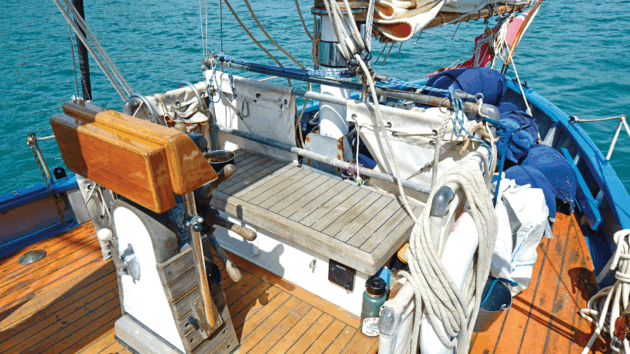
Who needs a cockpit when you have a steering bench! Photo: Nic Compton
The Zulu class first appeared on the Moray Firth in Scotland in 1879. The story goes that a fisherman in Lossiemouth wanted to build a new fishing boat, but while his wife liked the shape of the local Scaffies, he preferred the bigger Fifies. They arrived at a compromise by combining the salient features of both types, merging the Scaffie’s angled sternpost with the Fifie’s plumb stem.
Whatever the truth of this story, the new type (named in solidarity with the Zulu people, then at war with Britain) proved astonishingly fast, and, courtesy of an enormous two-masted lug-rig, was able to rush the freshly-caught herring to market.
Author Mike Smylie describes the boats, which at their peak were up to 80ft long, as ‘the mightiest of all British sailing fishing craft’. But, while several smaller Zulus (known as ‘half-zulus’) survive, the only remaining full-size vessel is the 1903 Research, whose hull is preserved at the Scottish Fisheries Museum in Anstruther, Fife.
Fishing foundations
Rely was built by Nobles of Fraserburgh in 1911 and, at just 40ft long, was one of those so-called ‘half-Zulus’. She started life as a pilot vessel but was soon bought by three women from Aberdeen – most likely as an investment to be run by an employed crew – and was used for fishing out of the Orkneys. In 1915 she was modified to enable her to trawl under power.
The sternpost was made bigger and more upright to allow a propeller shaft to be fitted, and the stern was given a rounder shape to make space for the trawl net gear.
She was then fitted with a tractor vaporising oil (TVO) engine which, when it was removed in the late 1970s, was donated to the Science Museum, where it remains to this day, albeit it’s currently in storage and not on public display.
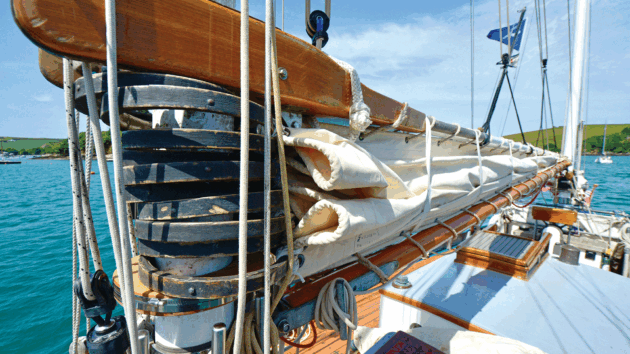
Halyards and control lines are mostly belayed at the mast. Photo: Nic Compton
The boat fished successfully off Shetland and Kirkwall for the next 40 years, apart from a brief absence during the Second World War when she disappeared, eventually turning up on the South Coast. There are rumours she may have played a role both at Dunkirk and D-Day, though there is no hard evidence.
She was converted to a yacht in 1955 and went through a variety of owners, including the war hero commander Cecil Ru-Ru McLarnon O’Brian, DSC, RNVR, who owned her for 10 years. After a period being used as a houseboat and artist’s studio, she was restored by the Falmouth Marine School and given a new lease of life.
Sophie and Martin Blackburn were childhood sweethearts whose courtship revolved around sailing, as Martin remembers: ‘Sophie was a passionate dinghy sailor, so I had to learn to sail in order to make her my girlfriend!’ Their first boat together was a Folkboat, followed by a shared ownership of a 35ft Danish double-ender, which they kept on the East Coast.
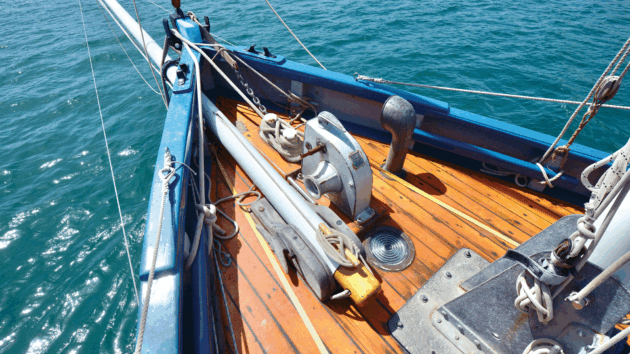
The foot of the main mast is located very near the bow of the boat. Photo: Nic Compton
When their first child Victoria (aka Vicky) came along, they decided they needed a boat with standing headroom and soon discovered Rely lying on the Lynher River near Plymouth.
‘The thing I loved about her is you can see it all,’ says Martin. ‘Nothing’s covered up. You can see all the frames. So I could see that there wasn’t a load of crap everywhere. And she felt super-safe. I figured that anything that’s 100 years old and has survived that long and been through a world war was going to be all right with us.’
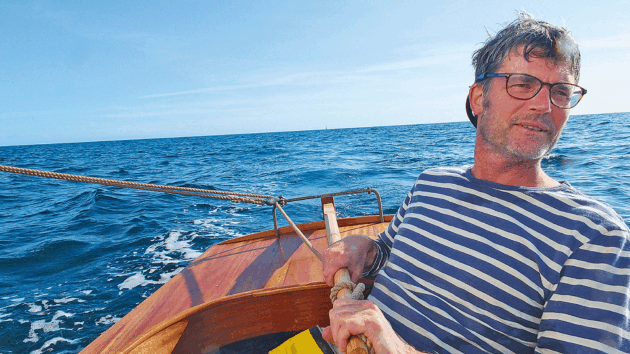
Nic Compton has been writing about boats and the sea for nearly 40 years. His latest book, Nautical Wisdom, published by GMC Publications is on sale now. Photo: Nic Compton
Learning curve
It took them months to persuade her owner to sell her, but eventually in Spring 1998 they got the call they’d been waiting for.
‘The owner rang us on the Wednesday, and Sophie’s dad drove us down there with a suitcase full of money. We sailed it back from Plymouth on the Thursday, and we got back to Walton-on-the-Naze on the Monday,’ remembers Martin, channelling the Craig David song 7 Days. ‘And then it took us 20 years to figure out how to sail her.’
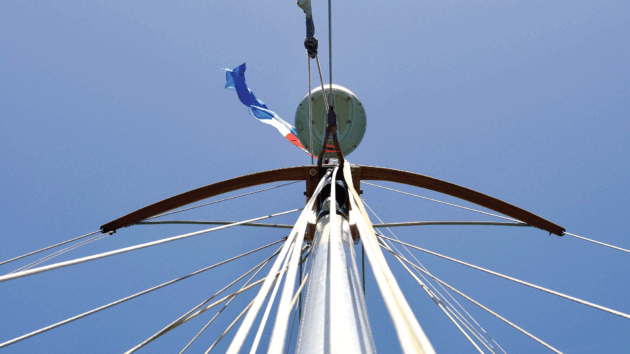
View up the new carbon-fibre mast. Photo: Nic Compton
Buying an old wooden boat such as Rely is to accept a certain burden of maintenance above and beyond what you might expect from your average mass-produced fibreglass boat. Martin and Sophie talk about a five-year cycle of repairs, involving at various times a new stem, the odd new plank, and several new frames.
It’s highly specialised work which they’ve entrusted to the Bedwell and Company boatyard in Walton-on-the-Naze, Essex. The yard also looks after most of the external paint and varnish and is responsible for the remarkably good finish on Rely’s topsides.
Alongside this regular and necessary programme of repairs, the Blackburns have steadily improved the systems on board to make the boat more comfortable and family-friendly. It started with the fridge, as Martin remembers: ‘One year, when we had three kids on board.
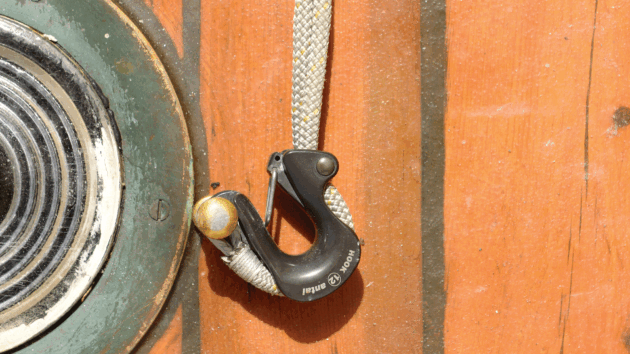
Even Dyneema has its place on this old gaffer… Photo: Nic Compton
Sophie said, “I’m not coming on board again unless we have a fridge.” So we put a little chest under the chart table, but we had to move a bulkhead to do that. Then, of course, we had to fit bigger batteries, and a big charging panel with an external regulator to increase the charge. Eventually we fitted an electrical panel over the chart table, with a chart plotter next to it. This was all spread over about 15 years.’
Around Covid time, Martin decided to rebuild the old BMC engine. He had spotted water in the oil and, having an engineering background, figured he could fix it himself. Sophie had befriended a man in Lincolnshire who had the necessary parts and who eventually offered to rebuild it for them. His name was Ian Martin.
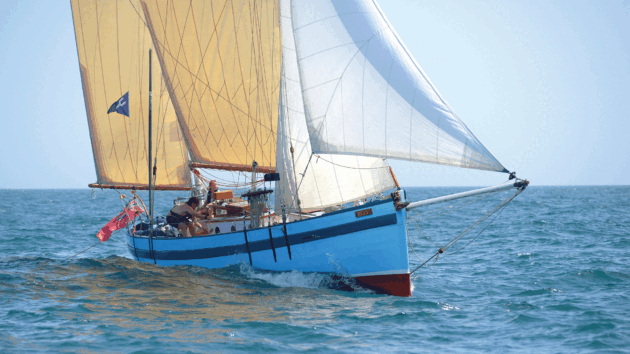
Going to windward well for a boat over 110 years old. Photo: Nic Compton
After playing around with it for a while, Ian decided it was too much for him and passed it on to his son to sort out instead. It was only then that the penny dropped and the Blackburns realised the man’s son was none other than Guy Martin, motorbike racer and TV presenter for all things mechanical.
Despite his fame, Guy had to rebuild the engine three times before he finally found the source of the problem: the crankcase had become porous, allowing water to seep through into the oil. A new crankcase was duly sourced and the engine was refitted to Rely.
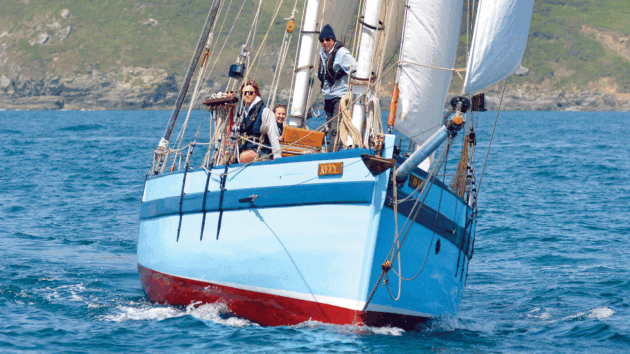
Rely moves well in a seaway thanks to her shape and displacement. Photo: Nic Compton
Soon after they bought the boat, the Blackburns joined the East Coast OGA and started competing in races, not to win but to improve their sailing skills. And from the outset they found the organisation welcoming and unjudgmental. More like a family than a boat club.
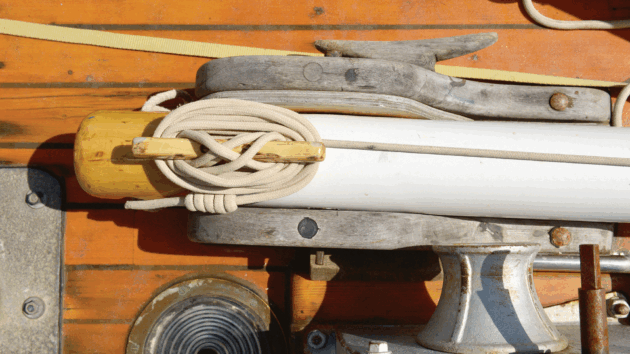
Rely’s carbon-fibre bowsprit is 20ft long. Photo: Nic Compton
‘They were so generous, the guys on the old gaffers,’ says Sophie. ‘Because we used to turn up with our boat, and we were terrible. We had three kids on board as well, so we couldn’t really do much. But we went to all the races to try and get better. And we’d be coming in two hours after the last boat, but they would hang around at the finish line and wait for us.’
After 20 years of coming last in every race, Martin and Sophie had had enough. When they discovered rot in the base of the mizzen mast for the second time in 10 years, they decided it was time to start again. The sail area had been reduced when the boat was converted from lug to gaff rig, and she was clearly under-rigged.
Steve Hall at North Sea Sails drew the sail plan, Martin designed the spars and Compotech made the two masts and the gaffs, which are all carbon-fibre. The booms are solid timber to keep some weight on the sails. Not only is the sail area nearly double what was there before, but the main gaff actually overlaps the mizzen mast when it’s down, which takes some getting used to.
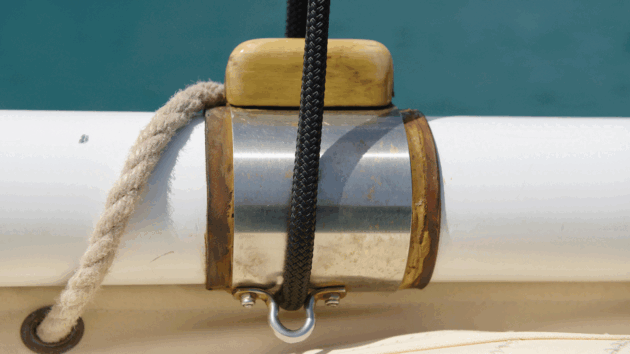
Attaching mast fittings to carbon-fibre requires ingenuity. Photo: Nic Compton
Transformative
The change has been transformative. ‘She sails much more like a modern boat now,’ says Martin. ‘Because there’s less weight in the rig, she doesn’t heel over so much. Plus she points much higher. We definitely aren’t very fast in light airs, but we’re not slow either. We’ve got a 20ft bowsprit and a huge sail we call the “Big Bastard”. Once she gets going, she’s fine. What we’re not good at is tacking, because you lose all your momentum in every tack.’
Predictably, in racing Rely forges ahead on the sea legs and slows down in confined waters. Since she’s had her new rig, however, her time behind the rest of the fleet can be counted in minutes rather than hours, which is all the family ever wanted.
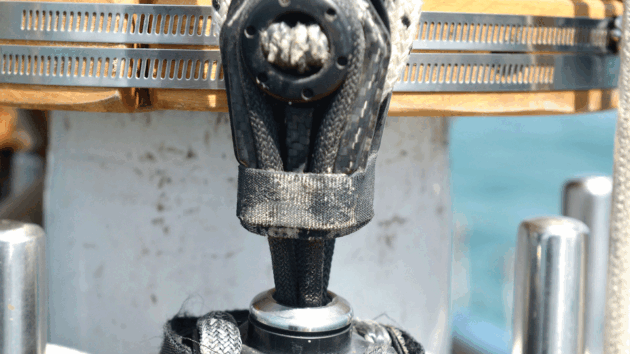
Not as pretty as a wooden block. Photo: Nic Compton
For Vicky, sailing Rely is second nature. Fiancé Tom, who has just left the Army, is a relative newcomer to the boating world and, like Vicky’s father before him, is having to learn the ropes to keep up with his sailor wife-to-be.
The idea of sailing around the British Isles was inspired by talking to OGA members, who organised a circumnavigation in company to celebrate their 50th anniversary in 2013, did the same again in 2023, and will no doubt do it again in 2033.
‘They all came back saying it’s fantastic,’ says Vicky. ‘So we thought we’d better do it before we get too busy!’ For Tom, it will be a baptism of fire, but he’s hoping that by the end of the trip he will be ‘pretty expert’. I caught up with the couple when they were passing through Salcombe.
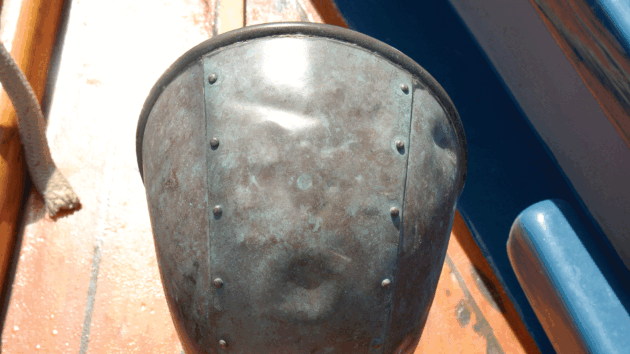
A riveted copper vent. Photo: Nic Compton
They had already had a few hiccups, including a broken gearbox on their first day out (fixed in 27 hours thanks to friend Josh and Vicky’s dad Martin), and being stormbound in Poole for a few days.
The plan was to meet Rely off Salcombe and transfer on board for a sail, but a series of unfortunate events (not least a close encounter with a lobster pot buoy) meant that didn’t happen.
I have, however, sailed on another half-Zulu: the lug-rigged Maggie Helen, which also proved to be deceptively fast. These are the kind of boats that, once you set them on course and get all the several sails set, you feel you could sail in one direction forever.
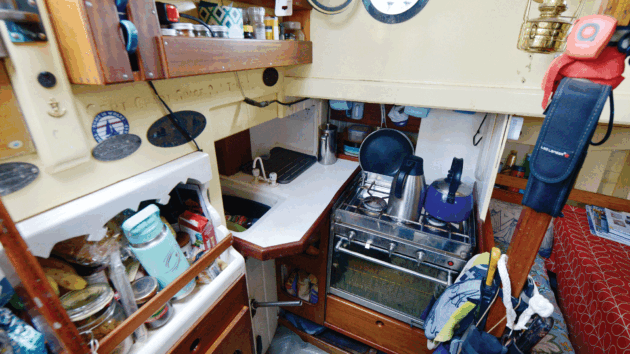
The galley area condenses all the essentials into a small nook. Photo: Nic Compton
That’s what that long keel does for you. With her carbon-fibre gaff rig, Rely no doubt points higher than Maggie Helen and requires less crew to handle her, but off the wind the lug-rig almost certainly has the edge.
The other big difference between the two boats is that Maggie Helen has a tiller whereas Rely has the wheel fitted for her piloting duties, which will certainly take some of the effort out of steering (Maggie Helen has a lot of weather helm) though you also lose some responsiveness. Either way, the boats may not give the thrill of round-the-cans sailing, but they are anything but boring.
Article continues below…
The abandoned boat problem: Investigating a nationwide issue
What to do with the many abandoned boats left to rot or disintegrate in creeks, rivers and estuaries up and…
Zen again: A 65,000-mile love story on a 1980s IOR classic
Zen Again is our Yamazaki Yachts Stinger 34 1980s IOR ¾ tonner. She’s gorgeous. She has a deep fin keel,…
What the experts say
If you should ever consider taking on the ownership of any wooden boat there is one thing you should first understand: it’s not ownership; you become a custodian and with it you assume many responsibilities.
Firstly access to a good boat yard that has experience and understanding of what’s required. Don’t be frightened to ask for references or photos of jobs they have done, especially major refits. Nic’s point about winterising with a tidy full cover is essential. In the yards I worked in on the East Coast almost every yacht in the 70s and 80s had their masts out and covers on as part of the normal winterising.
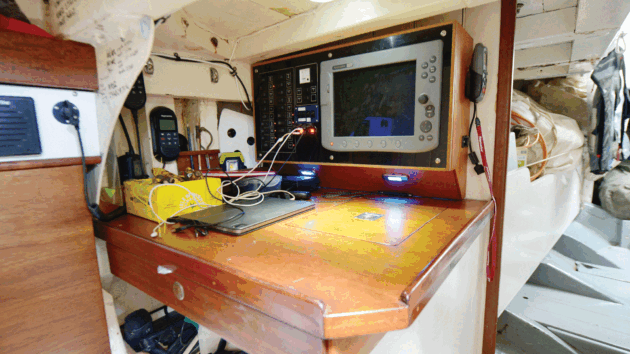
The chart table and nav instruments have been updated over the past 15 years. Photo: Nic Compton
With my own craft we’ve had a mast-up cover that goes full length and around both spars! But ventilation is paramount on any craft, especially a wooden vessel. When I worked in the yard, some of our older craft went into mud berths rather than being lifted out – to keep the hull moisture levels right.
From a structural point of view if you fancy becoming a custodian, then knowing the boat’s repair history and conversion is again something that’s very beneficial, especially ones that change stem or stern arrangements. But most importantly you must find out which timber species have been selected and what methods and materials were used to fasten the planks.
Many fishing vessels were made of substantial oak frames with larch or oak planks with iron spikes that sadly don’t last more than 30-40 years depending on location. With oak and iron you can get tannic acid that will cause the iron nails to fail and can start rot quickly where the timbers lap. If you look hard you may find one with substantial copper rivets and bronze fastenings that will last 80 years.
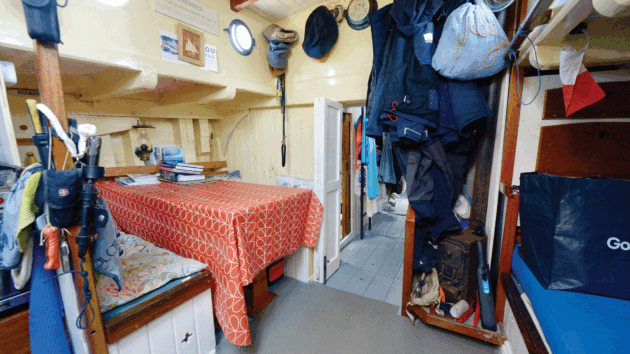
The accommodation forward of the cosy saloon area is ‘crouch height’ only. Photo: Nic Compton
Finding a good surveyor if planning a purchase or refit is essential for good communication and understanding that costs that can spiral out of control on a refit as things get discovered when opened up.
So a war chest of money will be prudent. A typical example is when exposing beam shelfs and framing in locations where light and air are in short supply. Sourcing good seasoned timber is becoming difficult but worth the effort and when sailing, becomes a serious reward. Lastly, check whether your vessel is on the historic ships register before starting a refit or making alterations.
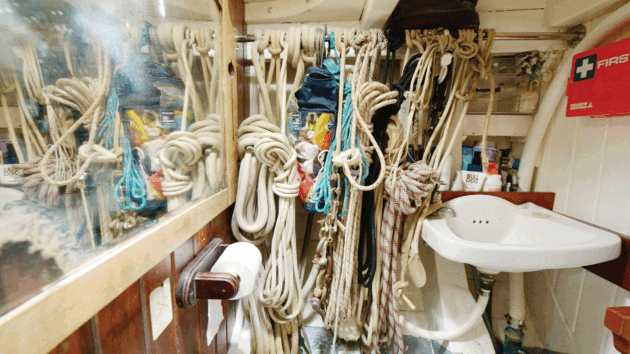
Stowage space is at a premium with all areas (including the heads) being utilised. Photo: Nic Compton
Alternatives to consider
St Ives Lugger
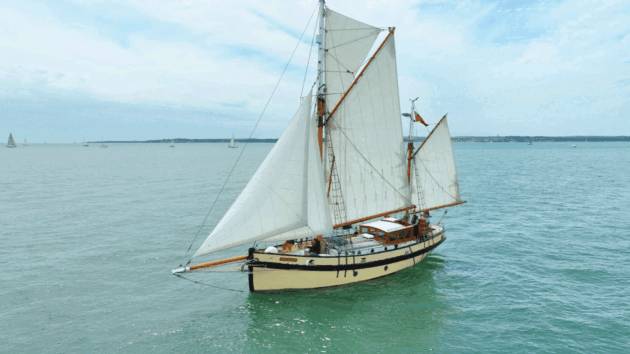
St Ives Lugger converted into a gaff ketch yacht. Photo: Nic Compton
‘St Ives men had a difficulty; they had a terrible harbour, with frightful side surf, and legs were impossible. This problem was solved by building a peculiar boat with a small bottom to obviate the leg necessity…’ This is how the historian Edgar J March describes the evolution of the St Ives luggers in his book Sailing Drifters.
The difference between the Zulu type of fishing boat and their sisters down at the other end of the country was quite dramatic. Both were used for drift netting, but while the Zulus were noted for their speed, the St Ives boat had a much fuller shape – all the better to take to the bottom at St Ives while a swell was crashing into the harbour – and travelled further afield. So, which makes a better yacht?
Our Lizzie was one of the last St Ives luggers built and boasts an unusual counter stern, instead of the usual double-ended shape. Unlike Rely, she was built to accommodate an engine (two in fact) and was converted to a yacht in 1937, some 18 years before Rely.
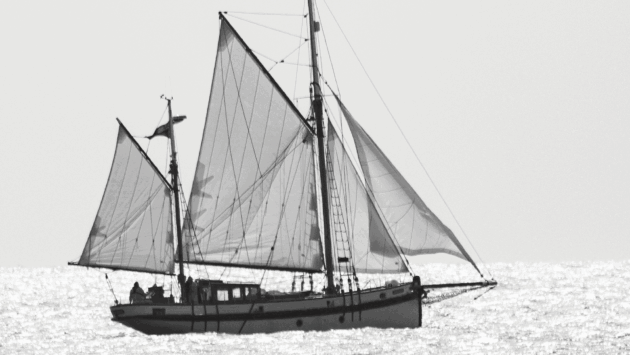
Our Lizzie has an atypical counter stern. Photo: David Collins
Like her northern sister, she comes with a fabulous history, including spying on the Germans just before the Second World War and a confirmed participation in the Dunkirk evacuation. She’s also appeared in half a dozen movies and TV series, including The Onedin Line, The French Lieutenant’s Woman and Dracula.
The difference in hull shape becomes obvious as soon as you go down below: Our Lizzie has far more volume than Rely, partly because she’s 6ft longer but also because of that fuller hull shape.
The displacement figures say it all: Our Lizzie is a mighty 35 tonnes, while Rely is ‘only’ 20. On the other hand, the Zulus have a reputation for speed, which might also be desirable in a cruising yacht. Our Lizzie is currently for sale through the Wooden Ships brokerage in Dartmouth (www.woodenships.co.uk).
St Ives Lugger Specifications:
Designer: WJ Oliver & Sons
Designer: Peter Ferris
Year built: 1919
LOA: 46ft / 14m
LWL: 38ft 9in / 11.81m
Beam: 14ft 2in / 4.32m
Draft: 6ft 10in / 2.08m
Displacement: 75,000Lbs / 34,000kg
Ballast: 21,760Lbs / 9,870kg
Sail area: 1,232sq ft / 114.5m2
Price: £15,000-£300,000
Looe Lugger
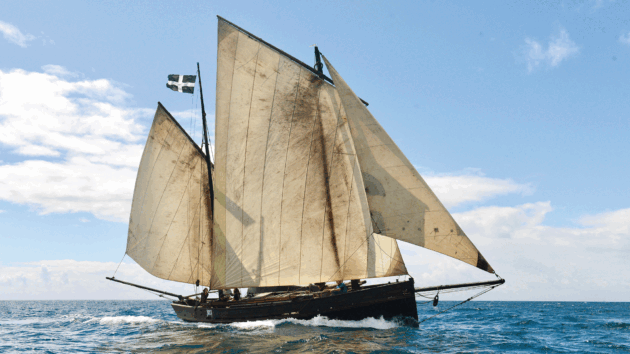
Guide Me has reverted to her dipping lug rig. Photo: Nic Compton
‘Speed was surprisingly good for such small boats, 8 knots was common, but a really fast vessel could do 10 comfortably, and could sail within five points of the winds with a jib set, or four without.’ This was Edgar March’s verdict on the Mevagissey luggers and, by extension, the almost- identical Looe luggers.
These boats were different again from the Zulus and the St Ives luggers, with a sharp, upright stem, a full hull shape (though not as full as the St Ives lugger), and wide transoms.
The seaworthiness of these vessels has been proven time and time again, and many have been converted into fine yachts, but you could have no better ambassador for the type than the 1911 Looe lugger Guide Me. Launched the same year as Rely, she too was built without an engine, though she had a motor fitted soon afterwards, and worked out of Looe for a remarkable 55 years.
Current owners Jude and Jonno Brickhill bought her in 1977 and, rather than converting her into a fancy yacht, they dispensed with the engine and restored her original dipping lug rig. It was a mad thing to do as the sails required a sizeable crew to manage them, and sculling into harbour with a sweep is an arduous task.
Yet the Brickhills proved all the naysayers wrong, sailing their ‘unimproved’ lugger across the Atlantic, across to South Africa and back to Cornwall. Not only that, but they won most of the races they entered along the way, proving conclusively that the lug rig might be old fashioned but, as Edgar March stated, it can also be surprisingly fast.
Looe Lugger Specifications:
Designer: Peter Ferris
Year built: 1911
LOA: 40ft 5in / 12.34m
LWL: unknown
Beam: 12ft 9in / 3.89m
Draft: 5ft 9in / 1.75m
Displacement: 39,680Lbs / 18,000kg
Ballast: unknown
Sail area: 1,600sq ft / 149m2
Price: £15,000-£250,000
Manx Nobby
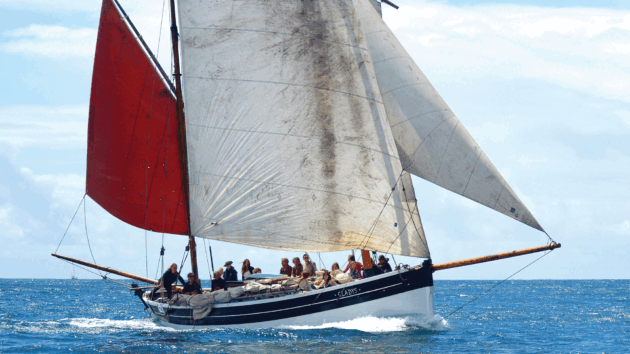
Gladys has a dipping lug rig to go faster… Photo: Nic Compton
‘For speed the nickeys were unsurpassed,’ to quote Mr Gawne’s own words, ‘My word them nickeys could sail! They could do 10 knots in favourable conditions, there was no rig ever created that could beat the lugsail.’ So says Edgar March, quoting a fisherman from the Isle of Man, talking about the nickeys, the precursors to the almost identical nobbies.
Up until 1864, the traditional fishing boats on the island were dandies and smacks, which pioneered the use of gaff rig. With the opening of the mackerel fishery by Cornish luggers, however, all that changed. Suddenly luggers were in demand again and the Manx nickey evolved, with a dipping lug rig on the forward mast. When that was changed to a standing lug, for greater convenience, they were renamed nobbies.
Gladys is a prime example of the type, described in great detail in Edgar March’s book, and proves why they were so successful. Built on the Isle of Man in 1901 as a nobby, she was converted to a dipping lug rig by her current owner Charlotte Whyte. Why? To make her faster.
And, in local racing, she is the only boat capable (just occasionally!) of beating the Looe lugger Guide Me. Gladys is also the go-to party boat at any trad boat festival, which is just as well considering the number of crew needed to handle her rig. But then that is the beauty of these big old boats: they are unashamedly social machines, happily hosting countless people during their long lives and giving pleasure to all who sail on them.
Manx Nobby Specifications:
Designer: NEAKLE & WATTERSON
Year built: 1901
LOA: 40ft 11in / 12.42m
LWL: 38ft / 11.58m
Beam: 12ft 2in / 3.7m
Draft: 5ft 4in / 1.63m
Displacement: 26,455Lbs / 12,000kg
Ballast: 8,800Lbs / 4,000kg
Sail area: 1,500sq ft / 140m2
Price: £15,000-£250,000
Enjoyed reading this?
A subscription to Yachting Monthly magazine costs around 40% less than the cover price, so you can save money compared to buying single issues.
Print and digital editions are available through Magazines Direct – where you can also find the latest deals.
YM is packed with information to help you get the most from your time on the water.
-
-
- Take your seamanship to the next level with tips, advice and skills from our experts
- Impartial in-depth reviews of the latest yachts and equipment
- Cruising guides to help you reach those dream destinations
-
Follow us on Facebook, Twitter and Instagram.
Note: We may earn a commission when you buy through links on our site, at no extra cost to you. This doesn’t affect our editorial independence.
Verdict
Despite her origins as a working boat, Rely has a lot of varnish on deck, which might look intimidating. The solution is simple: a cover. Setting up a full-length cover for the winter months will completely transform the life expectancy of a wooden boat and, while it might seem expensive, it’s a fraction of the price of having the varnish redone every other year, let alone replacing the decks. Down below, there are certain structural limitations which are impossible to overcome. Rely has a lovely cosy saloon and galley, complete with solid fuel stove, which is the living heart of the boat. It’s not hard to imagine spending days if not weeks here, cocooned by the 115-year-old timbers, reimagining the boat’s rich history. All the accommodation both forward and aft of the saloon and galley area, however, is stooping-height only, something you can either embrace or might be a deal-breaker for some, particularly on a 40ft boat. For the Blackburn family, it doesn’t even seem to register as an issue, and Vicky was quick to tell me that she and Tom had become so used to their cosy bunk on Rely that they couldn’t sleep when they went ashore and slept in a ‘normal’ bed.
Details
Designer:Nobles of Fraserburgh
Year Built:1911
LOA:40ft 0in / 12.19m
LWL:unknown
Beam:12ft 0in / 3.65m
Draft:5ft 0in / 1.52m
Displacement:40,000Lbs / 18,140kg
Ballast:15,430Lbs / 6,350kg
Sail Area:1,600sq ft / 150m2
Price:£15,000-£250,000