



Abandoned and unloved boats are a growing problem all over the UK’s coastline and waterways. But despite the technology available, there is no complete solution. Barry Pickthall investigates
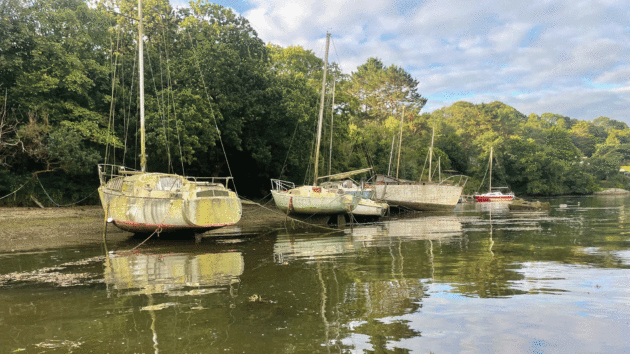
What to do with the many abandoned boats left to rot or disintegrate in creeks, rivers and estuaries up and down the country? Most are leisure craft built in the early 1970s and onwards when highly durable glassfibre-reinforced plastics (GRP) transformed the boatbuilding industry.
Instead of building labour-intensive one-off designs in wood, steel or aluminium, glassfibre gave us the option of cheaper mass-produced boats with a lifespan of 30-50 years.
But now the clock has stopped on many of these early boats, and with no national plan or inexpensive methods to dispose of or recycle them, they are being abandoned in greater numbers, often with terrible consequences for the environment.
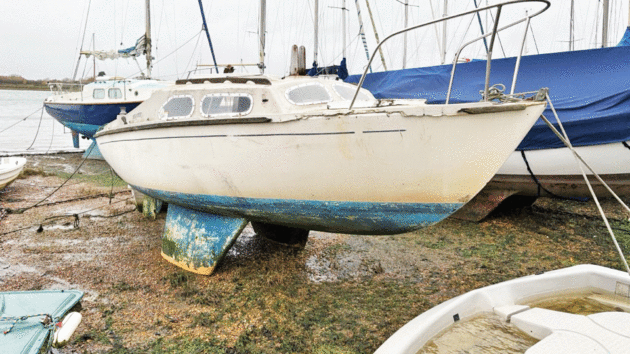
This bilge-keeled yacht has been lying under Brunel’s historic rail bridge at Saltash for some time. A one-month disposal order was attached to the boat on 15 July 2025. It is still there six months later, along with a number of other wrecks which simply attract more abandoned boats to the site. Photo: Barry Pickthall/PPL
As these hulls are broken down in watery graves by wind and waves, many are releasing microscopic fibres, fuel, oil and environmentally destructive chemicals, including battery acids and paints, into the marine ecosystem.
Two recent scientific studies, one by the University of Brighton exploring plastic pollution within Chichester Harbour, the other on the effect this is having on the lobster population in Nova Scotia carried out by researchers at Dalhousie University, make disturbing reading.
Brighton researchers found that in the Chichester oyster beds that local fishermen have worked so hard to re-create, the molluscs have ingested thousands of glass micro-particles. In Nova Scotia, it has become a case of lobster tails being served with a side of microplastics. Sixteen lobsters taken from four zones around the province were found to have 6-7 plastic particles (3.65 micrometres in diameter) per gram of tail meat.
Here in the UK, these findings have had significant implications locally, leading the oyster beds in Chichester to be closed, and signalling serious environmental health issues in other estuaries and harbours that have yet to be tested.
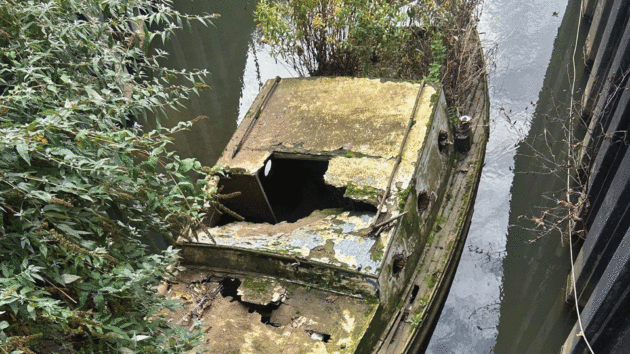
This wooden pocket-cruiser has lain in the Bath canal for so long that shrubbery has taken root. It has filled with rainwater, making it much more costly to retrieve than it would’ve been when still afloat. Photo: Barry Pickthall/PPL
Council complexities
Not all microplastics come from boats of course. Rainwater run-off and regional flooding is also responsible, but abandoned boats add to the logistical difficulties faced by councils already struggling with limited funds to fulfil their fiduciary duties to empty bins, repair roads and assist vulnerable residents.
To make matters worse, it has not been uncommon for councils to syphon off maritime income generated by harbour authorities in order to support wider local government commitments. A recent year-long court case between a group of harbour users at Whitby and Scarborough Borough Council could change that.
Last year, the High Court ruled that monies raised by Whitby Harbour Authority by dues, moorings, rents and parking fees on land it controls are ring-fenced for development and maintenance of the harbour, and ordered the Council (now North Yorkshire Council) to pay back £18.5M that had been syphoned off to meet other commitments.
Under the Harbour Authorities and Merchant Shipping Act 1995, owners of abandoned boats face fines of up to £1,000, together with the cost for removing and destroying wrecks. But that pre-supposes that owners can be traced.
As one harbour master told YM, ‘That’s often easier said than done. We might trace an owner through mooring records, but invariably when we contact them, the answer is: “Oh I sold the boat to a guy in the pub… No, I didn’t take a note of his name or address.”’
Without licensing of boats or even a legal requirement to insure them, the cost of disposing abandoned boats invariably falls on budget-starved local authorities who just stick an ‘Order to Remove’ notice on them.
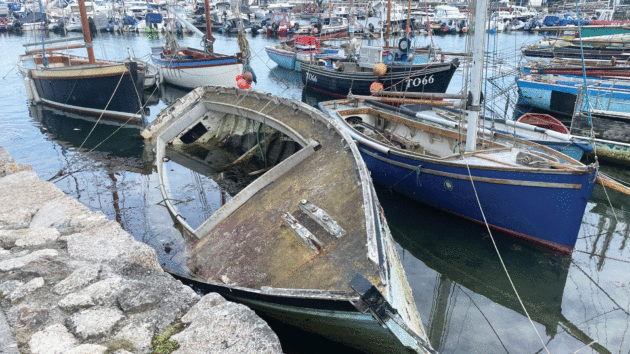
A wooden Oyster Dredger laid up and wrecked along the quayside at Mylor in Falmouth. Not only is it an eyesore, but the wreck is leaching paint particles into the water and is taking up valuable mooring space in the village. Photo: Barry Pickthall/PPL
The clean-up crews
But it is not all bad news. Environmentalists in the West Country together with Cornwall County Council are leading the way in highlighting and finding pathways to clean up and dispose of boats and waste products littering their coastline.
Chris Jones, the enthusiastic marine manager within the Council says: ‘Income from harbours in the county is ring-fenced, and so far we have spent £150,000 removing 85 abandoned boats. We still face problems where boats are linked to police investigations and mental health issues, but we are addressing the problems and making headway in clearing up our coastline.’
Steve Green leads a team of volunteers under the banner Clean Ocean Sailing based in the Helford River. They have cleared 32 wrecks and over 70 tonnes of foreshore plastic with donation-based funding and landowner contributions.
‘Scrapping these boats cost £500 per tonne plus transport costs, which some councils and harbour authorities simply cannot afford,’ says Steve, whose group collected 12 tonnes of plastic waste littering Cornwall’s coastline last year. He has gained crowd funding to salvage and recycle what is possible from three abandoned vessels as a costing exercise. The first of these is was a Westerly Centaur 26ft cruising yacht that was abandoned in Helford River.
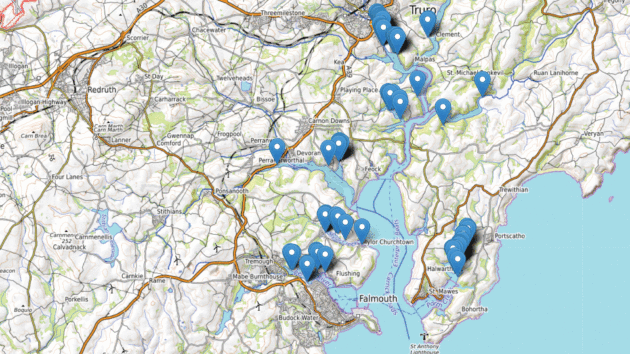
Campaigners at www.wreckfree.org are actively trying to remove abandoned boats in the Helford and
Fal Rivers, having mapped 160 of them already with more still to be included
Mapping abandoned vessels
Steve is also part of the Falmouth and Helford group wreckfree.org campaigning for policy solutions and funding to better deal with the issue of end-of-life boats in the Helford and Fal rivers. So far, the group has mapped 160 such vessels. ‘We’ve probably only mapped half to two-thirds of the abandoned boats around the estuary foreshores, and there will be a lot more in boat yards and gardens.’
Jake Burnyeat, one of the group’s volunteers adds, ‘While there is a good case to introduce compulsory registration for boats so that owners can be traced, you can’t really blame end-of-life boat owners for walking away from their boats when there is no realistic alternative.
It costs thousands of pounds to scrap a boat responsibly. Somehow that cost needs to be spread over the life of the boat and not just fall on the last owner who will likely not have the money to pay it. Boat owners need an easy and low-cost means of doing the right thing when their boats reach the end of their lives.’
Miles Carden, CEO of Falmouth Harbour Authority disputes the number of abandoned boats in his waters. ‘We don’t have a problem with wrecks in Falmouth – never more than two or three a year,’ he says. Nor does he support the idea to licence boats or a surcharge to mooring costs. ‘Sailing is expensive enough as it is and I don’t believe existing boat owners should have to pay for these legacy issues.
I will support any initiatives to solve the problem, but this is just one of a number of environmental issues I face. We need a national solution because I don’t believe this will be resolved regionally. The cost of setting up responsible recycling (of boats) is very expensive.’
This is not the case in the Penryn and Truro rivers controlled by separate authorities, which flow down into the Falmouth estuary. Our research has located a dozen hulks and unloved boats holed up in last resting places within these rivers, many of them leaching microplastics and more down river into the Fal estuary.
Jake Burnyeat, one of founders of the wreckfree.org campaign highlights a further issue: ‘The Fal and Helford are complicated by the fact that we have three harbour authorities covering some, but not all, of the Fal estuary and no authority covering the Helford. So the more Harbour Authorities do to clamp down on end-of-life boats in their areas, the more the problem is pushed to unregulated areas like the Helford and Flushing rivers.’
Ironically, most of the wrecks in this region are within close reach of Truro Recycling, situated on the town quay. But this highlights another bureaucratic issue, as Roman Drew, their recycling manager explains: ‘We have a licence to scrap boats, vehicles and metals here on site. We need a separate mobile licence to salvage a boat in the harbour and lift it out by crane, which is expensive, and not cost-effective.
‘We break up boats here, often working with Steve Green who brings them here by road, salvaging the fittings, recycling the metals, and sending any wood to waste energy, leaving the glassfibre to go to landfill. We would like to recycle everything, but the system that grinds up glassfibre to turn it into boards costs upwards of £2.5m. As things stand, that’s simply not affordable.’
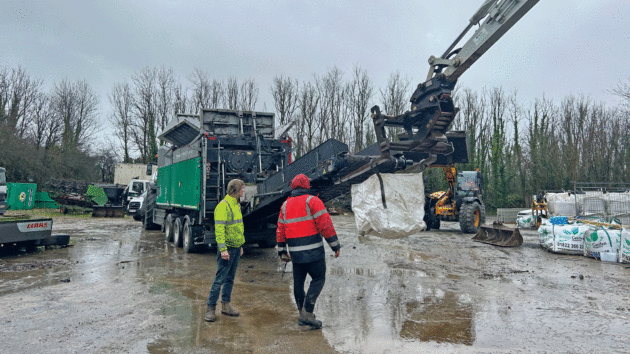
A mobile £500k biomass shredder that can macerate a stripped-out 20ft sportsboat whole. Marine & Boat Recycling based in Tavistock, Devon, describes itself as the first yacht recycling company offering a zero-to-landfill promise. Photo: Will Higgs/ Marine & Boat Recycling/PPL
Case study 1: Marine & Boat Recycling
Sixty miles to the east, a new start-up company, Marine & Boat Recycling based on a countryside industrial estate outside Tavistock, Devon, describes itself as the first yacht recycling company offering a zero-to- landfill promise.
Sailing environmentalist, Will Higgs, has joined forces with the waste management group Agecko UK, based in Yorkshire, to provide a full boat recycling service. They charge £450 + VAT per tonne to dispose of a boat, with a payback for engines and fittings that are in good order.
‘It was clear to me that the issues surrounding end-of-life GRP vessels have become increasingly serious and widespread,’ says Higgs. ‘I did some research and discovered that while most GRP ends up in landfill, Agecko, at the forefront in the drive towards more sustainable disposal methods, has a solution to the problem, transforming GRP waste into a valuable resource.’
Agecko’s core business is providing sustainable, total waste management – assessing customers’ waste streams and finding them the most sustainable routes to disposal.
‘They had no experience with boats, so I explained my experience within the marine industry and how we separate the waste streams and reusable parts, and a partnership was born. Agecko has provided some startup investment and connected me with key stakeholders in the wider composites industry which continues to evolve with others in the marine industry.’
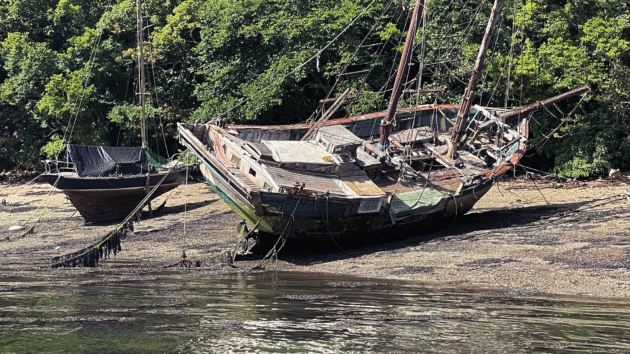
One unfortunate owner who bought this old wooden schooner has been ordered to responsibly remove her at a cost of £58,000 after the boat fell over during a gale. Photo: Barry Pickthall/PPL
Innovative re-use of materials
Utilising a £500k shredder that can macerate a stripped-out 20ft sports boat whole, the company is regenerating the powdered residue into GRP scaffold boards and as an additive for concrete which increases its strength-to-weight ratio by 20 per cent.
‘We have set up a website to sell engines, fittings, masts, rigging and trailers and have recently opened a second temporary recycling site at Dunoon, Scotland.
We plan eventually to open other sites around the country,’ Higgs says, adding that sending waste to burn for energy is not a good long-term plan. ‘The resin burns, but not the glass fibres.
‘There are two schools of thought: Wait until we get a perfect system to recycle boats or do the best we can now and work to improve things as we go along. There are issues still to be resolved including paint and antifouling in particular, but there are tolerances. We wash off the hulls and sand blast the worst areas before shredding them.’
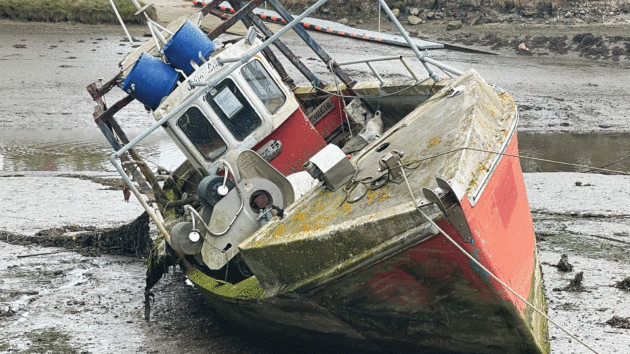
An unloved fishing boat abandoned in a mud berth in the upper reaches of the Truro River, Cornwall. Photo: Barry Pickthall/PPL
Free boats for sale
Yachting Monthly has found several websites and Facebook groups offering boats for free or at knock-down prices. Some of the boats appear to be in sound condition, but Steve Green says that invariably, these offers simply move the problem from one area to another.
‘The engine may need fixing, the rigging needs replacing, and by the time you add these costs to berthing fees and insurance costs, the new owner who thought he could get afloat for a few hundred pounds, is suddenly facing bills amounting to several thousand pounds – the exact reason why the previous owner wanted to get shot of the boat in the first place.’
There are companies like Responsible Boat Disposal operating in Plymouth, Ipswich, and Manchester, and Boat Salvage based in Southend-on-sea which work to find new owners for unloved boats, only scrapping vessels as a last resort.
Boat Salvage, which has been in business for 45 years buying all types of repairable and stolen/recovered vessels, finds new owners who either take on the refurbishments themselves or carry out this work for them. This, they say, can save the customer a lot of money.
Among their offerings online is a storm-damaged 2019 Hallberg-Rassy 412 now repaired but in need of cosmetic surgery for £98,500, and a 55-year-old
STEFINI 60 that has undergone a partial professional restoration for £99,950.
Responsible Boat Disposal, which has as its strapline ‘We don’t break boats, we care for them’ provides a similar service. At the time of going to press, the website had a Contessa 32, a couple of Westerly Centaurs and an 8m Van de Stadt offshore cruising yacht available free to a new owner.
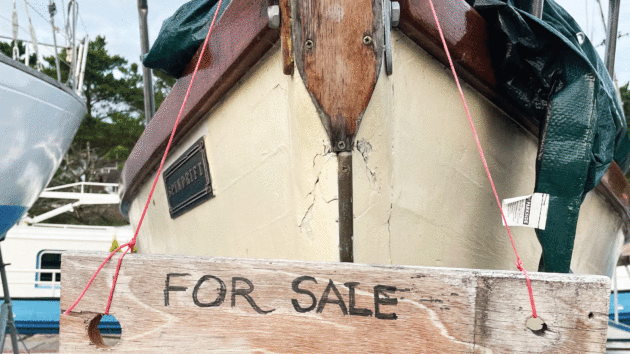
Many end-of-life vessels are offered free or for a song to people thinking they can be fully restored for a few hundred pounds. When reality sets in, these boats are then left abandoned to leach microplastics, oil and battery acid into creeks and rivers. Photo: Barry Pickthall/PPL
Case study 2: Boat Breakers
Boat Breakers, based in Gosport, Hampshire, is sitting in an area full of wrecked boats and abandoned dreams, taking in Chichester, Langstone and Portsmouth harbours, the Beaulieu and Lymington rivers and Isle of Wight. Luke Edney says that their principal clients are owners who want to dispose
of their vessels ethically, together with insurance companies, boatyards, marinas and harbour and river authorities saddled with cleaning up the wrecks.
Boat Breakers charges £400 per tonne plus transport and operates nationwide, taking boats to the nearest scrap or recycling centre. Edney says that while scrapyards may say that the glassfibre goes to waste energy, the reality is that much of it finishes up in landfill.
‘Abandoned boats are the biggest problem. We have had two yachts sink in Portsmouth harbour only this week. We alerted the Council a year ago, when it would have been cost-effective to tow the boats away and scrap them, but nothing happened.
‘Now they face an additional £3,000-£5,000 in diving and lifting costs to clear the wrecks. Responsibility boils down to whoever owns the land or water they are sitting on. Invariably, the boat owner is untraceable, and the landowner has first to pay the cost of obtaining legal ownership before facing the cost of actually removing the wreck.’

On this abandoned boat the cockpit had filled with water. Photo: Luke Edney/Boat Salvage UK/PPL
Broken dreams
He adds that many of the vessels they are called on to dispose of do not look like they are at the end of their life. Edney points to a Sadler 32 that was up for sale for £9,000 recently, only for it to fail its survey because of osmosis.
‘She seemed to be in nice condition, but when we pulled the carpets up, the keel bolts were badly rusted, and the hull was flexing around her keel. The cost of fixing it all was estimated between £12-15,000.’
He has many other examples, invariably boats bought for a song by dreamers who think they can fix them up. One is a Hurley 22 bilge-keeler left to rot
at Dell Quay in Chichester harbour. ‘When we arrived, the Hurley was a picture of good intentions gone wrong.
She had already been stripped by the owner in an effort to get a head start on the project, leaving her empty and exposed. The inevitable happened. The owner lost interest probably because of unforeseen costs, and the hull was left completely full of rainwater, slowly sinking into the mud, filled with good intentions.’
Article continues below…
Sailing’s dirty secret (and the innovators solving the GRP landfill crisis)
We may never know the origin of the phrase: ‘Where there’s muck, there’s brass’ – but as a southerner, I…
How to check the structural integrity of a GRP yacht hull
A GRP yacht hull may be strong and durable, but it’s also, unfortunately, relatively heavy. To overcome this problem, naval…
Wooden boats vs GRP
Some might think that wooden boats are more environmentally friendly when it comes to their disposal. Think again.
Back in the 1970s, wooden houseboats that had reached the end of their useful lives used to be burnt in their mud berths, and the metals salvaged by raking through the ashes. Not anymore. Disposal and deliberate sinking is now heavily regulated and involves strict environmental licensing. There is a liability for hazard removal and potential criminal penalties can be enforced under maritime law.
One unfortunate owner who bought an old wooden schooner in Fowey with a view to restoring her to former glory now faces a £58,000 bill for responsibly removing the wreck after it fell on its side during a gale.
The vessel is beyond repair, and the owner has been ordered by the Harbour Commissioners to remove the wreck. The cost is not only beyond the means of the owner but also that of a cash-strapped local authority, so the hulk remains exactly where she fell on the beach.
Steve Green has now stepped in to see if his Clean Ocean Sailing group can secure a license from the UK Marine Management Organisation (MMO) to tow the Fowey wreck back out to sea and scuttle her to become a new home for ocean life.
Westerly Centaur
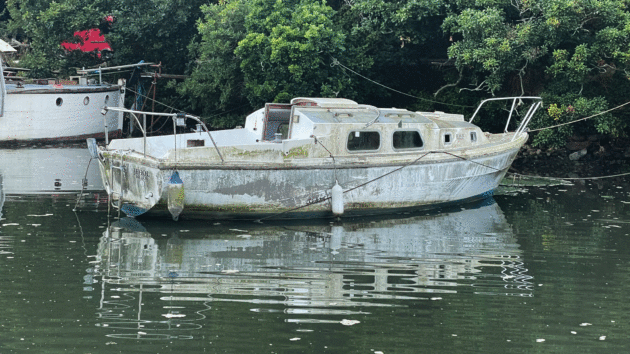
This Westerly Centaur was abandoned in the Helford River. The yacht was scrapped by Steve Green and his Clean Ocean Sailing ecology group. After recycling her engine, keels, fittings and rig, and sending wood to waste energy and glassfibre to landfill, the net cost of the process was £421.90. Photo: Barry Pickthall/PPL
Location: Helford River
Length: 7.92m
Beam: 2.56m
Displacement: 3,039kg
Iron (keels and engine bearers etc): 1,262kg
Iron mix (engine, gearbox etc): 260kg
Dacron Material (sails x4): 14kg
Alloy (mast/boom): 72kg
Stainless steel (rigging, fuel tank etc): 38kg
Brass/bronze: 6kg
Copper/plastic mix (wiring/instruments): 13kg
Plastic mix (pipes/tubes): 7kg
Wood/ply (bulkheads/furniture): 28kg
Foam/insulation: 4kg
UPVC (deckhead lining): 8kg
Polyester (ropes/mooring lines): 12kg
5 x PVC fenders 6kg GRP hull: 1,295kg
Cost to dispose GRP to landfill: £-647.40 (£500 per tonne)
Income from scrap
Stainless steel: £9
Aluminium: £2
Brass/bronze: £3.50
Iron: £208.00
Total income: £225.50
Total cost of disposal: £-421.90
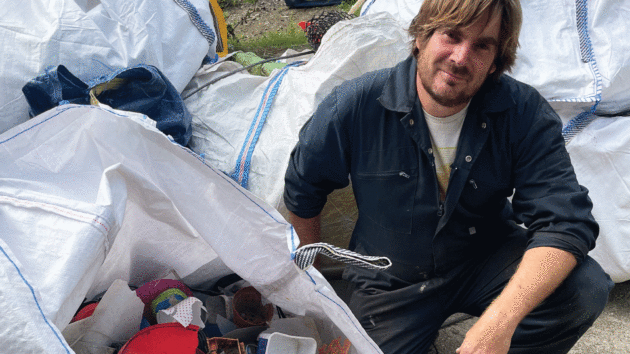
Steve Green has made it his life’s mission to clean up Cornwall’s rivers.
Useful contacts
Cornwall
- cleanoceansailing@gmail.com
- wreckfree.org
- trurorecycling.co.uk
Newton Abbot
Plymouth and Ipswich
Gosport
Essex
RYA Green Blue
Facebook groups
Boats for free or cheap. Boat bits for sale or wanted or free: www.facebook.com/groups/1157773175739696
Pay It Forward (free or cheap boats): www.facebook.com/groups/1157773175739696
Boat Scrapyard & Lonely Boats: www.facebook.com/groups/boatscrapyarduk
Boat Salvage UK – boat parts: www.facebook.com/p/Boat-salvage-UK-61554491234160
Project and affordable boats for anyone looking to move onto the water: www.facebook.com/groups/591544142195413
Enjoyed reading this?
A subscription to Yachting Monthly magazine costs around 40% less than the cover price, so you can save money compared to buying single issues.
Print and digital editions are available through Magazines Direct – where you can also find the latest deals.
YM is packed with information to help you get the most from your time on the water.
-
-
- Take your seamanship to the next level with tips, advice and skills from our experts
- Impartial in-depth reviews of the latest yachts and equipment
- Cruising guides to help you reach those dream destinations
-
Follow us on Facebook, Twitter and Instagram.
Note: We may earn a commission when you buy through links on our site, at no extra cost to you. This doesn’t affect our editorial independence.