


Richard chose Loch Tay to show his partner Maxi how great sailing can be. His lessons proved unforgettable.

Greece, 2024 – first light breaks, the anchor is catted, and Namika’s bow blows ever so gently off with the early land breeze. As she turns out to point into the Gulf of Hydra, I unfurl the genoa and she slowly gathers way, reaching perhaps a knot or two.
The engine never went on and my wife Maxi is still half-asleep down below. There is not another boat in sight – either at anchor or underway. I engage the autopilot, and as I am about to go below to put the kettle on, I hear a noise like someone letting the air out of a balloon. I turn to see a dolphin exhale at the surface to starboard.
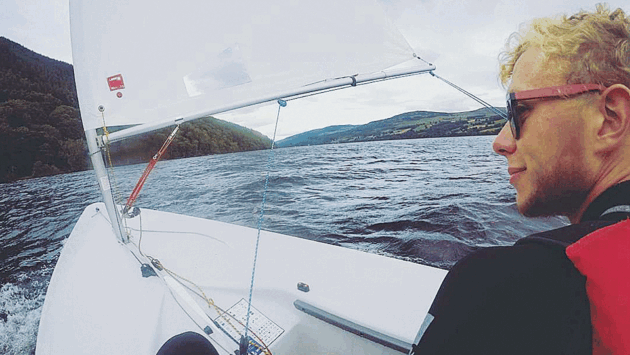
Richard chose Loch Tay to demonstrate the joys of sailing to partner Maxi. His lessons proved unforgettably immersive. Photo: Richard Thomson
Needless to say, perfect days are easy days. Any sailor worth their salt knows that not every moment is like this. When I was pitching a cruising dream to my then-landlubber wife a few years before, I naturally put significant emphasis on the peace and serenity – dolphins, sunsets, idyllic anchorages. But to be frank, it is a miracle that we made it to this point.
Scotland, eight years earlier – the dull sky morphed constantly through apparently endless, subtle variations of slate grey. A gale howled across inland Loch Tay. The cresting white horses were well formed, and spray whistled through the air. Out at sea, keelboats would by choice be almost exclusively hidden away at anchor in such conditions, and dinghy sailing would not have been considered other than perhaps by the foolhardiest.
Of course, this was not the open sea. Even with a gale blowing, the size of the waves on an inland loch is naturally constrained by the limited fetch, and there is no risk of being washed out into open water. Even if something were to break, a dinghy and its occupants will just drift to shore.
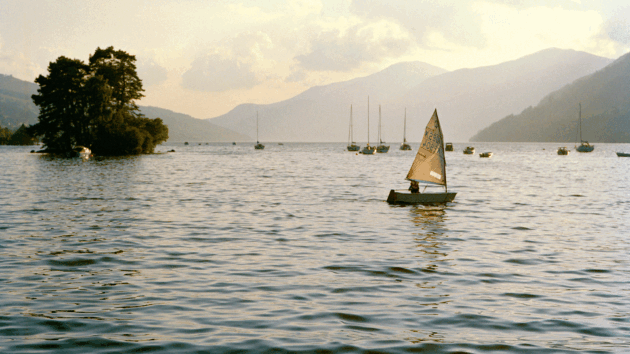
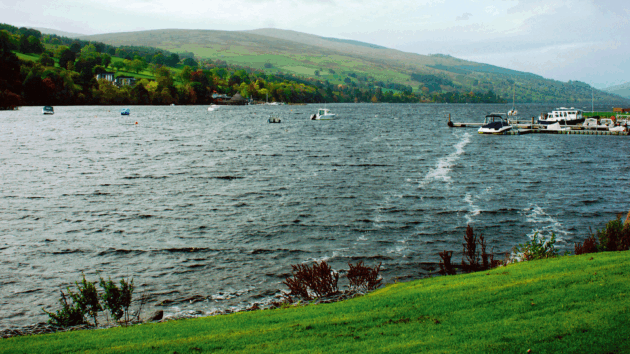
Perthshire’s Loch Tay has its moments of tranquility… enjoy them while they last. Photo: Richard Thomson
After being taught the basics as a very young child in more benign conditions by my father, the thrill of near-gale or gale-force conditions in a Laser dinghy was largely how I had continued learning to sail.
While my perspective on keelboats is that you should be reefing as soon as anyone thinks about it, on a dinghy in enclosed waters my view has always been that there is nothing wrong with a good soaking and that there is much to be learned from the experience. Very cautious readers will perhaps be less than impressed, and I am not seeking to change their opinion.
All I will say is that I’d grown up learning this way, and I loved it. That said, it was perhaps not the wisest introduction to sailing for my future wife.
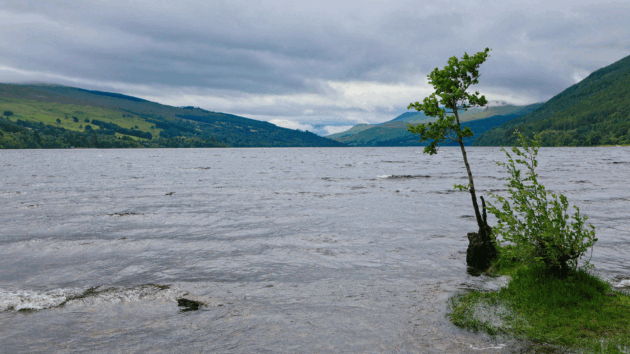
Howling gales greeted Maxi’s baptism into the sailing life back in 2016. Photo: Richard Thomson
‘Do you want to go out for a sail?’ I asked. She looked at me with slight bafflement. ‘Is it not a bit windy?’ ‘Nah, it’ll be fun!’ I reassured her, grinning foolishly. To be honest, she didn’t really take more convincing than that. She’d introduced me to skiing, and I’d trusted her then. She trusted me now.
We donned wetsuits and buoyancy aids – she managed to squeeze herself into an old teenage-sized neoprene of mine – then went to rig the dinghy. I opted for the little 4.7m sail – plenty small even for the conditions, as we’d be sailing in tandem, which of course the Laser isn’t really designed for.
While rigging, I explained to her where we’d be sitting, how to use the toe strap for bracing, and that the only thing to really watch for was to duck under the boom when we ran out of water and had to tack to come back the other way across the loch.
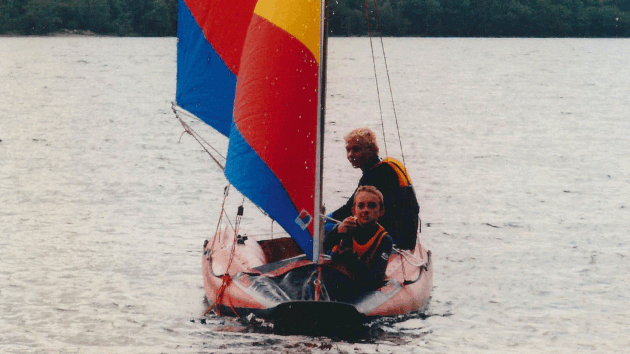
Maxi’s Loch Tay apprenticeship left a lasting impression. Photo: Richard Thomson
I explained she didn’t really have to do anything unless she wanted a go, as only the tiller and mainsheet needed to be controlled, and I could manage both of these. I explained that I would let her know when we would tack and remind her to duck, and off we went.
Mostly (in my mind) we were going out for a bit of fun anyway – it was never intended as a serious teaching experience, though I still think I had explained the basics reasonably clearly. I was not a complete novice at teaching novices, having previously taught dinghy sailing to children – admittedly in more benign conditions.
I had, however, failed to mention one thing – that capsizing a couple of times was going to be par for the course on a day like this. That was a mistake.
We close-hauled across the loch a few times to gain some ground to windward, luffing occasionally as necessary in the stronger gusts to keep the boat upright. Having got a bit of ‘sea room’, we came off the wind onto a reach to plane and surf. As anyone who’s sailed a Laser in fast conditions will know, the hull hums when really hammering along.
Richard was brought up around boats on the west coast of Scotland and inland lochs, then taught sailing and skippered in the US, Caribbean and Mallorca. He now works as an illustrator. Photo: Richard Thomson
I believe the phenomenon is known as vortex shedding, and originates from disturbed water flow at the trailing edge of the daggerboard and in some cases the rudder. To my biased ears, it can be really quite musical, and is a sound and feeling that has a place of affection in my heart.
Inevitably, at some point, we capsized. Into the water we went, up we popped and I must surely have had a big silly grin plastered over my face. Maxi’s eyes were a little wide, but she didn’t seem too fazed. I righted the dinghy and helped haul her in. Dripping, she asked if what had happened was normal, and I reassured her that it was nothing to worry about, and off we went again.
We capsized perhaps three times in total – probably once or twice in a gust, and once or twice in a lull where we were caught a bit too hiked out. At some point, starting to get a little chilled after our soakings, we headed for home. I came back pleasantly tired, ready for a shower and a hot beverage, and happy as Larry.
Perhaps it was my enthusiasm, or perhaps she just felt lucky to be alive – but it seemed to me at the time that Maxi felt broadly similar.
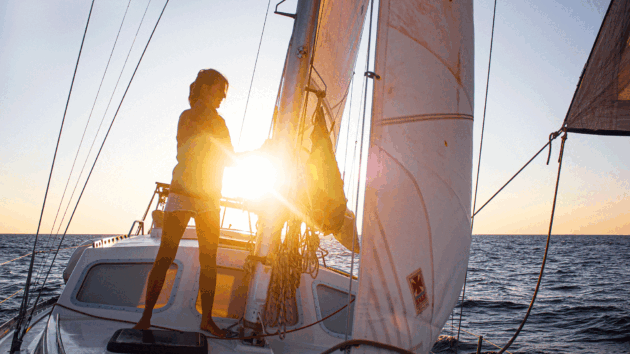
A clear plan is the path to plain sailing. Photo: Richard Thomson
Triggered in greece
Greece, 2021 – We were here on holiday, but also as a test. During lockdowns, I’d developed a hankering to go cruising – perhaps a not uncommon response to the slight feeling of incarceration so many experienced during that difficult time, when lots of people seemed to be thinking about camper vans, boats or just being able to go anywhere.
Maxi and I had gone sailing on various dinghies a few times before Covid and it had gone pretty well – though always in significantly less wind than that first time. Prior to Covid, I’d also gone off to work in the Caribbean, skippering 50-foot yachts with groups of 10-15 teenagers onboard.
When I voiced the cruising idea to Maxi during lockdown, her (quite reasonable) first condition was that we do at least one charter, as she had never even set foot on a big boat before. So we booked the cheapest charter we could find, and were lucky to be ‘upgraded’ on arrival from the significantly smaller, older vessel we’d booked.
The warm sun and the Mediterranean blue sky set off the rugged mountains of the Ionian as our Jeanneau Sun Odyssey 35 charter heeled gently to the afternoon breeze. ‘Are we going to capsize?’ Maxi asked, nervously.
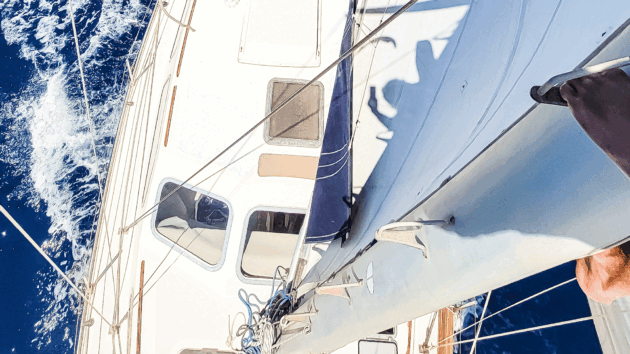
Cruising on Namika has increased Maxi’s confidence. Photo: Richard Thomson
Lingering anxiety
2026 – It’s taken time to undo the damage I caused by throwing Maxi in at the deep end so early on. It still comes up occasionally as an almost knee-jerk reaction on our 38-foot yacht Namika, even though she now knows how differently a yacht and a dinghy behave.
I think the problem was twofold. One – her first experience was certainly toward the deep end of dinghy sailing. Two, I did not mention in advance that capsizing was to be expected in a dinghy in those conditions.
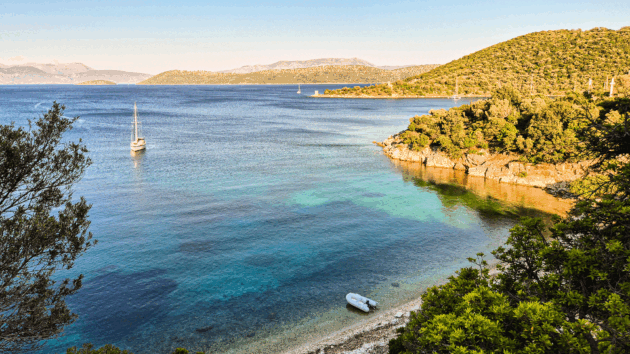
Greece is gradually soothing Maxi’s early woes. Photo: Richard Thomson
I may have said we’d get a bit wet but not specified how, or perhaps I just took it for granted, but I certainly did not deliberately omit it. Although I reassured her underway after the first capsize that there was nothing wrong with a dinghy mast in the water, the effects of her initial shock couldn’t be undone.
It was also compounded by the fact that Maxi grew up on frozen water near the Alps, and not on the merely chilly water of a Scottish loch. She’s more wary of the wet stuff than I am, just as I am less confident on skis than she is.
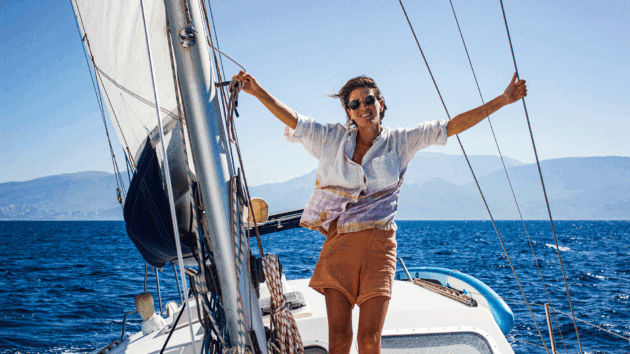
Photo: Richard Thomson
Into the sunset
As I said earlier, my perspective on keelboats is to reef when someone thinks about it, because the sea is a different animal. On a dinghy in enclosed waters there is much to be learned from a good soaking that can be translated to yachts.
But get it wrong, and you can dent confidence that takes years to rebuild. That Maxi is still around 10 years later, and agreed to go cruising on a yacht, is frankly a miracle. For what it’s worth, I don’t believe I have put any of the kids I’ve taught to sail through half what I put Maxi through on that slate- grey day in Scotland, and if so, certainly not without warning. Sometimes we take our partners for granted, I suppose.
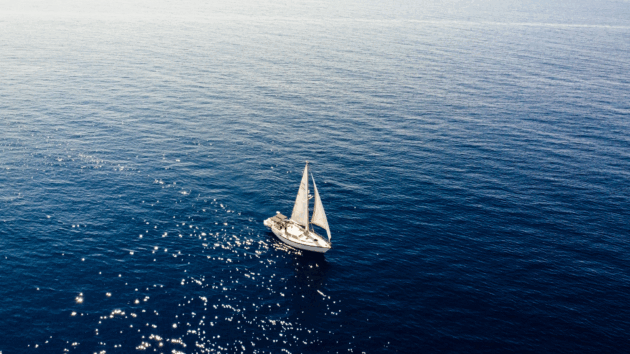
Namika’s crew have both come a long way. Photo: Richard Thomson
In any case, the moral of the story is clear: building confidence is a gradual process, and being clear about what you might encounter is important. You can do damage by trying to skip steps.
I’ve certainly got better at this, and we are doing our best to sail off into the sunset with dolphins at the bow and a mug or glass of something in hand.
Article continues below…

Land and Sea breeze basics: how to make the most of your coastal sailing
No matter where you are in the world, coastal sailing is all about knowing how to read your immediate surroundings…

Sailing with katabatic winds: what you need to know this season
There are several localised metereological phenomena sailors and watersports users should know all about. Two key phenomena are land and…
Lessons Learnt
Take it easy
Building confidence is a gradual process, and you can do damage by skipping steps. Best not rush it.
Spell it out
Addressing missteps helps keep you on the right path. I was able to acknowledge my error and always try to be clear in advance about what to expect. If being dunked in the deep end is unavoidable (or at least reasonably likely), be clear about this.
Discuss the unknowns
Discussing uncertainties is also hugely valuable. The goal is to work towards making decisions together. For the more experienced of two sailors, I would suggest talking over eventualities and uncertainties ahead of time, particularly on things like passages and anchorages. This will build trust rather than undermine any ‘authority’ or ‘experience’ you may have, or think you have. Sailing yachts involves a lot of uncertainty.
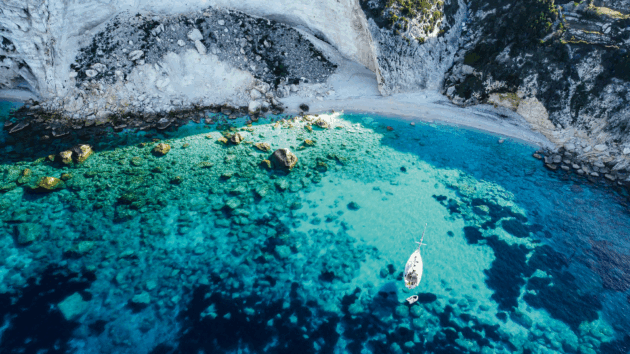
Photo: Richard Thomson
If any mishaps do arise, you have already discussed them, and have in some way shared responsibility (‘you didn’t tell me about X’ is a situation to be avoided). Either way, you should have an idea of what to do next.
Try, try, try again
Sailing also offers a lot of repetition if the goal is to improve. For almost every misstep, there will be plenty of opportunities to do better next time.
Look on the bright side
Remember, your partner chose to come to sea with you. Enjoy it.
Enjoyed reading this?
A subscription to Yachting Monthly magazine costs around 40% less than the cover price, so you can save money compared to buying single issues.
Print and digital editions are available through Magazines Direct – where you can also find the latest deals.
YM is packed with information to help you get the most from your time on the water.
-
-
- Take your seamanship to the next level with tips, advice and skills from our experts
- Impartial in-depth reviews of the latest yachts and equipment
- Cruising guides to help you reach those dream destinations
-
Follow us on Facebook, Twitter and Instagram.
Note: We may earn a commission when you buy through links on our site, at no extra cost to you. This doesn’t affect our editorial independence.