


The Kiel Canal is the busiest shipping canal in the world, but it’s an easy transit for yachts that leads to a cruising nirvana, says Detlef Jens
There are not many ways into the Baltic. A yacht travelling from the west has to either go north around the tip of Denmark (Skagen), or through the beautiful Limfjord (see p66) from Thyborøn on the West Coast past Ålborg to Hals on the Baltic side.
There is a lesser- known route that is rather scenic, but slow and inconvenient as it can only be used by motor boats or yachts that have lowered their masts. This route takes you up the Elbe river past Hamburg and, once through the locks at Geesthacht, via the idyllic Elbe-Lübeck canal to the beautiful,
Hanseatic town of Lübeck (where the mast could be raised again) and from there down the Trave river to the Baltic.
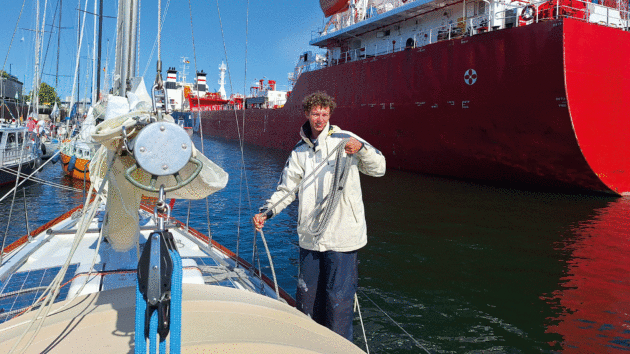
Detlef’s son Ole prepares the lines as they get ready to transit the canal once more. Photo: Detlef Jens
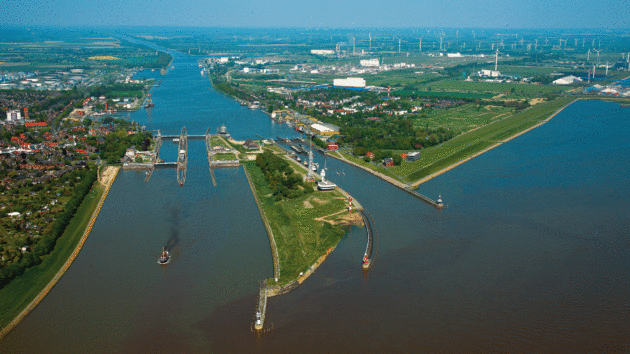
Then there is, of course, the ‘motorway’ to the Baltic, the Kiel Canal. First opened in 1895, it cuts across the north German county of Schleswig-Holstein from Brunsbüttel on the Elbe to Kiel on the Baltic over a length of 98 kilometres (53 nautical miles, or 61 land miles). There are only two locks, one set at each end. This is the world’s busiest artificial waterway, with around 30,000 ships passing through each year.
If leaving Brunsbüttel early and motoring along at five knots, it is possible to transit the canal in one long day, or in just under 11 hours. Yachts are only allowed to navigate the canal during daylight hours, however, and not in reduced visibility.
Refuelling is only possible in Rendsburg, two thirds through the canal if heading to Kiel, and in Kiel itself. This means that transiting the canal is something of an undertaking, so ensure your diesel tank is well filled, check the forecast, and opt to break the journey into two days if you want an easier passage.
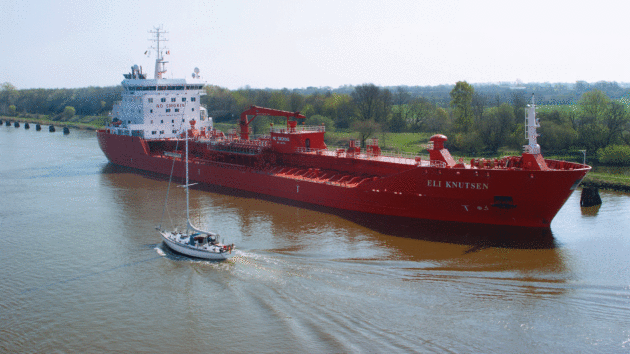
Known as the ‘motorway’ to the Baltic, the Kiel Canal accommodates both small leisure yachts and huge cargo ships. Photo: Mark Dunn / Alamy Stock Photo
From Kiel Week to Cowes Week
The ‘Kaiser Wilhelm Kanal’, as it was originally named, had been built for strategic reasons, to let the German Imperial Navy pass from Kiel and other Baltic ports to the North Sea quickly and without having to negotiate Danish waters – the idea for the canal was born during the Danish-Prussian war of 1864.
However, the new waterway soon also played a significant role for yachting, as it does to this day. Between 1900 and the outbreak of World War One in what was known as the ‘Golden Age of Yachting’, the huge racing cutters of industrialists and royalty now could compete both in Cowes and at Kiel Week, which had first been run in 1882.
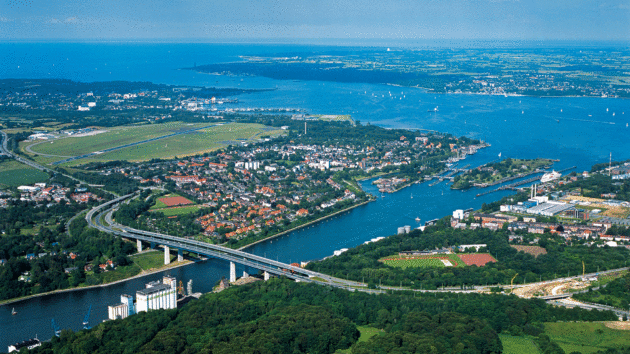
The Baltic lies waiting to be explored once you emerge from the lock gates into the Kiel Fjord. Photo: Agencja Fotograficzna Caro / Alamy Stock Photo
In particular, the sailing rivalry between the German Emperor Wilhelm II and his cousin, King George V, also became legendary, arguably spilling over into naval rivalry too. George took part in the grand opening of the new canal, which was filmed by the British film-pioneer Birt Acres.
The resulting film Opening of the Kiel Canal is one of the first ever documentaries. In the years up to 1914, the racing yachts taking part in both Kiel and Cowes Weeks could regularly be seen as they were towed through the canal.
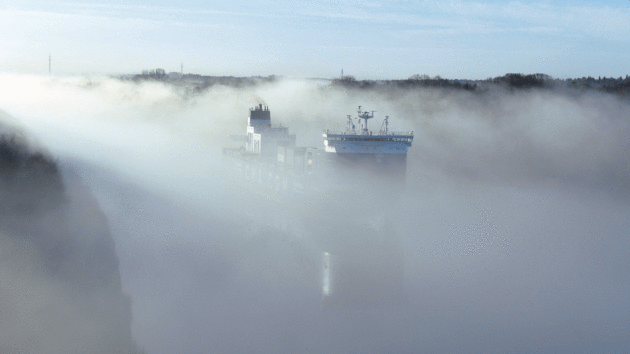
A vast container ship navigates down a misty Kiel Canal. Photo: imageBROKEaR.com / Alamy Stock Photo
Approaches to the Kiel Canal
Via the Netherlands
If sailing from the south-east of the UK, the obvious and easy route toward the Elbe estuary and Brunsbüttel is via the Netherlands. Either outside along the chain of Frisian islands or inshore through the standing mast route that can be entered in Vlissingen (Flushing), Amsterdam, Harlingen or Lauwersoog, and which takes you as far east as Delfzijl on the river Ems.
From there it is only a few hours to Borkum, the place to wait for tide and/or weather for the day’s hop from here into the Elbe. Depending on circumstances, you can sail as far as Cuxhaven or even straight to Brunsbüttel, should the tide then still run in your favour.
A possible stop-over along the way would be Norderney, which has a fairly large harbour and an approach through the Seegat from sea that is easier and safer than that of the other islands here, but which still needs to be navigated with care and on a rising tide.
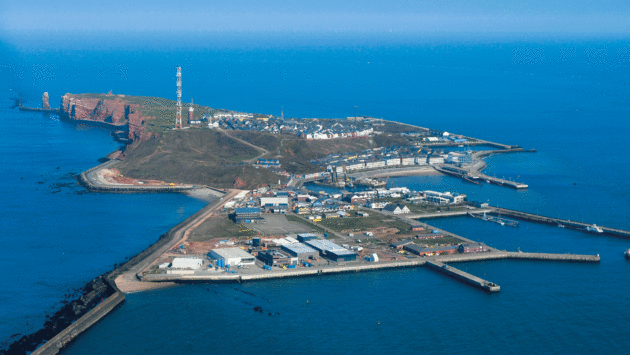
The island of Helgoland is Germany’s only non-coastal island. Photo: Alphapics / Alamy Stock Photo
Via Helgoland
The classic port of refuge in this part of the North Sea is Helgoland, safe to enter at any state of the tide and in virtually any conditions. Helgoland is a bit of a detour from the direct route along the string of Frisian islands but well worth the extra day or so.
It is ideally placed to again wait for the right tide into the Elbe and has some attractions, of which its tax-free status is not the least: tax-free fuel and booze is a very strong call of the Sirens indeed! From Helgoland, it is just over 30 miles to Cuxhaven and another 18 miles or so to Brunsbüttel. Leave Helgoland an hour or two before low water to catch the flood that will sweep you up the Elbe.
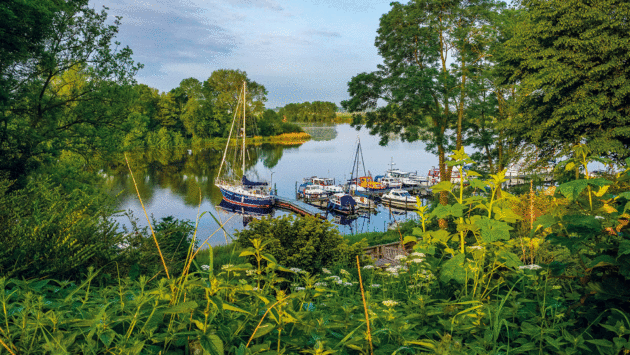
The Eider’s tranquil scenery. Photo: Image Professionals GmbH / Alamy Stock Photo
Alternative Route
from Helgoland
Instead of sailing for the Elbe from Helgoland, you could also head due east into the Eider river. This offers a very scenic and idyllic alternative route that joins the Kiel Canal about a third of the way from Brunsbüttel to Kiel.
It will add two days to your transit but if you are not in a hurry this tranquil and winding river is really attractive, with the added advantage that it has no commercial traffic whatsoever. It can be navigated by yachts with a draught of up to 2.5 metres and a mast height of 30 metres.
From Helgoland, it is around 20 miles to the approach buoy of the Eider. Follow the winding and well-marked channel through the sandbanks and remember that the buoys are frequently moved corresponding to the changing fairway, so even with the latest chart, always rely on visual pilotage here.
This will take you along 15 miles to the Eider lock and barrier, after which you are still on a tidal river. Just behind the lock, the drying harbour of historic Tönning is beautifully serene. After a second lock, you have reached non-tidal waters. This part of the river meanders its way to the Gieselau Canal and lock that eventually joins the Kiel Canal.
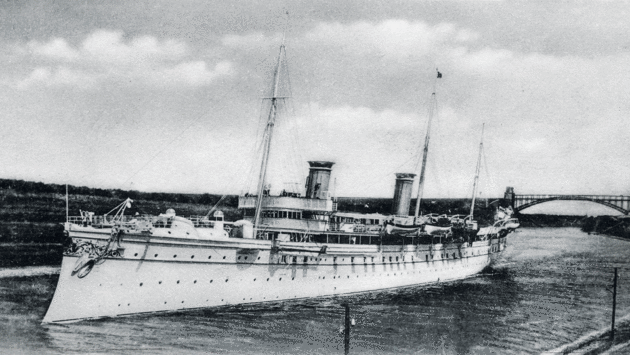
The German Imperial Yacht SMY Hohenzollern II, launched in 1892 in the Kaiser Wilhelm Kanal, as the Kiel Canal was then called. Photo: INTERFOTO / Alamy Stock Photo
Canal passage practicalities
The passage through the Kiel Canal is easy and straightforward but also well regulated, which makes sense with regards to the heavy traffic.
At first, it can be rather intimidating to share this narrow stretch of water with some of the biggest beasts of commercial shipping, but after a few hours you do get used to it.
Waiting area outside the locks in Brunsbüttel
On the Elbe, east of the locks and out of the main channel. Communicate with the lock-keepers on VHF 13 and 12, phone +49-4852 885 252 (Brunsbüttel locks) and +49 431 3603 152 (Kiel locks).
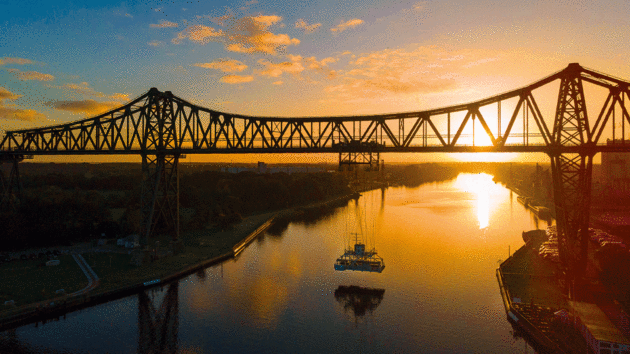
There is a swing ferry for foot passengers and up to four cars below Rendsburg railway bridge. Photo: BROKER.com / Alamy Stock Photo
Signals
One occulting white light is the signal allowing yachts to enter the lock. Once inside, smoking and naked flames are strictly forbidden.
Making fast inside the lock is alongside very low-floating pontoons – fenders should be hung at waterline level. The pontoons are slippery so crew must
take care when stepping off the boat.
It makes locking easy as you make fast to the floating pontoon without having to adjust lines as the water level rises or falls. Beware of propwash of commercial ships that sometimes share the small lock with yachts.
Article continues below…
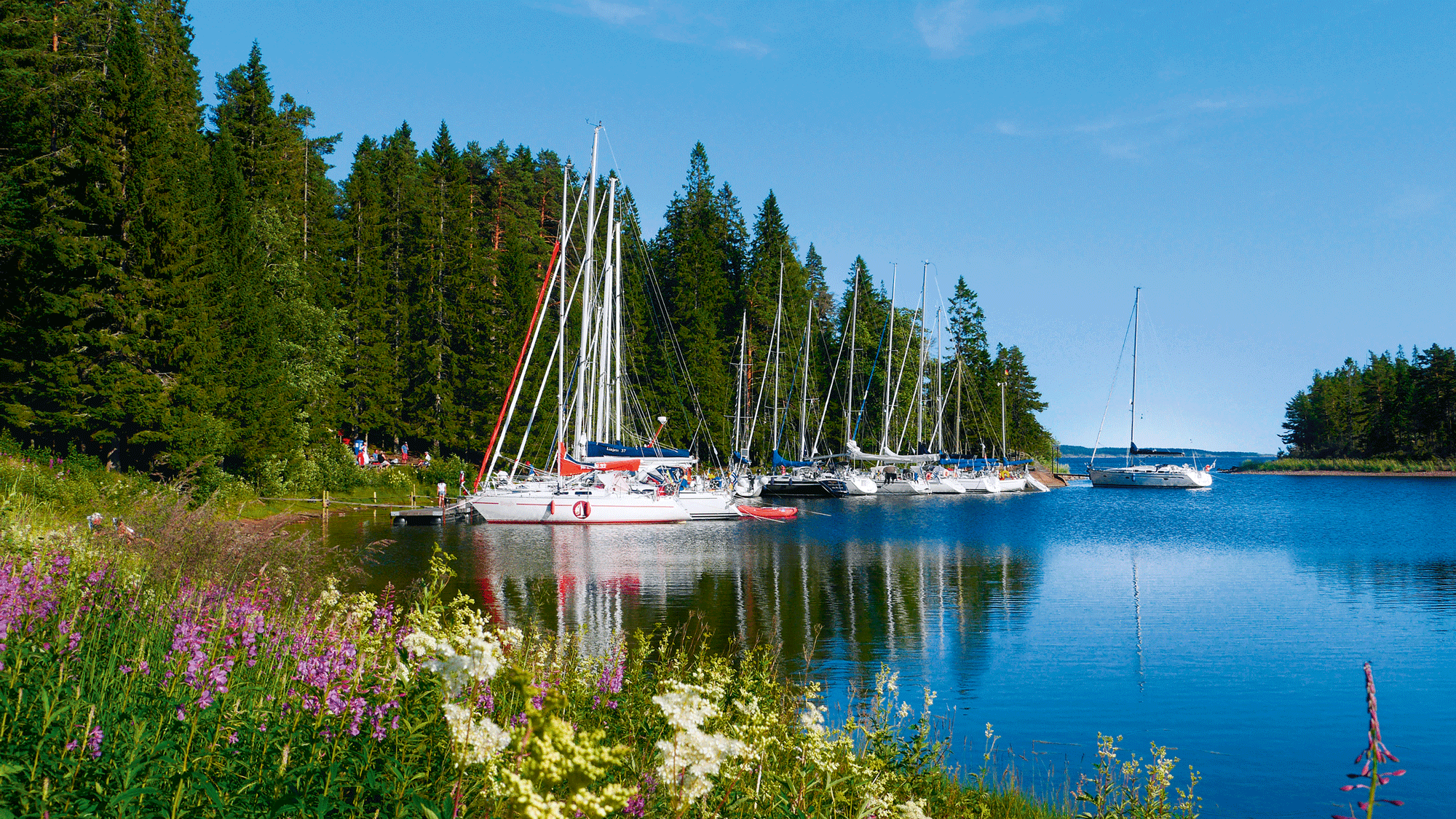
‘We spot a reindeer on the shore of an island close to an anchorage’: Sailing through the Baltic to Bothnia
The massive structure of Svartklubben lighthouse looms on the horizon. Standing on the small Swedish island of Singö, it guards…

Sailing Uma talk sailing to Svalbard in an electric-assisted yacht
Eight years ago, Dan and Kika sold everything they didn’t need and bought their first sailing boat, a 1972 Pearson…
The passage itself
Sailing in the canal is not allowed, although motor-sailing is, in which case you must display the black cone pointing downwards in your rigging.
Self-steering or autopilots are not allowed to be used during the canal passage.
AIS is mandatory for yachts of 20m and larger – keep it on if you have a transceiver.
Always keep as far right as possible.
In some sections of the river, the minimum distance to be kept from the bank is indicated by signs. When big ships pass by your boat they will suck water from beneath your keel so do not get too close to the canal bank, while still keeping well clear of the passing ship.
Signals at stopping bays are normally only for large commercial craft with the exception of these:
- One quick flashing red light – do not enter the stopping bay.
- Three vertical occulting red lights
– no exit from the stopping bay. - One green occulting light
– exit from stopping bay. - Two horizontal fixed lights – do not proceed into Brunsbüttel inland port area.
- Onwards from Kiel
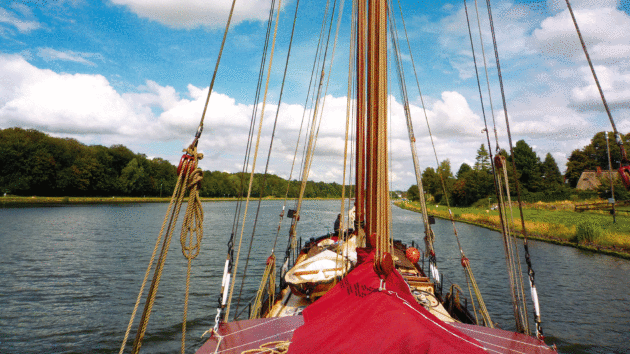
You’ll need enough fuel to motor the 53 miles through the canalas sailing isn’t allowed. Photo: Detlef Jens
It is always a pleasant sensation when, after 10 or 11 hours of motoring through murky brown waters, the Kiel lock gates finally open to let you out into the clean, sparkling Baltic.
Here, an entirely new, beautiful cruising area awaits. While you can easily spend many summers in this ‘Eastern Sea’ (Ost See), as it is called by locals, many of whom happily devote their entire sailing lives to this beautiful and varied area, let us take a look at some options from Kiel.
East
Sail east from Kiel towards the island of Fehmarn, which is only a day’s sail away. From here, keep heading east towards the beautiful island of Rügen,
or maybe stick to the Danish side, visiting Falster and Møn en route for Copenhagen. From Rügen, on the other hand, it is a nice passage to Bornholm from where one could head up the Swedish east coast, or, again, north towards Copenhagen.
North
Heading north from Kiel will take you to equally enticing destinations, with shorter sailing distances between them. Popular is the Schlei Fjord or, just a few miles further on, Flensborg Fjord. Both are scenic and sheltered.
Head further north into the Lillebælt, possibly sailing through the lively and beautiful university town of Sønderborg and, passing under the lifting bridge there, through Als Sound and into Als Fjord. This area is completely sheltered and offers many anchorages where one could spend many days.
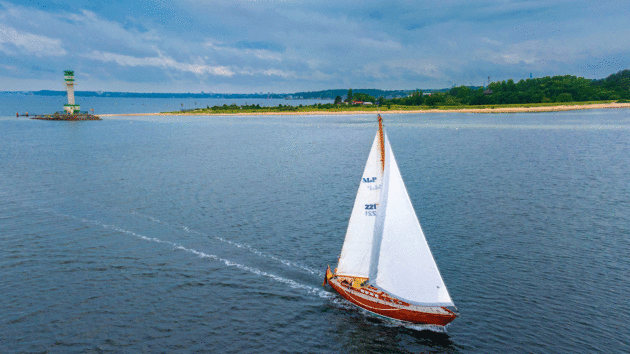
Sailing past the historic Friedrichsort lighthouse in the Kiel Fjord. Photo: makasana photo / Alamy Stock Photo
North east
Just N by E across from Kiel, the famed so-called ‘Danish South Seas’ beckon. This is an area of shallows and tiny islands just south of Fyn, between Ærø and Langeland. Again, here are many anchorages and small island harbours with some lively towns thrown in – the historic skipper’s town of Marstal, beautiful Svendborg with its resident harbour dolphin, or the easy-going Fåborg.
Heading home
Of course, you can continue north, passing either east or west of Fyn, maybe visiting lovely Samsø island on your way to Hals and the Limfjord, should you want to return to home waters that way. You can of course sail straight across the North Sea from Thyborøn, which will land you somewhere in Scotland, but that is a long passage.
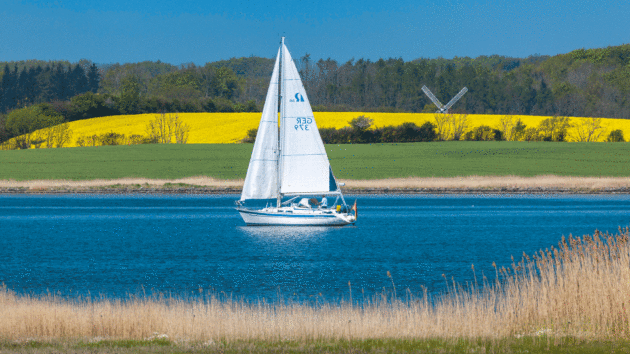
Heading north, one of the first stops could be the Schlei, a beautiful inlet well worth exploring. Photo: Image Professionals GmbH / Alamy Stock Photo
If bound for UK’s southern coast, it’s better to sail south along the Danish west coast possibly calling in at Hvide Sande, Fanø, or Sylt en route to Helgoland from where you can continue south-west, with the chance to visit those places that you missed on your outward-bound journey.
Canal Dues
Transit fees can be paid online at wsv.webshop.bund.de. If coming from the Eider river, these can also be paid at the Gieselau Canal lock keeper.
In Kiel, there are ticket machines outside the canal at the yacht berths west of Thiessen Kai or inside the canal and locks on a floating pontoon on the north side of the canal.
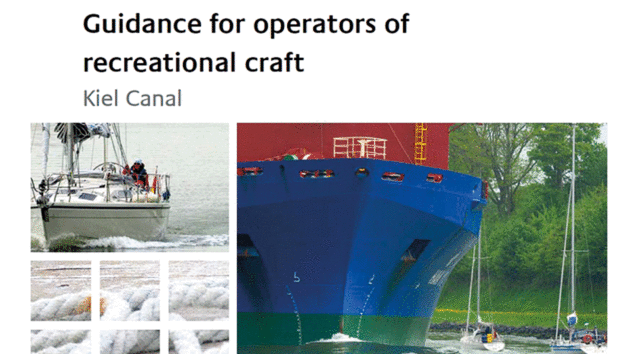
‘Guidance for operators of recreational craft’
A PDF titled ‘Guidance for operators of recreational craft’ can be downloaded in English from the website of the German Shipping Administration, WSV.de https://www.gdws.wsv.bund.de/SharedDocs/Downloads/DE/NOK_Befahrungsabgaben/Flyer/PDF_Merkbl_Spobo_eng.html
Enjoyed reading this?
A subscription to Yachting Monthly magazine costs around 40% less than the cover price, so you can save money compared to buying single issues.
Print and digital editions are available through Magazines Direct – where you can also find the latest deals.
YM is packed with information to help you get the most from your time on the water.
-
-
- Take your seamanship to the next level with tips, advice and skills from our experts
- Impartial in-depth reviews of the latest yachts and equipment
- Cruising guides to help you reach those dream destinations
-
Follow us on Facebook, Twitter and Instagram.
Note: We may earn a commission when you buy through links on our site, at no extra cost to you. This doesn’t affect our editorial independence.