



Regional initiatives in the UK to clean up and prevent owners from abandoning end-of-life boats simply show that the Government and the marine industry have their heads in the sand, says Barry Pickthall
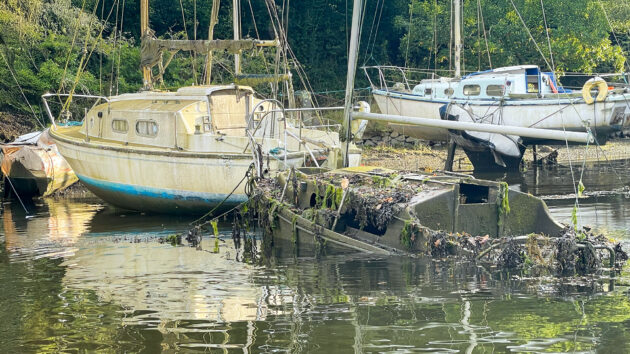
Recently in Yachting Monthly we set out the abandoned boat problem as councils, harbour and river authorities try to deal with the increasing number of end-of-life (EOL) boats being abandoned around Britain’s waterways and the pollution they are leaching into our estuaries and rivers.
This is particularly pressing with regard to the first generation of glassfibre vessels built from the mid-1960s. In this article, we look at what is – and is not – being done to solve the problems, and what steps other European countries are taking.
Here in the UK, neither the Government nor the marine industry have made much progress on the issues of sustainability and how to fund the clean-up. Without licensing, or even a statutory need for insurance, it is often impossible for authorities to track down owners of abandoned boats. This in turn means the size of the problem is unknown and it is virtually impossible to apportion the costs of scrapping the boats in order to solve the pollution problems they present.
Article continues below…
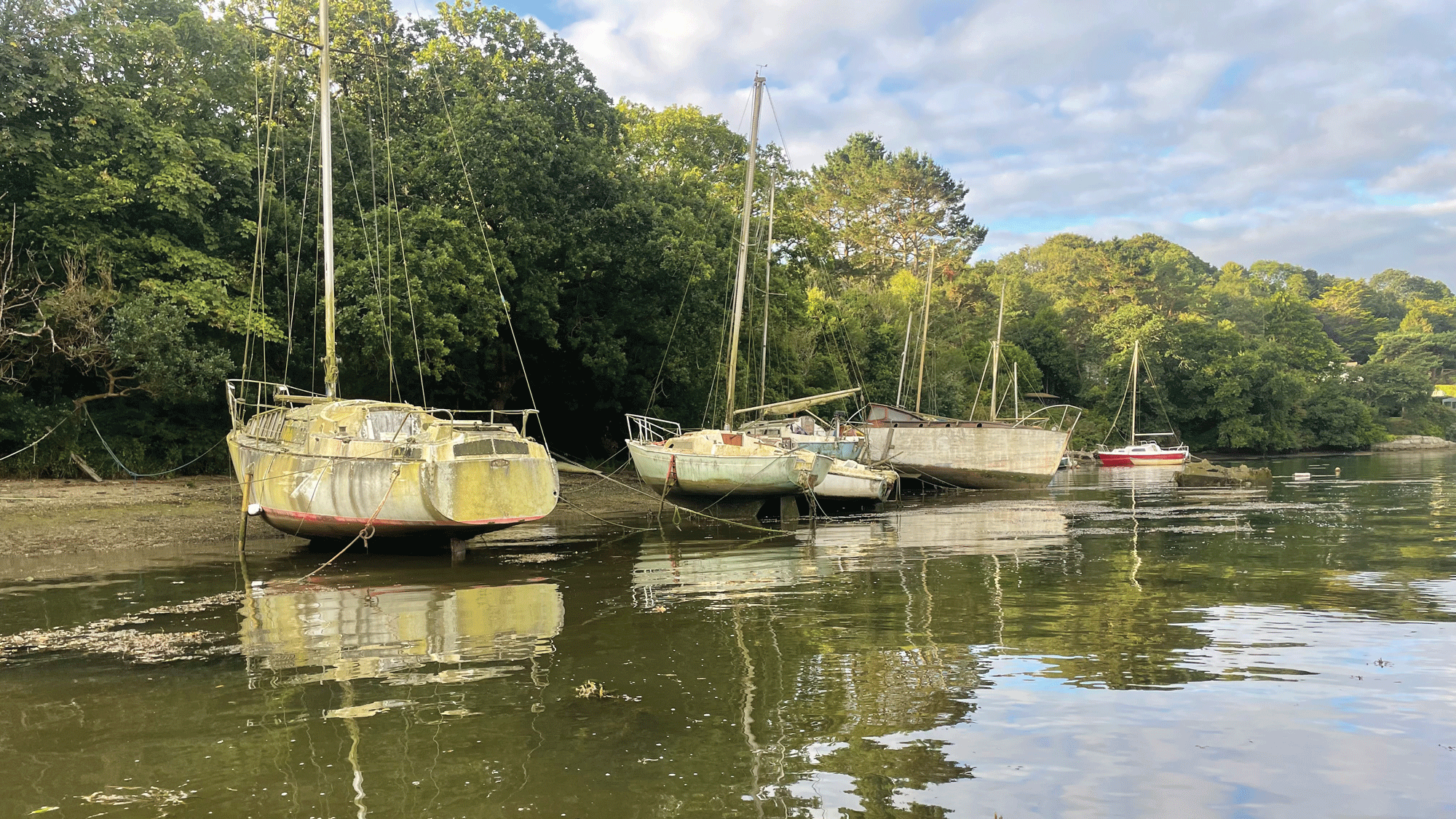
The abandoned boat problem: Investigating a nationwide issue
What to do with the many abandoned boats left to rot or disintegrate in creeks, rivers and estuaries up and…
Still stuck in the mud
In April, the Department for the Environment, Food and Rural Affairs (DEFRA) published its latest assessment of the health of our seas. It makes for alarming reading. Of the 15 criteria used to measure ocean health, only two meet the standard for good environmental status (GES) – the benchmark for healthy seas that the UK committed to six years ago. The other 13 are failing, uncertain or worse.
While climate change is blamed for failing to meet some targets, the report flags up pollutants, in particular high concentrations of lead, mercury, copper and zinc, together with continuing high levels of marine litter.
Worryingly, the paper does not cover contaminants in seafood like that highlighted in last month’s article where the oyster beds in Chichester Harbour have been closed following research carried out by Brighton University showing that the molluscs have ingested thousands of glass micro-particles. This is because the last government survey on shellfish was carried out in 2020, and there is still no data available for contaminants found within fish.
One region that is facing up to the EOL boats issue is the West Country, where the Cornwall Harbour Board has spent upwards of £460,000 clearing 75 abandoned craft from 12 harbours under its control since 2015. This year it has earmarked a further £150,000 to clear further wrecks over the next three years. For the moment these costs are borne by harbour users in the form of increased harbour dues and mooring fees.
This, however, is unlikely to resolve the problem long-term because no sooner has one wreck been cleared, another end-of-life boat is often abandoned in its place.
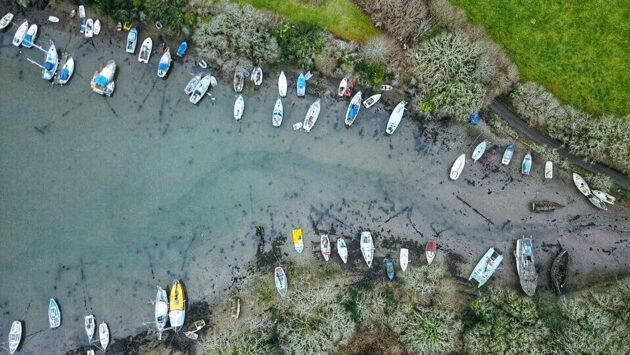
End-of-life boats are cluttering up our waterways. Photo: Clean Ocean Sailing
Jake Burnyeat, a founder of wreckfree.org, which tracks abandoned boats within the Fal estuary and Helford River, says: ‘Nothing will change until we have a national policy with the scrappage costs spread across the lifespan of the boats. At the moment, there is a complete policy vacuum. Jane Kirkham, our local MP, together with Lord Teverson, have each tabled parliamentary questions about the issue, and received dismissive responses, referring to a study commissioned years ago, which has never been acted on.’
He is pointing to a paper published three years ago by DEFRA which highlighted the lack of any reliable data on the number of recreational boats in use within UK waters, and those at the end of life. The report offered five options:
- Extended Producer Responsibility
- Mandatory Registration of Vessels
- Public Funding for End-of-Life Vessels
- Establishing National Guidance on Waste Management of End-of-Life Vessels
- Circular Design
The preferred options expressed in the report include mandatory registration of recreational vessels to help identify owners and deter abandonment, together with extended producer responsibilities (EPR) to help fund waste management of vessels and ensure producers are contributing to the cost.
And there lies the rub: UK boat manufacturers do not want to see any increase in retail costs (EPR), while the Royal Yachting Association has historically not supported compulsory boat registration.
We spoke to Kate Fortnam, the RYA’s sustainability manager, who explained that the issue is more complex and that the two approaches do not necessarily go hand in hand: ‘We do not believe that the introduction of a compulsory national boat register, in isolation, would resolve the growing issue of end-of-life recreational boats.
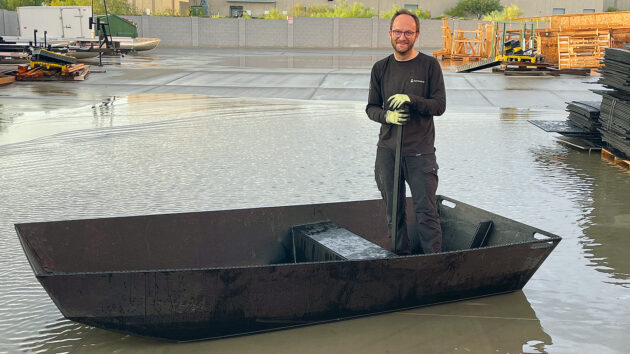
US company Supersede has made a flexibly plywoodtype material from recycled GRP. Photo: Supersede/PPL
‘While a number of projects across Europe and elsewhere have helped raise awareness of dismantling and recycling practices, far fewer have addressed the fundamental question of how disposal and recycling should be funded. Currently disposal costs fall solely on the final owner of a vessel, and these owners are often the least able to afford them.
‘The RYA’s position, aligned with that of the European Boating Association (EBA) is for Extended Producer Responsibility, where a levy on a new boat could contribute to funding disposal. The APER system in France has taken this approach and it’s part of the work within the European Commission. One major advantage of APER is that it doesn’t require a vessel registration scheme, as the levy is not tied to the vessel but provides an immediate source of funds for disposal of boats [the French are required to register their boats and pay annual boat tax – Ed].
‘Looking ahead, the RYA would also like to see the UK Government lead a coordinated approach involving stakeholders from across the marine industry […] No single organisation can solve this issue alone. Collectively, we need to:
- Build a clearer understanding of the scale of the problem through accurate data.
- Continue raising awareness among boat owners and encourage good maintenance practices that can extend vessel lifespans.
- Build upon the valuable work of previous recycling and disposal initiatives.
- Support the development of sustainable recycling infrastructure and circular economy solutions for the recreational marine sector.’
Fortnam points to one RYA initiative calling on members to report any boats they see by updating the abandoned boats map featured on the RYA website, adding: ‘While reports to the RYA have so far been relatively low, with around 250 vessels reported as being potentially abandoned, this reflects reliance on voluntary citizen science to help complement other similar initiatives and data gathered by harbour authorities.’

Recycled composite. Photo: Barry Pickthall/PPL
To give some scale to the problem, marine-industry research conducted in 2015 in the Netherlands estimated that approximately 2.5 per cent of Dutch recreational vessels would require dismantling between 2015 and 2020 (approximately 12,500 vessels) and this would increase to 7.5 per cent (approximately 35,000 vessels) between 2025 and 2030.
Cross-continental coordination
During our research, we spoke to a number of harbour authorities and found that all had a very good handle on the number of abandoned vessels within their waters – but not the funds to do much about them. To find a true end-of-life figure for the British Isles, a freedom of information request to each would provide a comprehensive figure.
Edward Tuite, the newly appointed technical director at British Marine (BM), which represents the UK boatbuilding industry, admits that if not addressed, the increasing problem of dealing with end-of-life boats will have an adverse effect on the British industry. Interestingly, he feels the solution lies with closer ties to the EU.
‘Part of the problem is that no one has any idea of the number of boats in circulation or approaching the end of their lives,’ he says. ‘We estimate that recreational craft in UK waters number anywhere between 500,000 and 1 million. Our best guestimate is that it is around the same as in France – some 850,000 boats. Europe is still our biggest trading partner so builders have to comply with EU regulations. The solution needs to be co-ordinated across the Continent, which means the EU should harmonise it all.’
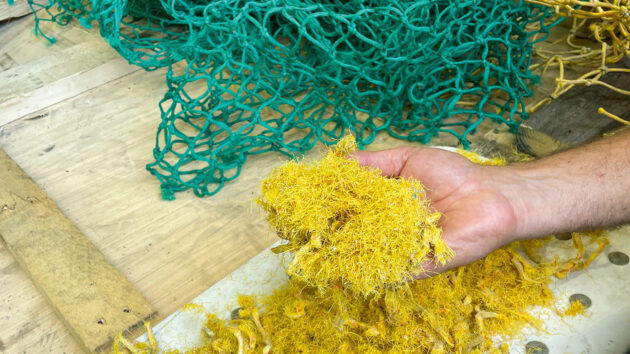
Recycled fishing nets can be turned into a wide range of products. Photo: Barry Pickthall/PPL
Where progress is being made
To date, France is the only country within Europe to have a nationwide scheme to recycle end-of-life boats which provides a model for other nations to follow. Created in 2009 by the French Nautical Industries Federation, the APER scheme has provided a free scrappage service since 2019 at 35 sites around the country and the French Caribbean islands.
In addition, several energy-autonomous mobile units were introduced in 2023 to pyrolyse the composite waste, separating and cleaning the glass fibres from the resin on an industrial scale for reuse in other applications such as a strengthening additive for concrete and injection moulding of other construction materials.
To pay for this recycling, France, which has now disposed of upwards of 7,000 end-of-life boats this way, has long had a licence programme for all vessels. This has been extended to introduce a product levy on new boats, together with an annual ‘TEAMUP’ levy for any vessel over 7m in length, calculated according to the age, size and power of each vessel.
This fund also covers a contribution to the French lifeboat service. Mandatory registration of all vessels, which would solve the problem of locating boat owners in Britain, also exists in Finland, Portugal and Spain, and for boats over 15m in Germany, Norway and Sweden. Denmark has the same for vessels displacing more than 20 tonnes.
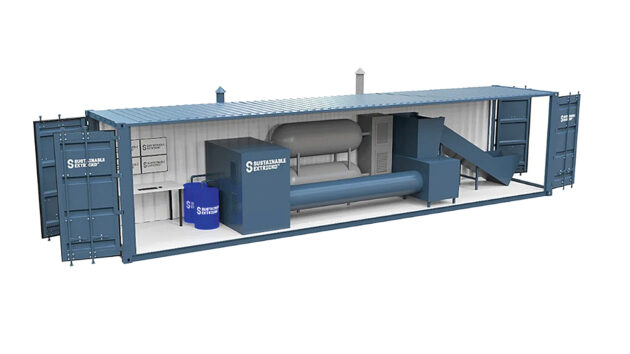
Recycling system in a container. Photo: Extricko
Edward Tuite agrees that landfill is not a good route to dispose of broken-up boats, which are invariably buried with toxic antifouling paint, oil and other contaminants, and nor does he see burning the wood and glassfibre for heat generation as a long-term solution. Instead, he points to two research programmes orientated towards recycling composite wind turbine blades using pyrolysis and pressolysis methods to produce reusable products.
The largest pyrolysis research project is called ‘REFRESH’ (REcycling of glass Fibre REinforced composite from wind power Sector through Holistic approach) and is an EU-funded programme to develop a circular system to recycle glassfibre-reinforced composites. This grinds the GRP into particles for use as raw material to create multifunctional panels for applications in the automotive, marine, and construction industries.
Pressolysis, by contrast, is a scientific breakthrough based on green chemistry and biotechnologies using superheated steam to process 99.9% of textiles and composites at a lower carbon footprint than pyrolysis or incineration.
It relies on super-critical steam and swings of compression and decompression to break down the surface area of the material to fracture the polymers in the form of yarn, resin or binder, which are then removed from the underlying components.
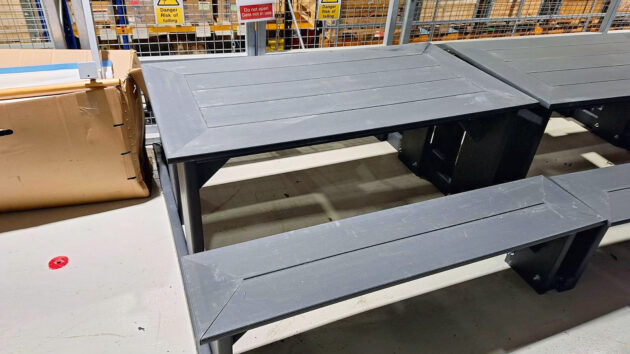
Marine and Boat Recycling’s facility outside Tavistock, Devon, uses a mobile biomass shredder to grind up composite plastic hulls and use the powdered residue to extrude rot-proof scaffold boards and shuttering for the construction industry. The boards are also used to construct anything from cycle sheds to garden bench seating. Photo: Marine & Boat Recycling/PPL
Even better, Extricko, one of the pioneering developers of this system, has packaged the entire recycling process into shipping containers, allowing it to be moved from one site to another with minimal transportation costs.
On the practical side, The UK Government has funded a pilot recycling scheme on the Dart, Salcombe-Kingsbridge and Yealm estuaries. Managed by South Hams District Council, the research programme has successfully demonstrated that piece-by-piece disassembly, recovery and recycling of end-of-life boats is both achievable and time-efficient. This included the recovery of almost 1,500kg of GRP composite using the pressolysis system developed by Deecom.
So the technology is here. What is required is the will, not just in the UK but across Europe to develop methods to fund a scrappage process spread over the life of the boats.
The French could well have the answer.
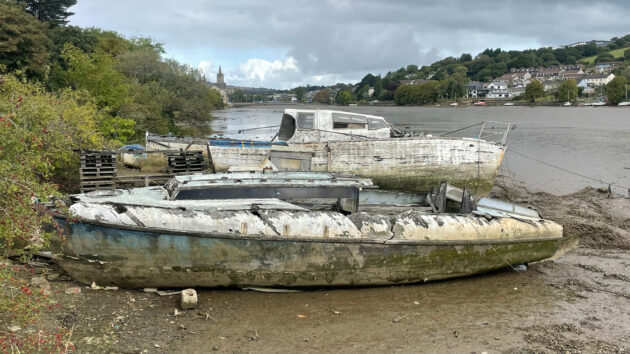
Unloved boats abandoned around Britain’s coastline
A 5-point plan
- Research: Formally and exhaustively find out what the scale of the problem is – how many boats are there? Do this quickly via harbour authorities around the UK.
- Register: All leisure boats required to register. Last registered owner is held accountable for their vessel, even if they bought it for £1. Unregistered boats can be removed, impounded for a year, and then scrapped if unclaimed.
- Scrappage fee: All new leisure boat purchases include a contribution to a scrappage scheme pot held by government. This may be unpopular with industry but should help unclog the market in the long term.
- Co-ordinate: Scrappage companies around the coast need to register and work as part of a network to get rid of old boats. They can only access money from the scrappage pot if they do so.
- Technology: Continued research and development in the tech needed to dispose of old boats in the least environmentally impactful way possible, with funding, possibly from the scrappage scheme to fund the development of facilities, or make new tech available to existing scrappage companies.
Enjoyed reading this?
A subscription to Yachting Monthly magazine costs around 40% less than the cover price, so you can save money compared to buying single issues.
Print and digital editions are available through Magazines Direct – where you can also find the latest deals.
YM is packed with information to help you get the most from your time on the water.
-
-
- Take your seamanship to the next level with tips, advice and skills from our experts
- Impartial in-depth reviews of the latest yachts and equipment
- Cruising guides to help you reach those dream destinations
-
Follow us on Facebook, Twitter and Instagram.
Note: We may earn a commission when you buy through links on our site, at no extra cost to you. This doesn’t affect our editorial independence.