




The UK government is advising yachtsmen, ship owners, ports and all those involved in the maritime sector to plan for operations without GPS, as spoofing, jamming, signal loss and interference in Global Navigation Satellite Systems (GNSS) increase worldwide.

In a significant move, the Maritime and Coastguard Agency (MCA) published a guidance note highlighting the increasing risk of GNSS interference and encouraging maritime stakeholders to review their operations and ensure they are not entirely reliant on GPS for safe navigation.
‘Recent years have seen a marked increase in reports of GNSS interference worldwide, particularly in the Black Sea, Baltic Sea, Gulf region and parts of East Asia,’ the MCA wrote in Guidance Note 719, issued on 1 October.
SPOOFING AND JAMMING
‘Such interference may take the form of jamming (where signals are blocked or degraded), or spoofing, (where false position information is presented to users).
‘This interference degrades or denies satellite derived PNT (Positioning, Navigation and Timing), meaning that GNSS is no longer universally available at certain locations.’
The MCA ‘encourages stakeholders to understand these risks, review contingency arrangements and maintain resilient navigation practices to support safe and continuous operations during periods of GNSS based PNT disruption’.
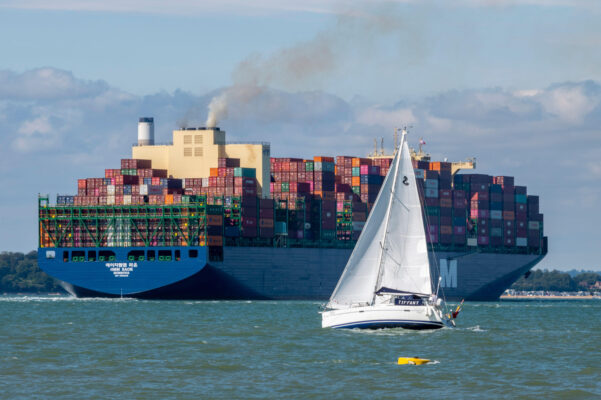
A yacht sails by a large container ship in the Solent
A Royal Institute of Navigation survey in 2025 exposed the vulnerability of critically important systems such as Global Maritime Distress and Safety Systems (GMDSS) and other SOLAS-mandated equipment that rely on satellite positioning and timing.
In 2025, at least two collisions and groundings were linked to GNSS interference in regions such as the Baltics, Straits of Hormuz and the Red Sea with hundreds of vessels affected daily, the RIN said earlier this year.
GNSS – GPS (US), Galileo (EU), GLONASS (Russia) and BeiDou (China) – have become key to modern maritime operations, providing PNT information to a wide range of onboard and shore-based systems, such as AIS, traffic management, port operations and other critical infrastructure.
EUROPE’S LARGEST MARITIME ECONOMY
The UK is Europe’s largest maritime economy with 95% of all UK import and export arriving by sea. Government research in 2023 showed that a seven-day GNSS outage would cost the maritime industry £1.5 billion; shipping £183 million, port operations £1.31 billion, fishing £8 million.
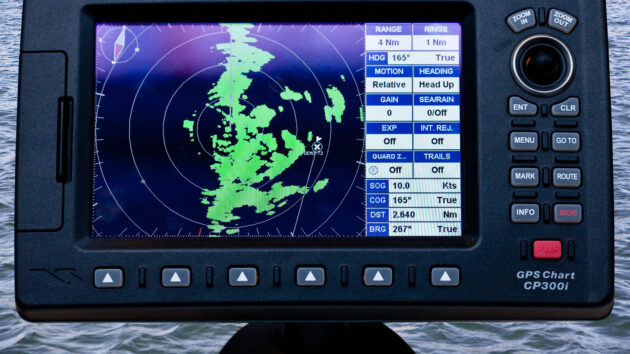
GPS Chart Plotter
Technologies offering an alternative to GNSS are under development, but many are unlikely to be available at scale in the near term, ‘consequently the maintenance of resilient navigation practices remains essential,’ the MCA said.
ALTERNATIVE TECHNOLOGIES
The government is developing a sovereign Enhanced Long-Range Navigation (eLoran) terrestrial-based programme, which will improve the resilience of the UK critical national infrastructure and reduce vulnerability to GNSS disruption.
An initial capability is planned for 2028 (Timing) and full operational capability by 2030 (Position and Navigation).
Image of digital icons and data processing over world map and satellite
The MCA is also working with International Maritime Organisation member states to establish alternative sources of PNT internationally.
Alternatives to satellite-based PNT under development include; VDES R mode, use of 5G (mobile) networks, automatic visual fixing, automatic celestial fixing and inertial navigation systems.
MARINERS NOT TO RELY ON SATELLITES
The MCA recommends that mariners practice navigation using alternatives to GPS.
‘The guidance reiterates the importance of being able to navigate without relying on satellite positioning, and looks at radar fixing, visual bearings, celestial navigation and even good old-fashioned dead reckoning as valid methods to consider,’ said Lee Gallacher, who manages event support at YB Tracking using global satellite systems.
‘They’re not skills we should be looking to consign to the history books, they’re skills that could potentially save your life if the electronics were to give up at a crucial moment.
‘You can have all the technology in the world, but if you don’t understand the limitations of it, or what to do when it fails, then you run the risk of putting yourself and others in danger.’