


John and Anne Marley set sail from Australia to bring medical and school supplies to Papua New Guinea. On leaving Sudest Island, their boat became stuck on the coral only to be saved by the islanders
The school flagpole at Dumaga Bay on Sudest Island was the mast of a wrecked yacht. This should have been a warning to us on our fourth sailing aid project to the Louisiades islands of Papua New Guinea. We knew that this would be our last time and, in a way that we didn’t anticipate, it very nearly was the end of our sailing days as well.
The Louisiades islands are a stunningly beautiful string of more than 90 islands stretching over 80 nautical miles, starting 100 nautical miles from mainland Papua New Guinea and a seven-day passage from Australia. There are no flights or ferries and transport there is mostly by sailing or paddling a canoe. There are a few open dinghies with an outboard though the islanders often don’t have fuel.
Island life
There is one unreliable phone tower which reaches only a few of the islands so effectively there’s no communication or internet and no postal service. Islanders are self-sufficient and have gardens in which they grow mostly root crops, a few greens, some citrus and plentiful papaya, bananas and coconuts. They have fish in the sea and chickens. While visiting the islands we trade for food using clothing, fishing gear, pencils, soap…
Our crew this time were two midwives Tash and Annie, a nurse Georgia, an occupational therapist Sharon, my wife Anne, a dietitian, and my medical self. There is one clinic on Nimoa island for the whole island chain. It is staffed by nurses and health workers.
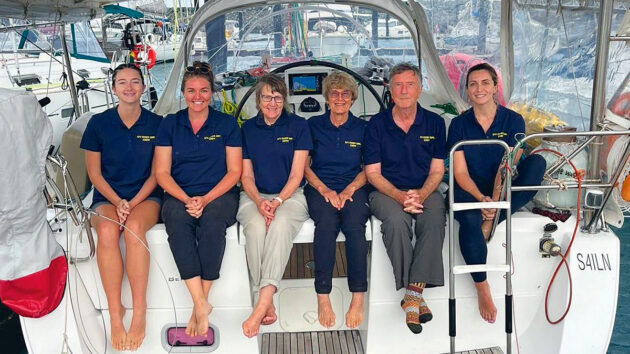
The crew aboard Essex Girl prior to departure. From left: Annie, Tash, Sharon, Anne, John and Georgia. Photo: John Marley
The nearest hospital is several days’ canoe journey away on mainland Papua New Guinea. Every island has a school for the first three years, after which children go to a larger island with a primary school for another three to five years of schooling. Children boarding have to take and cook their own food. Schools have few books and little writing equipment.
Each time we’ve set out from Australia with our Beneteau Oceanis 37, Essex Girl, loaded with medical equipment, medicines and school supplies. Soccer, netball, volleyball and other sports are enthusiastically played, so we also take donated uniforms, balls and pumps. The crew do contraceptive implants in conjunction with ‘Spacim Pikinini’, a programme partly funded by Rotary Australia Worldwide Community Service. We administer whatever medical help we can give from our back deck or in village huts.
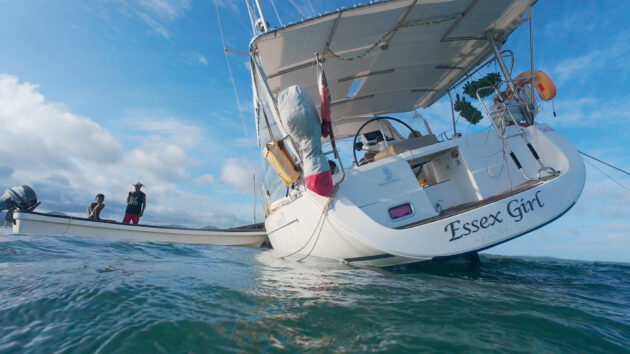
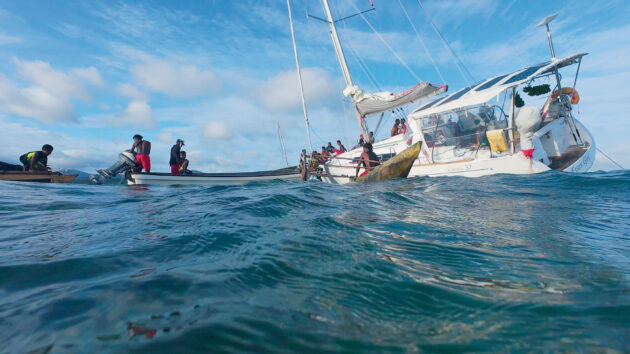
Stuck firmly on the reef on a falling tide. Photo: John Marley
Tearful farewell
After four weeks in the islands, we were setting out back to Australia from Dumaga Bay. Departing was very emotional and as we upped anchor, the crew and islanders who had come to see us off were all in tears. This was our seventh time into this anchorage, and we had thought that the chart there, unlike many places, was actually reasonably accurate.
The entrance to the bay was two miles away and as we approached it, in deep water on the chart, there was the unmistakable bang of keel hitting coral. We were motor sailing downwind with the main up, fortunately with two reefs still in from a recent blow, but getting meaningful reverse was just not happening and we washed a little further into the coral.
At this point Anne said, ‘Judging by the nearest tidal information, (which was about 80 miles away), it’s just after high water.’ We were broadside onto the wind and waves. Georgia hopped into the water with our action camera to search for a way out of the reef.
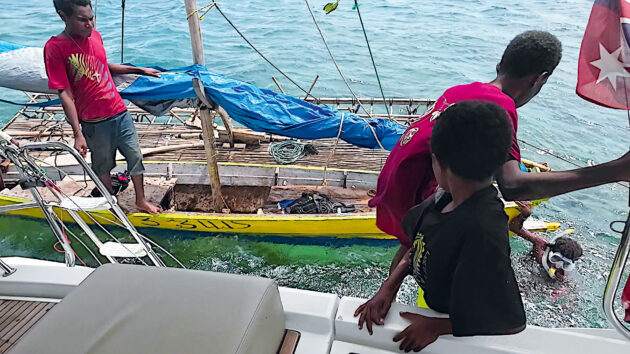
Islanders check underwater. Photo: John Marley
We rapidly and unsuccessfully tried all the strategies we had to get the boat into the tantalisingly close deepwater, including crew over the side on the end of the boom. Unfortunately, all of the crew are slim! We had deflated and stowed our dinghy for the return passage and given away the last of our outboard fuel. It was just after 0900.
We could see sailing canoes setting out from the anchorage and hoped we could attract their attention, not thinking that a flare could have been handy for this. In fact, they had seen our track and knew that we would hit the reef but had no way to let us know, and we were soon surrounded by sailing and paddling canoes. The islanders took charge and clearly knew what they were doing. White people are called ‘Dim Dims’, an appropriate name in the circumstances.
Article continues below…
A cold shower and shredded £50s: The reality of Mediterranean yacht ownership
I wonder what proportion of Yachting Monthly readers are boat-owners? And what proportion are dreamers? And how many of the…
‘Our dinghy outboard was being smashed to pieces by the swell’
Our dinghy is the equivalent of everyone’s car at home; it’s how we get from our boat at anchor, to…
Crowbars and coral
One canoe was dispatched to get crowbars to clear a passage to deep water. With the tide fast falling, the islanders laid ropes out from bow and stern to lumps of coral and we attached a rope to the spinnaker halyard and took that out to the side so we could use the winch to keep the side off the coral as the boat heeled over. Keel on coral is one thing, but the side of the boat on coral would have been fatal.
Our bow anchor was taken out into deeper water. Anne was alarmed by being told that the rudder was loose, but actually it was good news as the islanders meant that it was clear of rock and coral. We gradually tightened our lines and at low tide we were at a steep angle, but the side never hit coral. The islanders said that the evening tide would be a higher one and they were sure that we would float off, meanwhile unreassuringly telling us stories of previous wrecks.
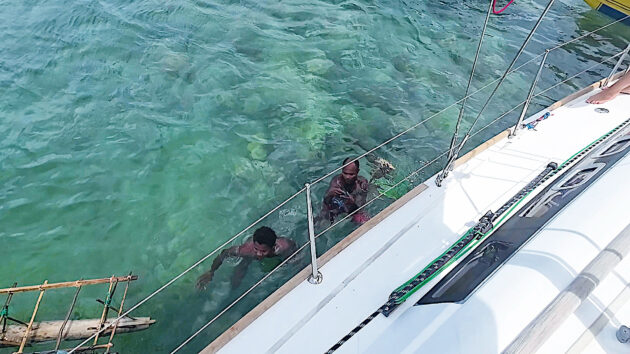
Local divers inspect the keel. Photo: John Marley
In the water were fit young men diving with crowbars and levering rocks and coral out of the way. In spite of the water being 28°C, they all became very chilled, and we had to find warm clothing for them.
We were trying to keep the boat as light as possible but islanders, especially teenage boys, swarmed all over it, investigating everything as Dim Dim boats are rarely seen. It was a long wait, and they found all our Yachting Monthly magazines. The technical text was beyond their reading ability, but they were agog at the photos of yachts, especially their interiors.
We had emptied the port aft water tank but were reluctant to empty the 200-litre bow tank as we aimed to keep the boat bow down and keep the rudder up. Freshwater is scarce on the islands which are in the middle of a severe drought, and it was distressing seeing all this precious water going to waste.
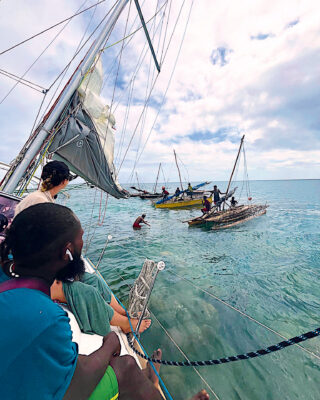
Lines to starboard holding the port side off the reef. Photo: John Marley
Waist deep!
It was dark and around 2000, with only a couple of hours of tide left to rise, when we started to lift. The channel cut for our keel to deep water was narrow and it was disconcerting to see people standing waist deep in water either side of us.
When we started pulling on the anchor and going ahead with the engine the young men would dive again and again to remove yet another obstacle in the way. When they were diving there were shouts of, ‘Boys in the water,’ and ‘Neutral.’ Shouting neutral was popular so there were loud choruses even though we suspect the children didn’t know what it meant.
When we eventually bumped our way into deep water, there was huge cheering. Throughout this whole experience we could not fault the local people. They are wonderful, kind and incredibly cheerful, clever people who kept us reassured and entertained all day as they saved our boat.
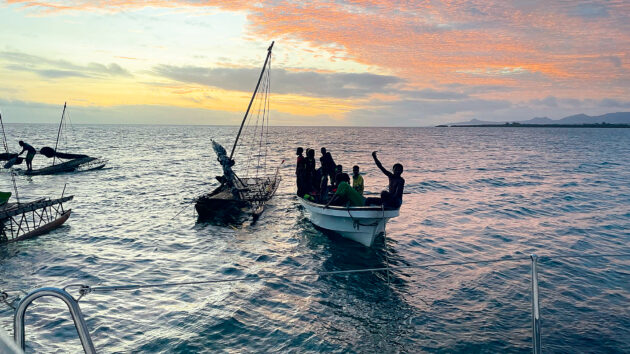
Night falling, hoping to float on the rising tide. Photo: John Marley
The island divers said that there were only chips off the keel and rudder and nothing serious and we could see that there was no water in the bilges. Just as well because there would have been no possibility of any repair being carried out.
Having reassured ourselves that the boat was not unsafe, she had to be sailed back to Australia in whatever shape she was in. When we set out again the next morning, not wanting a repeat performance, the islanders insisted on driving our boat through the reef! With a huge grin, one of our islander friends took the helm.
For the first time in our sailing career, we seriously faced losing our precious and loved boat that has carried us some 30,000 miles in the last 10 years. And it would have been entirely our fault. The Louisiades are so remote that there would have been no hope of salvage, but a small consolation would have been that every tiny part of the boat would have found a use in the Islands.
Lessons learned
Complacency is dangerous – We were complacent because we had been into the bay a number of times before without incident.
Don’t trust the chart – We knew in other Louisiades locations that the charts weren’t right, why did we assume this one was?
Use satellite photos – We had satellite photos which we used in other places but inexplicably weren’t using them here.
Don’t be distracted – We were distracted by islanders and all of us being very distressed at leaving.
Keep a good lookout – We committed the cardinal crime of not posting crew with polarised sunglasses to spot reef.
Trust the locals – The islanders knew what they were doing and while keeping a careful eye on them, the best thing to do was let them get on with saving our boat.
Enjoyed reading this?
A subscription to Yachting Monthly magazine costs around 40% less than the cover price, so you can save money compared to buying single issues.
Print and digital editions are available through Magazines Direct – where you can also find the latest deals.
YM is packed with information to help you get the most from your time on the water.
-
-
- Take your seamanship to the next level with tips, advice and skills from our experts
- Impartial in-depth reviews of the latest yachts and equipment
- Cruising guides to help you reach those dream destinations
-
Follow us on Facebook, Twitter and Instagram.
Note: We may earn a commission when you buy through links on our site, at no extra cost to you. This doesn’t affect our editorial independence.