



Every month Yahchitng Monthly's resident expert answers a reader's question. This month, Mike and Linda ask if it's wise to cross a shipping lane without AIS
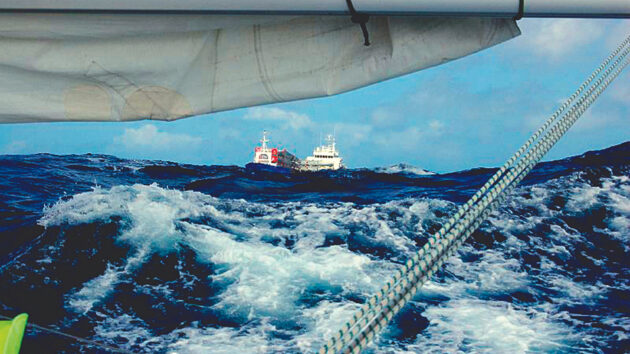
Mike and Linda are crossing the Channel from Poole to St Peter Port via the Alderney Race in their Bavaria 38, Isabel J. However, the AIS, which they usually rely upon, has stopped working. They’re over halfway across and have negotiated the SW-bound stream of traffic without incident, however they can now see an intimidating line of ships on the starboard side.
The wind is E F5, they’ve rigged a preventer, poled out the genoa and are making 6 knots. Mike wants to heave to and wait for a better gap in the traffic. Linda thinks they should stand on since they’re under sail and well clear of the TSS.
They can contact the ships by VHF to ask them to give way if need be.
Who’s right?
Should you cross this line of shipping?
Although the COLREGs don’t recognise AIS as a collision avoidance tool, most of us are becoming quite reliant on it for this purpose, significantly reducing the stress of shipping encounters. However, its convenience comes at a price: traditional collision avoidance skills become rusty or, for those who’ve learnt to sail in the digital era, may never fully develop.
The basic principles of collision avoidance aren’t complicated, though – a risk of collision is determined by a steady bearing and reducing range. There’s no reason why Mike and Linda can’t assess this without AIS and make a safe and efficient passage.
They have three options in this scenario: hold off, stand on, or navigate through a suitable gap.
Whilst holding off to wait for a gap in the traffic is a legitimate solution in some cases, it can be inefficient. They need more information before they decide to take this course of action, not least because their poled out genoa will require management.
Article continues below…
Linda’s right that Isabel-J is the stand on vessel in this scenario. Some skippers would maintain course and speed, letting the ships do the manoeuvring.
However, this approach is stressful – sailing boats don’t have 360° manoeuvrability, especially downwind, and if the other vessel fails to give way, Mike and Linda will be forced to take action at the last minute.
Negotiating collision avoidance over the VHF is considered ‘fraught with danger’ by the MCA due to the risk of miscommunication and isn’t recognised in the COLREGs, so in my opinion this isn’t a reliable strategy. In my view, the best approach is to maintain their current sail plan as far as possible, while proactively managing their course and speed to avoid a risk of collision developing in the first place.
It’s much easier to alter course by 10° early on than to make a 90° turn at the last minute. To do this, though, they need to understand what’s happening up ahead by monitoring the relative bearings of the vessels by eye and hand bearing compass.
Observing a ship against a part of the boat like a stanchion can give a good indication of whether a risk of collision is developing, but it’s more difficult in a following sea. In complex scenarios with multiple vessels, it’s important to take hand-bearing compass readings or sight them across a binnacle compass as soon as they appear and record the bearings.
It can take a while for a change of bearing to register, and the readings are rarely precise, so plenty of time is needed to identify a trend.
If they find a vessel of concern, they need to decide whether to pass ahead or astern of it, and consider what impact that has on the other vessels. If they choose to pass ahead, to maximise clearance they should increase the boat speed and cut the ship’s track at 90°.
This might mean gybing the genoa off the pole and coming onto a beam reach. Alternatively, they can slow down and open up the angle to pass behind the ship. In this case, bearing away deep downwind would help to take off speed. If all else fails, rounding up, stalling or heaving to is still an option.
When the AIS is working again, Mike and Linda can take bearings whilst the other monitors AIS. With practice, they’ll develop a feel for crossing shipping lanes by eye and compass – it can be surprisingly accurate.
Enjoyed reading this?
A subscription to Yachting Monthly magazine costs around 40% less than the cover price, so you can save money compared to buying single issues.
Print and digital editions are available through Magazines Direct – where you can also find the latest deals.
YM is packed with information to help you get the most from your time on the water.
-
-
- Take your seamanship to the next level with tips, advice and skills from our experts
- Impartial in-depth reviews of the latest yachts and equipment
- Cruising guides to help you reach those dream destinations
-
Follow us on Facebook, Twitter and Instagram.
Note: We may earn a commission when you buy through links on our site, at no extra cost to you. This doesn’t affect our editorial independence.