


What are the pros and cons of a double headsail rig? And what are the options to possibly convert from the usual sloop to a double headsail configuration?
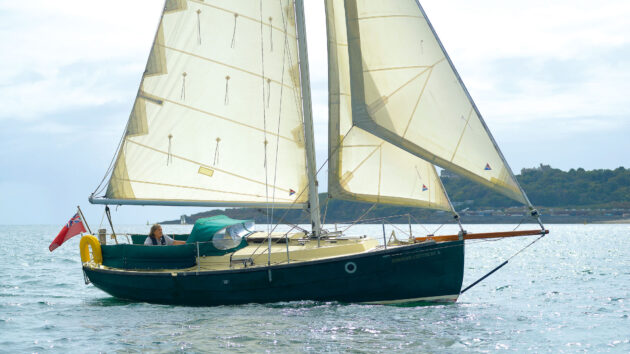
The vast majority of production sailing boats these days are rigged as sloops and fitted with a genoa on a furling system. Many older boats, from before the advent of the fractional rig and the International Measurement System (IMS), hark back to the early times of the IOR rule, with huge overlapping genoas.
Endless expanses of sailcloth, laborious to haul in every tack, to the extent that the ‘coffee grinder’ was invented for larger yachts to power the winches. A piece of fitness equipment on deck where two bodybuilders could strengthen their arm muscles while driving the genoa winches.
On every tack, with a sheet under intense pressure – which felt as if it were two km long – the sail needed to be hauled in as quickly as possible.
Then came the fractional rig, sporting a powerful main and a modest headsail. Highly effective, but equally not without its handling challenges, especially as the mast often needed running backstays to support the forestay and needed to be tended on every tack and gybe – at least aboard racing yachts.
In cruising, a rather different rig had naturally evolved. The early, true cutters had long bowsprits setting a jib on the end, with a staysail set on the forestay from the stem.
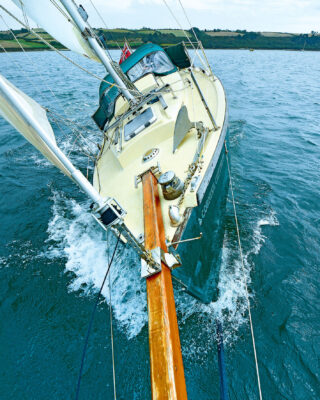
Bowsprits like this went out of fashion for years, but fixed sprits are now firm favourites again. Photo: Nic Compton
This divided the sail area into two smaller, more easily handled sails (important in the days before powerful winches and furlers), while also moving the sail area further forward to keep the sail plan balanced and prevent excessive weather helm, especially on gaff-rigged boats with long booms.
As aluminium masts grew taller and the Bermudan rig took over, bow sprits fell out of fashion, and while larger sails could be handled more easily, the additional sail area, combined with the ability to reduce sail area incrementally meant that cutter rigs remained popular, developing into the double headsail rig.
A modern interpretation of the cutter rig sees the jib or genoa set from the forestay, with an inner stay set part way aft on the foredeck from which a smaller working staysail can be set. More recently still, this morphed into the Solent, or Slutter (sloop-cutter), rig, with a large genoa set on the bow and a smaller working jib set almost immediately behind it.
Increasingly, even conventional sloops are having bowsprits built in again, this time to accommodate large furling Code Zero sails, designed for offwind work, but capable of sailing up to a close reach in light airs.
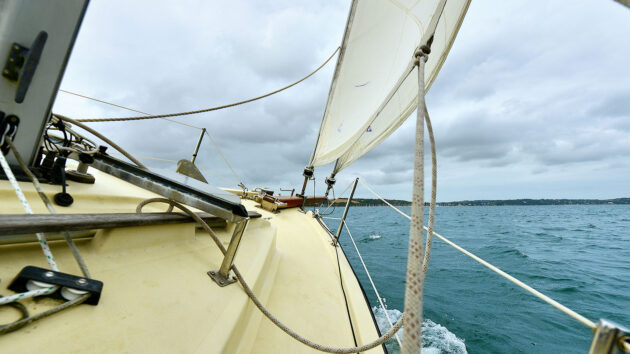
Two smaller headsails are easily handled, offering lots of options and help accelerate air over the back of the main. Photo: Nic Compton
This keeps boats sailing when their otherwise small jib ceases to offer enough area off the wind, or as the wind drops. Whatever the exact configuration, it is clear that having a one-size headsail has limitations, and that for boats old and new, a second headsail is still very much on the menu.
Let us take a closer look at these modern double-headsail rigs which are becoming more and more popular with cruising folk.
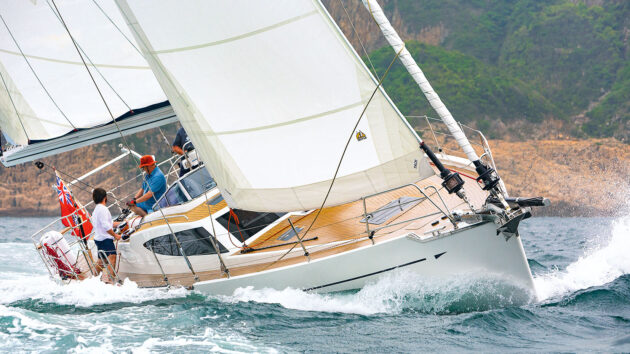
A working jib, often self- tacking, is ideal for inshore work with lots of tacking, and for stronger winds. Photo: David Harding
The basic idea
The ‘standard’ rig on most production boats, the sloop with the headsail on a furling gear, is fine for relaxed inshore or coastal cruising. When the wind picks up, these headsails can be reefed by being partially furled, meaning that there will usually be no need for anyone to go to the foredeck to change the headsail.
This is acceptable for a short sail or for reaching the next available harbour. On longer passages, however, this is not ideal. The shape and profile of a partially furled genoa leaves much to be desired. At worst, this will be baggy and significantly reduce drive while simply increasing heel. It will also harm the long-term shape-holding of the sail and shorten its lifespan.
This is where the cutter rig and its variations comes into play. A cutter rig is popular, mainly among ocean-going blue water cruising folk, where reliability and ease of handling is the preference over performance, as it divides the headsail area into two more manageable sails, making handling easier.
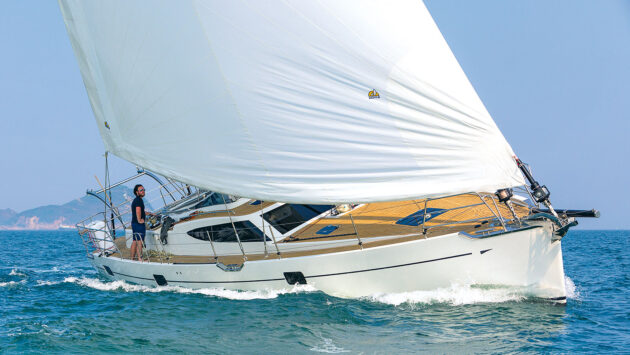
A large genoa provides power off the wind and in lighter breezes. Photo: David Harding
The staysail increases the upwind performance in normal conditions and the boat handling in stronger winds. Instead of having to change a large headsail in a rising wind at sea, the outer, larger headsail (Genoa or Yankee) can be furled away completely (or dropped to the deck if it is set on hanks) and the boat be sailed on under main and staysail only.
The staysail sets far better than a partially reefed Genoa and helps to optimise the sail-plan, moving the centre of effort towards the centre of the boat as the wind increases, resulting in a more balanced sail-plan. Because the genoa is now completely furled in strong winds, it prolongs the lifespan of this sail.
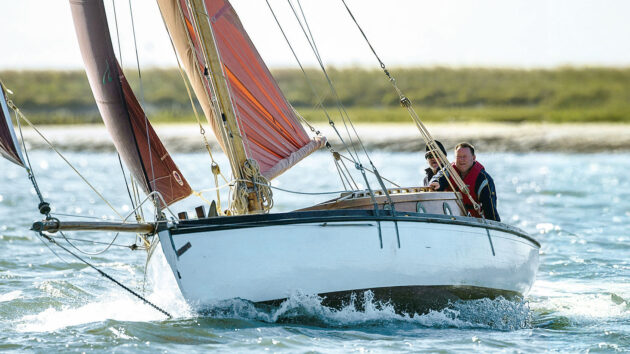
Dick Durham’s classic 1926 centreboard gaff cutter Betty II balances her long boom with jib and staysail, plus a long sprit.
The traditional cutter rig
The original cutter rig is the most versatile for offshore cruising. Here, both headsails can be set at the same time. This will increase upwind performance as there now is an extra sail to channel and accelerate the air flow between foretriangle and main.
Most cutter-rigged boats actually point higher when sailing upwind with both headsails. And as the wind increases, instead of having to change or reef headsails, just furl away the outer headsail and carry on with the staysail.
By design of the sail-plan, especially if the main is reefed as well, this will result in a very balanced and comfortable, yet also effective sail set up. The downside of the conventional cutter rig is the need for running backstays to keep tension on the cutter stay and to stop the mast from ‘pumping’ (bending forwards in the middle), especially when sailing upwind and slamming into waves.
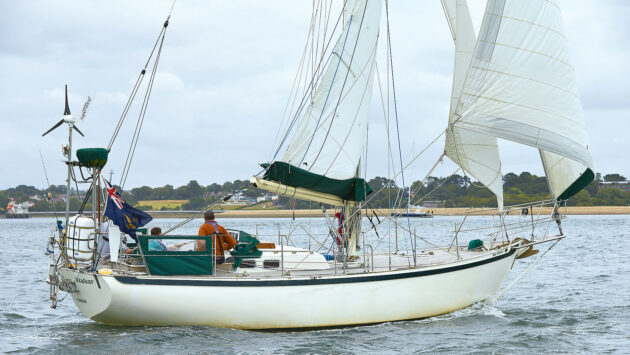
Cutters are designed with a large foretriangle length to allow space for additional headsails. Photo: Graham Snook / Graham Snook Photography
On some rigs, a jumper strut can at least partly replace the running backstays, meaning that you do not have to be too alert on the runners – you will not risk losing the mast if failing to tighten the windward runner immediately after the tack. And the staysail can be designed as a self-tacking sail (they are often set on a small boom). In this case, when going about it is only necessary to tend to the Yankee and the runners.
Ideally, boats have to be designed for the traditional cutter rig, with the mast placed relatively far back, often as much as halfway along the centre-line in the middle of the boat. This gives a large ‘J’ measure (the foot of the foretriangle), meaning enough space between the mast and the bow for both stays and sails.
With quite a large gap between both headsails, the cutter can usually be tacked upwind under all sails – although tacking the outer headsail, usually known as the ‘Yankee’, can still be laborious. Offshore, this is not a problem – some ocean voyagers like to proclaim that they ‘only tack on Tuesdays and Fridays.’
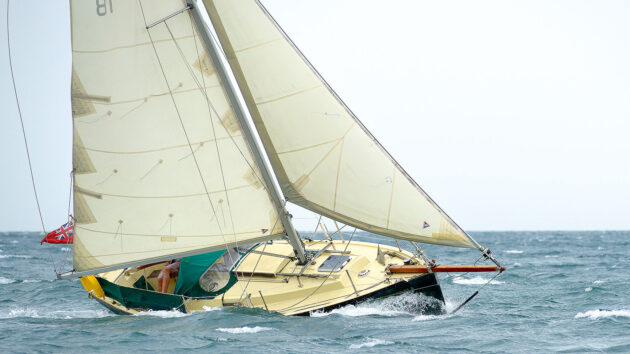
A Yankee is a large working headsail with a high-cut clew. Photo: Nic Compton
However, if short-tacking in more confined waters, it will pay to furl away the Yankee and continue stress-free under main and staysail only.
Some cutter rigs feature a removable cutter stay, in which case the outer headsail will probably more resemble the genoa of a sloop that the Yankee of the traditional cutter. This also gives great versatility, as the boat can effectively either be sailed as a sloop or, when the cutter stay is deployed, as a cutter.
The cutter stay will be tied back to the mast or chainplates when not in use. When setting it up, the stay is fastened to a dead-eye on deck, with a fitting for tensioning, such as a Highfiled lever, a high purchase tackle, or a jammer via which a line can be led aft to be winched on hard.
This set up requires a bit more forward planning than the all-out, fixed cutter – if you expect conditions to develop in such a way that you might want to replace the genoa with the staysail, it is easier to set up the cutter stay beforehand, particularly if you plan to set a storm jib in rough weather.
As the outer headsail here becomes more of a genoa, however, this set-up might be less balanced than the fixed cutter where the Yankee and staysail are carefully matched for each other.
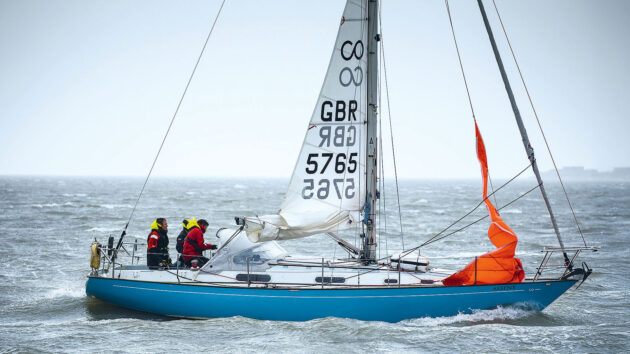
Hanked on sails can be dropped on deck, but need bending on or lashing down by someone on deck.
Furling vs hank-on headsails
To make deployment of the stay easier, the staysail on a removable cutter stay is sometimes set on hanks. This is quite easy to handle as the sail will be tied down on deck when not in use, and will drop down to the deck when the halyard is released. It does, however, require a crewmember to go to the foredeck to hoist or hand the sail.
An alternative would be a furler set on a 2:1 Dyneema halyard without the need for an extra stay. Once hoisted, this staysail is ready for use and can be deployed from the cockpit.
Hanked-on sails might feel old-fashioned, but many ocean sailors prefer them to furling systems. This follows the time-proven idea of keeping things simple and robust.
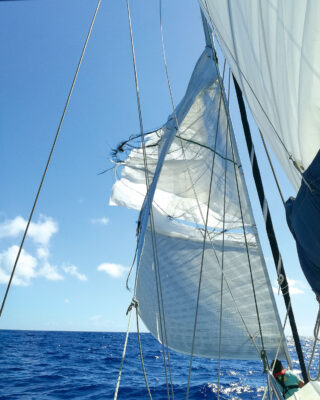
A jammed furler can be dangerous, with the loss of the sail, or worse, the rig
A sail on hanks will always come down as soon as the halyard is released, while jammed furler with the headsail stuck half-way out with the breeze building, can be a nightmare.
Often, the jam is caused by loose turns on the drum being pulled tight as the load increases and then forming a blockage that can’t easily be removed, with a sail that can’t be furled or dropped, just at the moment you need to get rid of canvas quickly.
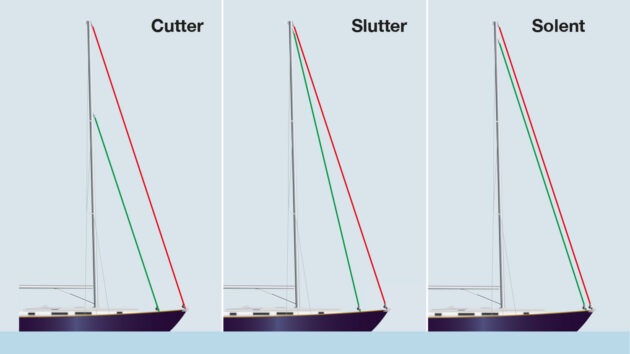
Cutter, slutter and solent rigs. Note the inner stay on the slutter is often removable
Variations on the theme
I have already mentioned, and you will have heard of the ‘Slutter’ and the ‘Solent’ rig. There appears to be some confusion in terminology between these two, probably because they are so similar, with the marginal difference being the spacing of the stays on deck. These rigs are often seen on yachts that have been converted from a sloop, which often have a too short J-measurement (see above) to be turned into a traditional cutter.
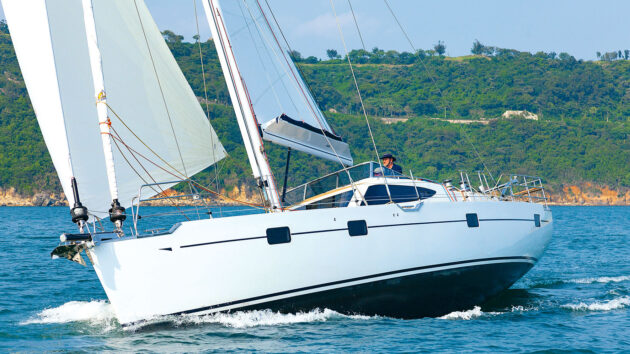
A Solent rig has two parallel stays well forward, both of which are fixed. Photo: David Harding
Solent rig
The Solent rig uses a high cut, narrow blade jib (the Solent jib) on the inner stay, which is set back from the forestay. This rig is not designed for both headsails to be used simultaneously.
Here, the inner stay is fitted immediately aft of the forestay. Unlike with a traditional Cutter rig, this inner stay is also attached very close to the masthead. This enables a high-aspect blade jib to be set, and it eliminates the need for the running backstays associated with a cutter rig.
The downside is that tacking the genoa is impossible due to the inner stay being so close to the forestay. It will be necessary to furl the genoa entirely prior to tacking, but this rig is not designed to short tack under geno; it is much easier and effective, even in light airs to do this under main and the Solent jib only, reserving the larger genoa for courses not hard on the wind or in open water.
The blade jib in place of the traditional staysail is perfect for tacking upwind. Just furl the genoa completely, unfurl instead the narrow, non-overlapping blade jib, which gives perfect drive upwind. Ideal for short tacking in inshore waters. And as soon as you are out at sea or on a stable reach, furl the jib, unfurl the Genoa and off you go.
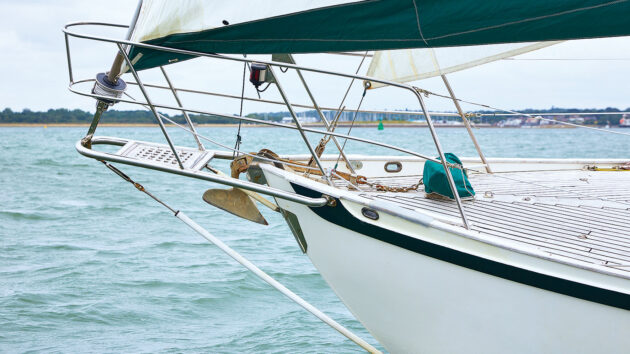
A slutter rig is much like a cutter or solent, but the inner stay is removable (note the highfield lever), and attaches near the head of the mast. Photo: Graham Snook / Graham Snook Photography
Slutter rig
The Slutter (sloop-cutter) rig often uses a removable inner stay for a smaller, inner headsail which again will be a blade-type jib. The foot of the inner stay is set further back, theoretically allowing for the Genoa to be tacked, even if in practice this is not easy and will always involve furling the sail at least part of the way.
The inner stay again reaches up to just below the masthead, eliminating the need for running backstays. Once more, it is best to tack upwind under staysail only, though this will necessarily be smaller sail than on a Solent rig.
In heavy weather, the small, non-overlapping staysail can be used as a storm jib on any point of sail. In light airs, the removable inner stay allows the Genoa to be used even when going upwind, as the boat is then effectively a sloop. This gives a bit more flexibility in your choice of sail plan.
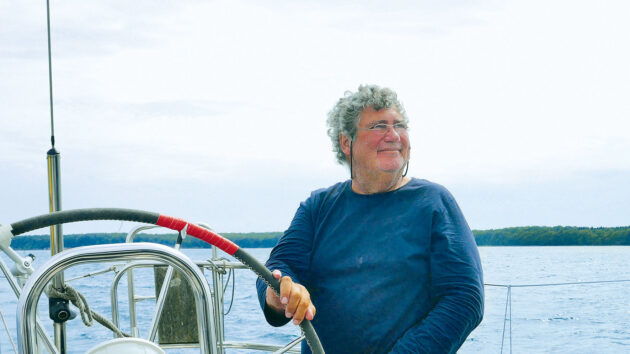
Detlef adapted his Breehorn 37 for easier offwind sailing
An easy two-headsail alternative
On the Breehorn 37 that I previously sailed, I had the choice of using a removable cutter stay. However, I decided to make things even easier for me, as I was, at the time, often single-handing.
Instead of setting up the cutter stay and a staysail, I banished the large genoa completely from the boat, instead permanently setting a sweet and easy-to-handle but very effective 110% jib on the main furler. I would use this sail under all conditions (except extreme weather which I was fortunate enough not to encounter) when going upwind or beating.
I also fitted a short bowsprit on which I could hoist a Code-type reaching sail, on an endless type furler. I would hoist this already in harbour whenever I felt that I would be using it later that day.
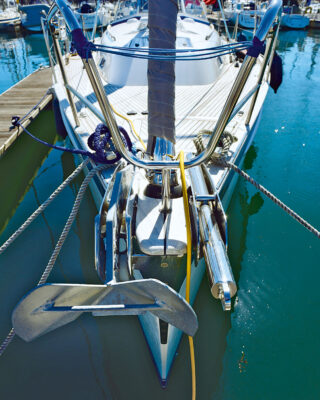
A short sprit can easily be added from which to set a furling offwind sail.
Upwind, the jib would be effective even in light airs. Bus as soon as I was able to bear off on any kind of reach, I would, from the cockpit, furl the jib and unfurl the Code sail to give me more reaching power than even the large Genoa would have been able to provide.
This was really easy but also effective and fun sailing, even if it meant gybing downwind instead of running at 180 degrees. Gybing with the Code sail was very easy. Simply furl in the sail, gybe the main, and unfurl the Code again on the new tack. Child’s play, really.
Many new boats favour this arrangement, in part as they need a bowsprit in any case to keep the anchor clear of the vertical stem that modern designs favour. With a short bobstay at the inner end, these are strong enough to support the tension for a furling Code sail, while loose-luffed cruising chutes can flow from the outboard end of the sprit.
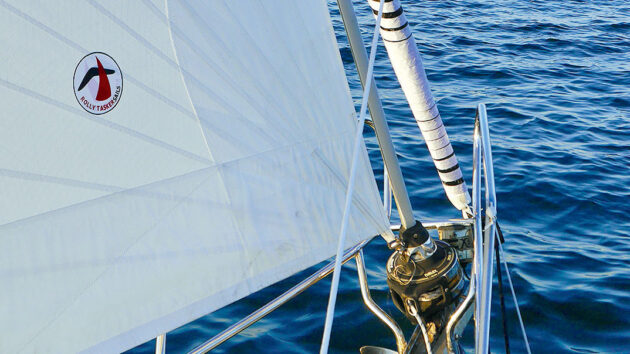
The furled sail can be left in situ even when not in use
Having your extra sail outboard of the forestay has the advantage of this is that it hugely increases the sail area available, making light-wind performance, or top-end speeds more easily achievable. The disadvantage is that this arrangement does not provide the heavy-weather options for which the cutter rig is so well suited.
Which rig for you?
For easy safe inshore or coastal day- sailing or club racing with crew, stick to your sloop rig with the genoa on a furler.
For relaxed cruising and offshore voyaging, several reasons speak for setting up your rig to take two headsails: easier handling, improved performance and more safety. Generally speaking, the cutter rig with its two headsails excels in offshore cruising by offering balanced sail plans, easier handling of smaller sails, and excellent heavy-weather performance. For a true cutter rig, the yacht will normally need to have been designed for this sailplan from the start.
Retro-fitting a sloop into a cutter-type rig is possible. This requires strong points both on deck, also with adequate reinforcements below deck to take the extra loads, and at the mast for the inner stay.
You may also need extra deck hardware such as extra winches and fairleads. Depending on your type of sailing this can be a good investment.
Adding a sprit and a furling offwind sail, whether an asymmetric spinnaker or a Code Zero, you’ll have a lot more options to keep the boat sailing in light airs, and it might even allow you to reduce the size of your spinnaker to make it better suited to stronger breezes. Either way, two headsails are better than one.
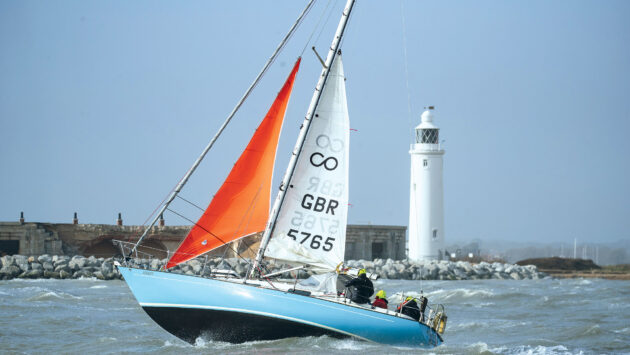
A removable inner forestay is a good option for a working or storm jib in strong winds
Fitting a removable inner stay – Option 1
Contessa 32 Assent is fitted with a removable inner forestay for the storm Jib. This is secured to the masthead rig about a foot below the forestay – close enough that no additional mast support is required The mast fitting was added by a rigger, with a stay of the same diameter as the forestay.
At the bottom, it has a rolled swage and eye fitting at the bottom, long enough to be about a foot off the deck when taken to the chain plates, where it secured with a small clip-on cleated purchase. Using HMPE/Dyneema in place of wire could help keep weight down, and may be easier to splice at each end.
On deck, there is a deadeye secured at the aft end of the anchor locker, where the locker’s bulkhead provides the necessary reinforcement to support the upwards loads on the deck.
To this is attached a Highfield level, itself removable. The stay is brought forward to this, and a drop nose pin inserted to connect the two. With the bottle screw adjusted to approximately the correct length, lifting and securing the lever in place pulls on the necessary tension.
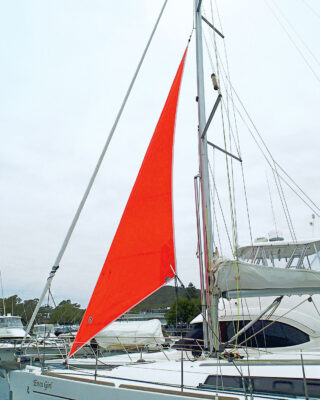
A storm jib on a furling torsion rope can be hoisted on a normal halyard
Some boats used a cleated block and tackle at the foot for the tension. Others fit a rope jammer flat on deck, from which a line can be led aft to the cockpit and winched tight before being locked off.
A storm jib can then be hanked on, sheets attached, and can then be lashed down on deck or left in its sailbag until needed.
Option 2
This sloop-rigged Bénéteau Oceanis 37, has a deep third reef in the main for heavy weather, but no storm jib. Rather than fitting a removable inner stay, sailmaker Craig Phillips suggests the following:
The spinnaker halyard is unused in heavy weather. Using a halyard diverter, this could be used to hoist a storm jib on a torsion rope, with a furler attached to a new padeye in the foredeck. This would allow the storm jib to be rigged early, and left up and furled, ready to use, or easily dropped when not needed.
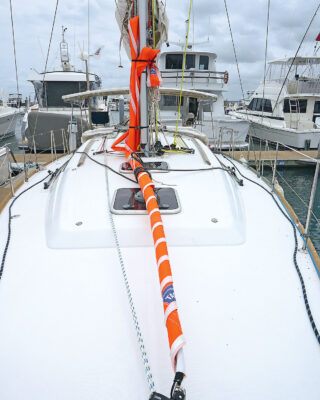
The furled sail can be kept on deck, lashed with bungees that pop off when the sail is hoisted
The spinnaker halyard is brought back to the cockpit, as is the continuous furling line, so the whole thing can be deployed without anyone needing to go on the foredeck. Craig had previously used this system on skiff class racing dinghies to allow crews to choose between masthead and fractional spinnakers.
The halyard diverter is another halyard that exits the mast via a new sheave in the front of the mast below the head of the genoa. It’s working end is spliced onto a low friction ring through which the spinnaker halyard passes.
When used for the spinnaker, the diverter is loose and the head of the spinnaker takes it to the top of the mast. When the storm jib is needed, the diverter is tightened hard in against the mast, pulling the spinnaker halyard with it and lowering the halyard’s ‘take-off point’ from the mast.
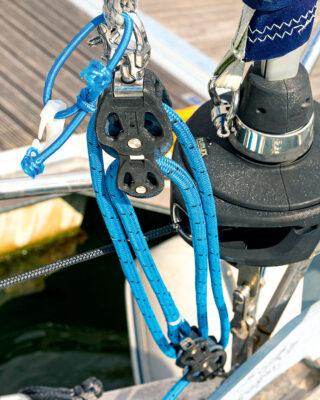
A Dyneema inner forestay is taken to the chainplates when not in use, and tensioned by a purchase on the stemmed that’s led aft to the starboard coachroof winch
This was refined to attach to the spinnaker pole topping lift, which was already below the head of the genoa and less often used.
On the foredeck, a new padeye for attaching the furler and tack, with a static load of 400kg and a spike load of 900kg. The boat’s existing jib tracks and winches are in perfect position for the sheets, and the continuous furling line is brought back to another cockpit winch.
The rig has swept- back spreaders so running backstays were not considered. On boats where the foredeck dead eye isn’t supported, a below-deck stay to the inside of the stem may be required to support the loads.
Enjoyed reading this?
A subscription to Yachting Monthly magazine costs around 40% less than the cover price, so you can save money compared to buying single issues.
Print and digital editions are available through Magazines Direct – where you can also find the latest deals.
YM is packed with information to help you get the most from your time on the water.
-
-
- Take your seamanship to the next level with tips, advice and skills from our experts
- Impartial in-depth reviews of the latest yachts and equipment
- Cruising guides to help you reach those dream destinations
-
Follow us on Facebook, Twitter and Instagram.
Note: We may earn a commission when you buy through links on our site, at no extra cost to you. This doesn’t affect our editorial independence.