


Whether it’s by choice or necessity, being able to handle your vessel solo in harbour and at sea is a safety skill that’s also hugely enjoyable, says Detlef Jens
When asked why he always sails alone, a well-known character of YouTube fame who notoriously sails in the far north, often in severe weather, once replied: ‘Whenever the sailing got tough and I began to enjoy myself, my crew became sick and wanted to go into harbour. I rather sail alone!’
That’s certainly a viable reason to go singlehanded, but the very opposite is also true. I prefer smooth sailing on a calm sea, when sailing can actually become very meditative. Just me, the boat and the sea. Nothing, and nobody, to distract or disturb me in my thoughts, or lack thereof.
There are also a number of practical reasons for at least the occasional lone passage, but be warned, once you’ve mastered sailing solo, it can quickly become addictive. I strongly believe that any boat owner should be capable of manoeuvring his or her vessel without the help of others. Even on a fine summer’s day, crew might not be available and wouldn’t it be a shame to miss out on your sailing just because of that?
Weighing heavier, however, is the possibility of your crew becoming unwell, sick or even injured underway. Not a problem on a fully-crewed boat where several replacements are on board. But the story is quite different when sailing as a couple or family. Should your partner be hurt underway, or maybe just have to tend to children below decks, you must be able to handle the boat by yourself and bring her back to harbour safely.
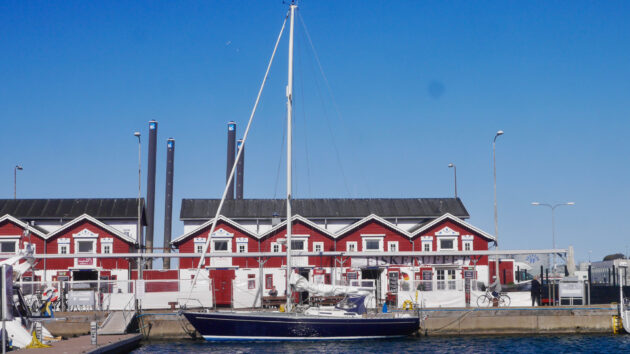
Detlef’s previous boat was fast and fun but quite a handful for singlehanding
Best boat size for solo sailing
You can probably singlehand a maxi yacht once out at sea, providing your sail handling systems are properly organised and up to the job, with the help of an autopilot on the helm. But size really matters when you have to enter a harbour or pick up a mooring by yourself – suddenly, smaller is so much better.
You need to be able to quickly and easily get from the helm onto the side-deck if going alongside, for example. Picking up a mooring by the stern might look unusual to many, but as I will explain shortly, it is one of the hacks that makes life much easier when singlehanding; it is really easy if your cockpit is close to the water, so you can fairly easily reach or lean over the side from your helm position to attach a line to the buoy.
Article continues below…
The bigger and beamier the boat, and the more freeboard it has, the more hassle this becomes. In this respect, centre cockpits are also not ideal for singlehanded manoeuvring.
Even though I live on board, I am a great fan of proper little boats that remain well under the 40ft mark. My current boat is 34ft, into which I have downgraded from a powerful 38-footer that I had before, and it does make a difference in handling. Of course, the merits of a particular size boat will also depend on the type and design.
A well-mannered and beautiful boat like a 28ft Twister, for example, can be an ideal singlehander, where a boat of the same size set up for fully-crewed racing may not be.
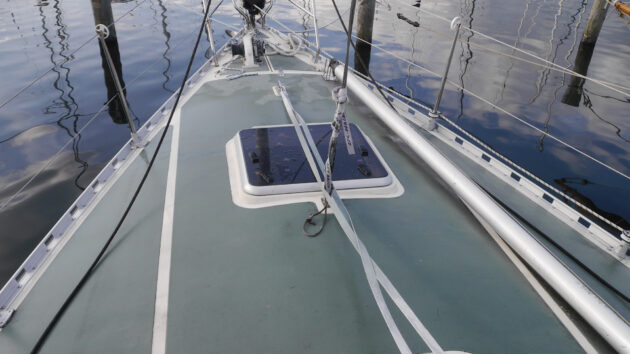
Jackstays should keep you on board. Detlef rigs his from the coachroof, midships via the mast and inner stay
Jackstays
The first imperative for singlehanders to always bear in mind is: overboard is overboard. For a singlehander, overboard really means the end. With the exception of incredible luck – a notoriously fickle companion – getting back aboard alone is going to be hugely difficult if not impossible. Even if clipped on, you will most likely be dragged through the water, without chance of getting to the stern and the boarding ladder there, because your harness is pinning you to the side.
Jackstays are no use at all, therefore, if they are so loose or run along the side-decks too far outboard so that they will actually allow a person to fall over the guardrails and overboard even when clipped on.
The jackstays should therefore ideally be running along the boat’s centreline instead, and you should be clipped on short so that should you fall or a wave push you off your feet, you will be stopped by your harness inside the guardrails before actually going overboard.
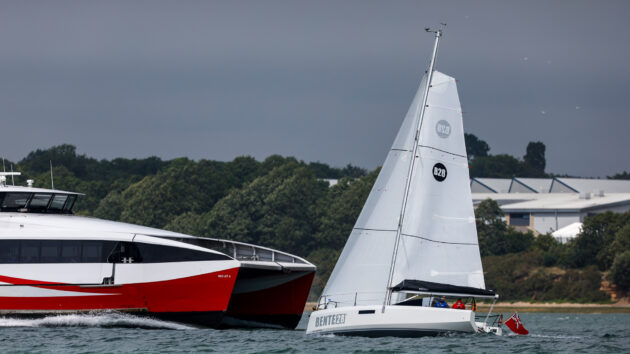
Going below is a risk solo, as situations can change very fast
See and be seen
Even for fully crewed boats, AIS transponders are becoming increasingly necessary in busy coastal waters, and I would include the entire North Sea, English Channel and Skagerrak in that, with lots of traffic, much of it very fast-moving shipping and fast ferries. I always prefer the low-tech KISS (keep it simple, stupid) approach to sailing but a proper AIS transceiver is one expensive piece of kit that I would wholeheartedly recommend investing in, for safety.
Needless to say, the added safety of an AIS transceiver is especially significant for the solo sailor. This does, however, not generally replace the need or the obligation for a proper lookout, which remains essential in coastal waters. I once sailed along the coast, on a beautiful day with light offshore winds. It was late autumn, with only one other boat in sight, far away to leeward and out to seaward on the same tack as me.
I went below to prepare some food and when I looked out again after what seemed to me only a few minutes later I got the shock of my life. The other boat had gone about while I was below and was in this instant charging across my bow only a few metres off, as if we were in an America’s Cup tacking duel. Scary! The lone sailor really needs the services of a very good and vigilant guardian angel. Unfortunately, they cannot be booked very easily, so looking out as often as possible is the next best solution.
There is also a reason that radar is included in the IRPCs when it comes to keeping a lookout but not AIS as they see what is really happening, rather than relying on other boats to have the equipment to tell you what they are doing.
A decent modern radar will be able to sound the alarm should any contact be on a collision course at a sensible range. They don’t come cheap, but are compatible with most modern chartplotters and really can offer an extra set of eyes for the shorthanded sailor.
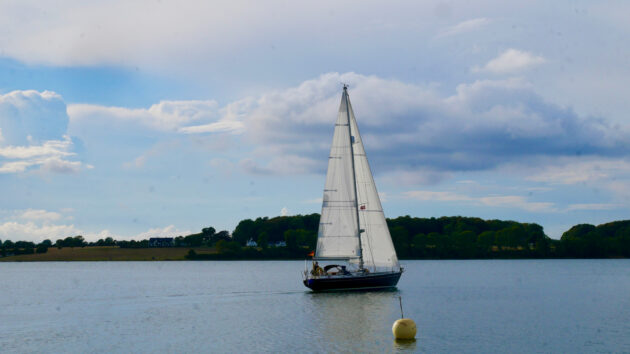
The size of the rig, the cut of the sails, and the systems you have to handle them all affect how easy it is to singlehand your boat
Planning and passage making
For me, the basics of singlehanded sailing can be summarised as: plan defensively and stay relaxed. Don’t be afraid, just wary. Don’t be more courageous than what is comfortable and sensible for you. When sailing, especially solo, I am in no hurry to get anywhere soon.
If you don’t feel like leaving, well, just stay. After all, there is no one on board to argue with about when to leave or not. And as the saying goes, it is always preferable to be in harbour wishing one was out at sea, than the other way around!
Plan your trip accordingly. Create a passage plan, with options B and C. I won’t go into the basics of a passage plan here in detail but this really is useful when sailing alone. Know your route, potential hazards, tides and possible boltholes along the way. Note it all down on paper in such a way that it makes sense to you even 24 hours later, when you might be tired and cold…
And once you’ve set off, stay flexible and remember that things do not always go to plan, especially when sailing.
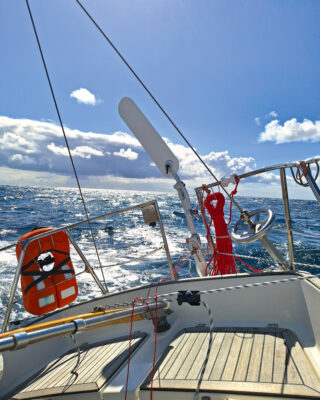
Windvane self-steering is a huge help, and often gets better in stronger winds, where electronic autopilots are better in light winds
Self-steering
Sleeping, eating, drinking, reading, even visiting the heads – nothing would be possible without reliable self-steering and ideally a back-up. For me, this is a wind-vane self-steering gear plus an autopilot.
Modern autopilots are reliable and useful. They will not drain your batteries too quickly provided your boat has a sensible electric system, you’ve paid attention to the settings and the boat and sailplan is well balanced. Despite this, they do consume power. Most autopilots also struggle at some point in higher winds and seas. The opposite is true for windvane gears.
They work mechanically only with the power of the wind and the water flowing past their (pendulum) rudder.
The more wind, the more reliable and precise their steering.
The obvious conclusion is having both on board, as the best of both worlds. An autopilot for motoring or drifting along under sail in zero to light winds and a wind-vane for sailing in a breeze. It takes a while to get used to trimming your boat and to set up the windvane to keep the boat on course, but once you’ve got the hang of this it is almost as quick and easy to connect the steering lines and trim the vane as it is to push the button on your autopilot.
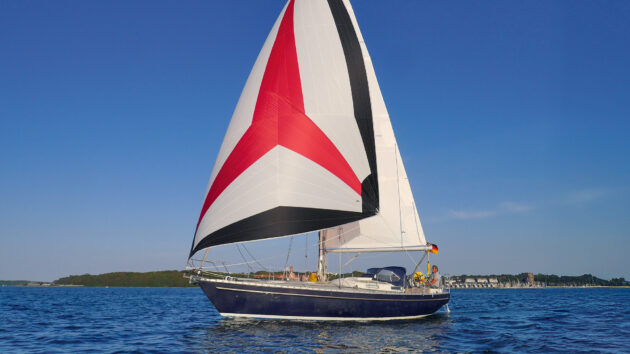
Offwind sails keep you sailing in lighter airs, but a furling system will make it far safer and easier to rig and set sails solo
I regularly use my Windpilot even on short day-trips and not only when alone, but often when there is also a crew on board.
Remember, though, that the windvane holds a course in relation to the wind, it does not steer a compass course like the autopilot. Singlehanders have run aground on beaches while asleep, when the wind had changed direction and the boat, accordingly, her course. It also does not steer a straight line but will veer from side to side by a number of degrees, depending on sail trim and sea conditions. But then, so will your average helmsperson.
If you’ve got half decent electronics on board, you will be able to set various alarms for going off course or more than a certain amount of cross track error.
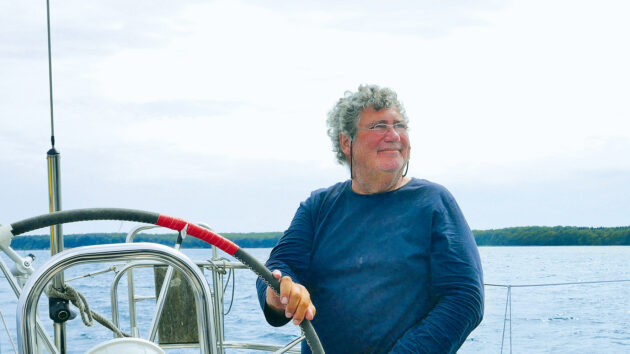
For Detlef, being at the helm, alone, in calm conditions is an almost meditative experience
Sail handling for solo sailors
There is little doubt that when sailing solo it is preferable to minimise trips forward out of the cockpit. That’s not to say, however, that you want to be lazy about having the right sailplan up. While a boat rigged with all lines at the mast can be handled by one, it’s certainly easier if most of the lines are led aft to the cockpit, especially main halyards and reefing pennants – though single-line reefing can add in unwelcome friction.
A furling headsail is easy enough to manage, and hopefully you’ll avoid conditions in which a storm jib becomes necessary. It pays to have a sensible-sized working genoa that covers all conditions, rather than a big overlapping genoa that might need changing underway.
But you may well want to rig offwind sails, particularly in lighter breezes. Snuffers certainly help but still require trips to the foredeck. A furling code zero, or top-down furling asymmetric, however, can be rigged before you leave harbour and left up for a whole passage, then set and furled as the need arises, all from the cockpit.
The initial set-up is admittedly costly, but is well worth the investment in terms of sailing enjoyment, if you can afford it. You may need a short additional sprit to keep the tack of the sail clear of the forestay, if the bow roller doesn’t project quite enough.
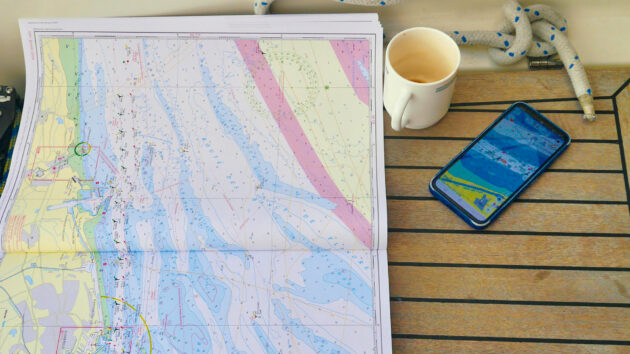
Detlef maintains a paper plot in the cockpit, with the occasional GPS fix from his phone. AIS and radar alarms serve as a back-up lookout
Singlehanded navigation
It is useful to have a paper chart, pencil, handheld VHF and torch ready in the cockpit. I plot my course on the paper chart for dead reckoning (DR) and only check this against the GPS or mobile phone every other hour or so, depending on circumstances.
A mobile phone or a tablet with navigation software and digital charts are much easier for singlehanded use in the cockpit than fixed chart plotters, unless these are, as some, fitted to the wheel pedestal immediately in front of the wheel – which looks rather ugly, interferes with the steering compass and is not really necessary.
On my current boat, I do not actually have a fixed GPS or chart plotter. I have paper charts, which I use also for passage planning; and I have both a mobile phone and a tablet with a good navigation software and up to date charts – by NV Charts for example, or Tom Cunliffe’s Angelnav that can be used with Imray and other digital charts.
This combination of paper chart and mobile device works perfectly for me. More for fun, I also have a hand-bearing compass mounted just inside the companionway and in easy reach from the helm or cockpit and, most important of all in coastal sailing, a reliable echo-sounder, also mounted outside.
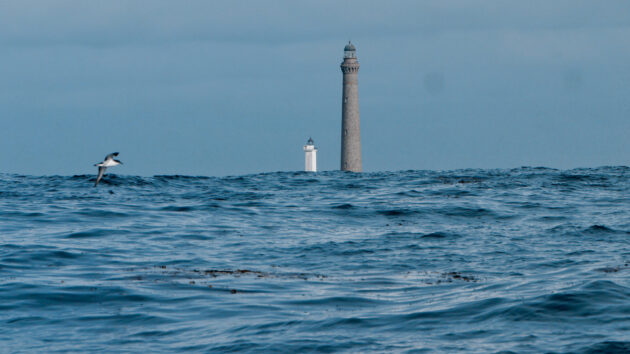
Things can change at sea, so don’t stick rigidly to a plan for the sake of it
When it comes to picking up a mooring buoy alone there’s only one way to do it; stern first! This is very easy if you have a boat hook with a snap hook to clip on your mooring line. The line itself can be led forward to the bow from the cockpit, then through a fairlead, block or closed bow roller and back outside all stanchions and rigging to the cockpit.
This end will have the snap hook bent on. Just idle up to the mooring buoy until it can be reached from the cockpit, snap the hook into the eye of the buoy, and pull in the other end as the boat drifts away. At your leisure, you can rig a slip line for easy casting off when the time comes.
Anchoring is pretty straightforward. Once you are happy you’re in the right spot, go forwards to drop the hook. Getting off is slightly harder, as many smaller boats do not have an anchor windlass, and you won’t have anyone steering the boat over the anchor. Should circumstances mean you need a winch to get the anchor up and you’ve used a rope warp, you can use a halyard winch on the mast in lieu of a deck-mounted anchor winch, with the added advantage that this is mounted at a much more back-friendly height.
Theoretically it may also be possible to lead an anchor rode to one of the primary sheet winches in the cockpit, but this is rather impractical – a long way from where the action is. Hauling in at the mast, you have the best overview of the anchor and your surroundings. If you’re struggling to recover chain, a handy billy, or a line hooked on and taken to a winch can add purchase.
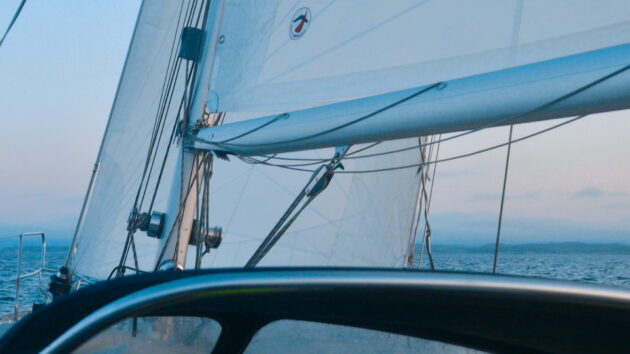
Passage-making under sail is one of the great joys of solo sailing
You may need to be patient getting the anchor up in a blow solo; when the bow yaws, stop and lock off the line. Once the boat stops and starts coming back into the wind, start hauling in again. Once the anchor is up, you may need to tend to the helm to hold position before going forward again to finish stowing the anchor.
Entering harbour
Before entering a harbour alone check the harbour plan in the almanac if you have not been there before. Have your lines and fenders ready, of course, but do not necessarily do this way out at sea, unless the weather is calm.
Taking down sails, preparing lines and fenders in big seas or swell can be uncomfortable and dangerous and there is a real danger of mooring lines made ready to use dropping overboard and fouling your prop. If the harbour you are entering is very small, then you have no other choice but to prepare your boat outside. But if it has a large sheltered outer basin, I would always prefer to use that for preparing lines and fenders to doing this in the rolly and potentially dangerous conditions outside.
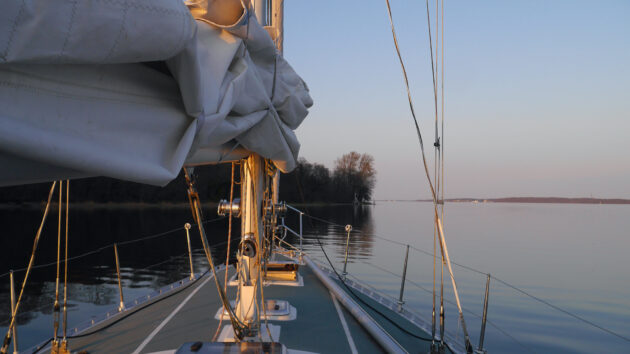
Anchoring is hugely peaceful and avoids difficult manoeuvring
Coming alongside
When alone, I prefer going alongside than being bow-to in a box berth. I always aim to secure with a midships line first. It is very useful to practise and perfect your line- throwing skills around a post or bollard ashore, if there is no one there to take your lines.
Secure one end of the line to the boat, coil several good lengths, and split the coils between your hands, keeping the working end secure in one hand so you can then throw a bight over and well beyond the bollard, cleat, or post ashore and haul in on the line. Quite easy once you have gained a little practice, though tricky if the pontoon has hoops rather than cleats.
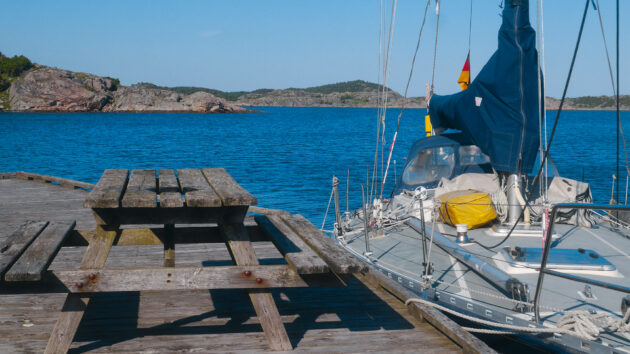
Blissful days under sail and quiet moorings unspoilt by noise and chatter are the reward
In the Baltic, more often than not one will have to moor bow- or stern-to between two posts. Doing this manoeuvre alone can be awkward and a solid rubbing strake on your boat really comes in handy here – with that, you can pick up one mooring post at a time, and even turn around one using a line as a spring, without having to worry about scratching your topsides. If you don’t have a rubbing strake, your thickest warp slung along the widest part of your topsides from bow to stern offers better protection than fenders.
Sometimes, guiding lines are attached to the piles that lead to the pontoon, which makes the whole operation much easier. It is then possible to go halfway into the berth, until the mast is roughly in line with the pillar, secure the boat there before tying a small rope from the bow to the guiding line in a way that this can slip along that line while the boat is motored or pushed into the berth, holding the bow and stopping it from hitting the next boat. Fenders should be ready but kept on deck and only be kicked overboard once the pillar has been passed. Otherwise, the fender can be caught behind as you move past and upset an otherwise smooth manoeuvre.
Enjoyed reading this?
A subscription to Yachting Monthly magazine costs around 40% less than the cover price, so you can save money compared to buying single issues.
Print and digital editions are available through Magazines Direct – where you can also find the latest deals.
YM is packed with information to help you get the most from your time on the water.
-
-
- Take your seamanship to the next level with tips, advice and skills from our experts
- Impartial in-depth reviews of the latest yachts and equipment
- Cruising guides to help you reach those dream destinations
-
Follow us on Facebook, Twitter and Instagram.
Note: We may earn a commission when you buy through links on our site, at no extra cost to you. This doesn’t affect our editorial independence.