



Every month Yachting Monthly's resident skills expert, Rachael Sprot answers a reader's question. This month how would you try to avoid this tidal marina collision?
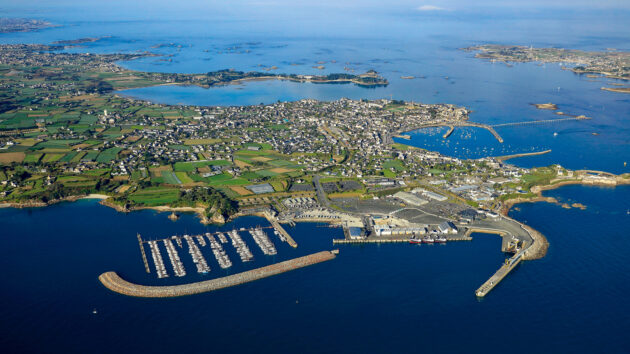
Roscoff Marina is one of the few all-tide ports in North Brittany. However, whilst it doesn’t have any depth restrictions, it does have a strong current which sets south through the marina on the flood, and north on the ebb. Ben has chartered a Beneteau First 40.7 for a sailing holiday along the Granite Rose Coast, just east of Roscoff, but has sought shelter from a gale in Roscoff.
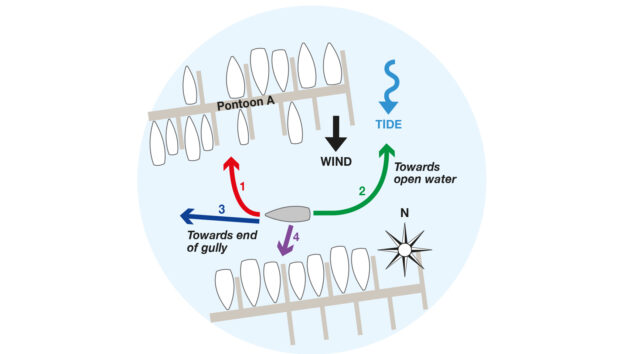
Ben is a qualified Yachtmaster Offshore. He has three friends on board, all of whom are Day Skipper level. They’ve set up lines port-side-to and entered the marina on the flood in a northerly F4, with the intention of turning back into the wind and tide to an empty berth on ‘A’ pontoon.
However, Ben was distracted as they made the turn around ‘A’ hammerhead and left it too late. It now looks as though they’ll be set onto the sterns of the yachts downstream. He has moments to choose a course of action and considers two options: power forwards and try to turn the boat into the tide, or reverse out as fast as possible. What should he do?
How would you try to avoid this tidal marina collision?
Powering forwards and to starboard in this situation could work depending on how close they are to the downstream boats and how strong the tide is. The Beneteau 40.7 has a deep-fin keel and single spade rudder, so she should turn well. However it’s going to require a big burst of forwards, lots of rudder, and a bit of luck!
Part of the problem is that as the bow turns to starboard around the pivot point, the stern will swing to port, potentially clipping the downstream boats. Reversing out at this stage is even riskier. In switching gears from forward to reverse there’s a period of time without steerage until reverse water flow is established over the rudder. Meanwhile, with a slight crosswind, the bow will fall off to port, potentially entangling their anchor in the pushpits of the yachts downstream. The manoeuvre’s success depends on how much forwards way they have on, how far into the pen they are, and how quickly the elements are setting them down.
Article continues below…
Will this anchorage be safe to stay in overnight?
Louise and Julia are cruising the north east of the UK on their Grand Soleil 43. They seize a brief…
Should you set sail if a Force 8 is forecast?
Toby is skipper of Cutting Edge, a 13m cruiser racer which he keeps in Salcombe. Cutting Edge is a powerful…
There are two other options though. Often, the tide decreases towards the shore end of the pontoons. Powering forwards, towards the dead end, might feel counter intuitive, but the tide will probably slacken off and make it easier to turn further in. It will also require less rudder than turning hard up into the berth, so would allow the boat to travel more efficiently away from down-tide boats.
However, all of these options add more power into what is already a close-quarters situation. There’s a strong temptation to use ‘panic revs’ in an attempt to avert a collision, rather than accepting some form of contact is imminent and focusing on fendering instead. With four people on a relatively lightweight boat they could manage an impact with good fendering and keeping speed to a minumum.
If they can settle across the sterns of the downstream yachts temporarily, one of the crew could run around to the up-tide pontoon with a throwing line and throw back to the boat as a heaving line for a midships spring. They can then winch themselves clear in a controlled way. The marina may also have a launch available, so it’s worth informing them of the situation – it’s in their interests to help.
This is a tricky dilemma. A skipper that knows their boat will sense whether they can pull off an escape manoeuvre. Experienced crew can make a big difference. Ben doesn’t have the advantage of either of these. However, that doesn’t mean he can’t remain in control of the situation by issuing clear instructions, keeping the crew safe and limiting damage. They need to record any damage to vessels and report it to the marina and charter company. The right approach will hopefully elicit a sympathetic response.
Enjoyed reading this?
A subscription to Yachting Monthly magazine costs around 40% less than the cover price, so you can save money compared to buying single issues.
Print and digital editions are available through Magazines Direct – where you can also find the latest deals.
YM is packed with information to help you get the most from your time on the water.
-
-
- Take your seamanship to the next level with tips, advice and skills from our experts
- Impartial in-depth reviews of the latest yachts and equipment
- Cruising guides to help you reach those dream destinations
-
Follow us on Facebook, Twitter and Instagram.
Note: We may earn a commission when you buy through links on our site, at no extra cost to you. This doesn’t affect our editorial independence.