


Delivering a boat is easier with your own crew, but when the boat is a family’s 35ft home, the stakes (and the stress) are much higher
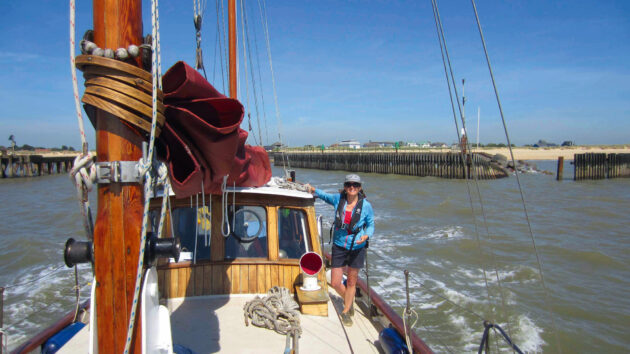
When you’re asked to take any boat from A to B, it’s always easier if you can do it with your own trusted people on board. This wasn’t an option on this job because Halcyon Oak was the home of Sim, Jo and Lottie, who I had met while visiting my sister Pat in Cambridgeshire.
The family lived on their 35ft wooden Inchcape motor sailer in Upware Marina, north of Cambridge, but had decided to move to London where Sim worked. The four of us planned to sail south from Kings Lynn in Norfolk. The Wash is extremely shallow, and channels change there each winter. We departed on the top of the flood and made a great start down to Wells-next-the-Sea where we had to wait for the tide to flood again for a few hours, because it has a high drying bar.
Wells-next-the-Sea creek was interesting to enter but is well buoyed. It reminded me of Leigh Creek (which has never been marked like this). However, Wells is far more exposed in northerlies on the Norfolk bight.
The boat’s sails hadn’t been all completely rigged yet; but the mizzen was finished in Wells and other jobs were completed on a lay day. It must have been a stressful prospect for Jo and Sim to move her into the North Sea.

The route
However, the weather looked fair. They spent a few days in Wells relaxing before heading on.
We did another fine leg from Wells to Lowestoft, but had to accept some foul tide due to leaving with enough depth to get over the bar from Wells at first. This was another pretty long passage. The spring tides run very strong here on this part of the coast.
Lowestoft had no problems with tidal height being quite a sizable port. Thus, on our fourth day together with fine weather I thought we might get into the mouth of the Thames Estuary. The fine sea boat motored along at six or seven knots, without putting any strain on her engine or diesel usage. We could use all the spring flood tide to propel us around Orford Ness.

Wells-next-the-Sea was the first stop
Engine emergency
Typically, two hours after leaving Lowestoft, just when you think all is going fine, the engine started playing up. The high-pressure system we had all been enjoying didn’t give us much wind, but we hoisted the sails.
They at least gave us steerage to avoid the navigation buoys, now the flood was running hard at three or four knots.
Sim had a sound idea about fixing his engine, and he started to work at it with Jo. They thought it might take them some time though. Meanwhile, Lottie and I were doing our best to keep the boat on course.
I was quite familiar with this coast having delivered another yacht to Scotland only last season. Having realised quickly we wouldn’t get to the estuary, I’d started to shape our course for Southwold, which I’d visited just last season. Unfortunately, this isn’t a harbour you’d choose because it has a very narrow entrance and is very shallow at low water. It was, however, our closest port of refuge on this coast, plus, we could always anchor outside.

Sim and Lottie in their element
A light sea-breeze
had sprung up, as the midday heat faded. I felt more confident that we could sail in on a flooding tide. I knew that the tide flows very quickly in this river. The depth on this entry meant at almost high water, the tide shouldn’t be running too strongly across it. To line it up and sail in with the light Force 2-3 southeasterly, we’d need all hands on deck ready to drop anchor. With good sail trim this idea might work, and if it didn’t, we could just drop the anchor.
Luckily, Jo and Sim managed to fix the engine about 10 minutes before we tested out this idea. We safely motored in (albeit with all her sails still up as belt and braces!) and moored alongside on an empty pontoon on the Walberswick side where we all took a relieved breather.

The family next to their floating home
The rest of our trip was much more successful, with a huge high-pressure system continuing all the way to London. We sailed via Shotley Point on the Orwell, Brightlingsea, Queenborough (slightly up the Medway) and finally to the family’s new home base in London’s South Dock Marina where we had to wait for a tidal height again to lock in.
The family’s quality of life should improve now that we’ve moved their home, as Sim now won’t have to spend so many hours commuting to work.
As to whether we could have sailed this heavy but lovely old yacht into Southwold, we didn’t have to answer that question, thank goodness. Having a secondary form of propulsion is simply good sense and proper seamanship, particularly if you’ve only one engine! With a large amount of wind, I expect she’d have sailed in just fine, but maybe not upwind. She had been designed to be a great sea boat by fishermen with marvellous hull form.
Whatever form of boating you do, ensure you have more than one form of propulsion unit: twin engines, a small stand-by – if only one, or oars if it’s a very small craft. We all know things can go wrong when you’re at sea, and they will eventually if you go to sea often.
Enjoyed reading this?
A subscription to Yachting Monthly magazine costs around 40% less than the cover price, so you can save money compared to buying single issues.
Print and digital editions are available through Magazines Direct – where you can also find the latest deals.
YM is packed with information to help you get the most from your time on the water.
-
-
- Take your seamanship to the next level with tips, advice and skills from our experts
- Impartial in-depth reviews of the latest yachts and equipment
- Cruising guides to help you reach those dream destinations
-
Follow us on Facebook, Twitter and Instagram.
Note: We may earn a commission when you buy through links on our site, at no extra cost to you. This doesn’t affect our editorial independence.