



The Saronic Gulf offers sailors a mix of deep blue seas, ancient history, and sheltered harbours between the Peloponnese and Athens
The Saronic Gulf is part of the Aegean Sea, extending from the Peloponnese in the west, Athens in the north, and the island of Hydra to the south. The geography features high hills and deep seas and is the home of one of Greece’s six active volcanoes.
As with many Greek waters, the wind is dictated predominantly by breeze from the north west in the morning and south east in the afternoon. The interaction between the land and the wind does cause dead spots and acceleration zones; however, these are usually seen as changes on the water surface long before you reach them.
Temperatures in the summer are usually 30ºC, although heatwaves that reach 40ºC are increasingly common. Night temperatures rarely drop below 20ºC. The sea is crystal clear and is so blue, it is almost as if it has been artificially coloured!

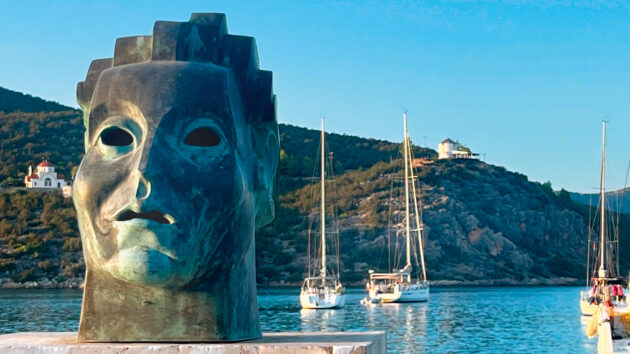
Palaia Epidauros is a well-sheltered anchorage
The Corinth canal
Our journey through this stretch of water started at the Corinth Canal in the north west of the gulf. Completed in 1893, it offers cruisers and smaller ships a cut through from the Ionian Sea, via the Gulf of Corinth, to the Aegean Sea. This saves approximately 700 miles by avoiding travel around the Peloponnese. It is a spectacular sight both from the water as well as from the bridges that cross it.
There are a couple of cafes at the top of the bridges, plus the opportunity to bungee jump if the mood takes you. Our first stop was the historic settlement of Palaia Epidauros, home of the historic amphitheatre as well as the 4th Century Sanctuary of Asklepios. The harbour is well sheltered from winds except easterlies.
Yachts can moor stern-to on a small quay, although many choose to anchor in the wide bay to the north. These anchoring options include either free-swinging or taking a line ashore to the rocks. We chose to visit the ancient theatre and temple early in the morning—a 30-minute taxi ride—to beat the heat of the day and the tourist coaches. It was fascinating to explore the site, as the theatre historically seated 15,000 people and is still being used for productions today.
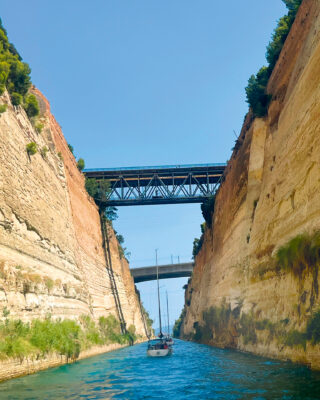
The Corinth Canal offers a cut through from the Ionian to the Aegean
Ancient history
The acoustics of the amphitheatre are amazing, allowing us to be heard speaking easily from the very back row approximately 100m away. Also on the site are the ruins of the Temple of Asclepius, a healing sanctuary dedicated to the Greek god of medicine. Thousands of pilgrims once came seeking cures through ritual, rest, and remedies. Our next destination was the small town of Methana, connected to the Peloponnese via an isthmus.
Our flotilla rafted together on the quay wall as another flotilla and many cruisers had already bagged the best spots. However, it did give us a bit of privacy for a punch party, one of many social events during the flotilla. Poros is another popular shortcut for those heading towards the Aegean and a great stop in itself. Poros overlooks a narrow strait that is charmingly busy with little ferries crossing from the mainland, manoeuvring yachts, and dinghies zipping everywhere.
Poros town has a beautiful clock tower overlooking the strait that you can visit and check out the views along the channel. We arrived during a special English language showing of Mamma Mia! in a local open air cinema, with a multilingual crowd watching.
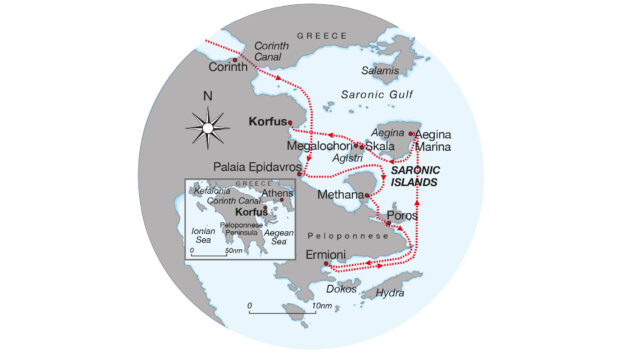
Our most southerly visit was to Ermioni, which we sailed to between the Peloponnese peninsula and the island of Hydra. The shores were rugged, mountainous, and steeped in history and myth. Ermioni is a beautiful town, nature reserve, and boasts plenty of shops, tavernas, and a chandlery.
Aegina to Angistri
Central within the Saronic Gulf is the island of Aegina with its newer harbour on the north-eastern side. The harbour itself has a long L-shaped sea wall, stretching south and east, which is deep enough on the outer part but shelved upwards towards the sandy beach.
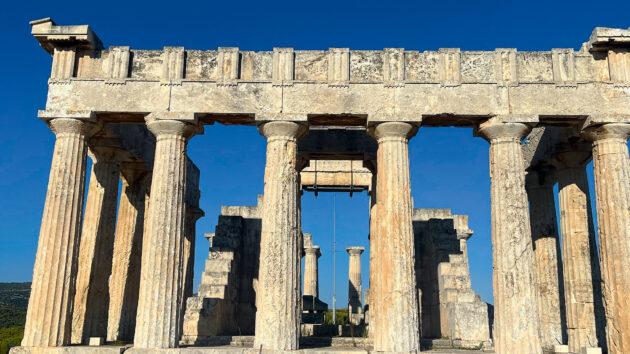
The temple of Aphaia in Aegina is an important historic site
Aegina is home to the Temple of Aphaia, which formed part of a triumvirate of important sites for the ancient Greeks. This triumvirate also included the Parthenon in Athens and the Temple of Apollo in Delphi. The temple’s position on the hill also affords breathtaking views across the Saronic Gulf towards Corinth, Salamis, Piraeus, and the outskirts of Athens.
To the west of Aegina lies the smaller island of Angistri. It has two harbours: Skala on the north east and Megalochori on the north west, with only Megalochori being suitable for deeper yachts. There is a small harbour for visiting yachts which is very busy. The bay is very good for anchoring (and swimming) in 3−7m with a sandy bottom.
We took the opportunity to go stern-to the quay wall once one of the tourist boats had departed for the day. Megalochori is a very picturesque town, with whitewashed buildings, quaint narrow zig-zag streets, and a beautiful church up the steep hill. The church shares its services via speakers to the congregation outside so the intoning of the minister gives the town a very traditional vibe.
Our final stop had to be Korfus, back on the Peloponnese, as this was the main base for the Seafarer’s flotilla. Korfus was a delightful little town, with a stunning beach and well sheltered by hills all around. It’s also said to be home to a colony of Mediterranean monk seals, a critically endangered species. They occasionally make a visit to the beaches to feed very young calves.
Enjoyed reading this?
A subscription to Yachting Monthly magazine costs around 40% less than the cover price, so you can save money compared to buying single issues.
Print and digital editions are available through Magazines Direct – where you can also find the latest deals.
YM is packed with information to help you get the most from your time on the water.
-
-
- Take your seamanship to the next level with tips, advice and skills from our experts
- Impartial in-depth reviews of the latest yachts and equipment
- Cruising guides to help you reach those dream destinations
-
Follow us on Facebook, Twitter and Instagram.
Note: We may earn a commission when you buy through links on our site, at no extra cost to you. This doesn’t affect our editorial independence.