


Tony Moss and his wife Marike cross the North Sea to sail around Britain anticlockwise, braving the Scottish summer along the way
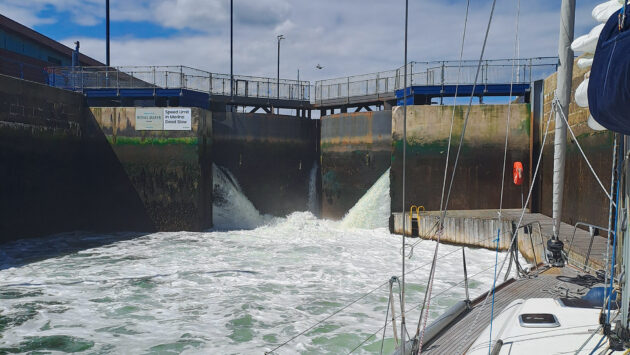
According to the news and messages from home, the beginning of July is a scorcher, with the heat almost unbearable. How I wish we were experiencing the same! Here aboard Pandora in Peterhead, we have leaden skies, rain and a northerly Force 7 wind coupled with temperatures as low as 10C. Summer – what summer? Thank heavens for the diesel heater!
All the way up the east coast of England we have had weather delays and now it looks like our goal of going around Britain via the Orkneys just isn’t going to be possible in the time available. We are not alone. There are several other boats of different nationalities attempting the same circumnavigation. One of them left early this morning trying for Wick but he is back again for supper before the fish and chip shop closes.
One by one our neighbours give up the unequal struggle and depart on a course due west towards Inverness and the Caledonian Canal. With a metaphorical tail between our legs, we join them only to find that once inside the Moray Firth the wind dies away to almost nothing and we have to start motoring yet again.
In preparation for our voyage several people warned us to allow for a lot of motoring, and how right they were. If we had unlimited time there would be no decision to make but now with our tightening schedule, we agree that if we can’t make at least four knots on the log, then on goes the motor.
I’m a world-renowned pessimist and people often ask me, tongue in cheek, what was the most memorable part of the voyage, and I find it hard to answer. Fortunately, my seaworthy wife, Marike, is the ship’s optimist, and she restores the balance. But looking back, our odyssey is like a kaleidoscope of places and events, both good and bad, all blending into one splendid whole.
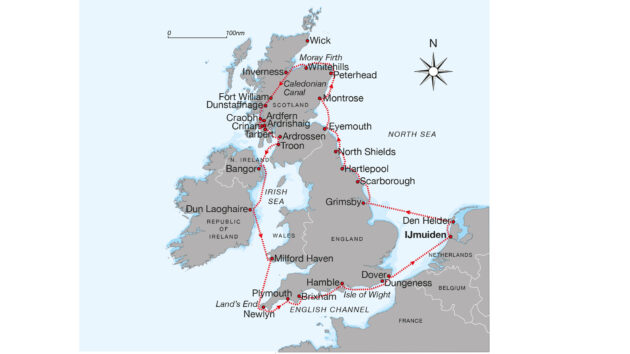
The route
Clockwise or anticlockwise
In planning our journey around the UK from IJmuiden, northern Netherlands, we had of course two choices: clockwise or anticlockwise around. There are compelling arguments in favour of both strategies. YouTube in particular is full of videos documenting, often in excruciating detail, voyages of boats doing the round trip and nowadays dozens of boats do it every season. However, planning a voyage on the iPad in front of the fire in the middle of winter is vastly different to making real-time decisions once the sails have been set.
On the day of our departure, we still had to choose our direction but with the latest long-range weather forecast predicting SW winds for the next few days, we opted for anticlockwise. We left IJmuiden in early June with a brusque SW wind and set course NW towards Grimsby.
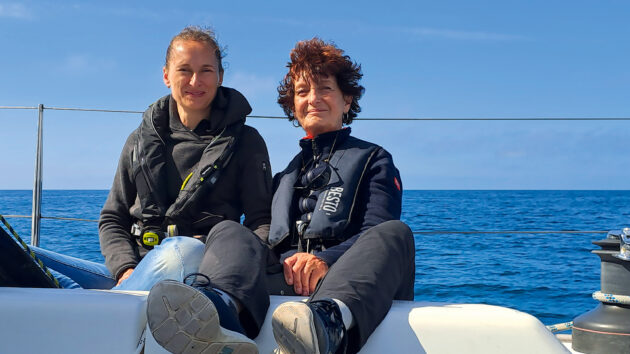
Marike (right) with daughter Sarah crossing the North Sea to Grimsby
Within a few hours, and contrary to the forecast, the wind had strengthened to WNW 6 gusting to 7. Now I don’t mind battering against a head sea for a few miles to make a waypoint but the prospect of doing that for 180 miles did not appeal and so we slid into Den Helder, which was only 25 miles away on a broad reach to the north.
The Royal Navy Yacht Club made us welcome and for the next three days of near gale force winds we played the tourist and waited for better weather.
Depressions & depression
On many occasions in the following weeks, we tried to convince ourselves that once we were in the Irish Sea, the almost continuous procession of Atlantic depressions would surely give way to something less miserable, but we were wrong.
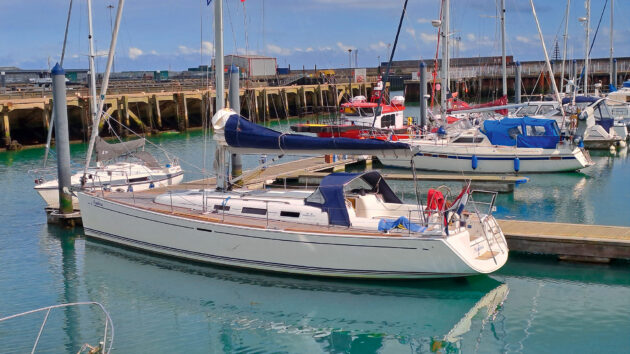
Pandora is a 2006 Dufour 44
From Fort William to Land’s End the depressions and strong southerly winds kept coming. I don’t want to give you the idea that we didn’t have any nice weather along the way because I once managed to wear my shorts for a whole afternoon in Scarborough.
Over the years I have come to believe that arrivals are often more exciting than departures and our arrival in Dover later in the trip is a case in point.
We left the Hamble early in the morning with our goal to ride the tide all the way to Dover in one leg, which is about 105 miles. This can be a challenging undertaking but if you leave the Solent at about an hour before slack water, and if you can be sure of keeping your average boat speed above 7 knots on a direct course line, then it is just doable.
When we left the Hamble, the wind was SW about Force 5, which was ideal, but there was a big swell running up the Channel due to the previous week of gale-force winds.
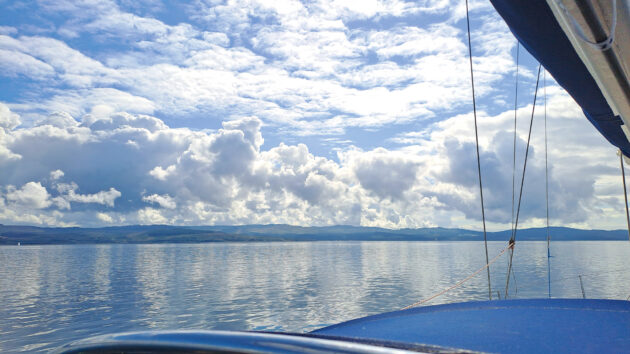
A beautiful skyline in Scotland. The weather alternated between no wind, or too much
Serious turn of fortune
We flew through the Looe Channel and past Beachy Head and Dungeness and then just as it grew dark, when we were within spitting distance of Dover, the tide finally turned against us. Things then rapidly got serious. Our speed over ground was down to almost nothing, so we turned on the engine for the last couple of miles but with wind against tide, the sea quickly became very rough indeed.
It was probably a good thing that, because it was now completely dark, we couldn’t see just how bad it was. Pandora was rolling and pitching frantically, and we had to keep the mainsail hoisted otherwise we would have been going backwards. In any case it simply wasn’t safe to try and stow a thrashing sail.
Article continues below…
Sailing the Shipping Forecast – Cruising the Humber: ‘A big fleet of Darts were racing and we had several enthusiastic waves’
Cruising the Humber The Humber sea area incorporates the interesting but more challenging coastlines of The Wash and North Norfolk,…
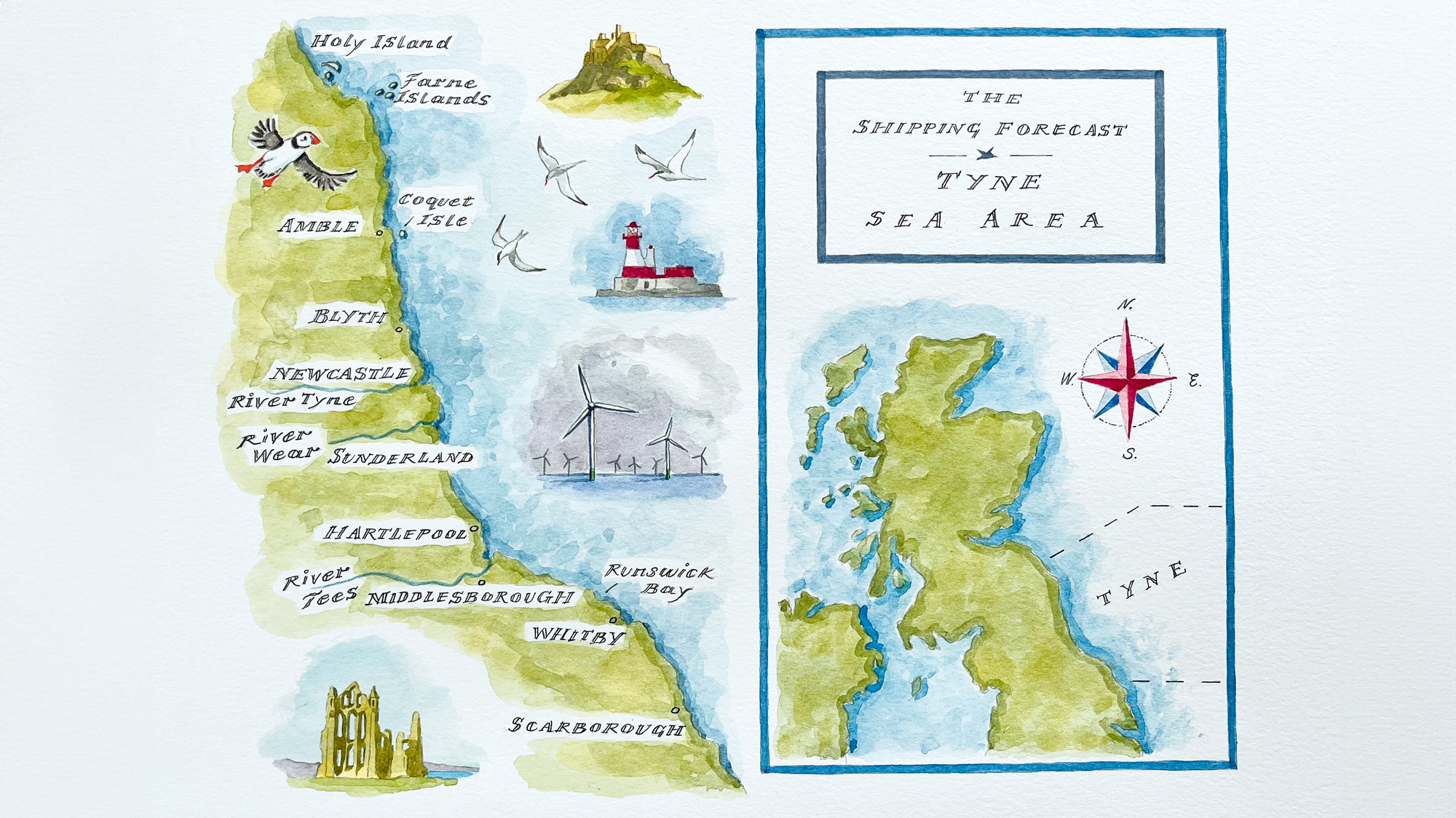
Sailing the Shipping Forecast: Tyne’s marvels and Holy Island, ‘A place that stirs the imagination’
The anchorage at Lindisfarne (Holy Island) lies right at the top of the Tyne sea area. Fewer than 10 miles…
The wind was dead astern and the boat became almost impossible to steer. Cautiously we made a ferry-glide across the tide towards the western entrance, although glide is probably not a good description of the manoeuvre.
Suddenly, about 200m from the entrance, we were knocked almost flat by a massive wave reflected from the pier. This lasted no more than five seconds until we were right side up again and then we shot into the shelter of the harbour. Marike and I hardly spoke until, when we were safely moored in the marina, we awarded ourselves a beer followed quickly by a whisky. ‘Well, that was fun,’ we said.
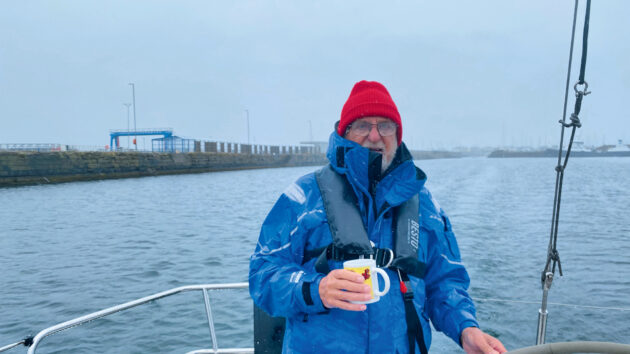
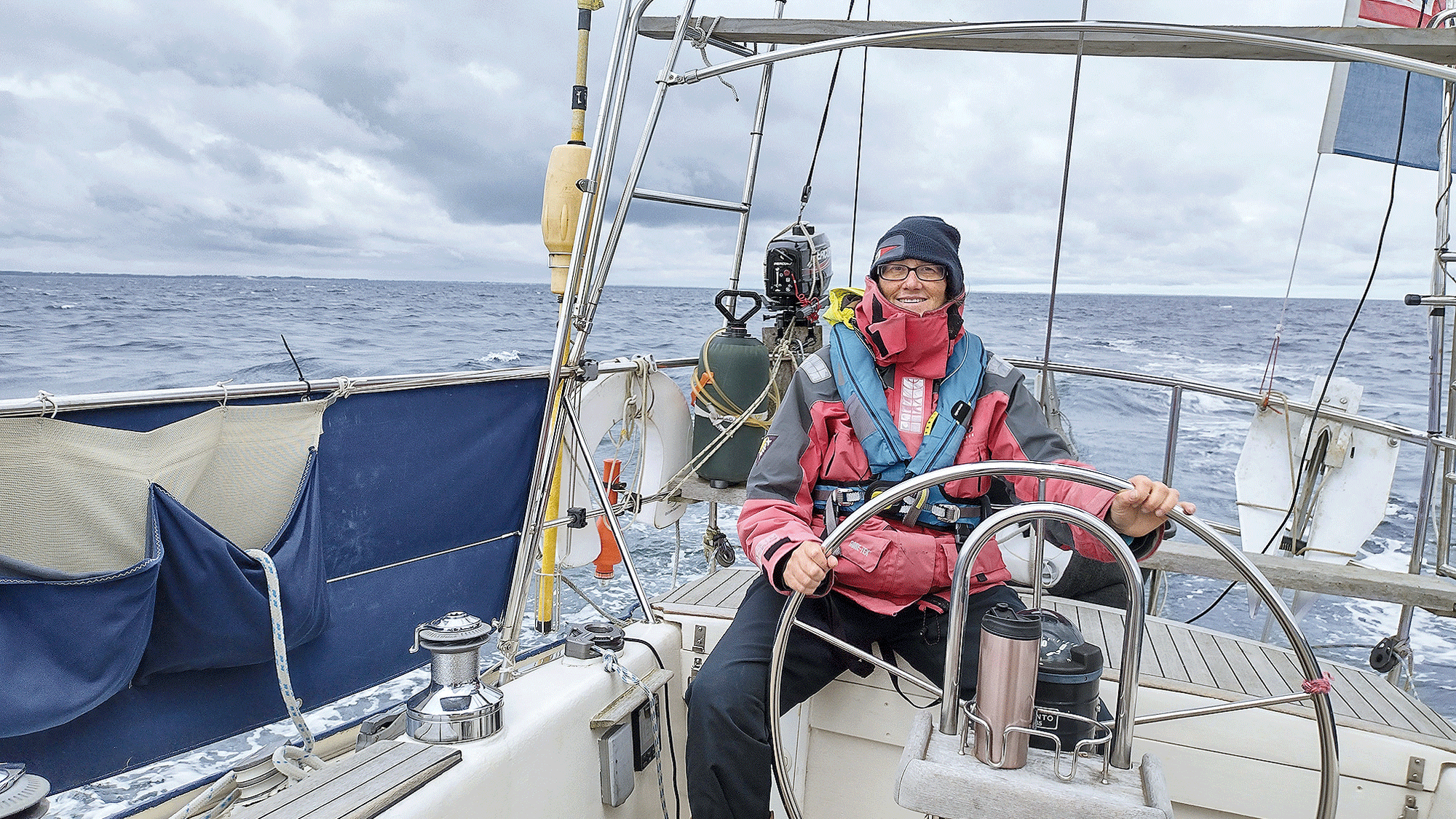
The wet skipper enjoys a warm brew
Beware the gas platform
Not everyone is so lucky. In Peterhead we meet a young Norwegian man on his father’s boat waiting for the insurance inspector. The boat was dismasted and 50cm of the bow crushed. With four friends he was on the last leg of a year-long round the Atlantic voyage and was heading back to Norway.
In the evening twilight, just to the east of Peterhead, all five of them went below for a bite of dinner but had not seen that they were going to pass inside the 500m safety zone around a gas platform. The guard boat called them repeatedly but was left with no other option than to come between them and the rig. Crash. His father is arriving tomorrow. Nobody was hurt but it’s no wonder he looks glum.
Without exception everyone we met was friendly and helpful, marinas and harbours had mostly excellent facilities with only the smallest of places being a little basic. However, I haven’t visited the east coast for several years and some of the towns outside the port areas were not as lively as I expected. In contrast, Scarborough was a joy. It is a busy, happy holiday resort with people from all over the north of England enjoying themselves.
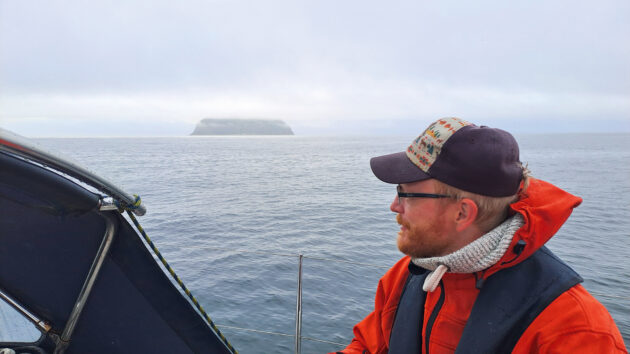
The wind was dead astern and the boat became almost impossible to steer
When crossing the border between England and Scotland, the predominant building material changes to grey stone and slate, which gives the little towns a sombre first impression, but the people are far from sombre. They took the time to wish each other good day and would often stop for a chat. I’m aware that this is only a snapshot from a grumpy old expat on a boat and that the reality is much more complex, but that is the fate of the itinerant sailor.
Everyone loves seals and dolphins but by the time we rounded Land’s End we were becoming quite blasé about them. We saw dozens of grey seals and hundreds of dolphins on both the east coast and in the Irish Sea. What we did find remarkable was the difference in the number of sea birds between the North Sea and Irish Sea.
In the east there was a far greater number and selection of birds compared to the west, and we were not alone in our observation. Perhaps it has always been so, but the difference was striking.
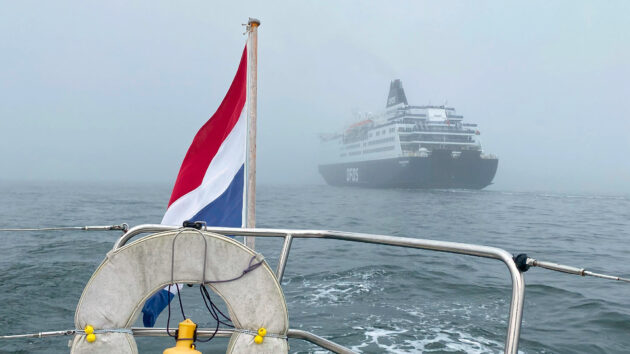
Visibility was severely reduced by fog when sailing on the Tyne
Fin whales salute
‘Whales, whales!’ goes the cry, and just a few metres from the boat, two enormous fin whales moving fast in the opposite direction break the surface and spout. They are much longer than Pandora, perhaps 20m, but in only a minute they are out of sight, having ignored us completely.
We also see far too many lobster pot buoys. They seem to be everywhere right around the coast and miles out to sea. A fisherman tells us that the conventional inshore fishery is almost extinct, but that the crab and lobster fishery has taken over. There are so many buoys, each with a 5m tail buoy, that a continuous sharp lookout is required in order to avoid getting them tangled around the rudder. This makes night sailing in water less than 30m deep very risky, so we try to avoid it.
We didn’t carry any paper charts but relied heavily on our Raymarine/Navionics chart plotter with AIS overlay. We also had an iPad and mobile phone with the Boating app as reserve. Reeds Almanac was invaluable as were a selection of Imray Pilots, particularly when the plotter gave up in the Irish Sea. We were very glad of the back-up.
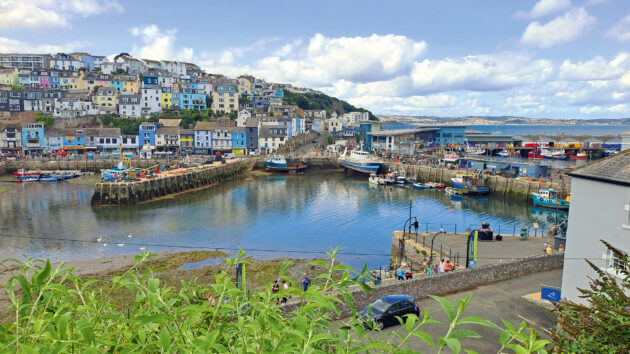
The picturesque harbour of Brixham
I suppose that you could do the whole trip with conventional charts and instruments but the North Sea with its myriad platforms, routings and wind parks would be a nightmare. Try plotting a course from Dover to Scheveningen in the Netherlands to see what I mean.
Our arrival in Ijmuiden was far less eventful than Dover but we had to motor-sail the whole way home. There was only a very gentle breeze with no prospect of wind to come. On our departure, nearly three months ago, we planned to be back on the last day of August, and we made it with six hours to spare!
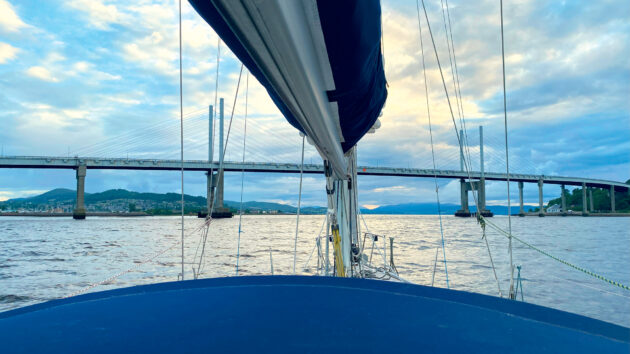
Arriving in Inverness, Pandora passes under the Kessock Bridge
Lessons learned
Be prepared to motor – The total trip was approximately 1,650 miles of which nearly half (805 miles) were motoring. This included the Caledonian and Crinan Canals and the sea lochs at each end where we had strong headwinds with no reasonable possibility to sail.
Plan daylight passages – From start to finish we were away for 80 days. We visited 28 harbours/anchorages, excluding stops in the canals. Passages between ports were mostly in daylight (20) with 8 day/night trips of 18 hours or more.
Take it slow for fuel economy – Our average speed was 5.5 knots, largely due to the weather. This was quite slow for a boat of Pandora’s potential but when motoring we tried to keep the diesel consumption and engine stress to a minimum.
Consider your direction carefully – When sailing, we sometimes logged 11 knots with a strong breeze and a following sea – we once managed 12 for about an hour – but overall, our speed was frustratingly slow when tacking against wind and tide. If we had chosen a clockwise voyage going north up the Irish Sea we may have had a less frustrating voyage, but hindsight is a wonderful thing.
The cost of motoring – Excluding food and drink, eating out and sightseeing trips ashore, the total cost of our summer voyage was almost exactly £4,500 (€5,400). This was for harbour dues, diesel and some minor repairs and spares. £56 per day for two people is, depending on your point of view, not bad. If we had motored less and spent more nights at anchor, then we could perhaps have saved 10% on the total.
Crew – Our daughter Sarah helped us across the North Sea from Den Helder to Grimsby, and we were joined in Scotland by my friend John and his son Martin for three weeks down the Irish Sea. For the rest of the trip Marike and I sailed on our own and were glad we had prepared Pandora for short-handed sailing.
Enjoyed reading this?
A subscription to Yachting Monthly magazine costs around 40% less than the cover price, so you can save money compared to buying single issues.
Print and digital editions are available through Magazines Direct – where you can also find the latest deals.
YM is packed with information to help you get the most from your time on the water.
-
-
- Take your seamanship to the next level with tips, advice and skills from our experts
- Impartial in-depth reviews of the latest yachts and equipment
- Cruising guides to help you reach those dream destinations
-
Follow us on Facebook, Twitter and Instagram.
Note: We may earn a commission when you buy through links on our site, at no extra cost to you. This doesn’t affect our editorial independence.