


Dick McClary give us his expert opinion on the benefits of tiller steering over wheel-driven boats
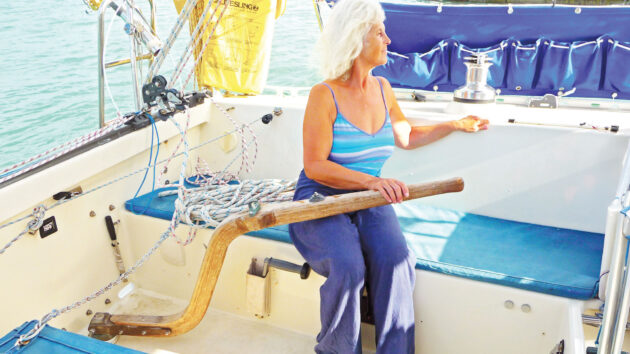
There is a lot you can change on board a yacht, but the method of steering – wheel or tiller – is typically not up for discussion or redesign. Some are agnostic, but most will have strong feelings one way or another, as demonstrated by this passage…
Under way, the cockpit is the centre of activity. Steering, watchkeeping, sail trimming or just plain relaxing – it’s all done from here. Sheets, cleats and jammers should fall readily to hand, and winch handles must be able to operate ‘full circle’. Properly thought out, it will be a satisfying and safe place to be: efficient for sailors and comfortable for our guests.
Foremost in the designer’s mind should be the steering gear. For a wheel-steered yacht, a ‘T’-shaped cockpit is often the preferred solution, giving the otherwise trapped helmsman room to move around the wheel into the main part of the cockpit.
The cockpit seats of a tiller-steered yacht must accommodate the sweep of the tiller without interference, and the tiller itself should be of a height and shape to avoid the knees of a sitting helmsman.
Who told the marketing men that we all want to steer our boats with wheels? Not me.
Admittedly, centre-cockpit designs have to be wheel steered owing to the distance between the helming position and the rudder. So too do large, heavy displacement designs where the tiller would need to be inconveniently long. But for all other designs under 15m or so, a tiller often makes more sense, and is much more fun.
Nothing beats sitting out on the coaming with a tiller extension, helming the boat like a large dinghy.

A T-shaped cockpit is ideal for a boat with wheel steering
When we built our bespoke 38ft light displacement cutter Alacazam, we positioned the primary and secondary winches a bum-width apart for this very purpose. Strangely, over the years, they’ve got closer together.
Having confessed my preference, perhaps I should explain myself.
In an aft-cockpit boat, a tiller:
- ✔ Rewards the helmsman with ultimate feel and feedback.
- ✔ By virtue of its mechanical simplicity, ensures reliability and robustness.
- ✔ Lets the helmsman, steering with the tiller between his legs, trim the jib, mainsheet and, if he’s really brave, the spinnaker, without disturbing the off watch crew.
- ✔ Works well with both windvane servo-pendulum self-steering gears and electronic autopilots.
- ✔ Allows the helmsman to gain shelter from the sprayhood.
- ✔ At anchor can be lifted up out of the way, leaving the cockpit clear.
- ✘ Can’t be geared down, however, to make high steering loads manageable.
Whereas a wheel:
- ✔ Can be geared down to make high steering loads manageable.
- ✘ Positions the helmsman right aft, denying him any protection from the sprayhood.
- ✘ In most cases, doesn’t allow the helmsman to trim the sails on his own.
- ✘ Is less precise than a tiller, and offers the helmsman little feedback.
- ✘ Requires an expensive and complicated linkage arrangement of wires and blocks, which without regular maintenance is prone to failure.
- ✘ Is awkward to link to both windvane self-steering gears and electronic autopilots.
- ✘ Adds weight right aft, just where you need it least.
- ✘ Clutters up the cockpit when at anchor.
- ✘ Is expensive.
All wheel-steered boats have – or should have – an emergency tiller, which may tell us something. Fashion has a lot to answer for.
This article is an extract from the RYA Offshore Sailing book, which can be purchased direct form the RYA at: www.rya.org.uk/shop
Enjoyed reading this?
A subscription to Yachting Monthly magazine costs around 40% less than the cover price, so you can save money compared to buying single issues.
Print and digital editions are available through Magazines Direct – where you can also find the latest deals.
YM is packed with information to help you get the most from your time on the water.
-
-
- Take your seamanship to the next level with tips, advice and skills from our experts
- Impartial in-depth reviews of the latest yachts and equipment
- Cruising guides to help you reach those dream destinations
-
Follow us on Facebook, Twitter and Instagram.
Note: We may earn a commission when you buy through links on our site, at no extra cost to you. This doesn’t affect our editorial independence.