


Anna and Angus cast off from New Zealand three years ago on an extensive circumnavigation, sailing across the Indian Ocean to the Maldives. To get to Europe, a difficult decision awaited: extend the voyage an extra 17,000 miles around South Africa or brave the Red Sea
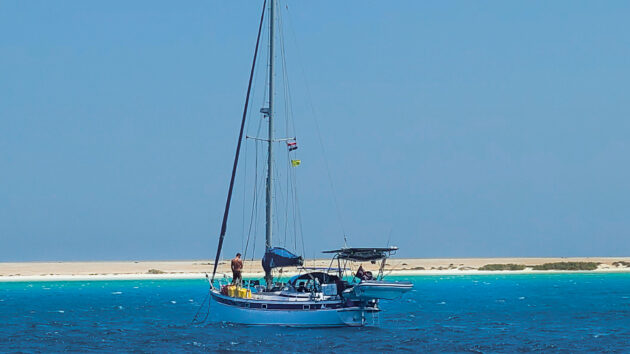
When we departed New Zealand in May 2023, our ultimate aim was completing a circumnavigation. We have owned our 42ft yacht, Innocenti, for over 20 years, and have cruised extensively over the years, including an extended trip with our three children.
Innocenti is a Bruce Clark-designed yacht, built from three skins of kauri timber and launched in 1982. After leaving New Zealand, we sailed to New Caledonia, entered Australia at Mackay, and then enjoyed cruising the Whitsundays before heading into Indonesia and Malaysia. We spent several months enjoying a very comfortable cruising lifestyle in Langkawi and Thailand, but then it was decision time.
To achieve our goal, we needed to make plans to be Mediterranean-bound. Having reached the Maldives, you’re faced with two choices to get to Europe. You can continue southwest across the Indian Ocean to South Africa, sail around the Cape of Good Hope into the Atlantic, mosey over to the Caribbean and eventually through the Strait of Gibraltar and into the Western Mediterranean.
The other option, which happens to be 17,000 fewer miles, is to tackle the Red Sea, then motor up the Suez Canal and pop out into the Eastern Mediterranean. This option sounded much easier to me, albeit with official warnings as to being fraught with danger.
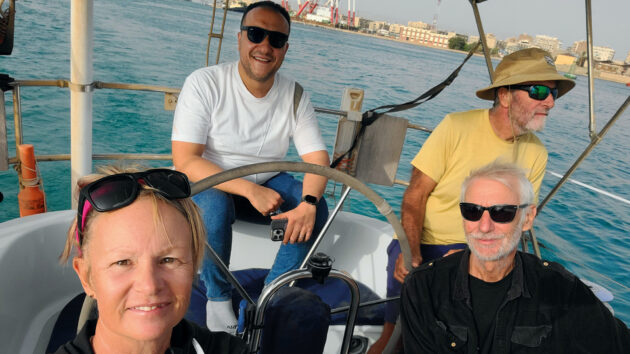
Anna and crew transit the Suez Canal with a pilot after an eventful leg of their circumnavigation
Decision time
After careful deliberation, weighing up the risks and rewards, we committed to doing the passage up the Red Sea. It was not a decision we made lightly, considering that there were civil wars in Sudan and Yemen, piracy attacks around Somalia and Eritrea, not to mention the situation in Israel and Gaza.
New Zealand and Australia have issued travel advisories warning against travelling to these areas, so we knew we could not rely on the New Zealand government to evacuate or save us if we got into strife. The Foreign, Commonwealth & Development Office also says its ability to provide consular help from countries along the Red Sea coast is ‘extremely limited’.
It warns of pirate attacks in the Gulf of Aden and up to 1,000 miles off the Somali coast. Essentially, we were on our own, except for the other dozen or more yachts that we were sailing in company with.
The three of us, my husband Angus, our friend, Mark and I, departed Maldives on 18 February, 2025, bound for the Red Sea, the Suez Canal and ultimately the Mediterranean. After 10 unremarkable days at sea, we arrived in Socotra. This beautiful, biblical island is famous for its dragon blood trees, and is administered by Yemen. We had an incredible three-day stop there.
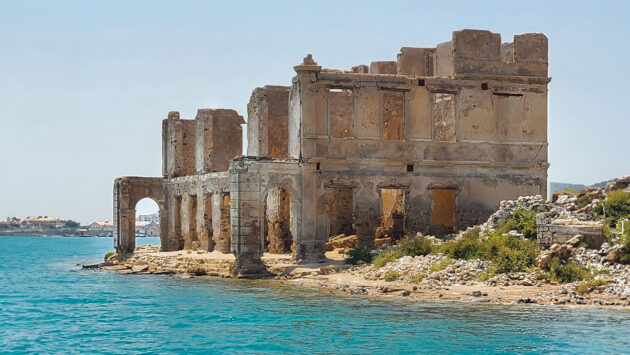
The ruins of the Sudanese port city of Suakin
We were able to get some supplies, and had an amazing tour into the rugged mountains to see the dragon blood trees, frankincense trees and the incredible natural beauty of the island. This was our first glimpse of the abject poverty of this part of the world. The population of Socotra is slowly increasing, with people fleeing from the war in Yemen.
There, Ghanem Ali was our agent, guide and genuinely kind person. He arranged our visitors’ permit, plus diesel and a day trip, which worked out to be around US$500 for the three of us. He took us on a half-day tour and to some shops to get some fresh supplies. I highly recommend a stop in Socotra if you’re considering sailing this way. There are very few people who can say that they’ve been there; it’s not exactly on the list of top holiday spots, although some intrepid travellers do go hiking and camping in the mountains.
The next stop was Djibouti, a six-day passage further on. Djibouti is the capital of the country of the same name, situated on the Horn of Africa, and is essentially the start of the Red Sea. Djibouti was previously known as French Somaliland, but it gained independence from France in 1977.
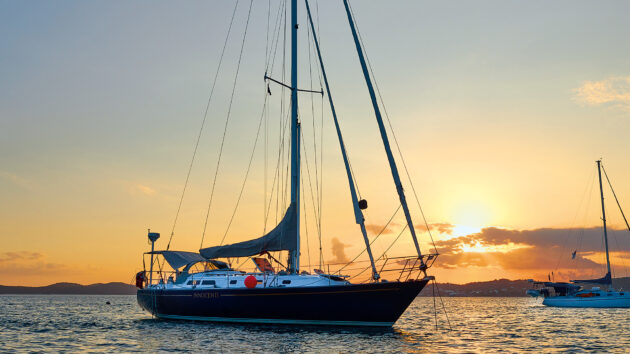
Innocenti at sunset, enjoying some welcome calm
It is bordered by Somalia to the south and Eritrea to the north. We anchored near the port, and rather than engaging an agent, we worked out the customs and immigration clearance ourselves. We took the dinghy to the commercial port, visited the police/customs, and the Port Authority. The policeman was asleep when we arrived, but he roused himself, stamped our passports, and sent us to the Port Authority. The Visitor Visa was around US$30 per person.
Djibouti had an edge to it, a feeling of underlying discontent and suspicion. It was the holy month of Ramadan when we were there, too, so it’s possible that people’s blood-sugar levels contributed to their irritability. It seemed as though everyone had their hand out for money. The extreme poverty was very evident in a very male-oriented, Muslim population.
A five-minute walk away from the port area, it was like being in a parallel universe. There was a very upmarket shopping centre, air-conditioned, with marble floors and speciality shops selling luxury goods. There was also a sizeable, well-stocked (except for alcohol) Carrefour supermarket. We topped up the ship’s stores, had some laundry done at great expense, then waited for the most favourable weather window. We took a deep, calming breath, and we were out of there after four days.
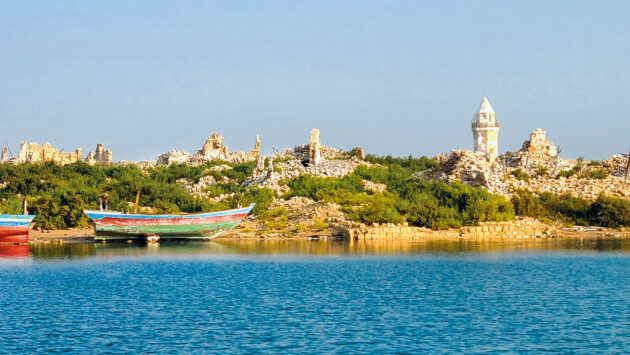
Suakin is a famous crossing point for the Hajj pilgrimage to Mecca
First challenge
The first hazardous challenge upon leaving Djibouti was to tackle the Bab El-Mandeb Strait. The Strait is the entrance to the Red Sea, between Yemen on the Arabian Peninsula and the Horn of Africa to the west. Bab El-Mandeb can be translated literally from Arabic to mean ‘Gate of Tears’ or ‘Gate of Lamentation’. It is thought that the name originated from the perilous conditions that can occur in the strait, such as strong and unpredictable winds that tend to funnel down the Red Sea, along with strong currents and shallow waters.
Our transit through the Bab El-Mandeb Strait was relatively uneventful. We had favourable winds, which allowed us some good sailing. We made our way to the recommended transit lane (which is highlighted as pink on the electronic chart) and travelled north as fast as we could, keeping to the edge of the lane to avoid ships.
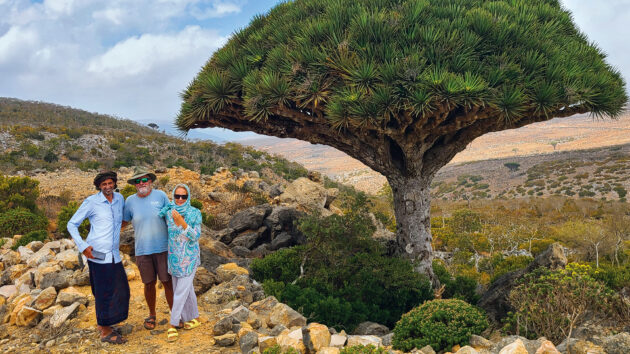
A tour around Socotra with Ghanem Ali, our intrepid agent
The transit lane is patrolled by naval vessels from coalition forces, although we never actually saw one. We experienced a very strange incident where the GPS froze on a particular set of coordinates. We looked at other vessels that we could see on the AIS, and their positions were exactly the same as ours. It stayed like this for some minutes, and then our position and the other ship’s positions returned to the correct coordinates. We figured that there was a military ship in the vicinity, and they had somehow jammed the signals of the ships while keeping their position secret.
At approximately 0100 hours on our first night at sea in the Bab El-Mandeb Strait, we heard jets fly overhead, then felt some deep repercussions. We found out the following day that the US was bombing Yemen. This was very sobering news for us, and it was a bit too close for comfort. For the next four days, we encountered high winds, which pushed us up the Red Sea. With a poled out headsail and two reefs in the main, we rolled along with an uncomfortable short chop, continuing on our way to the historic port of Suakin in Sudan.
Suakin became a social hub for us. There were nine vessels in total anchored in the very sheltered basin on the other side of the commercial port. We were all anchored next to Suakin Island, which was once a medieval port city built of coral and the main trading hub of the Red Sea with an incredible history. It’s now a pile of rubble with crumbling buildings.
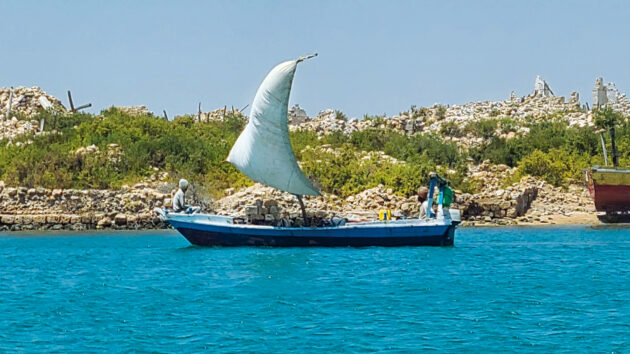
Fishing is a way of life for many locals in Suakin
Suakin culture
Mohammed was our silken-voiced agent in Suakin, who looked after all the boats in the anchorage. He checked us in, took our US$200 clearance fee and bought us a bag of fresh bread each day. He came on board in his long white garments with some difficulty. He joked, ‘I have a problem with my leg… I’ve only got one.’
His wooden leg could be seen leaning against his car when he was waiting for us to come ashore. We asked if he could arrange for us all to go and see the Nubian Pyramids of Meroë. Sudan has over 200 pyramids. Mohammed kindly explained that this was not possible as Sudan is in the middle of a civil war, and there was no way he could guarantee our safety. He did, however, organise for the museum to be opened and to transport us all there by van.
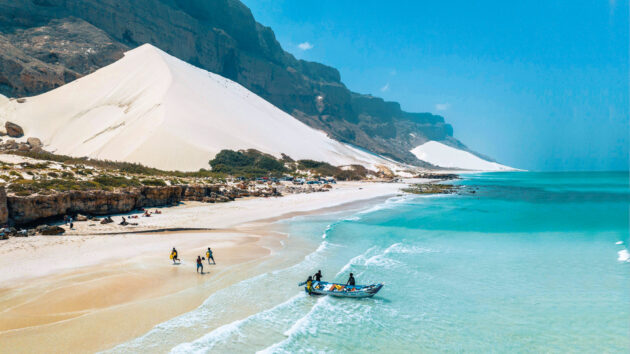
Stunning turquoise waters meet sandy beaches in Socotra, Yemen
Dusty trail
Every surface inside and outside the boat was covered in red dust that was transported on the relentless wind. The dust caused Angus to develop an eye infection, which required antibiotics. When the boat got wet with sea spray and waves, the dust turned into a red mud. Despite the conditions, it was a forced rest for all the boats in the anchorage and a chance to make repairs, play backgammon and share a meal hosted by Sandy and Scott on Sea Moon – Friday night being their pizza night. A lasting camaraderie was formed by this group of boats that happened to be travelling up the Red Sea at the same time.
The next 500 miles were punishing! We were in the northern section of the Red Sea, the coast of Egypt on our port side. We had either no wind at all or strong, hot, dusty wind on the nose, with an ugly, steep chop, making progress frustratingly slow. We expected headwinds in this part of the Red Sea, and when looking at the chart, you can see how close you are to the start of the Suez Canal. So close… but yet so far.
We ended up having two days at Wadi Jamal waiting for the weather, and then two days of respite in Soma Bay, the very upmarket resort town. We were not allowed to go ashore here (or even swim, although we disregarded that particular rule) because there was no possibility of checking in to Egypt at Soma Bay; clearance into Egypt must be done in Ismaelia.
We were in company with Alba Venturer at Soma Bay. Ian, Daniel and Igor were anchored in Suakin with us. They were somehow able to get groceries, beer and fuel delivered out to the two boats. I’m sure this was also against the rules. Clandestine deliveries were done under the cover of darkness. US dollars were handed over to the men in a small runabout to buy the groceries on our behalf at a hugely inflated price, but we were glad of the fresh food.
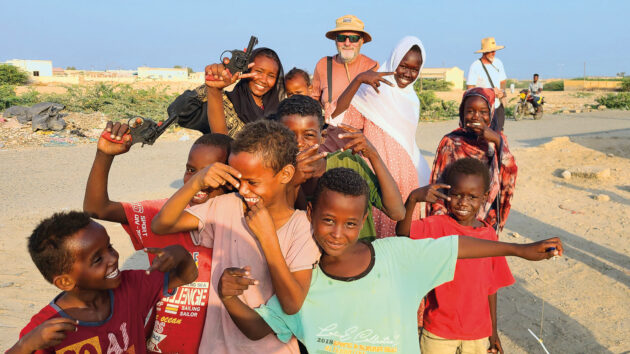
Angus joins the local Suakin kids (the guns are toys!)
Dramatic changes
After leaving Soma Bay, we sailed into the very busy Gulf of Suez. We stuck to the edge of the northbound shipping lane, sailing through areas lit up with oil rigs, and vessels and structures under tow. Initially, we had following seas and good wind, then the wind dropped out and we motored, hoping to make it to the allocated anchoring spot at the start of the canal. With 38 miles left to run, we had a dramatic change in weather.
The wind increased from behind, the air filled with dust and the temperature went up to around 40°. Then, without warning, the wind shifted 180°, increased to 40 knots, and the temperature plummeted, sending us all to dig out jackets and beanies. We were now barely making headway, and opted to try and seek shelter at a little spit of land called Ra’s Matarimah.
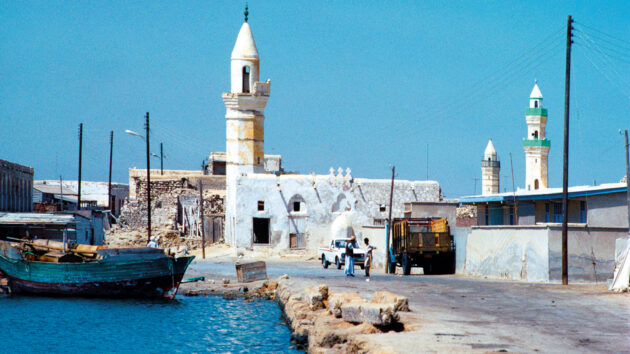
Now struggling, Suakin was once a main trading hub for the Red Sea
We anchored at 2230, absolutely exhausted after bashing our way north for five miles. There was no way we were going to arrive in time for our 0700 canal transit, so we contacted the agent, Captain Heebi (Prince of the Red Sea). He guessed that we were holed up and rebooked us.
We departed Ra’s Matarimah late the next morning in flat calm conditions with absolutely no wind. We motored all the remaining 32 miles and found our way to the C1 anchoring area for the night, ready for the first part of the transit of the Suez Canal to Ismaelia.
Our hopes for a peaceful night’s sleep were dashed when, around midnight, a local fishing boat got its net tangled in our anchor chain and bashed into the side of our boat. This happened again at 0300. We should have radioed the Canal Authority, because fishing activity is prohibited in the anchoring zone.
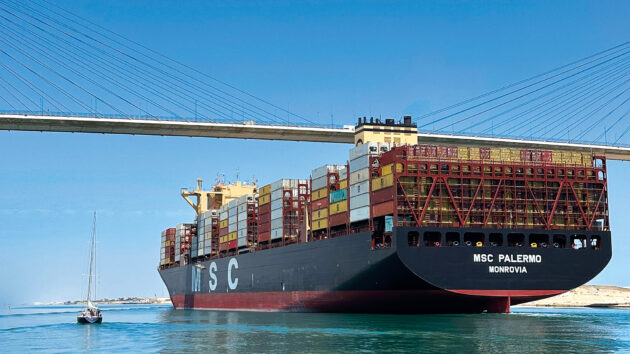
Little Innocenti dwarfed by a container ship going through the Suez Canal
Having had minimal sleep, but excited to have reached the end of the Red Sea, we welcomed the pilot on board at 0630 for the first day of our transit through the Suez Canal. The pilot vessel skillfully manoeuvred alongside, and our pilot jumped aboard. The canal is an amazing engineering feat. The pilot steered the boat all day, allowing us to soak up the view and see the enormous ships travelling through.
We reached Ismaila Marina late in the afternoon. Captain Heebi welcomed us to the very posh, but empty, marina. We had been in contact with him since the planning process began. The Red Sea is just a dusty adventure on the other side of the Suez Canal. We opted to leave the boat in Ismailia and go touring in Egypt, to see the pyramids and museums in Cairo… but that’s another story.
Enjoyed reading this?
A subscription to Yachting Monthly magazine costs around 40% less than the cover price, so you can save money compared to buying single issues.
Print and digital editions are available through Magazines Direct – where you can also find the latest deals.
YM is packed with information to help you get the most from your time on the water.
-
-
- Take your seamanship to the next level with tips, advice and skills from our experts
- Impartial in-depth reviews of the latest yachts and equipment
- Cruising guides to help you reach those dream destinations
-
Follow us on Facebook, Twitter and Instagram.
Note: We may earn a commission when you buy through links on our site, at no extra cost to you. This doesn’t affect our editorial independence.