



A reverse-osmosis desalination machine for less than the cost of a set of new waterproofs? There must be some mistake…
Watermakers cost a fortune, right? This recent review of marine watermakers lists four products that range from £3,000 to £10,000 and take up as much stowage volume as the tank they’re designed to fill. Not to mention the power draw, the cost of spares and the maintenance routines…
Well, if that’s been your experience too, you’ll be jumping at the chance to buy one of these: the Access portable watermaker from Vital Lyfe that costs just £560!
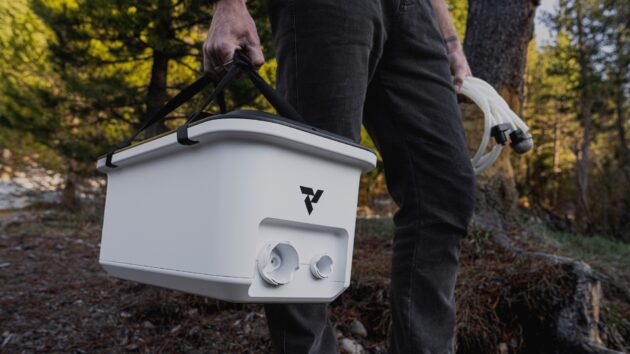
California-based startup Vital Lyfe claims that Access is a universal water purification system: a reverse-osmosis unit with a Class B UV-C exposure chamber that is capable of transforming virtually any natural water source, including seawater, into filtered water.
The duffel-bag-sized box weighs in at 11.3kg and can desalinate sea water at 22 litres per hour with double that rate for fresh-water filtration. It’s push-button operated with automatic sensors instead of user settings.
The built-in battery will desalinate for an hour continuously on a single charge – up to three times as long for less demanding fresh-water filtration.
The lifespan is estimated at about 6,000 hours (about 2 years of continued daily use) with new membranes (estimated to need replacing every 6-12 months) costing around $30 each, with orders placed via the app and installation simple enough for anyone to do.
Yachting Monthly spoke to Vital Lyfe co-founder Jon Criss via Teams from his factory in Torrance, California, to find out more:

Jonathan Criss, co-founder of Vital Lyfe interviewed by Yachting Monthly
The question is, to what extent was the marine market on your radar in terms of designing and marketing this product?
Quite honestly, the maritime industry was a big driver. My sister’s an avid boater, so, you know, having initial conversations with her on ‘What do you guys do for water?’ was an early indicator. And then in our research, it was pretty obvious that the maritime industry has a desalination (DSAL) technology, which is just super-crazy-expensive. It’s very painful to maintain and operate these [maritime-specific desalination products]. So those are all big indicators to me to think: ‘Let’s go make a good consumer product that people in this industry can own and operate.’
But who do you anticipate is going to be your biggest marketplace for this? I mean, who are you really thinking of when you designed it?
At the end of the day, the our mission is to make a meaningful impact on the number of people around the world who have access to clean drinking water. Our prime customers are humans. We want developing nations to be the long term adopters of this technology for sure.
The early adopters are the maritime industry, the overlanders, RV-ers, people who live off grid and generally prep [people who stock up for emergencies, disasters, or potential societal disruptions]. All of these markets are much more willing to spend on cool tech. They’re excited to try out new things and they give very honest feedback. So we like to partner with those types of enthusiasts as soon as possible to really build our innovation cycle.
So are you a scientist, an engineer, a physicist?
I’m an engineer. I spent 13 years at SpaceX, started off as a mechanical engineer, moved into integration testing and then ended up taking over the entire Dragon program, and then moved over to Starlink. I did a bunch of really fun special projects where you could actually see the real impact in the world when you give someone something that was traditional infrastructure.
I use my sister again as an example. She’s a photographer and she lives in the middle of nowhere, Kansas. She would have to upload photos overnight and just hope that they would be done in the morning via whatever Internet provider she had. I gave her a Starlink and her life changed in 15 minutes.
She watches Netflix and does her job now. She’s like a part of normal society just by having access to the Internet. Very similarly, we think that we can do the same thing with Vital Lyfe for people who don’t have very good (or any) access to clean water, just by giving them the traditional infrastructure and allowing them to do it themselves. So that’s one of the longer term visions that we’re really excited about.
Was desalination and filtering etc actually your area of expertise?
No. The thing that is exciting to me about DSAL in general is its high-pressure fluid systems. Rockets and spacecraft are volatile and very high pressure fluid systems. So when I started digging in with my co-founder it was very obvious. Oh man, these are fluid systems. I’m pretty good at fluids. Let’s go see if we can build one.
We built one in relatively short order in the garage and then really started doing our research and trying to understand how do we take our previous experiences at SpaceX, apply them to this new technology and really go see if we can build an awesome consumer product with it.
The price just looks amazing. It’s difficult to find a marine watermaker for under £3,000. So what’s the secret to getting the price as low as it is?
That’s our IP (Intellectual Property). We essentially attacked this problem from engineering fundamentals. So we went back to the very beginning of understanding how reverse osmosis and desalination work and then designed a product around that. And when we did that, we realised there are very traditional ways of thinking that have made their way into this industry for the last probably 50 or so years.
We can take aerospace grade technology in terms of materials science and manufacturing and apply those to this very same tech and then take that and scale it. And that gives you the price capability that we’re able to achieve with Access. What I always like to say is we’re building for scale and great manufacturing from the very beginning.
That gives you economies of scale. So our factory can produce more DSAL devices in the course of a month than currently exist. That’s a capability that we designed from the very start. That initial-rate capability gave us the ability to go negotiate with our suppliers, really drive down the cost and push that back into a good consumer product.
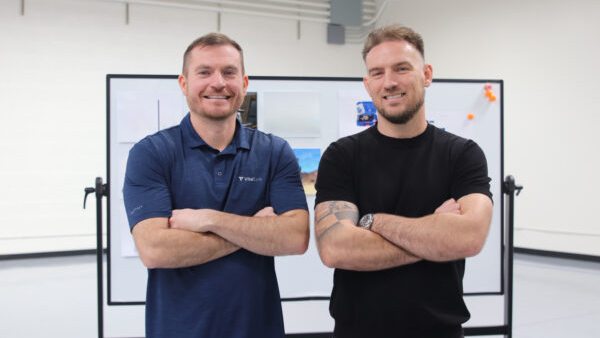
Left to right: Andrew Harner and Jonathan Criss are co-founders of Vital Lyfe watermakers
So you’re talking about 6,000 hours of lifespan, correct (250 days round the clock use)?
It depends on what type of water you’re cleaning. The saltier the water, the harder it is to clean. So we baseline that in our initial design and then obviously we add in our design factors of safety and margin on top of that to make sure that we’re producing a good product. If you’re cleaning fresh water, it should be much higher than that.
And the cost of a replacement membrane?
We put membrane costs at about $30. We’re still working on our final pricing of the membranes, trying to make sure that we get that as affordable as possible. Our entire philosophy is that you should have the ability to use this whenever you want, however you want. And if you want to clean dirtier waters that impact the membrane, that’s fine. We make them much cheaper and affordable so that you’re not in here paying a ton of money for maintenance.
How long will those membranes last?
It depends on what type of water you’re cleaning. If you were running these things in pure ocean water, it’s actually quite a long time, easily six months [180 days] is what we’re targeting. The thing that gets you is when you are starting, stopping, letting it dry out for a long period of time, not doing any storage and then cleaning like an algae bloom or something in a lake.
That’s what can really [harm the product’s longevity]. There are ways to clean them and then our system can recognize how much life has been consumed. We have some flushing procedures that the system can run all by itself to try to recover some of that life. It really depends on what type of water you’re cleaning and how frequently. But we’re essentially aiming for about six months.
Most Atlantic crossings last about three to five weeks. And you’re saying pure ocean water would run for six months, 24 hours a day?
Yeah, it’s better for us if you run them longer.
A large, fully crewed yacht might want that amount, but if you did it once a day for a few hours, would you be keeping it lubricated enough to be, to be in good condition?
Yes. I like talking with boaters and yachters because they’re just used to living in environments with so much pain! Marine systems suck, but they don’t have to. We can make a better product. So we try to design all the pain points out for your consumers.
How easy would it be to use the Access as a filter for all the water coming from the boat’s tank, while also having it set up to purify an hour or two of salt water every day, for example?
We have a whole catalog of accessories that we’re excited to build out for our customers. The initial ones are things like through-hull kits that make it much easier for you to either do a permanent installation or a semi-permanent installation inside of your boat. That’s why we’re excited to get the product into customers’ hands so they can give us feedback and we can create what they need.
And it’s possible to power the unit 12V, mains power, solar energy… anything basically?
AC-DC. We say that we can run on clean or dirty power. So you can use a solar cell. The Access has an integrated battery to try to help with some of the energy distribution. But really, any energy source is kind of what we design the product for.
And as far as availability in the EU and the UK, what is the plan?
We have pre-orders in 26 countries right now. We’re prioritising wherever the greatest demand is. We are going to certify for CE, which will give us the capability to sell into the EU market. We’ve designed the product around those regulations initially. So we’re hoping to kick off certification here soon. We definitely have an international goal and scope. The whole North Star of the company is making that meaningful impact on the number of people who have drinking water.
Are there plans to make bigger versions or even smaller versions or anything like that. Is that, is that in the pipeline or are you just going to concentrate on this?
We have our future products on a roadmap we’re very excited about, but we’re not sharing quite too much information about them yet. The future of Vital Lyfe products is very exciting. We have a great team of investors. Our last round was co-led by General Catalyst and Interlagos, who are some of the more prominent firms in the hard tech space, which is very exciting.
We pride ourselves on trying to make products that are beautiful. If you see one of our products sitting on a table or a shelf, we want people to ask, what is that? So, a good user experience and a good UX or UI are super important to us.