



Plastic and carbon pollution won’t just go away on their own, but progress is possible, as these innovative companies demonstrate. Rob Melotti reports
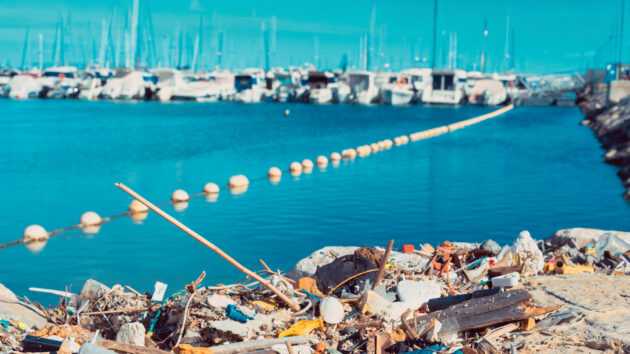
We may never know the origin of the phrase: ‘Where there’s muck, there’s brass’ – but as a southerner, I feel it in my bones that it’s best understood spoken in a Yorkshire accent. On one level it means ‘If you are willing to take on the dirty work, you can charge good money for the service’, but there’s a cannier interpretation too.
Novoloop is a Silicon Valley startup that can turn almost any plastic waste into material that is good enough to make brand new sports shoes – a multi-billion-dollar market worldwide. Novoloop prefers the phrase: ‘Garbage is gold’ and ‘Where some see waste, we see possibilities’.
All well and good, but where does that leave the marine industry in the UK in 2026?
We went on a journey to the edge of the recyclable universe to find out the latest technology for carbon-free, pollution-free sailing (and living).
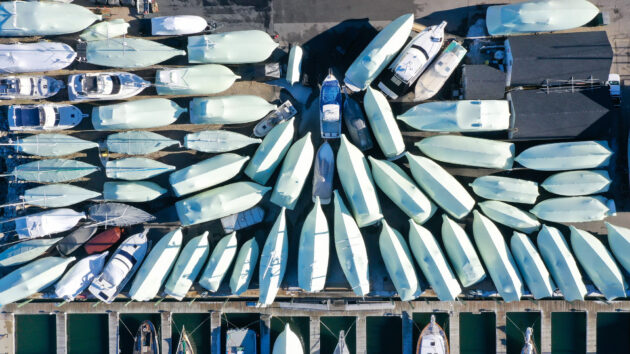
Most shrink-wrap goes straight to landfill and won’t biodegrade. Photo: Richard Langdon / Ocean Images
Circular flow
Buying and using products that are made of recycled materials is an excellent way to reduce your plastic footprint (the average UK citizen disposes of 78.5kg of plastic annually). But the long-term benefit really comes from products that can then be recycled repeatedly.
Earlier this year, Marblehead ECO sailcloth was featured in YM’s New Gear section, but it is a great example of a product that is both profitable, recycled and recyclable. Sold in the UK by Crusader Sails, Marblehead ECO is manufactured by the US company Challenge Sailcloth. The woven cloth is made from 100% recycled plastic bottles (2,336 plastic bottles for a mainsail on a 40ft boat, according to Challenge) and has the same properties as virgin fibre. It is also 100% recyclable at the end of its life.
Previously, the industry has struggled to develop a fully recycled cloth, as recycled polyester yarn varied in consistency, resistance to UV and stretch. According to Paul Lees, founder of Poole-based Crusader Sails, Marblehead ECO is comparable to traditional Dacron sailcloth:
‘There is no other sailcloth that has the whole equation of being made from 100% recycled material and is 100% recyclable at the end of use. It also has the same performance as traditional sailcloth. Crusader’s entire offshore range is now made with Marblehead. There is little excuse now not to use recycled sailcloth in polyester/Dacron cruising sails.’
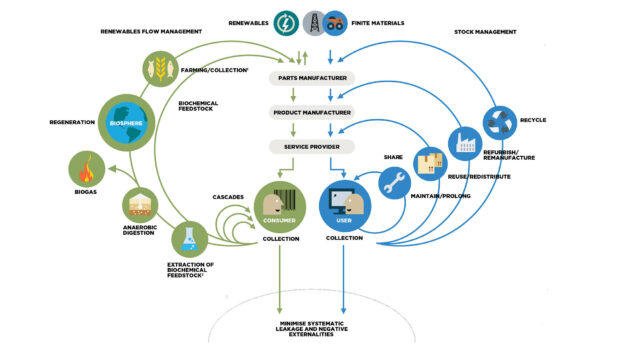
Dame Ellen MacArthur left ocean racing 16 years ago to start an environmental foundation and the term ‘circular economy’ has now entered the lexicon in large part thanks to the foundation’s work
Naturally, there are hundreds of thousands of sails out there that are not made of Marblehead ECO, so what’s to be done with them? Non-profit action group Clean Sailors was founded in 2020 by sailor and ocean activist Holly Manvell. Clean Sailors is a collaboration between a small number of committed individuals to raise awareness of ocean conservation opportunities within sailing.
Dismayed by the fact that over 97% of old sails end up in landfill and the lack of formal recycling facilities, anywhere in the world, they set up ReSail to connect recycling programmes with boat owners seeking to discard old, used sails, bags and sheets. At the time of writing there were 14 drop-off locations in the UK and 44 in total across 15 countries.
One high-profile recipient of this recycled material was Ruskin School of Art’s first-year fashion students, who were set the task of designing clothing from old sails.
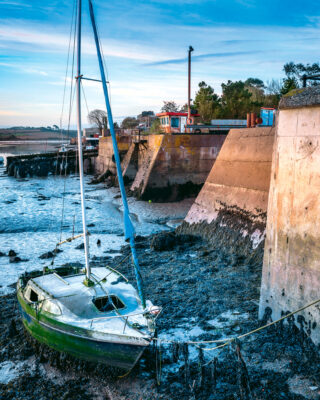
A long forgotten sailing boat is left to rot next to the entrance of the old shipyard in Appledore, North Devon
End-of-life GRP hulls
According to a European Boating Industry report from 2022, yacht building can be a dirty business. Not only is there 70,000 tonnes of waste generated per year from yacht construction, but there are 24,000 abandoned yachts in the EU alone, creating significant disposal challenges.
There are two parts to the typical plastic boat hull: the plastic and the mesh of fibres inside it. The plastic is of a type known as thermoset plastic (polyester resin or epoxy resin) which cannot be re-melted or recycled, meaning the old boat hull either goes to landfill or gets burned for energy.
Worldwide, 95% or more of GRP boat hulls go to landfill and do not decompose. However, thermoplastics, such as PVC, nylon and rigid polystyrene can be remelted indefinitely and can be combined into useful composites with biodegradable fibres or recyclable mesh. More on that later.
Will Higgs runs a company called Marine & Boat Recycling in Tavistock, Devon, that claims to be the only business in this field that sends none of its GRP waste to landfill. He arranges to transport end-of-life boat hulls of all sorts to be dismantled at his facility (or with his mobile plant) for spare parts and materials, before the hull is broken down and, in the case of GRP hulls, mechanically recycled into GRP planks.
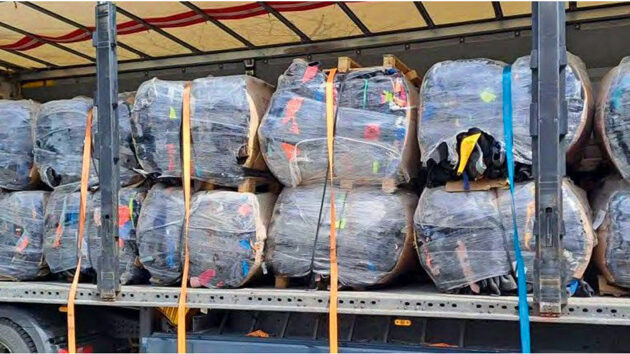
Bales of old wetsuit material ready for transportation
Giving GRP new life
‘We’re not changing the chemical makeup of the GRP,’ he tells me. ‘We’re grinding it back down into an aggregate, which is a sort of fluffy, dusty, spiky kind of a matrix, kind of like loose chopped-strand fluff, but obviously a bit dirtier…’
This re-ground fibre is then mixed with resin and ‘a few secret sauces, just to make it UV stable, and so on…’ before being heated and extruded into planks of the size and shape you’d see scaffolders using on a construction site.
All these extracted and extruded goods are up for sale at the company’s shop on site in Tavistock, with plans to sell online as well. The planks are useful for making picnic tables, outdoor decking and more. He explained that lead in the keel will usually cover the cost of the dismantling process, but transportation is the fee that private owners or harbour authorities are required to come up with.
‘Once people realise that they’re staring down the barrel of a £1,500 mooring bill for the year, or a £5,000 marina bill for the year or whatever, the disposal option isn’t actually that bad – it’s only what they would spend on that year anyway if their boat’s sitting there as a liability.’
Article continues below…
Obviously, mechanical recycling is better than straight to landfill, but the systemic solution to the problem is to make a completely circular flow by using materials that can be reused for the same purpose almost endlessly – the Ellen MacArthur way.
I reached out to Grace Stubbins, senior managing editor of CompositesWorld magazine, for context on the wider topic of composite recycling: ‘Unlike thermoset resins [such as polyester resin and epoxy resin], thermoplastics are considered inherently “recyclable” because of their ability to be remelted and remoulded.
There are many companies developing various recycling methods – mechanical, chemical, thermal and other – that support these efforts in different ways. We’ve got an entire list of composite recycling companies, or companies offering equipment/processes to achieve recycling at: www.composites world.com/kc/sustainability.’
Ecominera is a fully recyclable composite that claims to be the first of its kind to be proven in real-world marine conditions.
It is manufactured using circular production methods using mineral fibre and bio-based resin, making it fully recyclable and free from toxic chemicals.
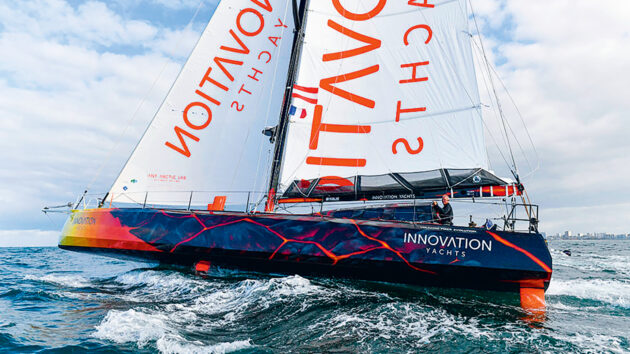
Open 60 yacht ANT ARCTIC LAB is made of recyclable composite
It is a commercial application of a technology developed by Innovation Yachts (IY) a French company based in the Vendée region that has been promoting its environmentally inert composite materials for more than 15 years. IY’s first prototype, Fipofix, was built in 2012. Similar to a Mini 6.50, Fipofix was a lightweight offshore racing yacht with twin rudders and a canting keel that can be fully recycled.
Instead of carbon ‘tow’ (the fibre matrix used in carbon fibre), which is considered a ‘forever’ material in waste management terms, Fipofix makes use of natural minerals such as volcanic ash and basalt rock. This recipe (which is a closely guarded secret) is melted and pulled into fibres that reinforce the biobased epoxy.
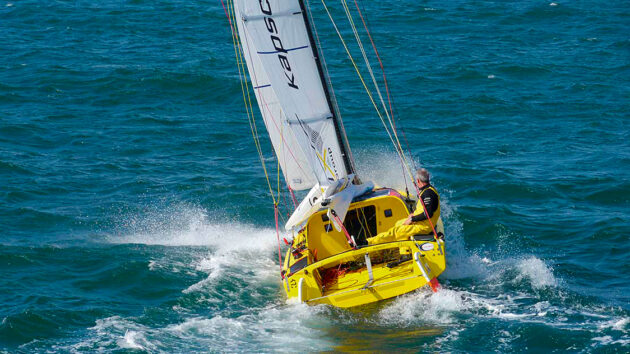
Open 16 Fipofix raced across transatlantic several times
Eco collaboration
EcoMinera has been developed as a joint venture with IY to form the foundation of a global-scale business plan that includes building and leasing a fleet of expedition yachts for commercial chartering, marine research vessels and documentary film-making boats, plus applications in construction, transportation (EV battery enclosures, body panels, trucks), wind turbine blades and other industrial markets, such as tanks and pipes.
CEO Andrew Cowen is ex-Unilever, while technical lead Andy Hindley was a senior member of the America’s Cup organisation with experience in finance and event management with Ben Ainslie Racing and the Volvo Ocean Race. Meanwhile founder and director of IY, Norbert Sedlacek Koch, is busy preparing his Open 60 ANT ARCTIC LAB (AAL) for an unusual circumnavigation involving rounding Svalbard before rounding Antarctica!
Italian company Northern Light Composites (NLComp) is trending in the same direction as EcoMinera, having developed its own recyclable composite known as rComposite. Its website lists projects such as EcoRacer 30, EcoRacer 25 and now the EcoFoiler – all made of rComposite, as well as a collaboration with performance cruising brand Grand Soleil.
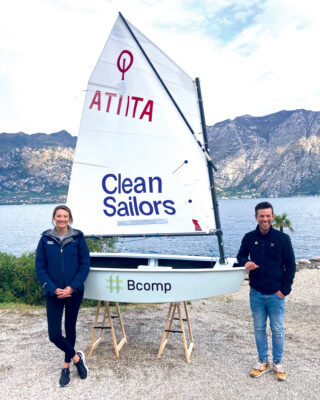
The EcoOpti project brought NLComp and Clean Sailors together to make a recyclable optimist dinghy prototype
‘Recycling composites is crucial,’ says company founder Fabio Bignolini. ‘Because, in 2026, it’s simply no longer acceptable to abandon boats in marinas or bury wind turbine blades in landfills in South America. The materials we’ve been using for decades were designed for performance, not for their second life – and now we are facing the consequences.
‘The good news is that solutions exist today. Technologies, processes, and new material approaches are already enabling circular pathways. I strongly believe it’s our respons-ibility – especially as a younger generation in this industry – to make sure these solutions are implemented, not just discussed.’
The EcoOpti was an early NLComp project in conjunction with Clean Sailors. Launched as a prototype in 2022, there are three main reusable elements: the boats’ laminate contains AmpliTex fibres made of natural flax instead of manmade fibres. AmpliTex is described by its Swiss manufacturer BComp as having ‘much more attractive end-of-life options and environmental properties’ than glass-fibre or carbon-fibre composites.
NLComp also makes use of a resin called Elium, by a company called Arkema, which is a thermoplastic matrix allowing for easy chemical processing and recovery of the raw materials, enabling the boat to be recycled at the end of its life.
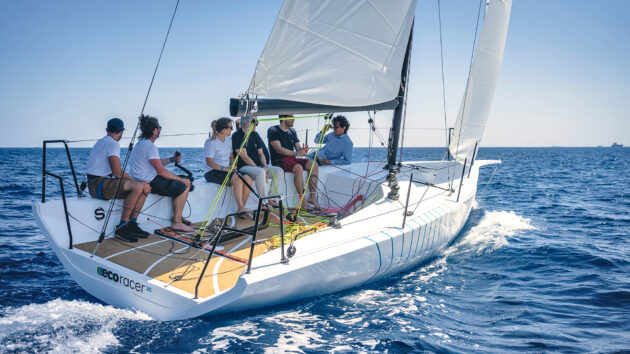
NLComp’s EcoRacer 30 is made of recyclable composite
And finally, OneSails used its proprietary 4T FORTE sailcloth to make the sails. Unlike the woven Dacron material used in Marblehead Eco, 4T FORTE is a laminate material. According to Onesails: ‘Glues, resins and solvents have been replaced by heat fusion and the base polymer is 100 per cent recyclable in a standard waste separation process.’
Raising awareness
Technology is part of the solution, but action and political pressure have a big part to play as well. Consumer power can move mountains in the surveillance-heavy markets we all frequent online, but there are individual stories of inspiration leading to action, plus big boating events, such as Southampton Boat Show and the recent RYA Dinghy Show that can reaffirm the ordinary sailor’s commitment to keeping plastic and other pollution out of the sea.
Shrink-wrapping boats is becoming more and more popular and is regarded as essential in many parts of the US to protect boats against the winter weather, but the waste is staggering: there are about 11.6 million registered boats in the United States, which generate more than 46,472 US tons of shrink-wrap annually. That includes 294 tons of shrinkwrap in Rhode Island, the smallest state in the Union, with only seven per cent of that being recycled. Then one man decided to do something about it…

Bioaqualife has created a landfill-biodegradable plastic wrap
BioWrap is a non-toxic plastic shrink-wrap solution that biodegrades in a landfill without leaving microplastics, unlike traditional marine shrink-wrap. The company, bioaqualife, was founded in Jamestown, Rhode Island, in 2023 by British sailor Simon Milne, who says that given the right landfill conditions (dry anaerobic digestion) bioWrap will attract microbes that can convert it into water, gas and organic matter.
It is as strong and waterproof as any other shrink-wrap and it won’t begin to biodegrade in normal use or storage. It is available in the United States, Australia, New Zealand, Turkey, France, and the Middle East, with plans to expand to the rest of Europe, Central and South America.
In March 2026, the inaugural Boating Tomorrow Show was held in Nice, Cote d’Azur. With exhibitors afloat and on land, plus two days of conferences, the sustainable boat industry came together to promote everything hybrid, electric and hydrogen-powered, including solar panels, bio-sourced construction materials, batteries, sail propulsion for cargo vessels, as well as sustainable deck fittings.
A month earlier, in Farnborough, Hampshire, the RYA Dinghy Show was held, with two environmental initiatives publicised in the build-up: the Final Straw Foundation (FSF), which supports environmental causes of particular interest to sailors and watersports on the South Coast, and Circular Flow, which specialises in a sustainable global circular economy for neoprene waste.
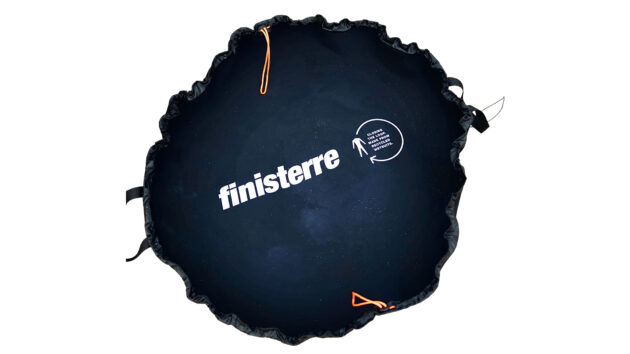
Finisterre sells a changing mat made of recycled wetsuit material
Saving the shoreline
Bianca Carr founded the Final Straw Foundation in 2018 after noticing the growing tide of litter on the South Coast and the unnecessary use of disposable plastics.
What began as a small campaign of beach cleans and business engagement has since grown into a registered charity, inspiring communities across the UK to cut pointless plastic and protect the environment.
FSF runs biodiversity programmes in support of seahorse habitats and oyster regeneration, while organising beach cleans and providing ‘how-to’ advice for other groups considering taking action on shoreline pollution.
The group is also involved in the 365 Days of Water Testing project, which is a year-long citizen science initiative led by Final Straw Foundation and Hayling Sewage Watch, running from July 2025 to July 2026 across Emsworth Harbour and Beachlands, Hayling Island.
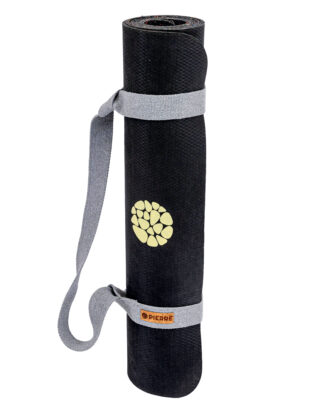
Pierresports has a yoga mat made from recycled wetsuits
Using advanced technology from a company called Fluidion, volunteers will deliver same-day results for pollution and E.coli, far surpassing the limited official testing. The project aims to give the community real-time, reliable data to protect public health and hold authorities accountable.
‘Our aim is simple: to collect a long-term daily data set of water quality metrics for the two sites, to give the community water quality results that protect public health, build trust, and inform local decision-making.’
Circular Flow is a company founded specifically to tackle the 60,000 tonnes of neoprene that goes into landfill annually, including tonnes of yoga mats.
Based in Bulgaria with some operations in Thailand, Circular Flow is in the business of mechanically recycling neoprene into a product called Renoprene, which can be made into useful products and then recycled continuously.
They don’t claim to be able to make new high-performance wetsuits, but socks, gloves and changing mats require less stretch and insulation, plus items with a solid rubbery feel, such as flip-flops, yoga mats and all types of insulation. The company was collecting old wetsuits and neoprene products at the sustainability hub at the RYA Dinghy Show, Farnborough, and is working with suppliers including Finisterre, Alpkit and Boardshop.
Alpkit will accept any brand of outdoor clothing or neoprene for repair and reuse, while Boardshop will accept neoprene that is beyond repair, sending it to Circular Flow for recycling. Wetsuit Outlet offers its WSO+ members the option of returning an old wetsuit when they buy a new one.
Giving neoprene a second life
Emma Major-Mudge is head of sales and commercial partnerships at Circular Flow: ‘From a business point of view, our model works because we’re able to turn a hard-to-recycle waste material into something useful. By collecting and processing old neoprene at scale, we can supply recycled material back into manufacturing, which helps brands reduce waste and their environmental impact while still making commercial sense.
Items made from Renoprene, can also be recycled again and again!’
Enjoyed reading this?

A subscription to Yachting Monthly magazine costs around 40% less than the cover price, so you can save money compared to buying single issues.
Print and digital editions are available through Magazines Direct – where you can also find the latest deals.
YM is packed with information to help you get the most from your time on the water.
-
-
- Take your seamanship to the next level with tips, advice and skills from our experts
- Impartial in-depth reviews of the latest yachts and equipment
- Cruising guides to help you reach those dream destinations
-
Follow us on Facebook, Twitter and Instagram.
Note: We may earn a commission when you buy through links on our site, at no extra cost to you. This doesn’t affect our editorial independence.