


Celebrating 100 years of the BBC Shipping Forecast, Jane Russell takes us on coastal cruises through the forecast sea areas, exploring the special places on offer in each
Sailing the Shipping Forecast: Dover
Dover sea area is a relatively small but significant wedge of water between Deal and Beachy Head on the English coast and across to the continental coast from Oostende in Belgium to Saint-Valéry-Sur-Somme in Hauts-de-France.
It is the meeting place of tides flooding up the Channel and down the North Sea. Within it is the squeeze point of the Dover Strait that funnels and accelerates tides and winds and also funnels shipping. Into the mix are the round-the-clock ferries heading to and fro across the Channel.
It is also the crossing zone for the ‘small boats’. All of which offer some challenges. Add to that the notorious Goodwin Sands and it may be tempting just to get through it.
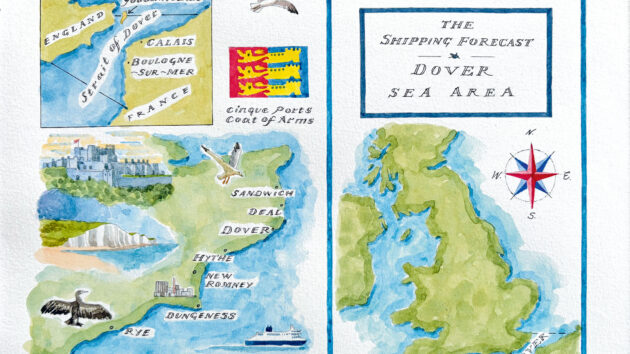
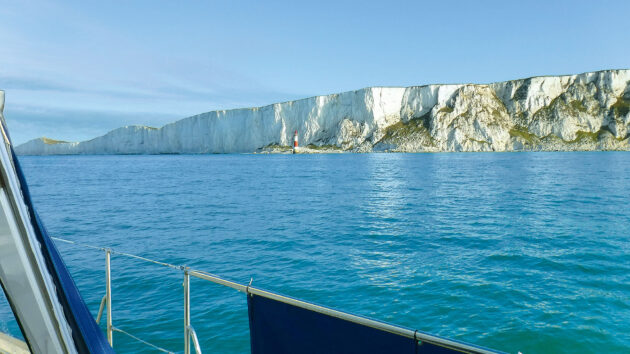
Photo: Joanna Martin, Curlew Cottage Design
But this small sea area has a big history. It is where William arrived to conquer and is the land of the Cinque Ports, formed for military and trade purposes in the 1100s.
Going back much further in time, the area’s unique geology is now celebrated by the Cross-Channel/Transmanche Geopark illustrating how chalk laid down in a shallow sea was tectonically uplifted into a chalk ridge that connected the UK to France. But the ridge was like a dam and the dam eventually burst, making us an island and gifting us the white chalk cliffs that characterise this coastline on both sides of the Channel.
These coasts are not as naturally indented as they once were and don’t offer many protected anchorages, but there are a few interesting river ports to explore. The main tidal shed is at Dungeness, not in the narrows off Dover.
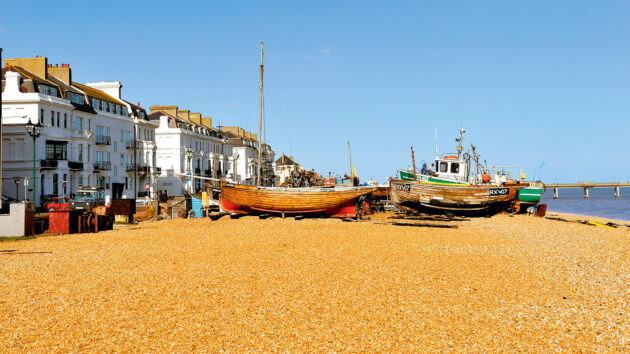
Waiting for a tide at Deal was an option to optimise their onward timings. Photo: picture that / Alamy Stock Photo
Sailing the Shipping Forecast: Variable 2 to 4. Smooth or slight. Fair. Good.
Making the most of the early season easterlies that had been forecast was our priority. We wanted to make the most of them to get us as far as possible down the Channel before the westerlies returned. Getting west from Dover was the first challenge on our voyage around Britain.
We had paused in Ramsgate to wait for the winds and see friends. Now, with a dredger in the harbour entrance, we waited a little longer for permission to leave, but we weren’t in a rush.
Tides run strongly past Ramsgate and through the shallows of the notorious Goodwin Sands. However, heading south, we sometimes choose to buck the tide for a while, because the aim is to be close inshore off South Foreland to pick up the very beginning of the westerly flow down the Channel.
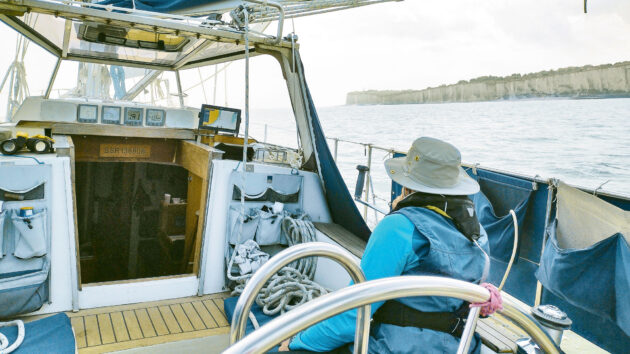
Reaching down to South Foreland to pick up the first of the westerly tide. Photo: Jane Russell
Alternatively, and depending on conditions, we might wait for a tide at Deal to optimise our onward timings. We anchored off the beach there, quite close in, just south or north of the pier. This time, with a light easterly wind, we were happy to make slow progress south from Ramsgate against the diminishing ebb, tucking inside the Goodwins and staying close to Pegwell Bay.
The buoyed channel that meanders across Pegwell Bay leads up the narrowing River Stour into Sandwich. This is the first of the original Cinque Ports and a very old harbour town, its story told at Sandwich Guildhall Museum. There isn’t much turning room in the river at Town Quay, but sufficient water over very soft mud to stay upright at low tide. At the end of the ebb, it wasn’t for us this time.
Strictly speaking, we were still in Thames waters, but as we inched onwards under main and cruising chute we eased past Deal and crossed into sea area Dover. We stayed close inshore, past the pier and the elegant seafront, past the castles of Deal and Walmer, and then along the groyned beachline beneath the cliffs of chalk rising to South Foreland.
Here we felt a new navigational worry for our times, that we might come across a small boat. Fortunately, it didn’t happen, but the awareness and concern was definitely there.
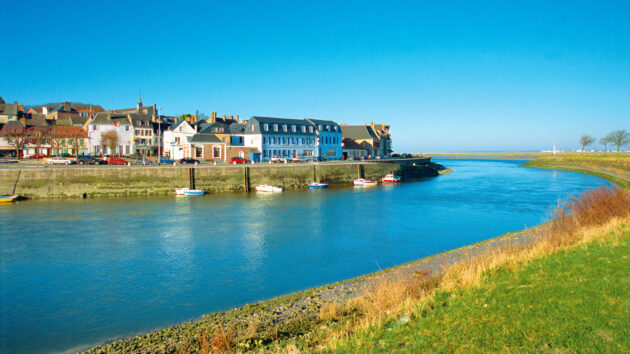
The entrance to the Somme estuary in France can become unsafe in strong onshore winds or seas. Photo: Robert Harding / Alamy Stock Photo
Sailing the Shipping Forecast: Variable 2 to 4, becoming N or NE 5 at times. Smooth or slight. Mainly fair. Good.
With the wind already gently from the east, these were much more benign conditions than we might have expected on this leg and it didn’t make any sense for us to stop at Dover. But Dover marina is a good place to pause and is definitely worth a couple of nights to allow a full day exploring in and around the medieval castle, including the Second World War tunnels, and visiting the museum in town.
Another of the original Cinque Ports, and long thought of as the key to England, Dover’s strategic maritime importance goes back at least to Roman times. The remains of the old Roman lighthouse are within the castle grounds.
But it seems likely that seafarers were using Dover as a refuge much longer ago than that. Dover Museum is home to the preserved remains of a Bronze Age boat which is thought to have been in use around 1500 BC.
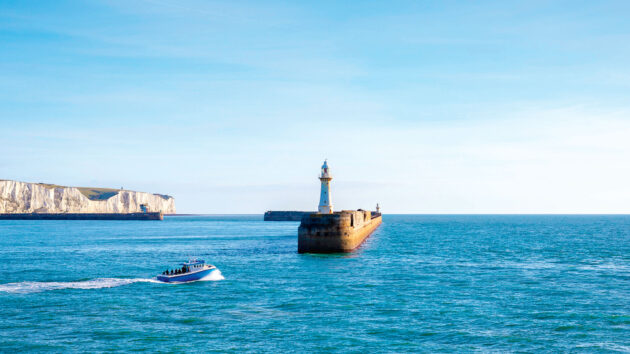
Take care passing Dover and if entering ensure to get permission from the harbourmaster. Photo: Stewart Mckeown / Alamy Stock Photo
Now, with the wind behind us and the tide beginning to turn, we headed out to steer well clear of the harbour and we called up Dover VTS to let them know our intentions. We had our eyes peeled, including on the ferry funnels in the harbour to spot the belch of smoke as they got underway.
Regular zoom-outs on the chartplotter helped us check distant but fast-incoming ferries on AIS. We kept listening watch, held our nerve, and were soon through the gauntlet of ferries going in and out of this busiest of ports. The wind had been fickle but now the acceleration effect of the strait gave us enough to twin out our headsails. We were into the groove and on our way.
A couple of seasons previously, conditions had been very different. It was our two weeks of holiday but the winds were relentless from the west. We had friends on board and we’d promised them foreign shores.
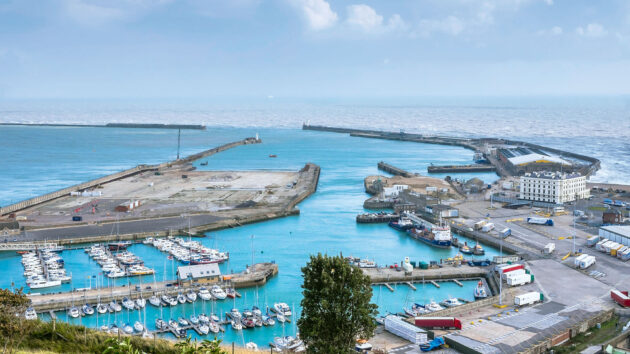
Dover’s strategic importance goes back to Roman times and older. Photo: ams images / Alamy Stock Photo
A veer in the wind and help from the tide gave us a brisk but straightforward crossing of the shipping lanes and down the French coast to Boulogne. There, to the bewilderment of the harbourmaster, I struggled to bring us alongside other boats on a hammerhead in the all-tide marina. The problem was a significant outflow from the apparently closed lock gates beyond the pontoons which kept pushing us off at the critical moment.
Tinfish usually kicks to port in reverse quite nicely, but it wasn’t enough that day. I should have gone in forwards and starboard-side-to. But the offending flow wasn’t fully evident until we looked down on it from above.
Happily, after a couple of failed attempts and some close circling in the rather narrow space, our fellow sailors on other boats took pity on me, received our lines and helped to manoeuvre us in. When we went up to the office I was treated to a rather incredulous shake of the head at my efforts. I could only imagine the thought bubble that accompanied it! But we were in safe, no boats were damaged, no people were hurt, and I had learned my lesson for next time.
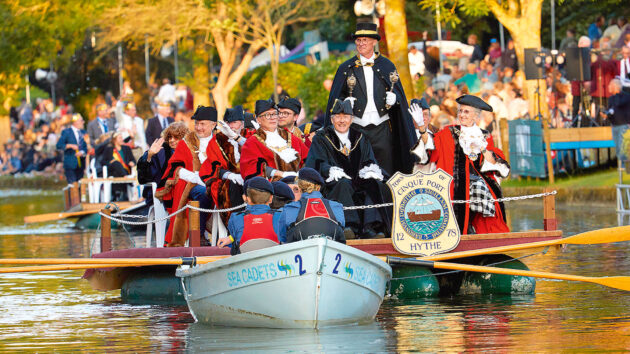
The floating Venetian parade at Hythe. Photo: Steve Hickey / Alamy Stock Photo
St-Valéry-Sur-Somme, a bit further down the coast at the boundary of the Dover sea area, had good reviews from friends. But with the onshore winds on that trip and the very shoal entrance, it wasn’t an option but it’s still on the to-do list.
Now here we were, running southwestwards over a very gentle sea towards the massive block outline of Dungeness power station. In the distance to starboard, long silted, no longer navigable and protected behind a high sea wall, were the original Cinque Ports of Hythe and New Romney. Walking the coastal defences there and looking out across the marsh and pastureland, it seems extraordinary that these were once important harbours maintaining ships for the king in case of war.
Dungeness is an important tidal gate and we needed to get past before the tide turned against us.
A moderate breeze had now filled in behind us and was holding steady and we were feeling relaxed as we passed close in to the point with plenty of time to spare.
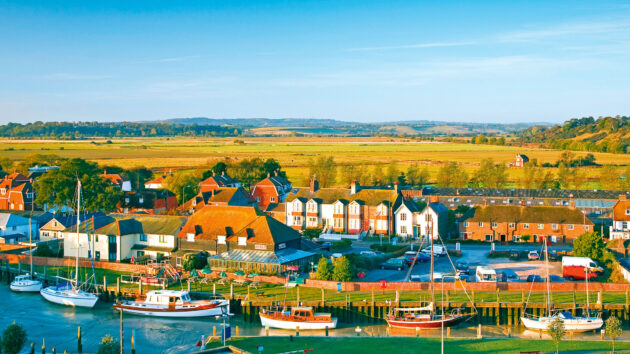
Visitor berths at Strand Quay in Rye dry to soft mud. Photo: Keith Shuttlewood / Alamy Stock Photo
The next gate would be Beachy Head and there wouldn’t be much to be gained by fighting the tide there, so we could take it easy across Rye Bay, looping north of the rhumb line to get us out of the worst of the adverse current.
It was now early evening and as the light faded we began to see the lights of a few fishing boats working beyond us in the bay. With twin headsails set and the windvane taking the helm we could enjoy our watches stargazing.
Up in the north of the bay was the entrance into Rye Harbour. With memories of youthful attempts at windsurfing, out through the surf, at neighbouring Camber Sands, Rye has always felt like a daunting entrance. It certainly wasn’t somewhere we would contemplate going into in the dark. But we know from friends that it is a gem of a place.
Visitor berths are at Strand Quay drying to soft mud. Call the harbourmaster for advice before arrival. Rye is a really lovely old town, perfect for wandering. Inside Fairlight Knoll we ran parallel to the coast.
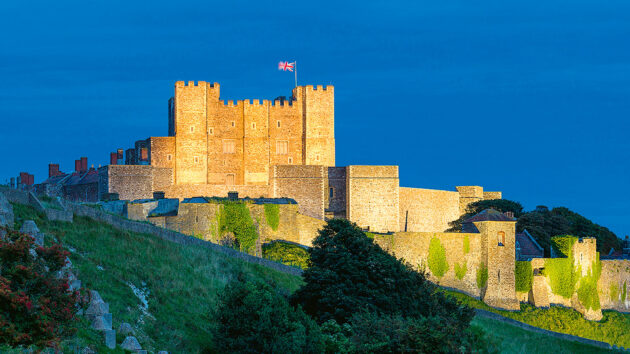
Historic Dover has plenty to explore, including its medieval castle. Photo: Stewart Mckeown / Alamy Stock Photo
East of Hastings all was dark. Not enough moon for an outline of the high ground at Fairlight. But then we closed in on the light-polluting but reassuring street lamps along the coast at Hastings and St Leonards and on to Bexhill. Hastings was the last of the original Cinque Ports. Like Hythe and New Romney, it’s hard to imagine that it must have once had a more indented, deeper harbour. But it still has boats hauled up onto the beach under the protection of a breakwater.
By the time we were off Eastbourne, well inside Pevensey Shoal, we had Beachy Head in our sights. Apologies to Eastbourne, but westbound, for us, is usually the way: we’ve bucked the adverse tide and we are anticipating the change in our favour.
Beyond Beachy Head are Newhaven and Brighton, boyhood home-ground for David. Why would we stop with the wind behind us and the tide about to turn? So, on we sailed, the wind still steadfast behind us, the seas still kind. We knew just how fortunate we were to have this window.
If it hadn’t been this way, if the wind had been against us, if we were about to miss the tide gate at Beachy Head, we would have retreated with gratitude into
the warm embrace of Sovereign Harbour.
At midnight we were approaching Beachy Head, its lighthouse flashing reassuringly. Away to port the various buoys on Royal Sovereign Shoals were flashing like a disco, signposting the hazards of the decommissioning of the old tower.
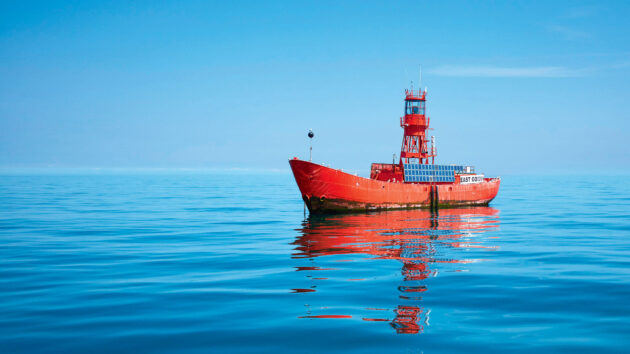
The East Goodwin Lightship, near Goodwin Sands, is a notable marker. Photo: Alan Payton / Alamy Stock Photo
The wind was dropping to a more gentle breeze but still behind us. We ghosted out of the Dover sea area and into the Wight zone.
It’s a relatively short walk up the hill from Dover Marina to Dover Castle, and a much shorter walk into town to Dover Museum and the Bronze Age boat. The history of the harbour and town is fascinating and the views from the castle are spectacular. It really is worth spending time there and exploring some of its history.
Rye became a further Cinque Port and although the harbour is now significantly reduced, the town on the hill above has retained defences and medieval buildings from that heyday. It’s a lovely place for walking the cobbled streets and enjoying the picturesque old buildings. There is also good access to the Rye Harbour Nature Reserve coastal wetland habitat.
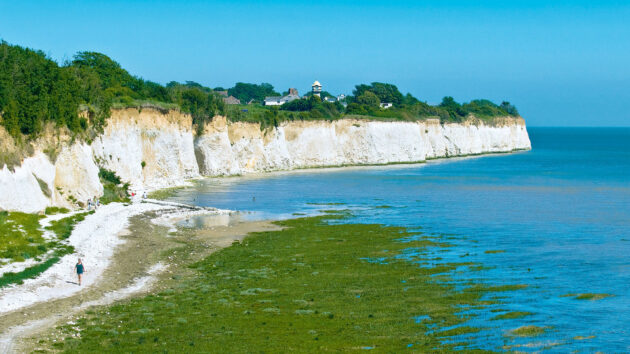
The channel that
meanders across Pegwell Bay leads up the River Stour into Sandwich. Photo: Loop Images Ltd / Alamy Stock Photo
For walkers, Eastbourne is a good base from which to walk over Beachy Head and the Seven Sisters to or from Seaford. Trains and buses will take you out or bring you back.
Like Dover, the history and appearance of the Belgian and French coastal towns was shaped by wars, remembered at a number of sites and museums. A much older shared geological past is now being celebrated, with encouragement to visit chalk landscapes, wetlands and significant buildings on both sides of the Channel at https://geoparktransmanche.org/
Article continues below…
[collection}
Scottish Coastal Sailing – Getting Around
Marinas and crew changes
On the English coast, there are marinas with visitor berths at Dover (all-tide or lock-in basin, 24 hrs) and Eastbourne (lock-in basin, 24 hrs). Both have rail connections and bus links.
On the continental coast there is all-tide access to marinas at Oostende and Nieuwpoort in Belgium, with access to inland waterways from both.
On the French coast, Dunkerque has two all-tide marinas with berths for visitors and access to locked basins and inland waterways. Calais has waiting buoys outside a lock-in marina basin and access to inland waterways. Boulogne has an all-tide marina and lock-in basins. All have rail connections.
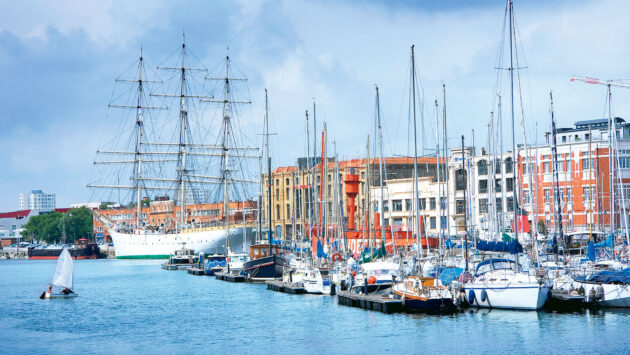
Dunkerque inner harbour, France. Photo: Mark Bassett / Alamy Stock Photo
Ferries run between Dover and Calais and between Dover and Dunkerque.
For boats that are shoal draught and/or willing and able to take the ground or sit in the mud there are further possibilities at Sandwich and Rye on the English coast and at Gravelines, Étaples and in the Somme estuary in France. The shoal or drying entrances to these harbours become unsafe in strong onshore winds or seas.
Cross-Channel exit/entry formalities have been changing over time, as have the regulations around travelling with pets. Before you go, check the latest rules at www.theca.org.uk > Information and Advice.
Pilotage information
North Sea Passage Pilot (Imray) covers routes to and from the continent across the shipping lanes from Dover. The Shell Channel Pilot (Imray) gives good guidance on passagemaking and details the harbours on both coasts. The Cruising Almanac (Imray) is also very helpful. Latest information for visiting Sandwich is at www.sandwichportandhaven.co.uk
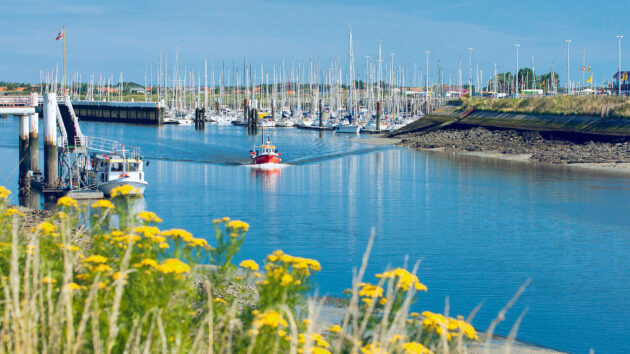
The Belgian port of Nieuwpoort is an attractive stop, marking the start of the Dover
area on the Continental side of the North Sea. Photo: Guido Vermeulen-Perdaen / Alamy Stock Photo
Places to Stop
Dover
The new marina has all-tide access and visitor berths. Call Dover VTS 2NM out from the harbour and do not enter without their permission. Cross the harbour close to the southern breakwater.
Entry into the marina past the wave-screen is also controlled by the VTS and there may be a wait. www.portofdover.com/marina/
Nieuwpoort
This port town is approached down an avenue of white-topped dolphins. The dredged entrance between piers is prone to silting and a cross set at the entrance. But once inside there are visitor berths at a choice of marinas, with full facilities, restaurants and access to the coastal tramway.

The passage took them close to Walmer Castle, behind Deal beach. Photo: Mat Ladley / Alamy Stock Photo
Calais
Be aware the route between Dover and Calais is subject to strong cross tides but course adjustment is restricted because of the TSS.
Aim to arrive about 1hr before HW to go through the bridge and over the cill into the marina. Monitor Calais Port radio and only enter with permission. See www.calais-marina.fr
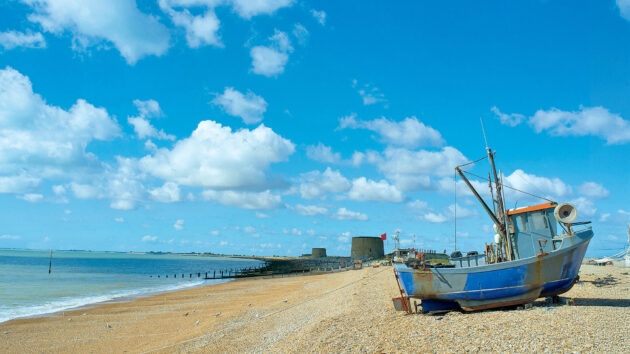
One of the original Cinque Ports, Hythe is
a great place for a wander. Photo: Stephen French / Alamy Stock Photo
Eastbourne
This purpose-built marina development is accessed along a dredged channel and through lock gates. All-tide access to the locks which open every half hour. There are full facilities including a boatyard, with shops, cafes and entertainments nearby. Call ahead to book a berth or if concerned about entrance depths.
Enjoyed reading this?
A subscription to Yachting Monthly magazine costs around 40% less than the cover price, so you can save money compared to buying single issues.
Print and digital editions are available through Magazines Direct – where you can also find the latest deals.
YM is packed with information to help you get the most from your time on the water.
-
-
- Take your seamanship to the next level with tips, advice and skills from our experts
- Impartial in-depth reviews of the latest yachts and equipment
- Cruising guides to help you reach those dream destinations
-
Follow us on Facebook, Twitter and Instagram.
Note: We may earn a commission when you buy through links on our site, at no extra cost to you. This doesn’t affect our editorial independence.