


What’s it worth to make your boat’s facilities easier and more convenient to use? Jake Kavanagh looks at the costs and the benefits to help decide
Efficient use of power is rarely far from a skipper’s mind, so building in capacity to flush toilets using battery power when the tried-and-tested mechanical option is so much less expensive might seem wasteful.
However, there are a few cogent reasons for spending the extra cash and complicating your boat’s plumbing – one of which is reduced water usage. This would lead to improved holding tank efficiency and the possibility of using fresh water instead of raw water for flushing, thereby reducing corrosion and odours in your pipework significantly.
Push-button systems are also more convenient, less time-consuming and make it more likely that guests and new users will feel comfortable and relaxed on board with fewer possibilities that they could make a mistake trying to flush the toilet. And if you spend any time on boating forums online researching the experiences of owners who installed electric loos, the general experience is very positive with repeated refrains of ‘I’ll never go back to manual pumping heads’.
The downsides are the extra cost and the power requirements of electric toilets, plus the noise of the pump and the macerator, although vacuum-pump models are now on the market that really do seem to promise home-from-home convenience.
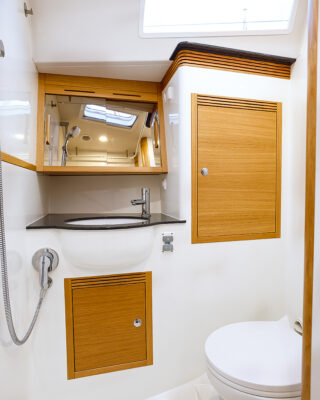
As with most new yachts of this size, the Saare 47 has an electric head installed as standard
Holding tanks
Since 2006, the EU Recreational Craft Directive (RCD) has required all new vessels to ‘have provision for a holding tank to be fitted’, yet in UK waters there is still no law preventing the evacuation of waste from a yacht straight into the sea. In practice, most boats observe the convention of sailing at least 3 miles offshore before emptying their tanks.
If you plan to sail abroad, many countries are a lot stricter than us. There’s a useful guide at: www.tektanks.wpengine.com/sanitation-systems/holding-tank-regulations
Water usage and waste
In places where holding tanks are required by law an electric toilet will help significantly, because it’s the amount of water pumped into the tank that uses up the holding tank volume, rather than the actual sewage. The less water consumed per flush, the less often you need to pump out your holding tank.
Manual pump toilets draw water in from the sea to rinse the toilet bowl. The water and the sewage is then pumped into the holding tank. Jabsco operating instructions suggest seven complete strokes of a manual pump per metre of discharge pipe. If each pump uses 0.5 litres that’s a minimum of 3.5 litres per flush. In practice there is going to be a lot of variation in water volume between different users and types of use.
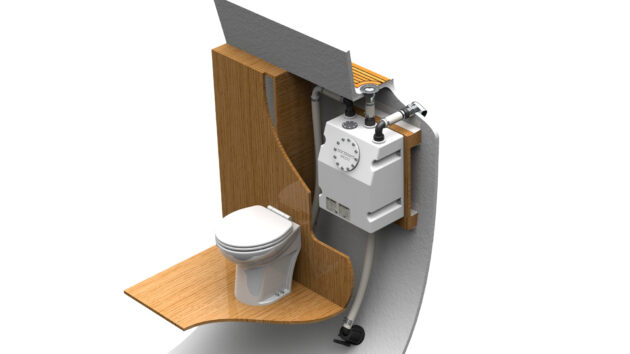
When sailing in waters where holding tanks are legally required, an electric toilet can help with water management
There are two main types of electric toilets on the market for marine use. The most common is a macerator toilet, which combines a pump with a spinning blade to convert water and waste into slurry. The other uses a vacuum pump, similar to the systems you find on aircraft and trains.
Macerator toilets use a managed amount of water per flush and in general, will fill a holding tank more slowly than a manual pump. But if water conservation is the goal, fitting a unit with an eco flush option is essential: for instance the SaniMarin and Dometic low-voltage macerator toilets use 1.5-1.7 litres for eco flush and between 2.2-2.5 litres for a full flush.
‘Most but not all have eco and full flush options,’ says Karl Sutcliffe, director of marine equipment company Lee Sanitation, but it’s worth checking the specifications. ‘Careful consideration of the water usage of a macerator toilet should be advised as there are some that use up to 4 litres per flush.’
The downside to both of these systems is that the contents of the toilet bowl can remain in the pipework until the next flush pushes them through to the holding tank.
It is essential to specify the highest-grade flexible marine hose for sanitation installations, but after a certain amount of time, odours will permeate. For this reason alone the more modern vacuum-pump system is an improvement.
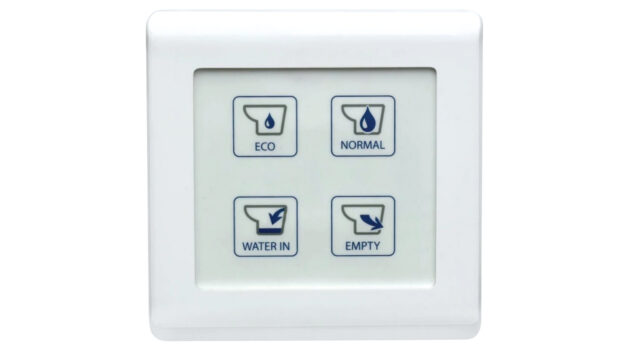
The control panel for the Vetus TMWQ features an eco-flush option
At this year’s Marine Equipment Trade Show (METS) in Amsterdam, Swedish company Dometic was nominated for an award for its VacuMAX tank system, which uses negative air pressure to pull waste from the toilet bowl to the holding tank. Most vacuum-pump systems use fresh water, but raw water is still an option. As mentioned, vacuum-pump systems leave the pipework empty, but they are also the most water-efficient, using as little as 0.5 litres per flush.
The VacuMAX system is a 50-litre holding tank with an integrated pump sitting on top and pipework that can all be connected and disconnected by hand. Dometic can also supply all the elements as separate components – often necessary for multi-head installations.
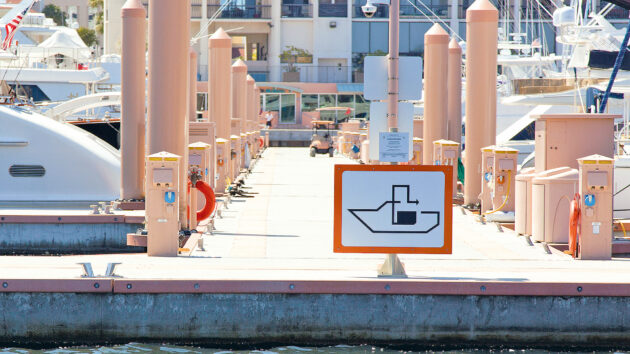
A marina pump-out station
Fresh water supply
Once you are confident about the water usage, it becomes feasible to consider using your boat’s fresh water supply for flushing instead of salt water. For one thing this removes the need for another through hull – instead a solenoid valve will control the water flowing into the bowl.
But the main benefit is to reduce odours and corrosion. Yacht toilets that flush with sea water have a distinctive smell, which
is usually not to do with the sewage. Rather, it is caused by the bacteria and marine life within the seawater decomposing in the inlet pipe. In the outflow pipes, urine reacts with seawater to create limescale, leading to blockages.
Fresh water flushing creates less corrosion and fewer odours, but it’s a big operation to obtain and store that amount of water, so the ability to use fresh water on occasion to rinse the raw water out of the system is a good compromise for those on a tight water budget.
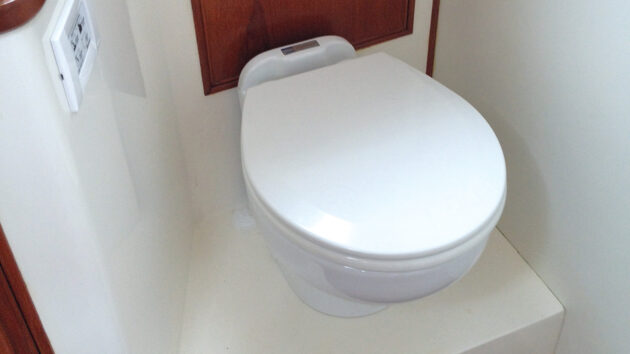
To ensure your electric toilet is as quiet as possible, seek out units with separate inlet pumps that can be boxed off and individually soundproofed
How to specify less noise
The use of macerators is both a plus and a minus. On the upside, the spinning blades in an electric toilet turn solid waste into slurry that is easy to pump away from the toilet. But on the downside is the noise.
Lee Sanitation’s Karl Sutcliffe says there is a big difference in specification at different price points.
‘There are a lot of toilets out there that are quite cheap, but they tend to use one motor to drive two impellers,’ he says.
‘One is the macerator and the other is the water inlet. It tends to be the water impeller that is noisy, as it is an “interference” fit. A rubber impeller fits tightly into a tube and this creates the noise. The quieter toilets feature a separate pressurised water pump. This will either draw flushing water from outside, or via the boat’s own fresh-water system. This means you can install the water pump away from the loo and enclose it in a special soundproofed box.’
The other factor to reduce noise is to have a soft-close seat and lid.
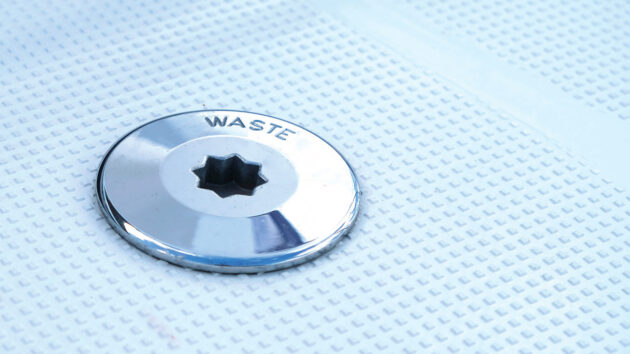
In some cruising waters all vessels are required to be fitted with holding tanks and all discharging at sea is banned
Wiring runs and wiring diameter
Another major factor is the wiring, as Lee Sanitation’s Karl Sutcliffe explains: ‘Electric toilets come in 12V and 24V versions, but a common mistake is to size the wire to the running loads, and not the start-up loads. Operating amps are between 10A and 20A depending on the design, but the initial start-up load can briefly be very much higher. A 12V loo just 3m from the battery will need 5mm wiring.
‘Think about how a bow thruster is wired, and the size of the fuses, and you’ll get the idea. A lot of failures are due to undersized wiring becoming corroded, and the motors getting worn. The two combine to drop the amps below what the motor actually needs.’
Saving space
Marine toilets are often cramped spaces, so electric heads can seem to free up some of that space by removing the manual pump from the side of the bowl. However, retrofitting an electric unit will mean making space below the bowl for the macerator and discharge pump, plus finding space elsewhere for the inlet pump (ideally with soundproofing).
‘Electric loos amidships tend to be easier to install,’ says technical director Chris Doran of Landau Marine, a company that specialises in upgrading equipment already in situ, such as toilets on board.
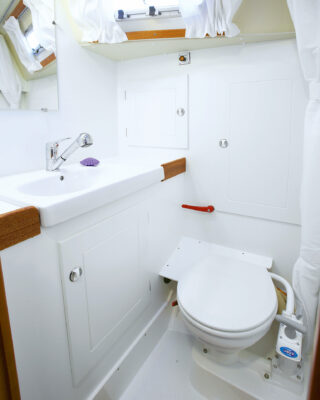
In some cruising waters all vessels are required to be fitted with holding tanks and all discharging at sea is banned
‘On smaller craft, or if the toilet is going into the forward part of the boat, space can be an issue. The hull sides sweep up, so allowances have to be made to leave enough space around the new loo to connect it up, whilst also leaving enough room to use it.
‘You will usually need to get access from below for base mountings, which could be different from the original, and you will have to bend pipes to allow them to connect.
Base height is another factor to consider. ‘We find that canal boats and river craft will go for a full height model,’ says Karl Sutcliffe. ‘Coastal craft usually have shorter versions as they are often mounted on a plinth within a combined shower and heads compartment.’
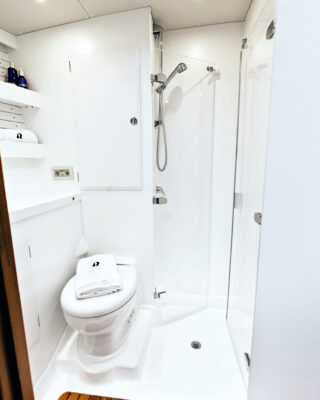
Electric heads in comparison are less bulky, but space is needed below and behind for the pump and macerator
Convenience and safety
The ‘facilities’ can be quite off-putting for many newcomers to sailing. Dual action pumps can also be quite tricky to use if you’re not familiar with them. The consequences of getting it wrong can, of course, be dire.
‘The biggest problems we see are where seacocks are left shut when the loo is being worked,’ said Landau’s Chris Doran
‘This is more of a problem for manual toilets or those that use diaphragms and duct valves. They can “hydraulic” and even blow a hose off. Some electric toilets have fill sensors, and occasionally these fail to shut off so the fresh water spills over the bowl.’
However, according to Xylem’s David Gray, an electric toilet will give many years of good and dependable service if it is treated well, not overloaded with paper, and regularly descaled with proper chemicals. ‘You just need to look after them and winterise them properly,’ he said. ‘Fresh water left in the system can freeze, expand and crack pump housings, so ensure you drain them well during lay-up.’
Enjoyed reading this?
A subscription to Yachting Monthly magazine costs around 40% less than the cover price, so you can save money compared to buying single issues.
Print and digital editions are available through Magazines Direct – where you can also find the latest deals.
YM is packed with information to help you get the most from your time on the water.
-
-
- Take your seamanship to the next level with tips, advice and skills from our experts
- Impartial in-depth reviews of the latest yachts and equipment
- Cruising guides to help you reach those dream destinations
-
Follow us on Facebook, Twitter and Instagram.
Note: We may earn a commission when you buy through links on our site, at no extra cost to you. This doesn’t affect our editorial independence.