


From step-free decks to apartment-sized saloons, modern production yachts are pushing interior space further than ever before
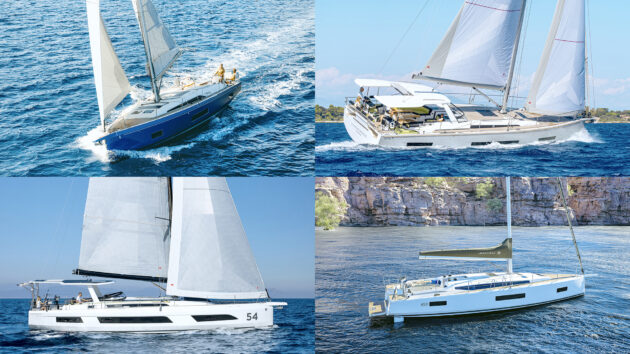
Production yacht design has entered a new era where volume is no longer a dirty word for traditional sailors. Modern naval architecture, defined by full-length chines, flared topsides forward, and wide transoms, has cracked the code, delivering vast interior living spaces without completely compromising the hull’s balance or performance under sail.
Today’s high-volume cruisers are built to cater to two distinct worlds: effortless, luxurious living at anchor, and comfortable, confidence-inspiring handling when passagemaking shorthanded. From step-free walk-through cockpits and fold-down helm pads to flexible cabin layouts that mimic home apartments, the latest generation of production yachts is smarter, roomier, and more adaptable than ever.
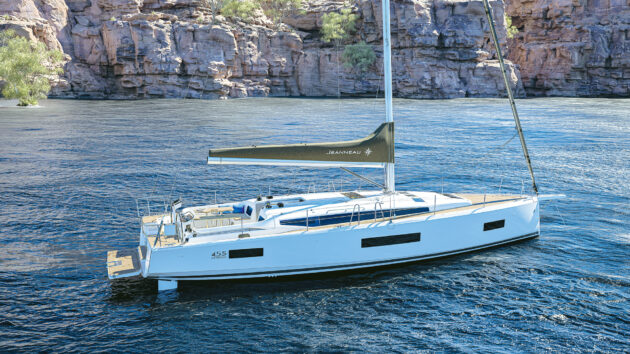
Large hull windows and a reverse sheer bring the Sun Odyssey 455 right up to date
Jeanneau Sun Odyssey 455
Jeanneau says its new models are all about AIR: Accessibility, Innovation and Reimagined spaces. In practice the company has worked hard to make its boats easier to move around and more ergonomic at sea. If it can do so in a way that makes them faster sailers and less expensive to build, then so much the better.
Bridles for the mainsheet strops and ‘flying eyes’ for jib sheet angle control, rather than car tracks, have been a Jeanneau hallmark for years. The other hallmark of the Sun Odyssey range is the step-free access to the foredeck thanks to walk-throughs aft of the twin wheels, via sloping sidedecks. Having sailed other models with this configuration, I can vouch for that fact that it works really well, relieving the need to clamber over cockpit coamings, making it safer and easier on the knees.
On the 455, as low-step coamings were no longer needed, the L-shaped cockpit seats have been fully encircled by comfortably higher, safer coamings, with the steering pedestals offering extended backrests when sitting facing forward.
These coamings hide and protect the main- and jib sheets, which are led aft to winches inboard of the wheels. This looks like a great move; you can winch without kneeling and easily handle sheets on boat sides when tacking shorthanded without having to frantically dash across the cockpit.
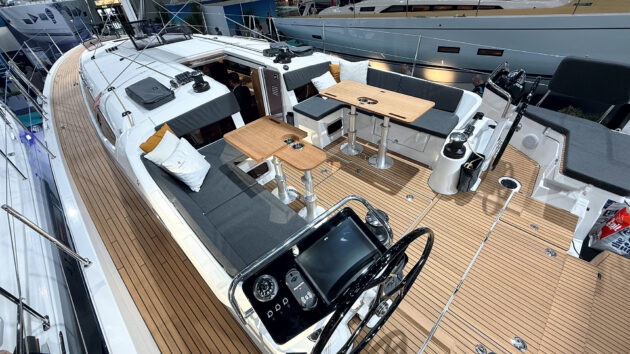
The cockpit features Jeanneau’s hallmark walk-through sidedecks, plus inboard winches
The space to do this is thanks in part to the new-look flared topsides at the transom. A hard hull chine extends all the way forward, and the wide forward sections keeps the bow up, the waterline balanced when heeled, and the twin rudders well planted in the water for decent performance.
Heading below, warm wood finishes have been updated with white cabinetry, making it feel light and stylish. Remarkably, layout options can accommodate up to 10 berths (plus the saloon), with the port aft heads converting to a Pullman bunk cabin, and the forward owner’s cabin splitting into two ensuite cabins.
Private owners will probably prefer the three cabin, two heads layout, in which there is also a utility/stowage space, and a proper forward facing chart table. Here, taking inspiration from the racing world, the simple seat has been upgraded with the addition of a fold-down headrest and fold-up footrest, so you can nap in comfort on passage, or lounge in harbour and converse with whoever is making dinner in the large C-shaped galley – a semi bulkhead on the aft end of this provides a good grab hold and bracing for moving around at sea.
This may be a boat that will be extremely comfortable to live on in harbour, but Jeanneau assure me it’s a boat that’s designed to sail properly and be fully offshore capable. I look forward to a test sail.
Jeanneau Sun Odyssey 455 specifications
LOA: 14.28m / 46ft 9in
LWL: 13.58m / 44ft 5in
Beam: 4.49m / 14ft 8in
Disp: 11.230kg / 24,758lbs
Draught: (standard) 2.35m / 7ft 7in
Ballast: 2,691kg / 5,933lbs
Fuel: 190L / 50gal
Water: 380L / 100gal
Sail area: 103m2 / 1,108sq ft
Price: TBC
Contact: jeanneau.com
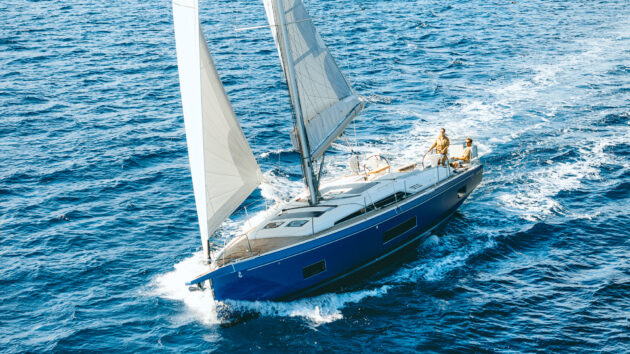
Beneteau Oceanis 47
If volume is your thing, the Beneteau Oceanis 47 has bags of it. Sharing a similar hull to the Finot Conq lines of the previous Oceanis 46.1, the 4.5m of beam and full-length chine carries the volume both all the way aft, and a long way forward.
This gives room for multiple layout options, from three cabins and two heads for the owner version, up to four cabins and four heads, or five cabins and three heads. For a boat of this size, it’s notable that the forward bulkhead is relatively far aft, almost to the mast support, giving a huge amount of space to the forward cabin(s).
Beneteau has aimed to make the boat feel as warm, welcoming and homely as possible, so that this is a space that works well in each area, while mirrors on the forward bulkhead, as well as the large hull windows, create a real sense of space and light. Whether you’d want to work at the chart table against this bulkhead staring at your own reflection is a matter of personal taste.
Putting the Oceanis 47 and the Jeanneau Sun Odyssey 455 alongside each other, it’s notable how similar the two boats are in dimensions, albeit the Jeanneau is (surprisingly) slightly heavier with a slightly lower ballast ratio, given Jeanneau’s reputation for focusing on sailing performance, while Beneteau, part of the same group, emphasises comfort and ease of sailing more. Neither has quite the absolute volume and open space as the Dufour range, which leads this sector in sheer open space below, but for serious sailing, that’s no bad thing.
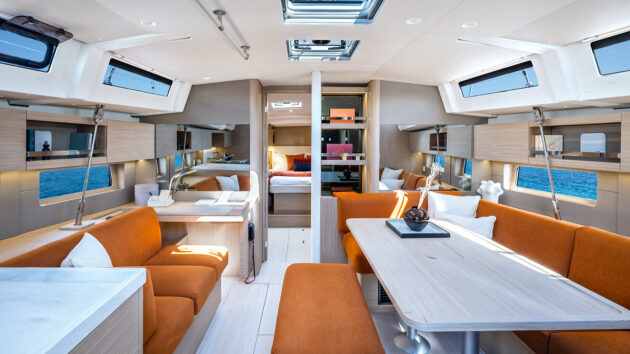
It’s a comfortable saloon, with more space given to the cabins
On deck, the cockpit is now wide enough to accommodate L-shaped seats with split tables either side, both of which can lower to form large lounging pads. With all lines led aft below the coamings to two winches either side, there is space either side of the companionway hatch for two additional sunpads on the coachroof, as well as those ahead of the mast – a sunbathing spot for everyone aboard!
There is also an option to have an open transom for ease of access to the water, or an enclosed transom, which makes things feel more secure for actual sailing, while creating additional space for stowage or an outdoor galley.
Given this is the eighth generation of Oceanis yachts, Beneteau clearly knows what it is doing and what its target buyers want. There’s little doubt that this yacht represents a lot of boat for the money.
Beneteau Oceanis 47 specifications
LOA: 14,60m / 47ft 11in
LWL: 13,24m / 43ft 5in
Beam: 4,50m / 14ft 9in
Draught: (deep) 2.47m / 8ft 1in
Ballast: 2,735kg / 6,028lbs
Disp: 10,981kg / 24,202lbs
Sail area: TBC
Fuel: 195L / 52gal
Water: 370L / 98gal
Engine: 57 HP
Base price: €420,070 inc VAT
Contact: beneteau.com
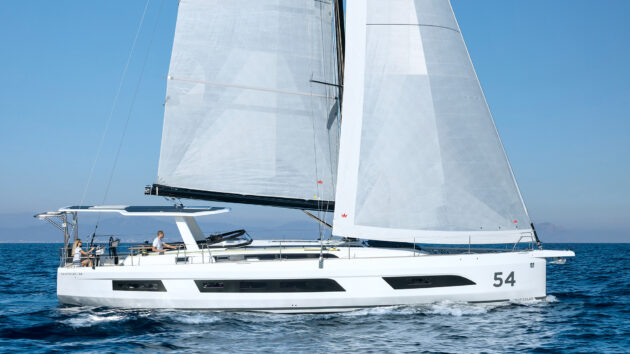
The Dufour 54 now has the option of a large hard-top cockpit cover
Dufour 54
I spent a week aboard a Dufour 44 with my family recently and we were blown away by the amount of space it had for a monohull of that size, making it comfortable for us all to live aboard. It also sailed remarkably level, meaning that those less keen on thrashing to windward were not forced to live at an uncomfortable angle.
Scale that up to the 54, and it’s like the boat has been on steroids. Admittedly, the boat on show at Düsseldorf was fitted out with a (removable) deep-pile carpet throughout, but stepping below was unlike almost any other boats I’ve seen. Yes, it’s a production boat, but it felt genuinely luxurious, at least when high and dry. Dufour doesn’t hide the fact that these are boats ideally suited to life at anchor somewhere glamorous in the Mediterranean, and this is a boat that ticks all the boxes for comfort.
The forecabin (in the three-cabin owner’s version layout) is so large that the king-size berth can be set with the headboard against the starboard hull side, making space for the heads and shower compartments forwards in the bow, so leaving room for a home office/ work space/dressing room port aft. You can opt for a more conventional, though no less spacious, midships berth and separate heads and shower compartments if you prefer.
The saloon has a large C-shaped sitting area to starboard, and most layout options have the galley against the forward bulkhead with cooking to starboard, screened from the saloon seating by a partial bulkhead, with more stowage and fridge space to port.
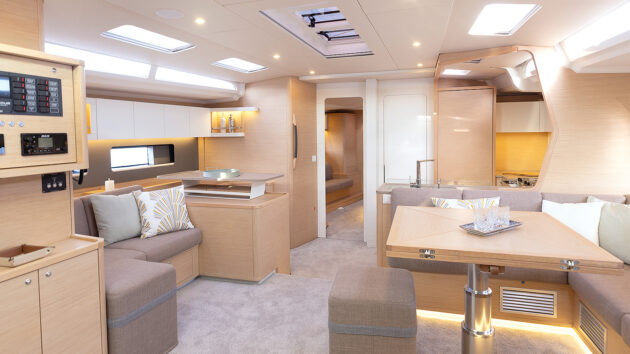
The layout options are modular, and the most spacious on offer
Only in the five-cabin layout does the galley move to port, leaving a compartment with bunk beds to starboard. Another option, if you don’t need everyone to have their own heads, is that the compartment ahead of the starboard aft cabin can become a navigation pod/home office, complete with bookshelves, desk, lockers and office chair. With a boat like this, it’s debatable whether you’d still need a home on land at all.
Despite their vast size, the Dufours I’ve sailed have done so remarkably well, even handling lumpier seas easily. That’s in part to the lines drawn by Umberto Felci, with the wide foreship keeping the bow up, the foredeck dry, and the deep single rudder well immersed for controlled and enjoyable sailing.
As with other high-volume boat of this size, the cockpit offers L-shaped seating and split, lowering tables. Sheets are led aft to powered winches on the coamings, ahead of the twin wheels. The walk-through between the wheel and the coaming makes getting on deck easy, but the winches are a bit of a stretch from behind the wheel.
Other lines and halyards are led to the companionway. Like the Oceanis, the mainsheet is kept out of harm’s way by a solid arch, and on the Dufour this can support a hard-top bimini, housing a huge solar array to support the domestic loads.
Dufour 54 specifications
LOA: 16.84m / 55ft 3in
LWL: 14.85m / 48ft 9in
Beam: 5.25m / 17ft 3in
Draught: 2.0m / 6ft 7in
Ballast: 4,900kg / 10,802lb
Price: €455,000 ex VAT
Contact: dufour-yachts.com
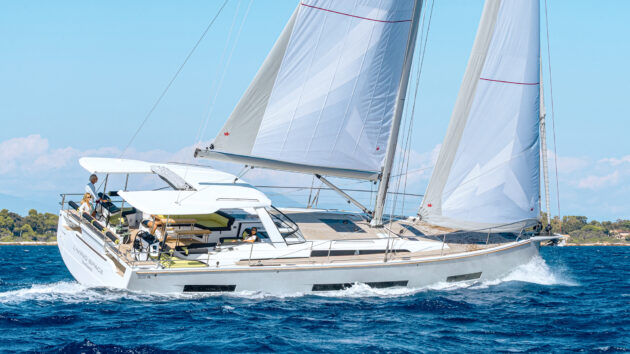
The 590 is Hanse’s flagship and about as big as you’d want to go without crew
Hanse 590
If you thought the other boats here were big, then Hanse’s 590 is a beast. Officially launched in 2024, it is very much in the same design philosophy of going big on volume, even bigger on comfort and making sailing as easy and as comfortable as possible. You have to go to Jeanneau and Beneteau’s Yacht lines to find anything bigger.
Designed, as is the rest of the Hanse range now, by Berret Racoupeau Design, it is larger in all respects than its predecessors the 575 and the 588. While this size of boat is right on the limit for an owner-operator (a crew cabin is an option), full push-button controls help make that achievable, including in-mast furling, bow and stern thrusters, and electric winches. All lines and winches are also led to the two pedestals right aft. Indeed, one of the prospective owners aboard the boat when I looked round at the show had narrowed in on this boat precisely for that reason. Nothing else of this size is as easy to handle solo.
The optional T-top is almost double the size of its predecessor and can host a large amount of solar panels while a mainsheet arch is an alternative, much like the Dufour and Beneteau. The hard top can be fully solid, or have a canvas opening aft section, as seen on the Moody Deck Saloon yachts. Security on deck can also be increased with the optional solid guardrails. Other options are extensive, and can add over 50% to the cost of the boat once you start ticking.
On deck this can include an inflatable ‘module’ which extends the swim platform into a beach club, a hydraulic gangway and sunlounging foredeck complete with awning. Helm seats lift for access to the transom and can have a wet bar between them.
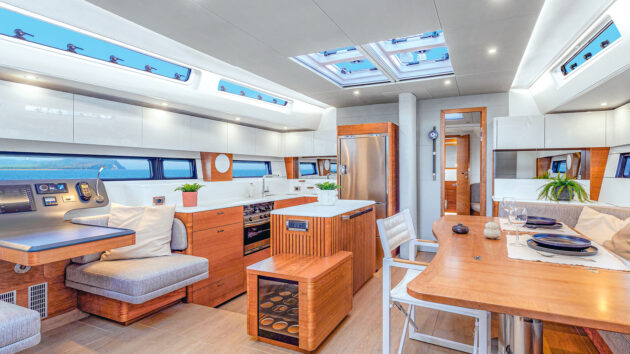
There’s bags of room and plenty of light below, with an island galley
Electric sliding companionway doors lead you into a low level interior, where a galley island makes for a central feature. We’re told this was a focus for Isabelle Racoupeau to help ensure it’s an easy boat to move through.
Layouts range from three to five cabins, and can include a useful utility/laundry cabin. The owner’s berth can be sited aft or forward, or be swapped for two double cabins, while Hanse has worked hard on ensuring good insulation between this and the forepeak crew cabin.
The aft cabins feel enormous, especially compared to the previous model, the tender garage of which intruded on aft cabin space. On this boat, an inflated tender of 3.1m can be stowed athwartships without impinging on the aft cabins. Hanse has the capacity to build 20-25 yachts of this size a year.
Hanse 590 specifications
LOA: 17.60m / 57ft 9in
Beam: 5.30m / 17ft 5in
Draught: Standard L Keel 2.53m / 8ft 4in
Disp: 22,900kg / 50,486lbs
Ballast: 5,900kg / 13,007lbs
Sail Area: 151m2
Water: 770L / 169gal
Fuel: 520L / 114gal
Engine: 110hp (150hp)
Price: €824,000 ex VAT
Contact: hanseyachtsag.com
Enjoyed reading this?
A subscription to Yachting Monthly magazine costs around 40% less than the cover price, so you can save money compared to buying single issues.
Print and digital editions are available through Magazines Direct – where you can also find the latest deals.
YM is packed with information to help you get the most from your time on the water.
-
-
- Take your seamanship to the next level with tips, advice and skills from our experts
- Impartial in-depth reviews of the latest yachts and equipment
- Cruising guides to help you reach those dream destinations
-
Follow us on Facebook, Twitter and Instagram.
Note: We may earn a commission when you buy through links on our site, at no extra cost to you. This doesn’t affect our editorial independence.