




Viv Herzum goes people watching at the International Cape Horner's Association gathering, where Dee Caffari dazzles and Sir Chay Blyth receives a lifetime achievement award

The foyer of the Royal Maritime Club plays 50’s lounge music. Just past it is a room full of people that, with a few exceptions, might reasonably have heard it in infancy.
In other words, the International Cape Horners Association has gathered in Portsmouth on Sunday 7 November for its annual luncheon.
There are suits, nautical ties, and countless poppies on lapels, the regular reminder of just how much of the UK sailing population has ties to the British Navy.
The first familiar face on entry is ICHA President Sir Robin Knox-Johnston, who I first met at the Golden Globe Race start in September. I do recall a typically off-colour quip about Prince Andrew that invited the reminder, ‘I’m not that young’.
Name tags prove useful in identifying the rest of the white halos. Mine certainly seems to help explain my presence, given my misalignment with the event’s usual demographic.
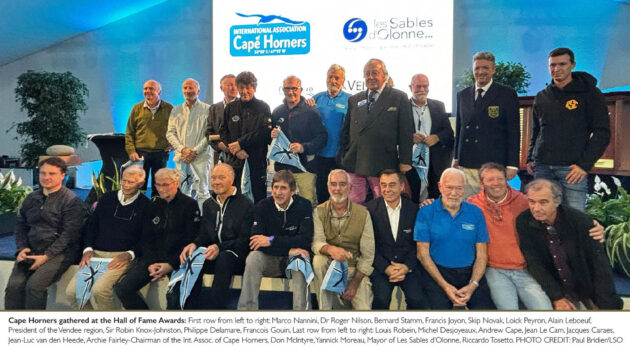
Photo by International Cape Horner’s Association
Guests mill about the bar, greeting old friends and languidly tapping credit cards to buy tickets for a fundraising raffle (the money goes towards membership).
The Cape Horner’s Association welcomes a whopping 38 new joiners this year.
Present are also a few of the new Hall of Fame inductees.
Six new entries were honoured in Les Sables d’Olonne in September: Brian Thomson, Guirec Soudée, Thomas Colville, Alexia Barrier, Paul Cayard and, for some reason, British Commodore George Anson, who led an eight-strong squadron of ships round Cape Horn in 1737 to rob Spanish galleons of their treasure.
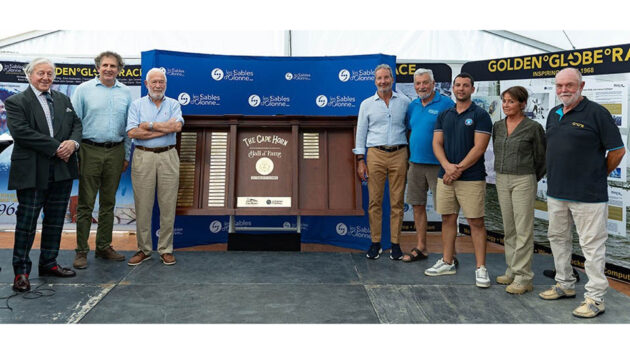
Induction of new ICHA members in Les Sables d’Olonne. Photo by International Cape Horner’s Association
Sir Chay Blyth accepts his Lifetime Achievement Award, dry as ever, less full-cheeked than usual after recovering from a nasty bout of sepsis.
‘Chay, you’ve changed my life and the lives of many people in this room today,’ says Andrew Pindar, presenting the award. His regard for the ‘Pied Piper for amateur sailors’ is echoed across the room.
Later, in the raffle, the winner of the first bottle of Prosecco will hand it straight to him to a smattering of coos, and so a second winner with a bottle of champagne.
Blyth accepts his award in his usual style.
‘Thank you very much for that standing ovation,’ he says. ‘I think you should’ve kept it going for another minute or so.’
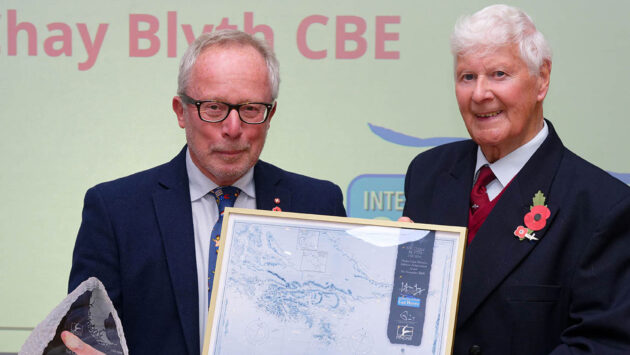
Andrew Pindar, Sir Chay Blyth CBE BEM. Photo by International Cape Horner’s Association
After his speech, the starched room softens. Cue Blyth poking fun at Sir Robin for still owing him a case of rum. It was whiskey, Sir Robin whispers to Dee Caffari.
Blyth finishes with a call to action for more sailors to round the Horn: ‘You’ve got to get out there and get on with it!’
His colourful life, from dropping out of school and working in a tweed mill until he could enrol in the army to undertaking the Sunday Times Golden Globe Race with exactly zero yachting experience, is a reminder of just how many midcentury yachtsmen earned their simply by not waiting for anyone’s permission.
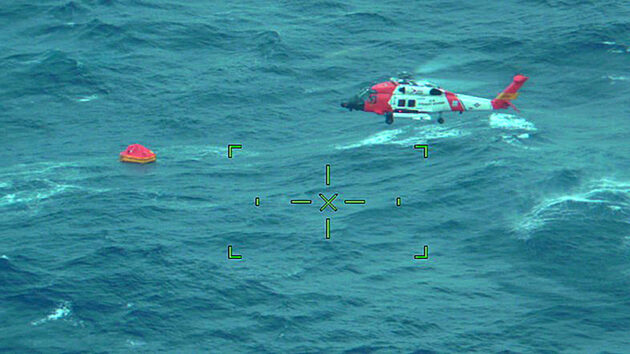
Rescue of Magic Bus Crew in liferaft. Photo by International Cape Horner’s Association
After Blyth has been sufficiently honoured, the US Coastguard is presented with the Ocean Safety Award for their rescue of the crew of the catamaran Magic Bus, which involved helicopters and diverting an aircraft carrier.
Blyth leads a rather humorous grace that starts with ‘Oh lord protect us from the storm’ and ends with a rhyming couplet about whiskey, and then it’s time for lunch.
Over a steak and ale pie, the discussion turns to various aspects of safety at sea, including differences in cultural attitudes around the topic.
It’s hard not to fall into stereotype recalling the years I’ve spent in the Mediterranean with nary a life jacket in sight and only a faint knowledge of where one might find them, compared to my first days onboard a UK yacht.
The skipper’s first item of business was involving the (lifejacketed) crew in rigging a handy billy.
I chat to the daughter of a Cape Horner, who says she has neither the time or the disposable income to keep up her father’s hobby.
A gentleman from the crew of Veritas describes his own Cape Horn as ‘anti-climatic.’ The crew had just had two accidents. In comparison, the revered passage seemed uneventful.
But as Dee Caffari says in her speech, Cape Horn is not so much an experience in of itself.
‘It’s a psychological marker,’ says Caffari. ‘It doesn’t matter whether you’re leaving or entering.
It represents courage and hardship, and the sacrifice of sailors who came before us, many of whom faced these waters in vessels and conditions we can scarcely imagine.’
That includes sailors like Sir Robin Knox-Johnston and Sir Chay Blyth.
‘They went, and the reason they went was to give us something to aspire to, something to excite us, encourage us, and allow us to follow in their footsteps.’
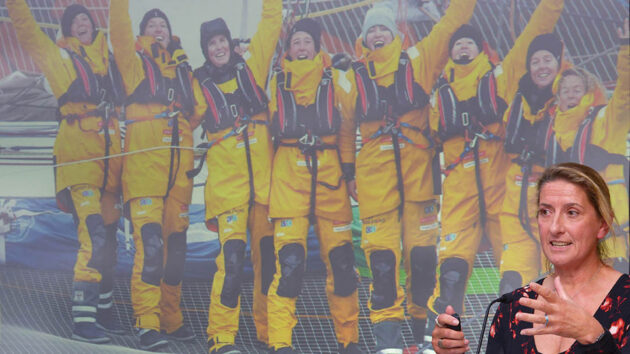
Dee Caffari talking about the all female Jules Verne Trophy attempt. Photo by International Cape Horner’s Association
Dee is introduced as having done 6 laps around the world. 7, she corrects.
Those seven laps taught her, ‘That resilience is not about pretending you aren’t worried, but acknowledging and recognizing the situation you’re in, facing it honestly, and finding a way forwards.
It’s understanding when to push and when to hold back, listening to other people, and being prepared to change your mind and accept that sometimes yours is not the most important contribution to be made.
And most of all, remembering your why.’
With the Famous Project, ‘We didn’t have a perfect boat, we didn’t have a perfect passage, but we had a team, a purpose, and a determination to find a way through, and that’s probably what I’ll remember most.’
Caffari, or rather her skill and charisma while commanding a room full of once-rowdy school boys who went rogue and chased the open ocean, is the indisputable highlight of the event.
‘Boats change, technology changes, our ambitions change, but the ocean demands respect, and Cape Horn commands respect,’ she says.
‘For those of us fortunate to have rounded it, we carry that experience with us, not just as a sporting achievement but as a connection with sailors that have gone before and might no longer be with us, and we all acknowledge the albatross that flies near us as the souls of those that we lost at sea.’
‘To everyone in this room and everyone that’s rounded Cape Horn, I salute you.’
Enjoyed reading about the International Cape Horner’s Association?
A subscription to Yachting Monthly magazine costs around 40% less than the cover price, so you can save money compared to buying single issues.
Print and digital editions are available through Magazines Direct – where you can also find the latest deals.
YM is packed with information to help you get the most from your time on the water.
-
-
- Take your seamanship to the next level with tips, advice and skills from our experts
- Impartial in-depth reviews of the latest yachts and equipment
- Cruising guides to help you reach those dream destinations
-
Follow us on Facebook, Twitter and Instagram.
Note: We may earn a commission when you buy through links on our site, at no extra cost to you. This doesn’t affect our editorial independence.