


A fast day-sailer makes perfect sense if you enjoy sporty sailing but don’t want either a racing yacht or a cruiser. That’s where the Saffier 27 comes in, says David Harding
Saffier 27 review: ‘When you’re under way, pretty well everything can be controlled from the helm’

Many’s the time I have observed that plenty of people who own cruising yachts rarely – if ever – seem to go cruising. They sail around the bay on a nice day. They anchor for a swim and might go ashore for an ice-cream, a drink or a meal. Then they sail the few miles back home. Some might spend the night aboard and do more of the same the next day.
That’s a great way to enjoy owning a boat. You don’t have to sail a long way to prove yourself as a sailor or to justify owning anything bigger than a Mirror dinghy (though some remarkable voyages have been completed in a Mirror). There’s just as much satisfaction and enjoyment to be had close to home.
Like many lifelong sailors, I have crossed oceans and visited remote places but still enjoy a spin around the bay and exploring rivers, creeks and estuaries in equal measure.
Speed and simplicity are what the Saffier is all about. Sail controls provide ample opportunity for tweaking if you’re so inclined
While it’s impossible to say that one type of sailing is more rewarding than the other, one thing for sure is that sailing locally can involve a lot less expense and complication.
The other thing about sailing locally is that you can choose a boat that’s more fun to sail and far better suited to day-sailing and weekending. Unless you’re going to go cruising, why buy a boat with lots of accommodation, stowage and equipment you will never need? Why have a hull designed to carry all that weight and bulk, which will make it slower and more ponderous?
Why have a large cabin and a small cockpit when what you actually need is a small cabin and a large cockpit?
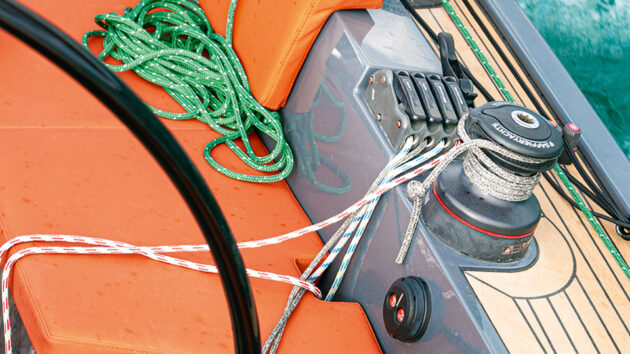
Sail controls are led aft each side to the helm, where rope tails can be tucked into bins to keep the cockpit tidy
The long view
In the UK at least, day-sailers have typically been small, trailable boats that you can launch from a slipway. If you want anything bigger, it’s assumed that you want to sail further and therefore need the appropriate accommodation, load-carrying capacity and so on.
Bigger day-sailers are few and far between. The Dutch, by contrast, have long taken a different view, building a good range of boats, both sail and power, designed to give you a grand day out and bring you home at the end of it so you can sleep in your own bed.
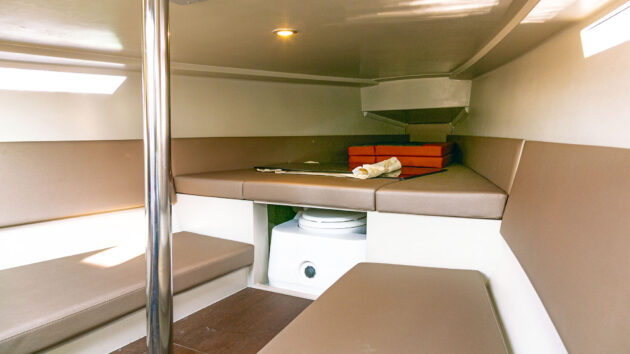
The forward berth is decent for a comfortable night for two, though there is little else by way of domestic facilities. Photo: David Harding
One of the best-known Dutch yards building day-sailers is Saffier, whose boats have featured previously in these pages. Going further back, I spent a couple of days at the yard in IJmuiden more than 10 years ago, sailing the SC 8m Cabin from the Classic range and the then-new flagship, the SE 33. It was also an opportunity to learn a little about the relationship that the Dutch and continental Europeans have with fast day-sailers.
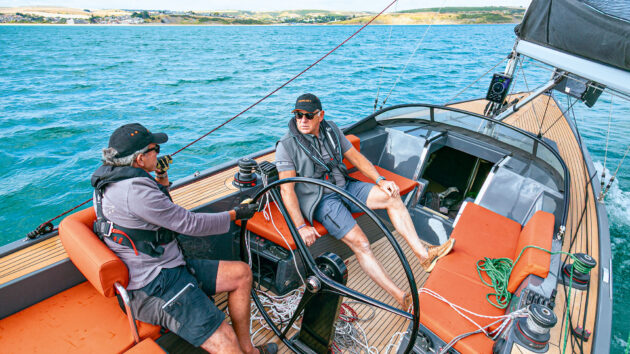
Wheel steering is the popular choice, though a tiller is standard and would leave more space at the aft end of the cockpit. Photo: David Harding
Gaining popularity
Since then, it’s no surprise to have seen a growing number of Saffiers in the UK and the yard adding new models. The timeless SC 8m and 6.50 Cruise continue to fly the flag for the classics, while the place of the 33 SE in the ‘Elegance’ range has been taken by the all-new 33 SE Life (tested in YM Aug 2024).
Other ‘Elegance’ additions are the 24, 27, 28 (new in 2026) and 37. Two larger models – the 46 launched last year, and plans for a 38 have just been announced – now form the ‘Luxury’ range for those who want cruising capability. Saffier has been busy since my visit, and I was keen to see how the 27 shaped up. She’s very much a smaller version of the 33, and a similar size to the SC 8m but totally different in nature.
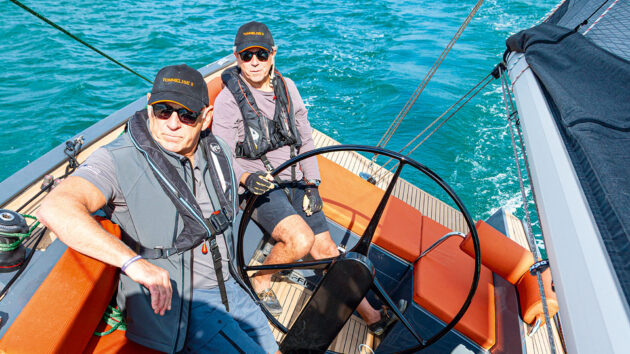
The forward part of the cockpit is kept clear for non-active crew. Photo: David Harding
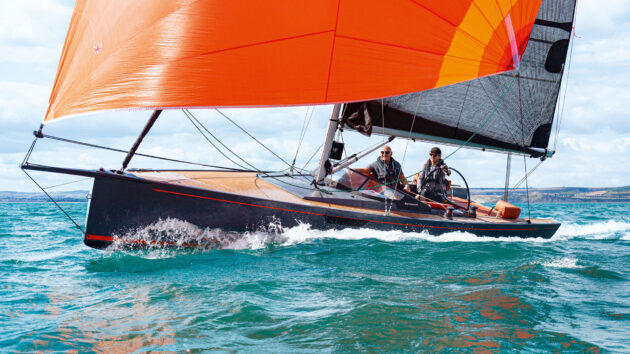
Like her sisters in the ‘Elegance’ range, she’s a light, slim boat with low freeboard, uncluttered lines, a fine entry, a vertical stem, a broad stern and a generous fractional rig with a large mainsail, a self-tacking jib and a bowsprit for flying downwind sails or a Code 0.
Balancing the rig is a choice of three keels, all in lead, giving a draught ranging from 1.15m (3ft 9in) to the standard 1.65m (5ft 5in).
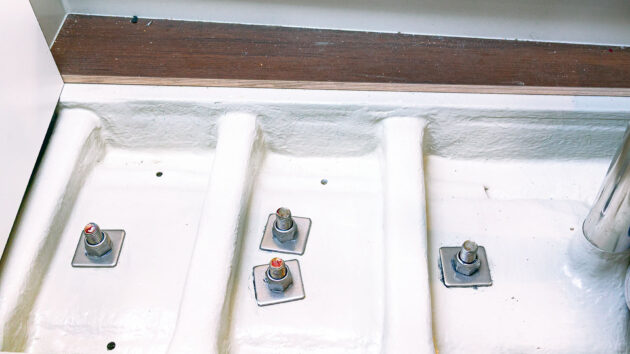
The keel is bolted through 22mm of solid laminate, reinforced with transverse and fore-and-aft stiffening members. Photo: David Harding
In between, as on our test boat, it’s 1.65m (5ft 6in). Twin rudders are used with the shallow option; otherwise it’s a deep single blade.
Reading this might make you think that the Saffier should be a pretty quick boat. Read on. Built with a 15mm foam core, she’s engineered to be as light as
the need for a good measure of strength will allow.
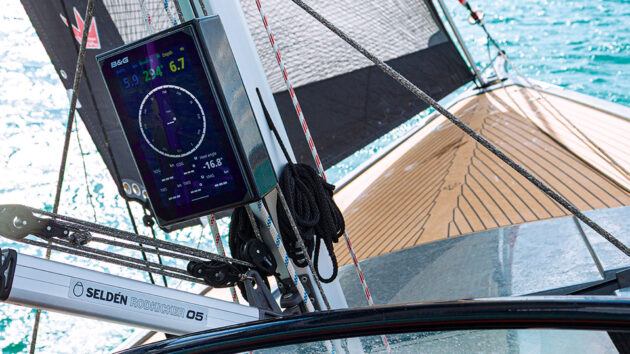
A clear view forward from the front of the cockpit, which is protected by the low fixed windscreen. Photo: David Harding
As you would expect, she has an area of suitably hefty solid laminate around the keel. Saffier has never been a yard that cuts corners when it comes to making sure its boats stay in one piece.
Her empty weight of just 1,900kg (4,190lb) gives the 27 a sail area/displacement ratio of 25. That’s approaching sportsboat territory and is helped by use of an Aquamot electric motor with a lithium battery, which together come to less than half the weight of an equivalent diesel (or you can have a diesel if you prefer). The displacement/length ratio of 148 also suggests that she’s not going to hang around.
Article continues below…
Saffier SE33 Life review: Achingly pretty luxury daysailer
Nine! Nine point five! Ten! Eleven! Eleven point five!’ Watching the boat speed climb into double figures in the gusts…
£280,000.00
Speedy daysailers and rugged explorers: This season’s most exciting new launches
The sailing world is currently witnessing a fascinating split in design philosophy. On one hand, the weekender market is pushing…
Fast is fun
With numbers like this, you would expect the Saffier to plane downwind. A video on the builder’s website shows her hitting 15 knots in 20-25 knots of breeze, while the polar diagram from Kees Van de Stadt of Satellite Yacht Design – co-designer with Dean Hennevanger from Saffier – indicates similar speeds at 150° in slightly more wind and flat water.
If you’re not used to light, planing keelboats, you might think that those sort of speeds sound rather alarming. Believe me, there’s nothing alarming about either the speeds or the way a well-designed boat like this behaves when achieving them – unless you’re unlucky, or someone makes a fairly major mistake. They’re far more tolerant and forgiving than you might imagine.
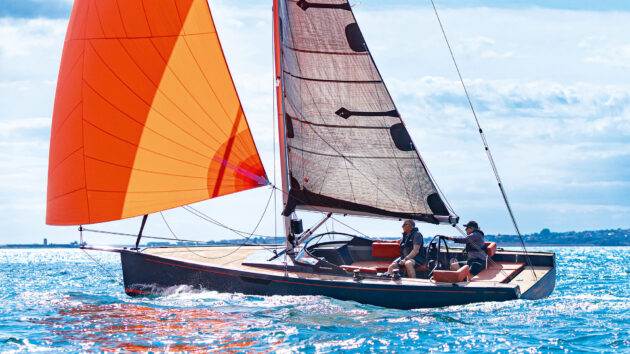
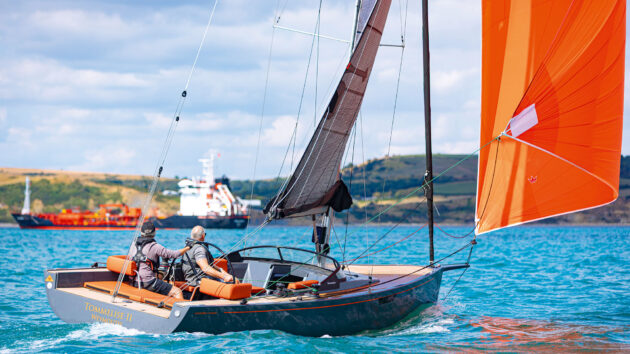
Reaching and downwind sails are flown from a fixed bowsprit. Photo: David Harding
During our test of the 27 we had flat water and a maximum of about 12 knots of wind, so double-figure speeds were not on the cards. With the 33 in IJmuiden back in 2014, on the other hand, we were hitting 16-18 knots with the help of a few waves, and that was with a Code 0. An asymmetric spinnaker cut for deeper angles would have given us more.
The owner of our test 27 wanted something fast and with a large cockpit, which is why he bought the Saffier. He had done some dinghy sailing – many Saffier owners are experienced dinghy sailors – and wanted a bigger boat but not a cruiser. So he bought a house by the coast and a boat for day-sailing.
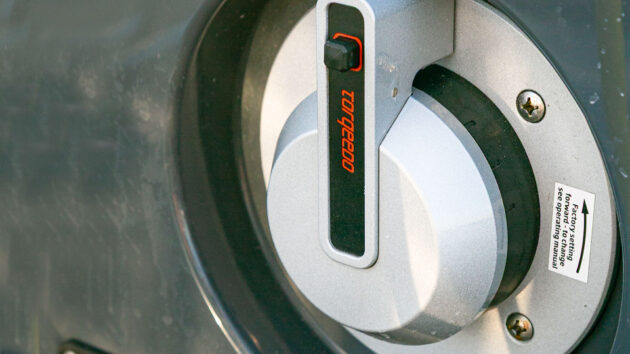
The test boat had a Torqueedo electric motor driving a two-bladed folding prop. An Aquamot is now standard. Photo: David Harding
I joined the owner and Mark Williams, the UK distributor, on a day that was perfect for showing how easily driven and easy to sail the Saffier 27 is.
With the 1.4m keel and aluminium rig (carbon is an option), we sliced our way upwind with the log reading 5.6-5.7 knots – almost exactly what the polars indicated. Tacking angles can be hard to establish with any accuracy in a shifty offshore wind, but the compass consistently showed 80° or less. That’s not bad going for a 27-footer of modest draught, giving a VMG of 4.3 knots.
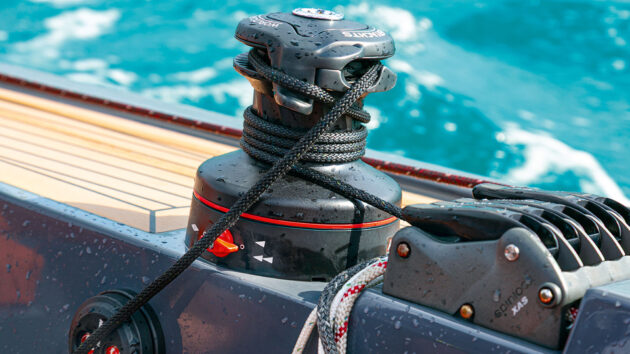
A two-speed, two-way Harken electric winch to port handles the mainsheet. Photo: David Harding
She seemed to have a pretty wide groove and didn’t punish momentary lapses of concentration in the way that a highly-strung race boat would. In fact she proved remarkably hard to upset.
If I pinched her mercilessly, she continued to make way until the speed dropped to less than 2 knots. Only then did the rudder and keel stall, resulting in side-slipping for some time until laminar flow was re-established and control regained. That’s surprisingly forgiving when you consider the keel’s short chord.
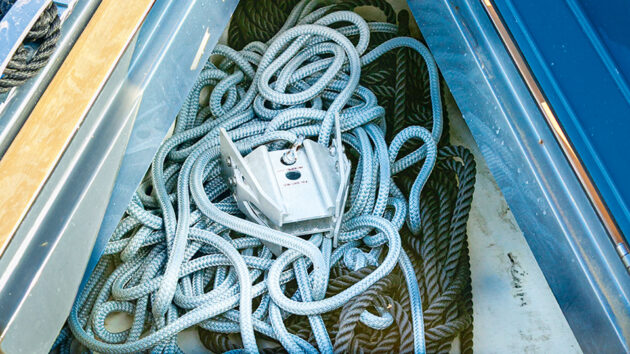
No anchor roller comes as standard, but there’s a good size locker in the bow. Photo: David Harding
Keeping a grip
When turned the other way, the Saffier was equally reluctant to misbehave. If I put the helm down with the sheets pinned in, she would bear away until the gunwale was awash. Then she rounded up very gently. With slightly less wind and less heel, she would do exactly as asked.
Tests like this are useful because they tell you how far you can push before losing control. Race boats typically have much lower tolerance, because it’s assumed that they will be sailed with far greater precision than would be expected of a cruising sailor. This is one important way in which the Saffier states emphatically that she’s not a race boat.
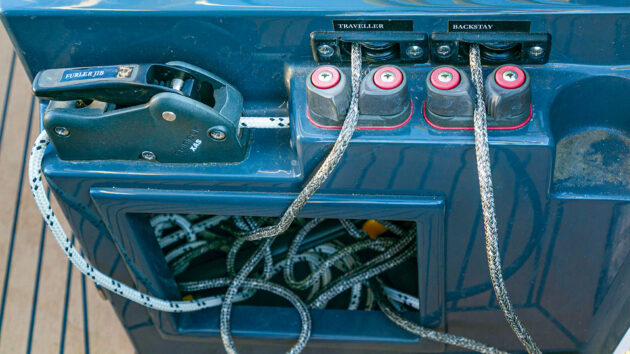
Rope tails are kept tidy by rope bins in the aft end of the cockpit seats, and more below them. Photo: David Harding
Her performance, however, is enough to give a good many tweaky race boats a run for their money. Cracking the sheets a few inches and putting the bow down a degree or two instantly brought the speed up to 6 knots plus, and then into the mid-7s on a close reach.
All the while the helm remained finger-light. As soon as the apparent wind came aft to about 70°, it was time to unfurl the Code 0, so we did, sailing the hottest angles we could and keeping consistently in the 8s and 9s with the boat still under perfect control.
Speed is a major feature of the Saffier. Tolerance and forgiveness are others, and so is ease of handling. The idea is that, when you’re under way, pretty
well everything can be managed from the helm.
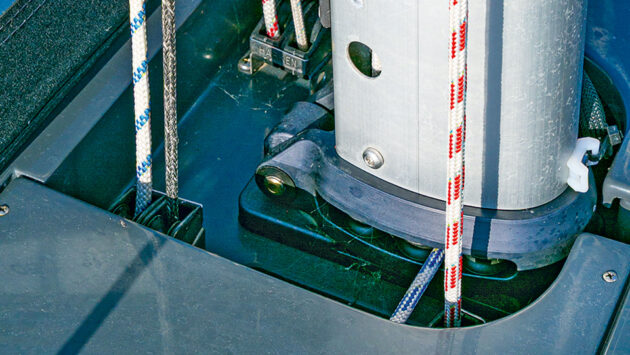
Lines coming down the mast are led aft beneath the mouldings forming the coachroof. Photo: David Harding
Sheets, halyards and control lines are led aft to a two-way Harken electric winch and a bank of clutches each side, and aft (or forward in the case of the traveller and backstay) to cleats and clutches on the aft end of the cockpit seats immediately forward of the wheel. It’s as close to push-button sailing as you can get. We’re used to it on bigger boats, but not on a 27-footer.
Two-way winches simplify trimming, even if perhaps it’s not as fast as trimming conventionally. It’s certainly not as fast with the German-style mainsheet – a feature you rarely see on a boat of this size – though of course you can always whip the sheet out of the tailing jaws and ease it manually.
Something else to remember if you’re used to more conventional arrangements is that the main halyard exits the mast at the base to run aft below the moulding that forms the low coachroof and cockpit coamings, so you can’t have someone ‘jumping’ it at the mast for a faster hoist.
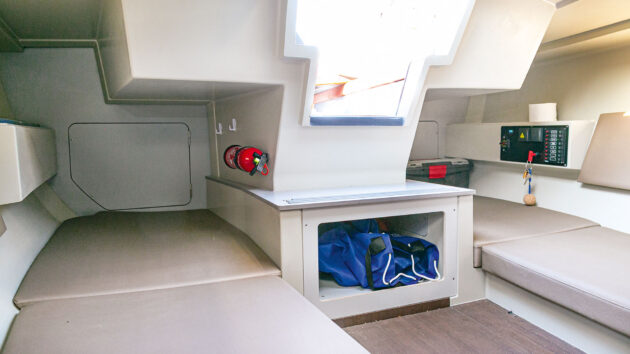
Settee berths extend below the cockpit to provide two extra full-length berths for sleeping,
while a fridge can be added below the companionway step to keep your drinks cool. Photo: David Harding
Spinning the wheel
Having everything controlled from the helm means that the space further forward in the cockpit is kept clear for non-participating crew. They have a seat 5ft 6in long (1.68m) each side on which to spread out.
At the helm, you have a choice of tiller or wheel. I would prefer a tiller on multiple counts, not least because it would give you more space in the control-line zone. Most owners, however, choose the wheel.
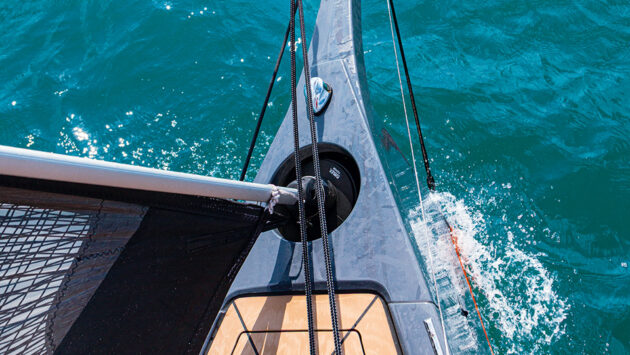
The bowsprit is designed as an integral part of the forward deck. Photo: David Harding
moulding
It still gives a light, direct, positive feel and a comfortable helming position far enough outboard to see the luff of the jib. You’re also given removable padded backrests (matching the seat cushions, of course) on tubular steel frames.
With a tiller, you would probably forgo the backrests and take advantage of the ability to helm from the coamings. In the stern is an area of decking, with cushions if you want, forward of a recessed, full-width track for the mainsheet traveller and then the 16:1 backstay.
Now that just leaves us the interior to examine – not that you would buy a Saffier 27 for space and luxury below decks. It’s principally somewhere to store the cushions, the helmsman’s backrests and any general kit you want to keep aboard or bring for overnighting.
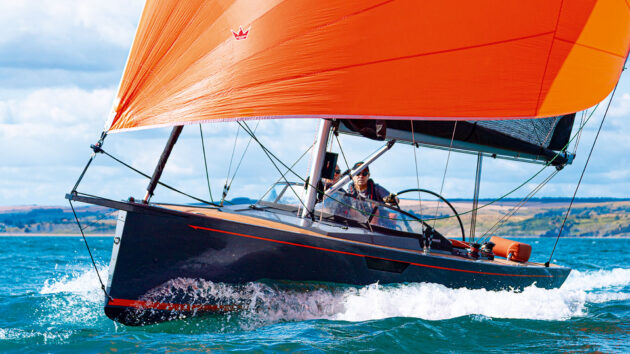
Offwind sails lift the bow and help the boat reach high single digits and double digit speeds without breaking a sweat. Photo: David Harding
Down here you find sitting headroom above the two settee berths that extend aft as quarter berths, a heads under the aft end of the V-berth in the bow, and space beneath the companionway for stowage or a fridge.
Mouldings are neat and kept to a minimum. Where possible they double as structural members in order to avoid unnecessary weight. The accommodation is neatly finished and perfectly comfortable for a couple for a night or two.
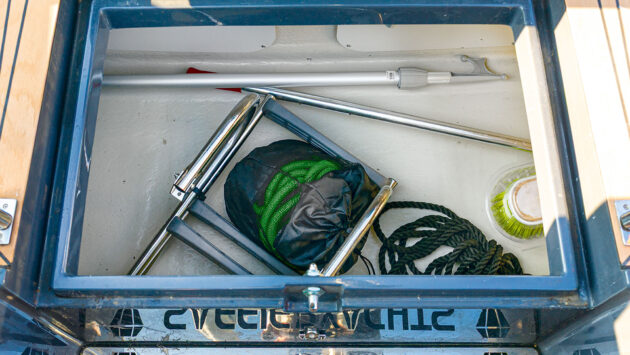
A locker abaft the wheel holds warps, fenders, deck brushes and other larger gear. Photo: David Harding
Enjoyed reading this?
A subscription to Yachting Monthly magazine costs around 40% less than the cover price, so you can save money compared to buying single issues.
Print and digital editions are available through Magazines Direct – where you can also find the latest deals.
YM is packed with information to help you get the most from your time on the water.
-
-
- Take your seamanship to the next level with tips, advice and skills from our experts
- Impartial in-depth reviews of the latest yachts and equipment
- Cruising guides to help you reach those dream destinations
-
Follow us on Facebook, Twitter and Instagram.
Note: We may earn a commission when you buy through links on our site, at no extra cost to you. This doesn’t affect our editorial independence.
Verdict
Saffier’s success proves that there is a market for boats that are neither cruiser nor racer, but fast, simple, stylish, minimalist day-sailers. The 27 is probably tougher, more stable, more powerful and more capable in terms of seakeeping than some fully-fledged cruising yachts. She’s a day-sailer because of her low freeboard, lack of space below and absence of guardwires; not because she couldn’t handle wind and waves. From my experience when I was working in yacht sales – and since – it seems that many people judge a boat’s value according to its length, price, headroom and number of berths. That wouldn’t work with the Saffier, any more than it would with a performance multihull such as a Corsair or Dragonfly. You have to think differently to understand a boat like this. After sailing the 33 SE, I concluded that ‘this boat is a blast to sail and a doddle to handle’. And it’s exactly the same with the 27.
Details
LOA :8.00m (26ft 3in)
LWL:7.40m (24ft 3in)
Beam:2.55m (8ft 4in)
Draught :(standard) 1.65m 5ft 5in)
Displacement:1,900kg (4,189lb)
Ballast :750kg (1,653lb)
Ballast Ratio:39.5%
Disp / Length :148
Sail area :(main and self-tacker) 37m2 (398 sq ft)
SA/D ratio:25.1
Motor :Aquamot 4.3kW (or diesel alternative)
RCD category: C
Designer :Dean Hennevanger /Kees Van de Stadt
Builder :Saffier Yachts