


Strongly influenced by the Contessa of the same length, the Sadler 32 has its own distinctive style and personality, as Nic Compton discovered
Sadler 32 used boat review: A lot like a Contessa… but different

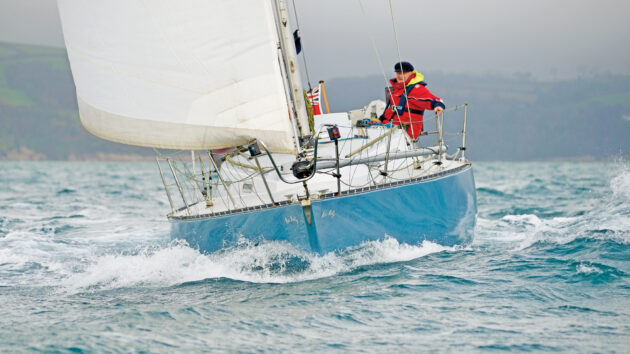
Nonchalant. That’s the word my kids use to describe someone who’s effortlessly cool and stays above the fray. It’s also the word that sprang to mind as I watched Rob Mclaughlin clamber forward on his Sadler 32 to coil a loose halyard. A southerly breeze had been blowing across Start Bay for a couple of days, building a decent chop. It was touch-and-go whether it would be possible to take photos.
But Miss Molly was unperturbed. She rode the waves as if she was made for this. Rob was likewise ‘nonchalant’, despite sailing the boat singlehanded. He simply set the autopilot and let her get on with it. One moment he was pouring himself a cup of tea from a flask, the next he was strolling up the side deck, apparently oblivious to the boat’s angle of heel. It was an impressive performance by the boat and her owner – neither of whom are particularly showy, but who can clearly pack a punch when needed.
I’d met Rob socially but hadn’t realised he was an accomplished sailor until we were already out at sea, dancing from wave to wave. Later, he explained how he got into sailing. Although he didn’t come from a sailing family, his father was a shipbuilder at Barrow-in-Furness. Somewhere along the line, the romance of the sea must have rubbed off on the young Rob. He started rowing aged 14 at his local club in Lancaster on the River Lune, and owned his own scull, on which he practised boat maintenance.
But the real revelation came when his uncle bought him a holiday on the Ocean Youth Club’s ‘Scotland boat’ Taikoo.
‘That was my first introduction to sailing,’ says Rob. ‘To be on this 72ft ketch, pounding through the Irish Sea. Just me, as a 15-year-old, on the helm in charge of this yacht. It just blew my mind. So I thought, I need to do more of this.’
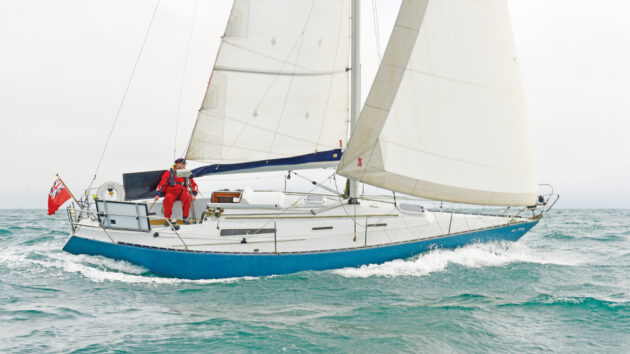
The Sadler 32 has a pronounced beamy bulge amidships and a very narrow stern, but 6ft headroom below
By chance, his French teacher from school also worked for Bénéteau in the UK and (later) Top Yacht in Turkey, and Rob soon became a regular crew on their delivery trips across the Med. Meanwhile, he studied PE, History and Geography at Liverpool University, and trained to be a teacher.
His first solo boating adventure was kayaking 2,500 miles around Britain. Coincidentally, he set off from County Hall in London on 15 April, the anniversary of the sinking of the Titanic, as someone gleefully pointed out just before he set off. Rob didn’t sink, however, and completed his circumnavigation in a very respectable 143 days.
Blue water ambition
Rob’s first yacht was a Moody 376 which he lived on for a while at Littlehampton on the River Arun, though she proved too big for single-handing. She was followed by a bilge-keel Moody 272, which he successfully sailed singlehanded across the Channel to France and the Channel Islands. When Rob and his partner Bella decided to move to Devon in 2023, he decided it was time to buy a more long-legged cruising boat.
‘I wanted to have a blue water boat I could go offshore in,’ he says. ‘Something not too big that I could sail by myself.’
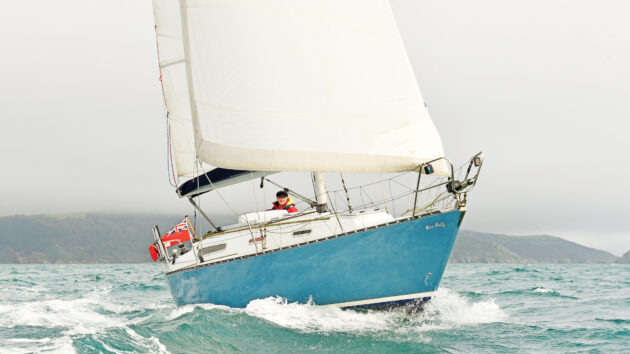
The Sadler proved itself in the deadly 1979 Fastnet Race and sails well in light airs
He soon homed in on Contessa 32s and Sadler 32s, which fitted both his remit and his budget, and eventually concluded that the Sadler had ‘a bit more space’ and, judging from the write-ups he’d read, was ‘a bit more of an offshore boat’. But what finally seemed to have swung it in favour of the Sadler was Miss Molly’s tasty new engine: a 25hp Beta fitted by the last but one owner.
‘A lot of the boats I looked at had old engines which would need replacing, and I didn’t have the finance to replace an engine like that,’ he says. ‘So the engine was a big draw for this boat.’
Of course, not everyone will agree that a Sadler 32 is ‘more of an offshore boat’ than a Contessa 32, and I can already hear an army of Contessa fans howling in disapproval. But these are the facts. Yacht designer David Sadler made his name designing the iconic Contessa 26 and Contessa 32 built by Jeremy Rogers (although some versions of the story suggest Jeremy ‘designed’ the C26 by altering an existing Folkboat hull, which was retrospectively drawn by David).
In 1974, David’s son (and former Rogers employee) Martin set up on his own as Sadler Yachts, starting off with the plucky Sadler 25 designed by his father.
It was probably inevitable that, following the enormous success of the Contessa 32, the Sadlers would build their own version of the design which addressed some of the older boat’s limitations. For while the Contessa 32 has proven its worth through countless ocean passages, there’s no doubt that they are quite small down below, as well as being quite tippy and quite wet in a blow. You have to pay for that sleek sheer line and slippery hull shape somewhere along the line.
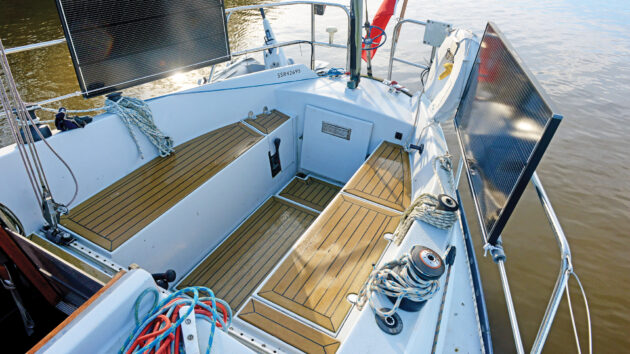
The cockpit is roomy but the traveller is inconveniently located at the entrance to the main hatch. The solar panels are adjustable
David Sadler’s new design, although often compared to the Contessa 32, was in truth a very different beast. Although designed only eight years later than its predecessor, it is an altogether much more modern design. With its flat sheer, high topside, and heavily cambered decks it has considerably more volume down below (though still small by 21st century standards), including 6ft headroom compared to the Contessa’s 5ft 10in.
The underwater configuration is a proper fin keel and separate skeg rudder, compared to the earlier boat’s more wineglass sections. Despite being 6in shorter overall, the Sadler boasts 1ft more beam, although some of that extra volume is lost to its more pinched counter stern, producing the classic IOR rounded midships.
At 4,300kg (9,500lb), the boat’s displacement is exactly the same, though the Contessa has 136kg (300lb) more ballast, giving her a better ballast to displacement ratio. The Sadler 32 has more form stability, making her a stiffer boat.
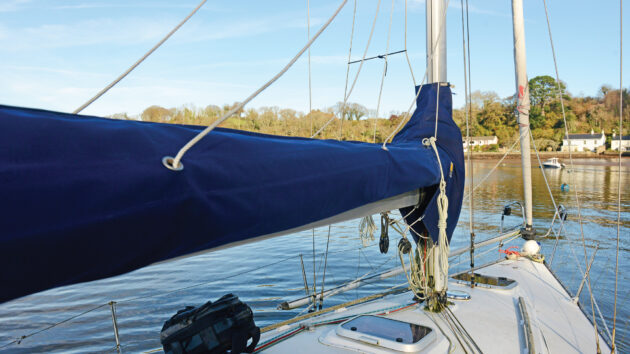
The deck layout is straightforward and user-friendly
Rewarding in every way
A previous review of the Sadler 32 in Yachting Monthly in November 2009 described her as ‘a boat that can be sailed hard and will keep you safe in adverse conditions. She’s drier than a Contessa in a seaway and sails better dead downwind. She’s also a more rewarding boat to gently cruise in light airs and more comfortable in harbour or at anchor, with a family-orientated cabin layout and extra interior volume.’
The new boat was soon put to the test in the infamous 1979 Fastnet Race, in which five boats were sunk and 15 competitors drowned. Martin competed as crew on a brand-new Sadler 32 called Sissy Too. Like most of the smaller boats competing in the race, they experienced the full force of the storm on the approach to Ireland, with winds of up to 65-70 knots and waves ‘at least the height of the mast’.
Several times, the boat was knocked down beyond 90° to the vertical, and even under bare poles she clocked up 6 knots. By the time the crew reached Ireland, they had had enough and pulled into Cork to lick their wounds – unlike the Contessa 32 Assent, which famously sailed on regardless and was the only boat in Class V to finish the course.
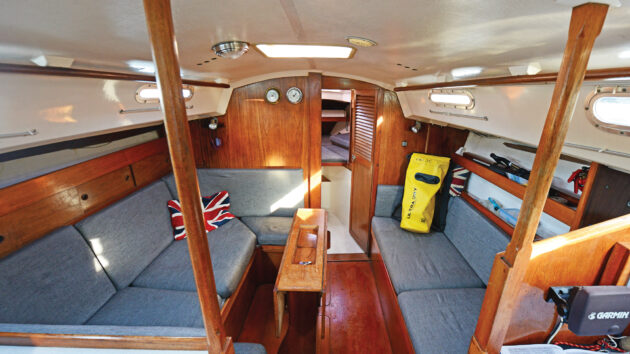
Dark wood dominates the look and feel of the saloon. Photo: Nic Compton
Writing about the experience in Yachting Monthly, Martin said: ‘I was very glad indeed that I was in a boat with a healthy ballast keel beneath us. In my opinion, many modern boats are too lightly ballasted and too prone to excessive roll in severe conditions. We were carrying a lot more ballast than is the average for the majority of modern cruiser/racers. I sincerely believe that it saved our lives.’
The boat’s performance, while not as memorable as that of Assent, was an important validation of David Sadler’s design, proving that it was seaworthy enough to survive a Force 10-11 storm. Sadler Yachts soon went into production, offering several variations of the basic design: with either a 5ft 7in deep keel, a 4ft 7in shoal keel, 3ft in bilge keels, or a 3ft 7in / 4ft 11in centreboard version.
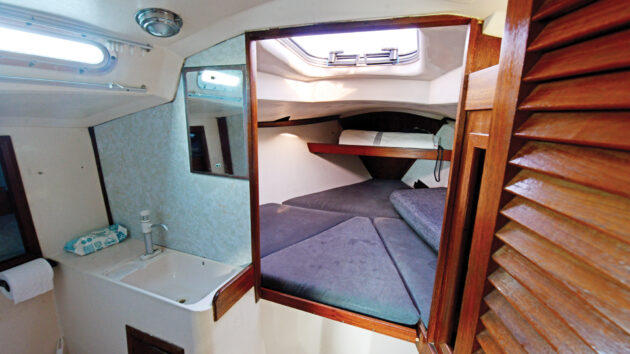
Access to the double forecabin is through the heads. Photo: Nic Compton
More than 300 boats were built by the company between 1979 and 1989, with a few more built thereafter by Mike Slack in the UK and others built in South Africa. It’s a good solid record, but you could argue that the Contessa 32 ultimately won the argument, as more than 800 of them have been built since 1971 and, astonishingly, new boats are still being built to this day.
Miss Molly was built in 1984 and had been through the usual mix of owners before Rob found her in Milford Haven. The previous but one owner was evidently a keen racer and made numerous upgrades, which have stood the boat in good stead. The boat was fitted with new cockpit covers, new stainless steel stanchions, and even a carbon fibre tiller – suggesting some serious racing must have taken place under that ownership.
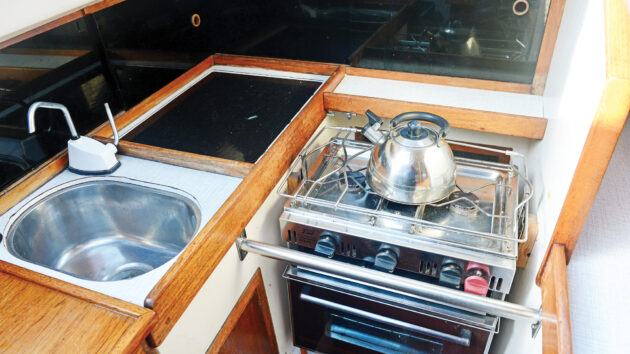
The galley has a gimballed stove and is located to port as you go down the companionway. Photo: Nic Compton
Since acquiring the boat, Rob has made several small upgrades. The most evident was to extend the stainless steel guardrails on either side of the cockpit and fit a pair of 125W solar panels to them. The panels hinge from the top rail, so they can be angled towards the sun, or simply parked in vertical mode when under way. They look slightly ungainly, but generate about 400-600 Watt-hours of electricity per day – not to be sniffed at.
The question at the forefront of my mind, however, was what autopilot was Rob using? Having watched him strolling around the boat without a care in the world, trusting the autopilot to do the work, I was keen to find out the secret of his insouciance. It turned out to be a Simrad TP22, which was amply powerful enough to cope with a 32-footer but also has a ‘tack’ button, which turns the boat through 90°. So now we know.
Below decks, the accommodation has the dark, woody feel of most British yachts of this era, in complete contrast to the Etap 26i which I had been on a week earlier – which was, admittedly, built 25 years later. It has a solid interior with ample stowage. Like most yachts of this size, you have to walk through the heads to reach the foc’s’le from the saloon, which won’t appeal to everyone.
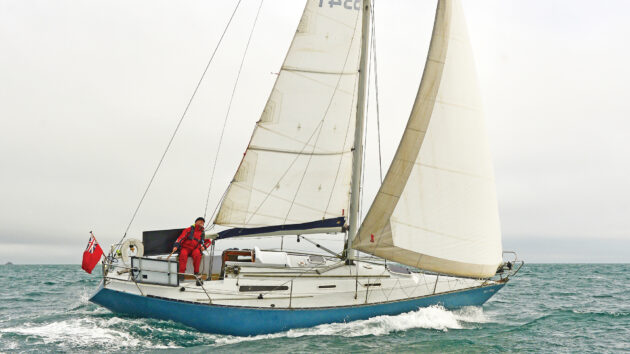
Photo: Nic Compton
Sadler 32 specifications
YEARS BUILT: 1979-89
LOA: 31ft 6in / 9.60m
LWL: 24ft 0in / 7.32m
BEAM: 10ft 6in / 3.20m
DRAUGHT: 5ft 7in / 1.70m
DISPLACEMENT: 9,500lbs / 4,309kg
BALLAST: 4,200lbs / 1,905kg
SAIL AREA: 423ft2 / 39.30m2
PRICE: £13,000-£35,000
Contessa 32 review: Still an enduring classic
‘Once, we were going around Portland Bill in a blow and we hit a wave – the boat stopped and…
Nordic Folkboat used boat review: One of the most iconic boats ever designed
It’s hardly surprising Richard Gregson owns a Nordic Folkboat, there was only ever one sort of boat he could reasonably…
Enjoyed reading this?
A subscription to Yachting Monthly magazine costs around 40% less than the cover price, so you can save money compared to buying single issues.
Print and digital editions are available through Magazines Direct – where you can also find the latest deals.
YM is packed with information to help you get the most from your time on the water.
-
-
- Take your seamanship to the next level with tips, advice and skills from our experts
- Impartial in-depth reviews of the latest yachts and equipment
- Cruising guides to help you reach those dream destinations
-
Follow us on Facebook, Twitter and Instagram.
Note: We may earn a commission when you buy through links on our site, at no extra cost to you. This doesn’t affect our editorial independence.
Verdict
Coincidentally, I sailed a Contessa 32 off Dartmouth a few weeks before I photographed Miss Molly, albeit in much gentler conditions. The older boat was perhaps more traditionally elegant, but there was also something very appealing about the Sadler 32’s strong sheer and dramatically angled coachroof. The result is smaller portlights but also wider side decks, which are good for walking around the boat. On the other hand, the pinched stern means the loss of some space in the aft part of the cockpit. Underway, I was mightily impressed by the Sadler 32’s performance in testing conditions. She was stiff, dry and able, giving the impression of a much bigger boat. By contrast, the Contessa seemed tender and rather demanding. The Sadler’s performance to windward may not have been quite as impressive as her slenderer rival, but she seemed like less work and also less likely to give her crew a soaking in the process. Or perhaps I was being fooled by the skipper’s effortless cool? ‘I’m happy with how she sails, how she points, and how she gets to hull speed quite quickly,’ says Rob. ‘I quite often reef, and she doesn’t lose too much speed then. Her hull speed is about 6.5 knots, and she cruises along well at that speed. She often points higher than more modern boats. So, although they may overtake us, when it comes to the tack, they’re tacking behind us.’ Rob’s cruising range with the ‘new’ boat has been limited. He had hoped to sail to the Scillies last year but, in common with almost every other sailor in the West Country, he couldn’t find the right weather window and only got as far as Newlyn. This year, he hopes to head to Ireland, the Azores or even the Canaries. But wherever he goes, you can be sure it will be cool, calm and, well, nonchalant. ‘I like pottering around,’ he says. ‘I prefer not to go into a marina, and just find somewhere to drop the hook, enjoy the peace, have a fish and catch a mackerel.’