


More and more boatbuilders are offering electric or hybrid propulsion as an option, says Rupert Homes, but is it viable yet for a heavy aluminium yacht?
Ovni 430 review: Defying the heavy-metal stereotype
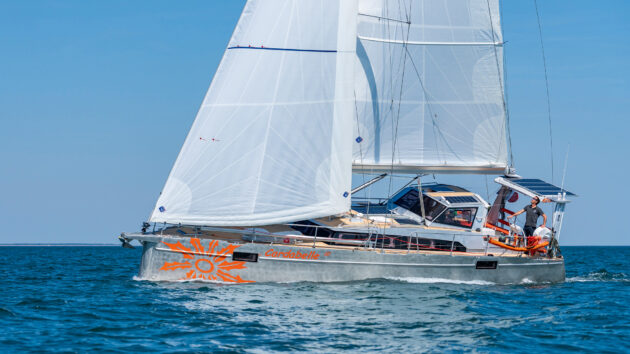
The concept of rugged aluminium centreboard boats is well proven, but can a boat displacing 14 tonnes when loaded sail well in the light airs that predominate during summer in cruising areas such as the Med, northern Europe and even the Arctic?
And can hybrid propulsion work in that context? The chance to jump on the first Ovni 430 to leave the yard during last September’s heatwave provided clear answers to both questions.
First impressions are of very practical and seamanlike arrangements, with acres of flat deck space, deep bulwarks, plus solid metal handholds, mostly near waist height. There are also plenty of mooring cleats, a capacious deep chain locker, and our test boat was also fitted with substantial granny bars at the mast.
The standard of finish on deck is high, with welds ground perfectly smooth, neat paintwork and the general feel of a well specified, comfortable yacht. It’s a marked contrast to Ovni’s trademark raw aluminium topsides that resist
knocks and dings so well.
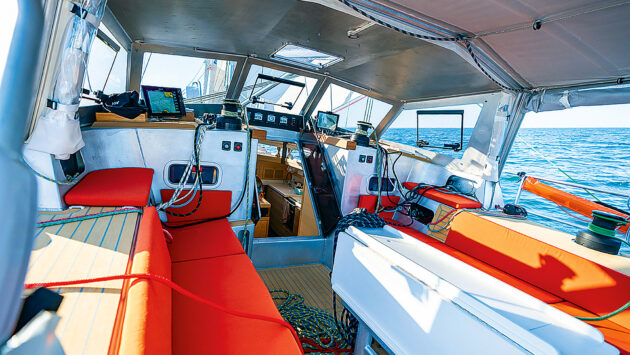
A solid doghouse offers superb protection without obstructing visibility. Photo: Nicolas Michon
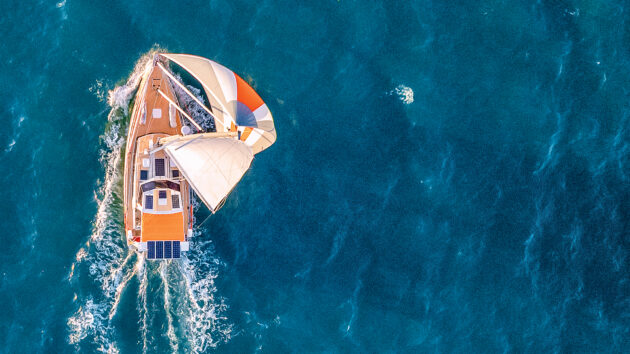
We set out from Les Sables-d’Olonne in a dying southerly breeze, under mainsail and an all-purpose gennaker in just six knots of true wind. Not so long ago most yachts of this size and weight would most likely have needed at least 10 knots of wind to get moving. But not in this case – we consistently made just over four knots, representing an impressive 70% of true wind speed.
The 430 is Ovni’s first model with an additional chine in the bottom of the hull, which reduces wetted surface area. The twin angled rudders are mounted well outboard on this chine and the steering has been re-engineered to give a more direct response.
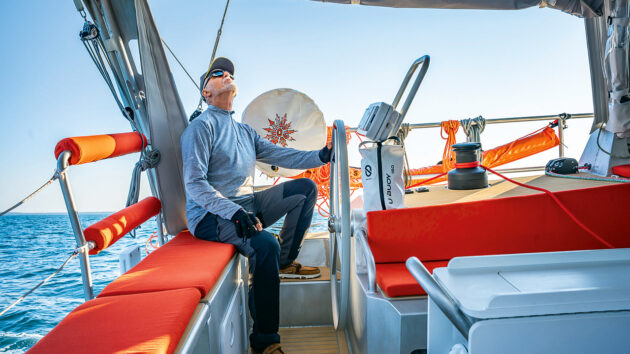
Wheels feel secure next to a closed transom despite being well aft and outboard. Photo: Nicolas Michon
A silent nudge
Despite the very light conditions, and the boat’s substantial weight, the helm felt positive at all times. Even with boat speeds as low as two knots, it was responsive and predictable, without oversteer and with a directness of feel that belies the hefty displacement. This is all the more impressive given the necessity for the rudders to be relatively short, with a low aspect ratio, to enable the boat to dry out on its flat bottom.
By the time we swapped to the Code Zero the wind had died to less than four knots, with boat speed under sail struggling to get much above half that.
Article continues below…
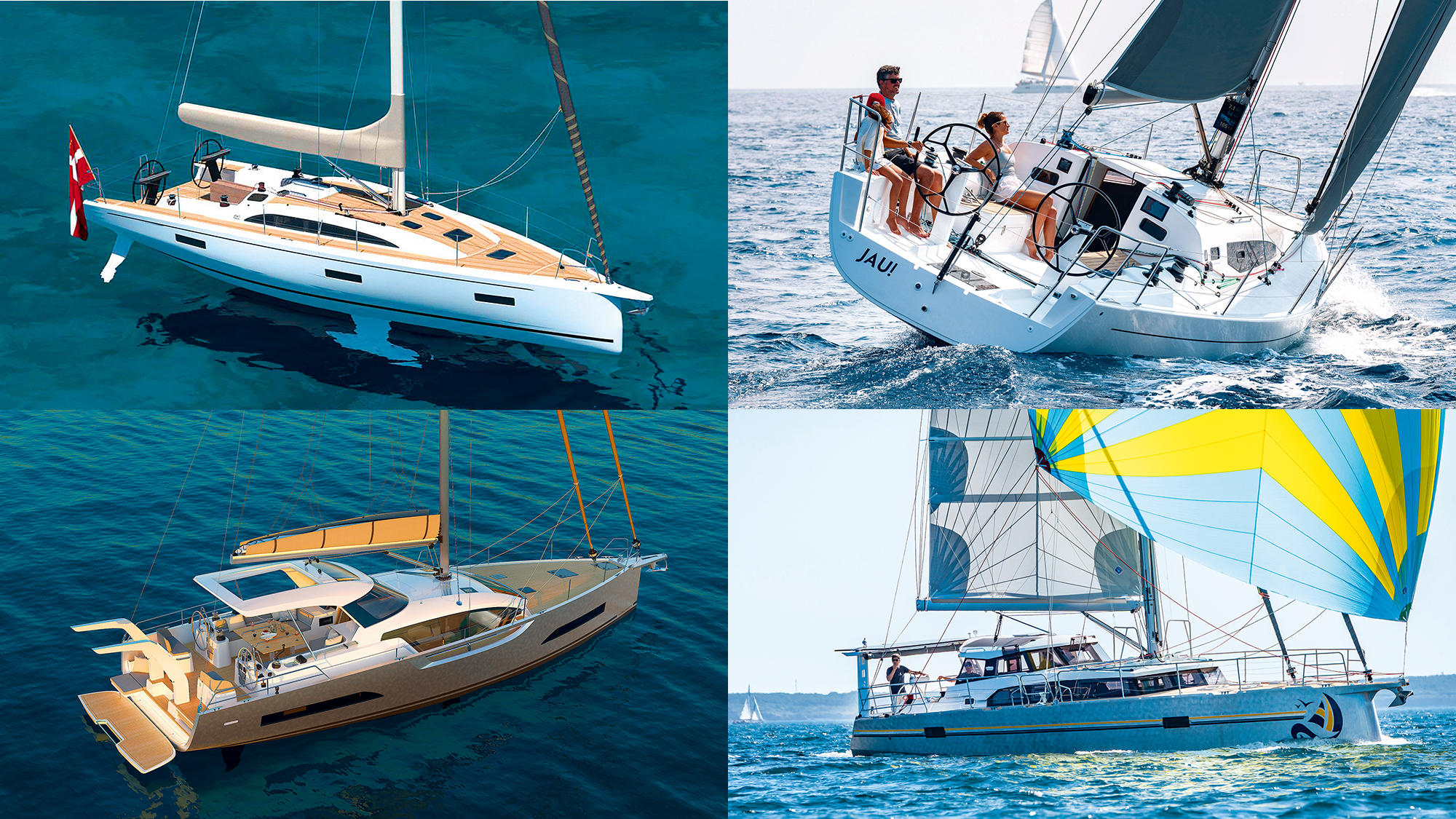
Speedy daysailers and rugged explorers: This season’s most exciting new launches
The sailing world is currently witnessing a fascinating split in design philosophy. On one hand, the weekender market is pushing…
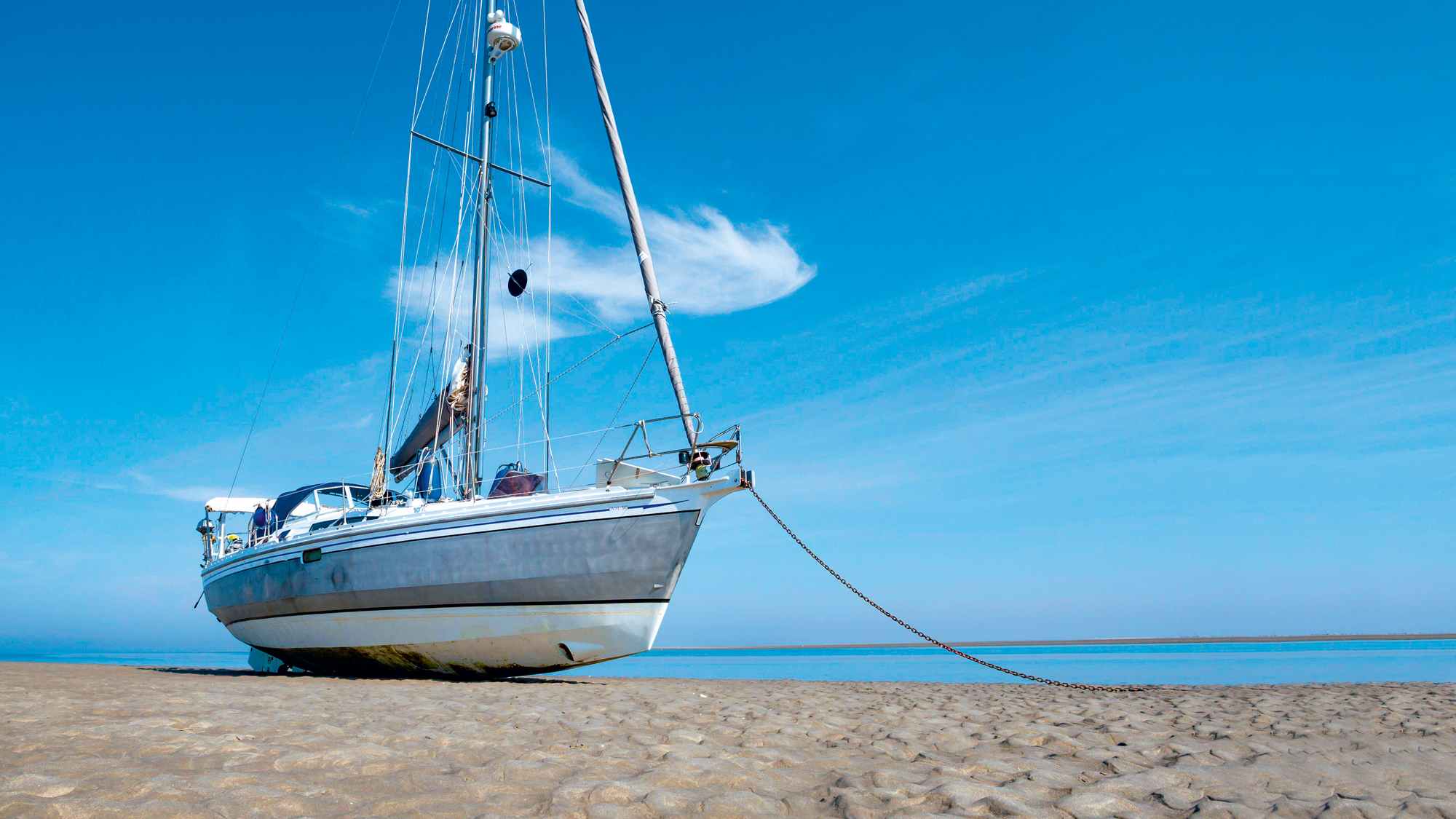
How to dry out to at any anchorage (and in harbour)
Almost all vessels, in the days of working sail, had to take the ground when calling at destinations around Britain.…
But adding a small boost from the electric motor – our test boat is the first-ever Ovni with hybrid propulsion – made a huge difference.
Just 3.3kW of propulsion power more than doubled boat speed to 4.4 knots, markedly improving range before needing power from the range-extending 11kW Fischer Panda diesel generator. Unlike motorsailing with a diesel propulsion engine, the only audible sound is a very low level from the gearbox – a noise that’s normally drowned out by the racket of even the best soundproofed internal combustion engines.
With this combination of sail and motor, we could have continued for more than six hours before depleting the 28.8kW lithium-ion phosphate battery bank and resorting to the generator, despite there being only four knots of true wind.
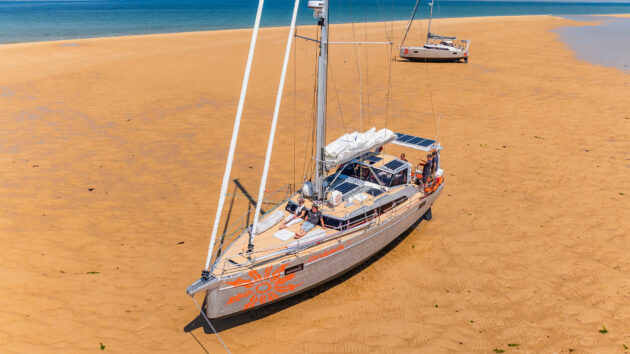
The extra third chine between waterline and keel, which is a new addition with this model. Photo: Nicolas Michon
The genset is far quieter than any diesel propulsion engine thanks to a soundproof box and very soft mounts. The hybrid arrangement also allows for a smaller propulsion battery to be specified than for electric-only boats.
Yet the expectation is it will rarely be used – the test boat has 900W of solar, while the electric motor’s regeneration mode produces 300W when sailing at 4.5 knots, a figure that increases exponentially with speed. There will be many occasions, therefore, in which the batteries can be fully replenished while on passage.
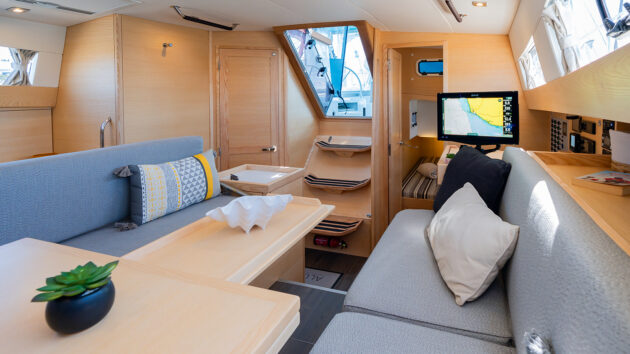
The raised saloon brings the seats up to the level of the nav station and closer to the action on deck. Photo: Nicolas Michon
This boat is a development of the Ovni 400, launched only three years ago, which itself was a big move for the yard. Its step change of style, with near-vertical topsides, a rounded reverse bow and proportionately longer waterline represented major changes compared to earlier generations.
The 430 uses the same hull with a few modifications, including wider sections in the forward two-thirds of the boat that increase both form stability and volume in the owner’s cabin.
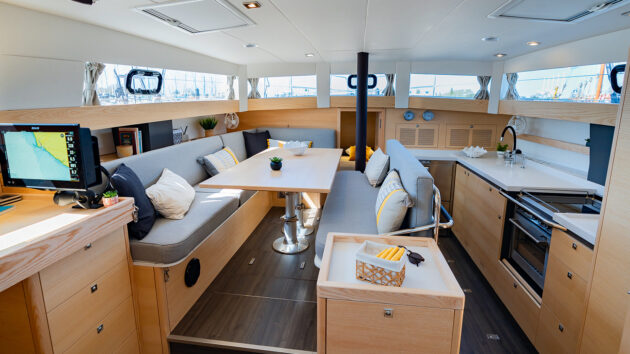
Opting for the raised saloon gives superb views from the coachroof windows. The linear galley to starboard is slightly lower, so that those sitting and standing can talk easily. Induction cooking has been fitted here. Photo: Nicolas Michon
Step change in style
As well as the additional chine in the lower part of the hull, builder Alubat changed to what it calls ‘semi thick’ construction for the 430. This uses 10mm aluminium for the bottom plate, 8mm for the rest of the hull and 6mm for deck and coachroof. By contrast, earlier models, including the Ovni 400, used 8mm alloy plate throughout. The 430 therefore has a lower centre of gravity and greater stability, yet the important bottom plating is thicker and more resistant to damage.
As standard the 430 has a conventional pin-head mainsail, with an 8m2 larger square-top sail as an option. Running backstays are needed for this configuration, though spreaders are well swept back, giving the rig support when gybing in lighter airs. In stronger breezes, with the first reef tucked in, the sail clears the runners, so both can be kept in tension. There’s a choice of a permanently rigged roller reefing staysail, as on our test boat, or a sail set flying on a furler that can be removed when not needed.
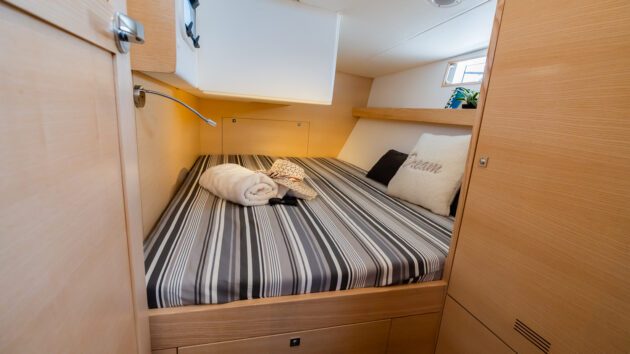
Aft cabins are a good size with rectangular berths and plenty of stowage, ventilation and natural light. Photo: Nicolas Michon
Two easy steps behind each helm station lead to the side decks. Cap shrouds are taken to the outside of the hull, via substantial aluminium chainplates welded to the structure, while lower shrouds terminate next to the coachroof sides, leaving a clear passage along the side decks. However, trips to the foredeck in anything other than comfortable conditions should be rare.
Most controls, apart from jib, staysail and spinnaker sheets, are handled at the companionway, under the protection of the optional solid aluminium doghouse fitted to the test boat. This offers great protection from the elements, yet doesn’t interfere greatly with visibility from the twin helm stations.
Alubat offers a number of options for mainsail reefing, with the boat I sailed having a single line system for the first two reefs, plus separate leech and luff pennants for the third. Decent roller bearing cars for the luff track further ease the effort associated with handling the mainsail.
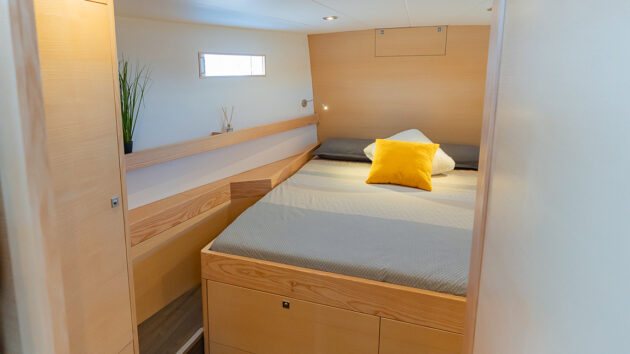
Forward accommodation has ample stowage, while white hull linings help it feel light and airy. Photo: Nicolas Michon
Three electric winches also help minimise physical effort. These include both primaries, which are ergonomically mounted inboard on pedestals aft of the seating around the cockpit table. The starboard companionway winch is also electric and is used for both the main halyard and the 700kg ballasted centreboard.
There are plenty of pockets for rope tails in the coamings, and under the inboard winch pedestals. Unlike earlier Ovni models the mainsheet is no longer taken to the stern arch, but still uses the same concept of identical systems port and starboard that are led to the coachroof instead. This works well, giving control of sail shape while also stabilising the boom. A smaller arch aft supports the dinghy davits, plus some of the solar panels and is more neatly integrated with the pushpits than on the 400.
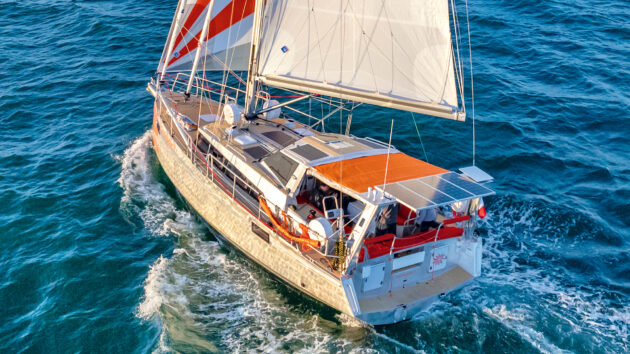
The beamier hull, reduced wetted surface area and lowered centre of gravity make for powerful performance even in light airs. Photo: Nicolas Michon
Manageable volume
With one exception, changes to the interior of the new model are mostly minor compared to the 400. These include more volume in the forward owner’s cabin, plus a greater amount of stowage throughout. The wider forward hull sections allowed the forward end of the coachroof to be widened by 235mm, creating a greater feeling of space in the saloon without compromising the side deck width.
At the same time, freeboard is reduced by 9cm, lowering the boat’s centre of gravity and making it easier to step off onto a pontoon. A step down into the forward and aft cabins from the saloon means this was achieved without reducing headroom. The boom is also slightly lower and headsails are tacked a little lower, increasing sail area without adding air draught.
An inner stay as well as forestay and bowsprit rigged headsails give plenty of options for changing gear. Photo: Nicolas Michon
The big change for the interior of the 430 is a new deck saloon option. This variant has the same exterior dimensions and structure as the classic saloon on our test boat, but has a raised dining area that provides a view through the coachroof windows. By contrast, in the classic model when seated you can only see out through a single hull window each side in the saloon. Both versions also have a neat raised nav station that allows a view out of the coachroof windows.
The large linear galley to starboard, which benefits from good stowage and worktop space, is also common to both. Our test boat was equipped with a GN Espace marinised induction hob, electric gimballed oven, as well as space saving and ergonomic sinks and Gastronorm storage units and utensils from the same company.
A useful technical area aft of the heads includes a single bunk with an aluminium base under the mattress, allowing this area to double as a workbench. It also gives access to all the electrical components and the generator.
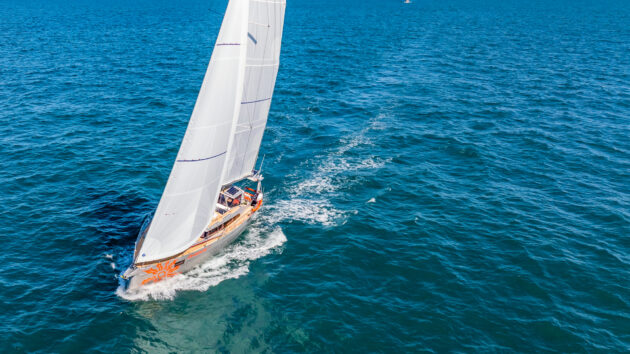
The helm felt positive, responsive and predictable with a directness of feel that belies the heavy displacement. Photo: Nicolas Michon
Returning to port using 4.2kW of electric propulsion at an average speed of 4.5 knots gave plenty of time to pack the boat away, without depleting the battery bank more than necessary. At this point the OceanVolt display showed 82% charge remaining, with around 4.5 hours range left at that speed.
Above modest speeds wavemaking resistance increases exponentially, so boat speed of a shade over six knots required 22kW of power, equating to little more than an hour of range under electric power alone. Running the generator would double this and a larger genset could be installed to extend range at higher speeds to a level where diesel tankage is the key constraint.
The first boat’s Canadian owners, who bought an Ovni to fulfil a long-standing ambition of sailing across the Atlantic, are very happy with the system and installation. They have yet to need to run the generator in anger, though point out the Oceanvolt throttle control lacks the feel of a conventional unit, even though electric car manufacturers have managed to solve this issue.
Ovni 430 specifications
LOA: 12.90m / 42ft 4in
HULL LENGTH: 12.28m / 40ft 3in
LWL: 11.54m / 37ft 10in
BEAM: 4.36m / 14ft 4in
DRAUGHT: 0.85-3.40m / 2ft 10in-11ft 2in
DISPLACEMENT: 11,900kg / 26,240lb
BALLAST: 3,330kg / 7,280lb
CENTREBOARD WEIGHT: 700kg / 1,550lb
SAIL AREA: 85m2 / 914sq ft
BAL/DISP RATIO: 34%
DISP/LENGTH: 215.7
SA/D RATIO: 16.6
ENGINE: Volvo Penta D2-50 (50hp)
WATER: 510L / 112gal
FUEL: 510L / 112gal
Enjoyed reading this?
A subscription to Yachting Monthly magazine costs around 40% less than the cover price, so you can save money compared to buying single issues.
Print and digital editions are available through Magazines Direct – where you can also find the latest deals.
YM is packed with information to help you get the most from your time on the water.
-
-
- Take your seamanship to the next level with tips, advice and skills from our experts
- Impartial in-depth reviews of the latest yachts and equipment
- Cruising guides to help you reach those dream destinations
-
Follow us on Facebook, Twitter and Instagram.
Note: We may earn a commission when you buy through links on our site, at no extra cost to you. This doesn’t affect our editorial independence.
Verdict
The Ovni 430 is a new interpretation of a successful concept and a significant update, while still representing evolution rather than revolution. The changes may not appear major on paper, but they add up to a boat that’s easier and more appealing to spend long periods of time on board. It’s more manoeuvrable, yet also more reliable thanks to elements such as a tunnel bow thruster in place of a retractable unit, and the rope system for lifting the centreboard instead of hydraulics.