


Introduced over 40 years ago, the Moody 37 became the 376 and quickly established a reputation as one of the most comfortable family cruisers you can buy
Moody 376 used boat review: More spirited than her reputation

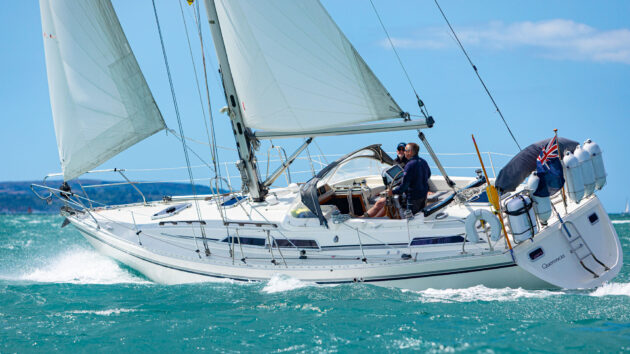
When the name ‘Moody’ is mentioned in cruising circles, it conjures up images of space, comfort and solidity. Most sailors will think of high-volume hulls and, on all but the smaller models, of centre cockpits and walk-throughs to vast aft cabins.
Of all the boatbuilders that have ever existed, Moody (in its original incarnation) probably had one of the strongest identities. Moodys weren’t fast or flash. Neither were they widely associated with serious offshore sailing or blue-water voyaging. They were family cruisers: spacious, comfortable, strongly built and unpretentious. They knew what they were good at, and did it very well.
It was a comfortable cruising boat that Tim Matcham and Andy Greaves wanted when they decided to buy one together. They had both already done a fair amount of sailing before they met aboard a charter boat on which they had each independently booked to sail from the Canaries to the West Indies.
Their wives were not committed sailors and, since Tim and Andy got on and had similar views about the sort of sailing they would like to do, it seemed logical to go halves in a boat.
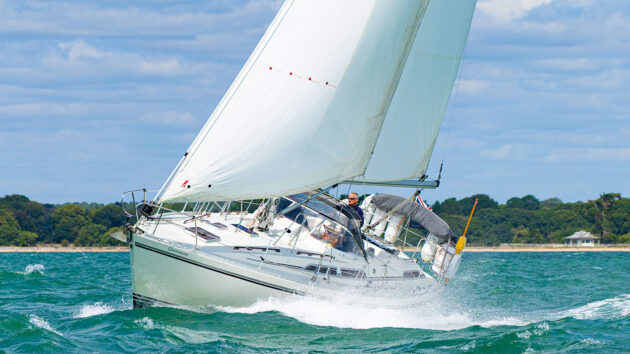
With the optional Scheel keel the draught is kept to a modest 4ft 6in (1.37m). Photo: David Harding
After a little searching, the Moody 376 emerged as a likely candidate. Andy, being the taller of the two, wanted standing headroom and, as Tim put it, ‘we’re both at the stage in life where it’s nice to be able to enjoy relaxing sailing.’ That called for a boat of a reasonable size – provided it didn’t come with too much draught. They were planning to sail from Beaulieu, where the bar would have been a restriction with more than 5ft (1.5m).
Andy had earlier sailed a Moody 376 with the standard fin, which gives a draught of 5ft 6in (1.68m). During the search, he found one of the relatively small number with the 4ft 6in (1.38m) Scheel keel (flared towards the tip). He contacted the owner only to learn that it had just been sold.
Then, some time later, he heard that the would-be buyer had pulled out. And so it was that Messrs Matcham and Greaves became the proud owners of a Scheel-keel Moody 376.
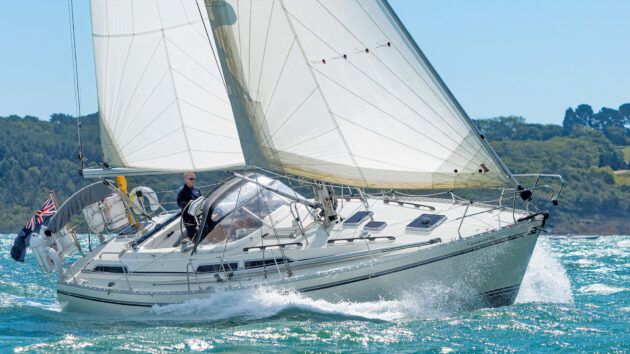
The Moody’s windward performance is respectable given her high-volume hull and relatively shallow draught. Photo: David Harding
As Andy says, ‘the windward performance isn’t great, but how often are we beating against both the tide and the wind? And we don’t have to worry about the bar at any state of tide.’
Alternative offerings
As well as the Scheel and the standard fin, the Moody 376 was offered with twin keels (4ft/1.2m), and you might even find one of the few lift-keelers.
Some owners who have had the chance to compare a Scheel-keeler with a standard fin version reckon there’s no great difference; possibly just a little more leeway with the Scheel, so Tim and Andy did well to find one.
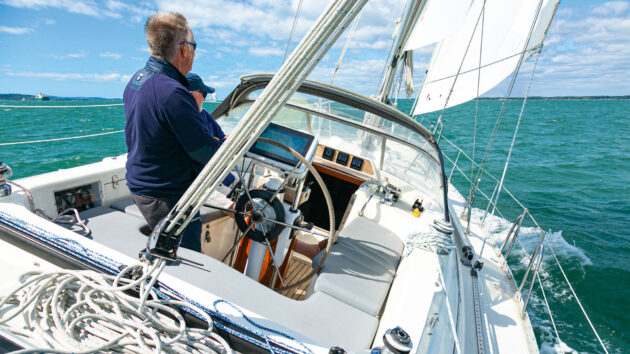
By modern standards the cockpit is modest in size, but it’s practical and the mainsheet is close to the helm. Photo: David Harding
Built in 1999, she had previously spent some of her life in Lowestoft, but had a Dutch name when they bought her from Port Solent. Her new name, Querencia, is a Spanish word sometimes described as meaning ‘a place where one feels safe, secure and at home, often associated with a deep emotional connection or longing’.
One other important point to mention at this stage is that the principal difference between the Moody 37 and the Moody 376 is that the latter has a sugar-scoop stern and a couple of ports in the transom. Otherwise they’re fundamentally the same boat.
One thing you don’t associate with Moodys of this era – whatever their keel configuration – is performance. Like a lot of voluminous cruisers with reasonably slippery hulls, they’re known to tram along nicely in a breeze once the sheets are eased, but how would the 376 cope upwind in a stiff breeze?
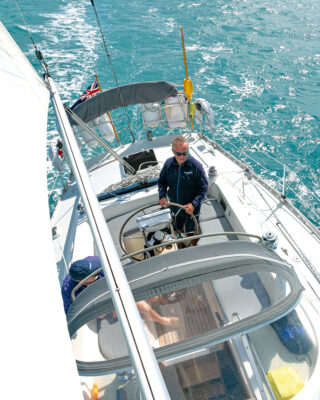
A short sprayhood helps keep the cockpit dry, though little spray tends to find its way aft. Photo: David Harding
That’s one thing I was hoping to find out when I joined Tim and Andy for a sail on a day when the westerly wind was due to freshen shortly after the spring tide started running west. That meant we would be contending with a sharp Solent chop not long after we set out, so I was keen to get the photos and video from the RIB sooner rather than later.
Predictably, the tide had turned and the breeze picked up by the time I hopped down from the Moody’s generously high deck into a bouncing RIB in the middle of the Solent. Getting very wet was the order of the day. Preserving the cameras became the first priority, followed by getting whatever shots were possible.
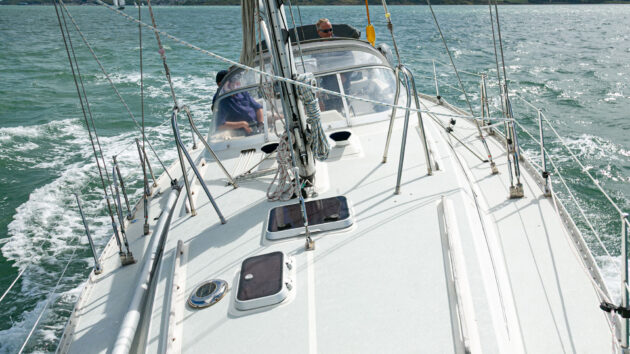
The non-slip finish in blue covers most of the deck, where there’s plenty to hold on to as you move forward. Photo: David Harding
An hour or so later, photographic missions accomplished, I scaled Querencia’s topsides and started to dry out on a boat that sent remarkably little spray over the deck, let alone back to the cockpit. By this time we had well over 20 knots of apparent wind against the full force of the ebb.
Many boats would have been distinctly wet, but the short sprayhood over the cockpit’s forward end had very little work to do. ‘Most of the wet you get here is rain’, says Tim.
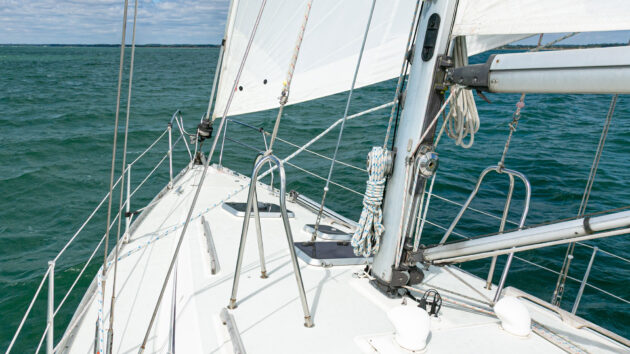
Halyards at the mast, where granny bars provide useful bracing points. Photo: David Harding
Ready to roll
Beamy, high-volume boats like the Moody generally prefer to be sailed reasonably upright, so Tim and Andy rolled in about a third of the in-mast-reefing mainsail and half the genoa once the breeze picked up further.
The remaining canvas was enough to power us through the chop, with Querencia heeling no more than 25° or so. She rarely heels more than that, I was told, and carrying more canvas doesn’t make her go any faster.
She digs in her shoulder and gets on with the job, in this case making an average of 5.6 knots through the water. I’ve heard reports of 37s and 376s making over 6 knots to windward in flat water with a full headsail, so dropping half a knot in a short chop and with rolled-down sails doesn’t seem bad.
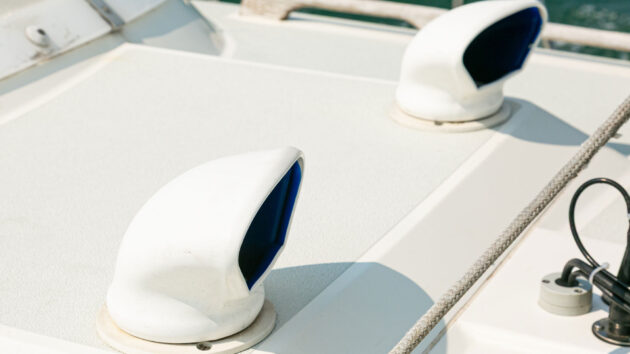
A pair of dorade vents in the hatch garage help keep the air fresh below decks Annotation caption her on here. Photo: David Harding
Of course a boat’s speed is only part of the story to windward. The other parts are the pointing and leeway. Our instruments showed a true wind angle of 49° (apparent wind angle 37°) which, combined with the boat-speed, gave a VMG (velocity made good) of 3.67 knots. For a boat of this nature in those conditions, that’s perfectly respectable.
Finding a way to windward
Acting against us were the chop, the rolled sails and the shoal draught. For us were the Brunton (self-feathering) Autoprop, a well-maintained boat, and owners who know how to sail her. As Tim observed, ‘When two boats are together it always becomes a race. Our windward performance isn’t great, so it has to be about tactics rather than speed.’
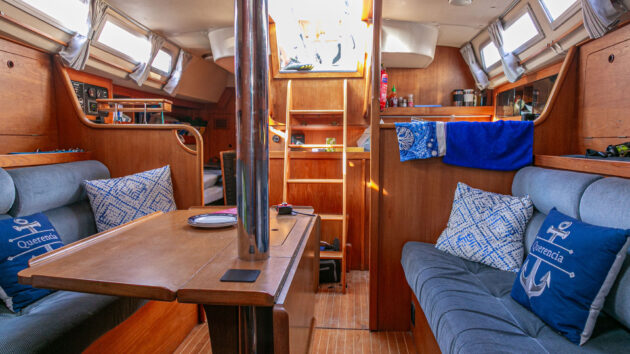
A centre cockpit pushes the saloon forward, but it’s still a generous size. Photo: David Harding
Even if the Moody might need a little longer than some to get you to an upwind destination, she makes life pleasingly comfortable along the way. She’s dry, she sails reasonably upright and she’s extremely well balanced, happily sailing herself to windward if we let go of the wheel.
For the designer, Bill Dixon, directional stability was important with the Moody 37/376; that’s why the keel is what he describes as ‘a moderate length optimised aerofoil section’. Apart from contributing to the boat’s relaxed sailing qualities, the keel’s length provides reassurance if you dry out alongside.
Dixon also drew a semi-balanced rudder on a partial skeg – designed, like the keel, ‘with cruising in mind.’
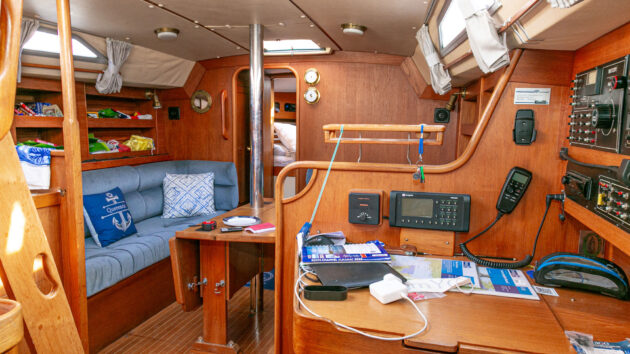
Down below, the Moody features nicely finished woodwork, plenty of handholds and a good chart table. Photo: David Harding
The hull he describes as having ‘powerful midships sections combined with carefully drawn and shaped bow and stern… giving a comfortable motion.’
One feature with which the Moody is strongly associated is the centre cockpit. Few people seem to feel ambivalent about centre cockpits, having strong views for or against.
Central feature
Not surprisingly, Tim and Andy are more than happy with theirs, Tim observing simply that ‘the Moody is an older design with a narrow cockpit and a big wheel. Modern boats would have two wheels and a big area for walking around.’
To a large extent that’s probably true, though the layout on the Moody works well despite the fact that the 36in (91cm) wheel fills the space between the seats abaft the pedestal, necessitating some seat-clambering to reach it.
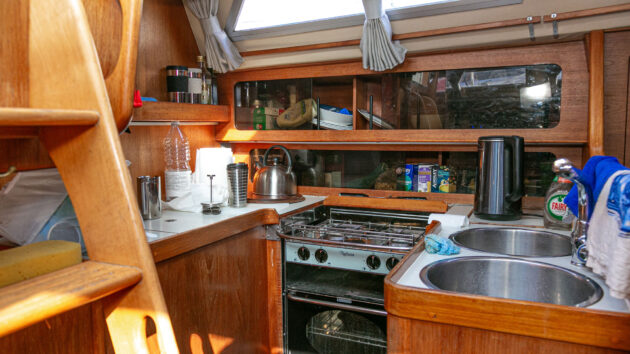
To port at the foot of the companionway steps is a secure and well-equipped galley. Photo: David Harding
I have long maintained that cockpits on many modern boats are too wide, offering few bracing points and giving you a long way to fall to the leeward side.
You don’t feel exposed on the Moody and, importantly, the wide decks allow easy access to the stern with no need to go through the cockpit. The sole is also reassuringly low, so you don’t feel as though you’re perched on top of the boat.
Of course, being higher up and further forward than with an aft cockpit means you have a more restricted view under the headsail. That’s less of a problem if, as on Querencia, you have a sail with a high clew.
Some of the essential sail controls are led aft to the cockpit, where they’re handled by a bank of clutches and a self-tailing winch to starboard. On boats of this era, however, much of the sail-handling was done from the mast. Here on the Moody you find a set of granny bars as well as the halyards with their winches.
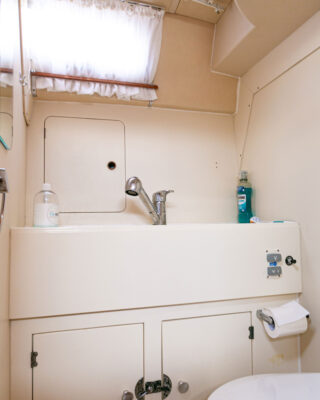
There is one heads aft and one forward. Photo: David Harding
On deck you also find wooden handholds along the outboard sides of the coachroof, moulded-in non-slip in a contrasting pale blue-grey, a pair of dorade vents over the hatch garage, a multitude of hatches forward of the mast and one over the aft cabin, abaft the mainsheet track.
Minor inconveniences are the rigging (caps, intermediates and aft lowers) in the middle of the side decks and the presence of a babystay, which inevitably makes tacking more of a chore. Stowage for bulky items is well provided for in the form of an enormous cockpit locker to port.
The Moody is known for her cavernous accommodation, and she certainly doesn’t disappoint down below.
As well as being notably roomy, she’s nicely finished: the woodwork is plentiful, robust and tidy. Stowage is excellent, with nooks, crannies and corners being used in a way that they rarely are on modern boats.
Practical features include the pillar handhold at the galley, together with a good number of well-placed handholds throughout.
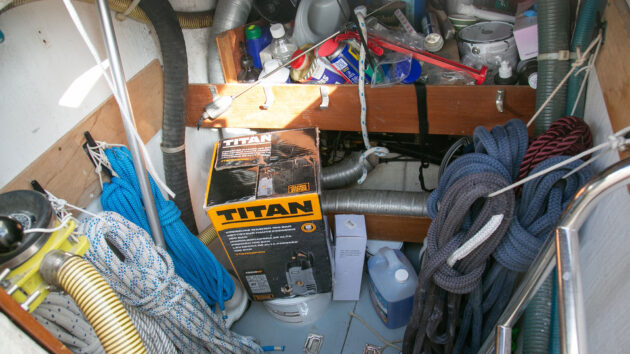
A large locker to port in the cockpit. Photo: David Harding
In terms of the Moody’s layout, there’s nothing particularly out of the ordinary.
At the bottom of the steepish companionway steps, you find the U-shaped galley to port complete with twin sinks and all the essentials. Opposite is a chart table set against a partial bulkhead.
The nav seat doubles as the navigator’s berth in the walk-through to the aft cabin, on the inboard side of which is access to the engine. The original Volvo had given up the ghost a year before our sail.
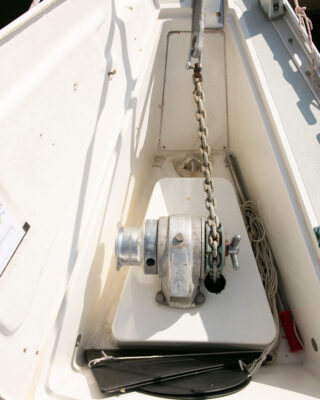
The windlass is on a plinth in the locker. Photo: David Harding
One yard quoted around £20,000 to take it out and replace it with a new equivalent, so Tim and Andy decided to look elsewhere and chose a 35hp, three-cylinder Beta instead. Apart from costing a lot less, their chosen replacement minimised surgery to the cockpit sole.
The large aft cabin has its own heads. Forward of the saloon is the second heads, with access from the saloon or forecabin.
Moody 376 specifications
DESIGNER: Bill Dixon
BUILT: 1985-1991
PRICE: £45,000-£58,000
LOA: 11.53m/37ft 10in
LWL: 9.53m/31ft 3in
BEAM: 3.81m/12ft 6in
DRAUGHT – Fin: 1.68 m/5ft 6in
DRAUGHT – Scheel: 1.37m/4ft 6in
DRAUGHT – Twin: 1.2m/4ft 0in
DISPLACEMENT: 7,383kg/16,254lb
BALLAST: 2,950kg/6,503lb
SAIL AREA: 59.40m2/634ft2
Enjoyed reading this?
A subscription to Yachting Monthly magazine costs around 40% less than the cover price, so you can save money compared to buying single issues.
Print and digital editions are available through Magazines Direct – where you can also find the latest deals.
YM is packed with information to help you get the most from your time on the water.
-
-
- Take your seamanship to the next level with tips, advice and skills from our experts
- Impartial in-depth reviews of the latest yachts and equipment
- Cruising guides to help you reach those dream destinations
-
Follow us on Facebook, Twitter and Instagram.
Note: We may earn a commission when you buy through links on our site, at no extra cost to you. This doesn’t affect our editorial independence.
Verdict
It’s probably safe to say that, in some circles, the Moody 37/376 has a reputation as a bit of a floating caravan. While she’s unquestionably roomy and comfortable below decks, I now know that she’s more spirited and capable under sail than you might expect. What’s more, the detailing and finishing are a reminder of how boats from reputable yards were built in those days. From the contrasting non-slip on deck to the well-placed handholds and good use of space, everything seems well thought out. She feels reassuringly robust, too. The tell-tale capping along the top of the main bulkhead, for example, suggests that it’s bonded to the deckhead, which is always comforting to see. Most importantly, she has proved to be an excellent choice for her owners, who have taken her over to France and the Channel Islands as well as west to Helford. More often than not, however, they will simply pop down for a spin around the Solent. ‘This boat has done everything we wanted,’ says Andy. We’ve had great fun in her.’