



She might look demure, but don’t be fooled. The Gib’Sea 312 Plus is a versatile 31-footer that packs a surprising punch for performance sailors
Gib’sea 312 Plus used boat review: Pace, grace, and space

Many boat-buying decisions start with lists: lists of possible boats, of their pros and cons, of the order of priorities, and so on. So let’s start with a list here.
Let’s say that you’re looking for a 31-footer for family cruising. Since you come from a performance-sailing background, you want something with a bit of get-up-and-go.
At the same time, it has to have good accommodation and to be easy to manage.
What would be on this list? It would quite possibly include the Moody S31, Hunter Channel 31, Westerly Tempest/Regatta 310, Hanse 315 and Jeanneau Sun Fast 32. For slightly slimmer or sportier contenders you might consider the Dehler 31, X-302, Beneteau First 31.7, and perhaps one of the 31.7’s hull-sisters, the First 310. There are more, of course, but these spring to mind first.
Some less well known options include Jeanneau’s Sun Fast 31 and the Gib’Sea 312.
Gib’Sea is by no means an unknown name. The builder, Gibert Marine, was a major force in French boatbuilding, producing an extensive range of boats from 20ft to 53ft over a period of about 40 years. Most were unashamedly family cruisers that placed the emphasis on creature comforts. In British waters, the Gib’Sea 242, 282, 76 and 84 are among the more widely seen.
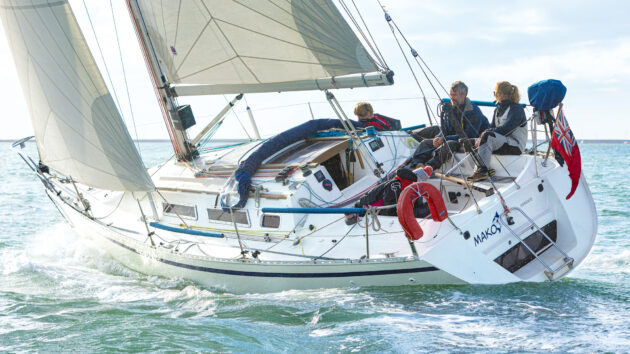
The cockpit is designed for tiller steering. Photo: David Harding
A few of the models, however, were distinctly sporty. These carried the ‘Plus’ suffix, such as the 80 Plus and 90 Plus. And then there were those designed by Rob Humphreys (yes – French yards did actually use British designers occasionally, the other notable example being Wauquiez and Ed Dubois, though in that case the designer’s name did at least sound French).
Humphreys-designed Gib’Seas included the 414 and 48 Master. They weren’t overtly racy like the 80 and 90 had been but, as you would expect from Humphreys, they sailed well. The 414 won more than a few races and made a name for herself at Spi Ouest (the big spring regatta in La Trinité) in the early 1990s, as had the 312 a few years earlier.
So let’s look more closely at the 312. She was Humphreys’ first design for Gib’Sea, and one of the few models (if not the only one) to be offered either as a no-frills masthead cruiser or in Plus guise. As the Gib’Sea 312 Plus, she was fitted with a deeper keel and a fractional rig that gives her appreciably more sail than her cruisy hull-sister.
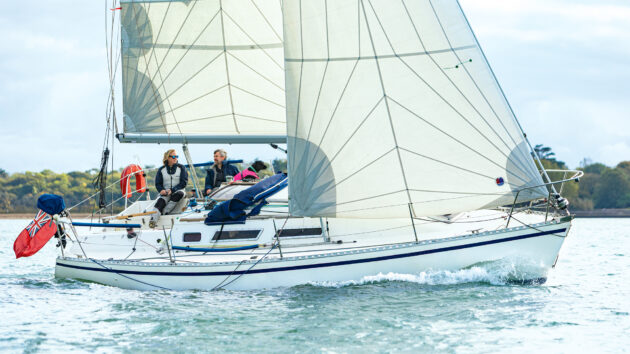
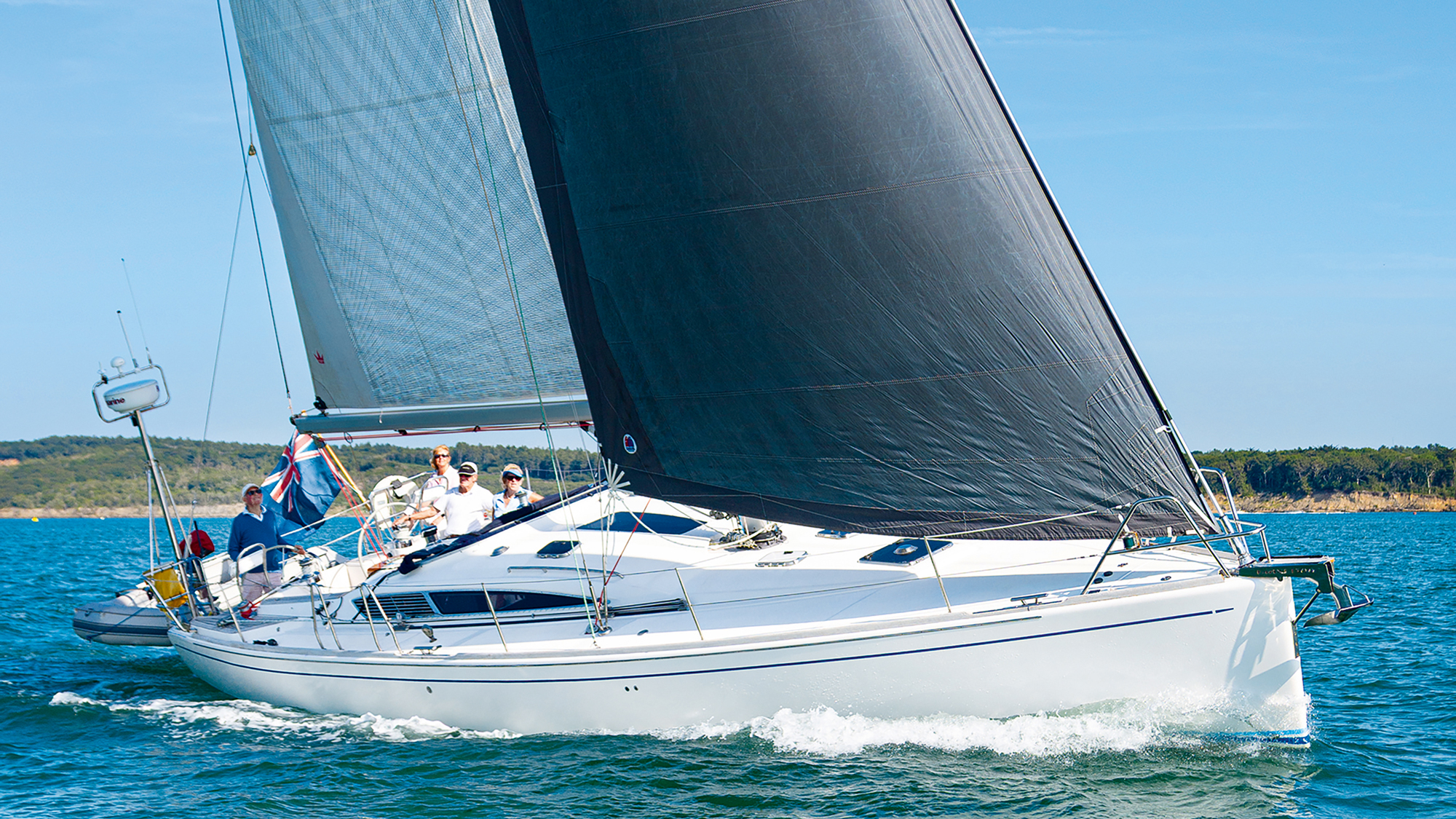
From a distance, the generous sail plan is about the only clue to her true nature. Otherwise she looks almost demure, and you might not give her a second glance if you saw her out on the water. But make no mistake: this Gib’Sea really does sail.
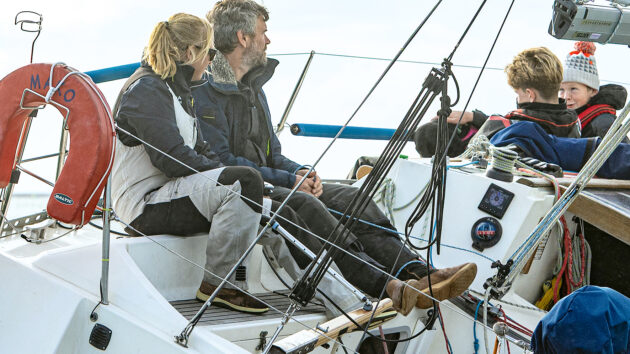
A well-arranged cockpit for efficient sailing, with a comfortable position on the coamings for helm and mainsheet trimmer. Photo: David Harding
A wolf in sheep’s clothing
In the case of Mako, a 312 Plus owned by Jo and Dan Wells in Lymington, the sporty side of her nature becomes apparent when you move in a little closer. Although she has a roller-reefing headsail, both it and the mainsail, from the Sanders loft, are in a tri-radial cut. You notice the 24:1 cascade purchase on the backstay, the towing genoa cars (with a 6:1 purchase so they can be adjusted under load), the 6:1/24:1 mainsheet, the split vang control led to clutches both sides, and the large-format Garmin displays mounted on the mast.
This is clearly a boat designed to be sailed efficiently, as indeed she is. Jo and Dan have both done plenty of racing, but they use Mako for cruising. The difference is that, unlike many cruising sailors, they have a boat that can be tweaked and trimmed to make the best of whatever conditions they encounter. They also have the knowledge to do the necessary tweaking and trimming.
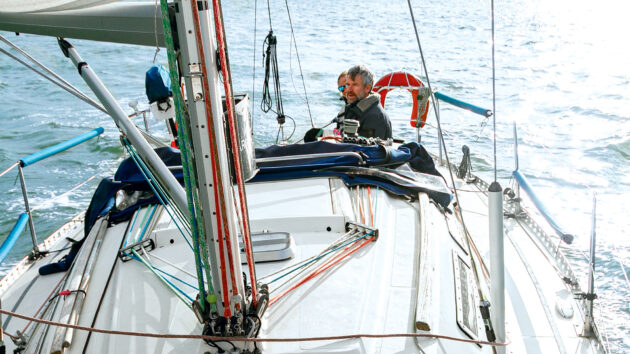
Inboard rigging and wide side decks make for an easy passage forward. Halyards and all lines are led aft from the mast. Photo: David Harding
Mako turned out to be a lucky find when they were searching for a boat in 2021, just after lockdown. ‘We looked as far afield as Cornwall for a suitable boat,’ explained Jo, ‘and then found this one on the Hamble.’
Under her previous ownership, Mako had been raced with some success. That explains the hardware (much of it upgraded from the original), the sail-control systems and why she came with a suit of racing sails in carbon, which have never been used since.
Article continues below…

Bavaria 30 Cruiser used boat review: Great little family cruising yacht
When you’re looking for a second-hand boat, it’s often easy to imagine that there’s a pretty broad choice in any…
Maxi 1300 used boat review: Easily handled fast cruiser
When we think of yachts built in Sweden, most of the names that spring to mind are from the west…
Taking her out
I joined Jo and Dan for a sail on a brisk day in October. With us were their two sons and the latest addition to the crew in the form of Maeve, the black Labrador, a year old and clearly well on the way to becoming a thoroughly competent sea-dog.
In a south-westerly wind and with a flood tide we had flat water in the western Solent and only a slight popple when we poked our nose beyond Hurst. The conditions made it easy to keep the boat on her feet under full canvas despite a wind that reached 25 knots over the deck at times.
That would have equated to a peak true wind of around 21 knots and an average of 14-17. In cruising mode, Jo and Dan normally take the first slab in the main at around 14 knots. For our outing, full sail made it more fun and we flattened everything down; much easier to do when you have ample purchases and good hardware.
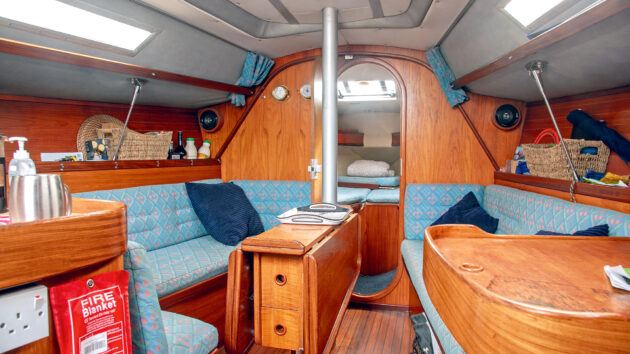
Nicely finished interior with solid trim and rounded corners. Photo: David Harding
Another factor allowing us to carry full sail was the No.2-sized roller headsail, which provides ample power in all but the lightest conditions. It doesn’t need to be rolled down until after the first slab has been taken in and the wind has increased to the high teens.
According to the log, we made up to 5.3 knots through the water at an angle to the apparent wind that, averaged between tacks, worked out at 32°. The log was certainly under-reading. I would have put our speed at between 5.7 and 5.9 knots. Those figures give a pretty good VMG and would explain why the 312 Plus achieved some success on the race course. If you’re not racing, they will simply help you get home (or wherever you’re going) more speedily.
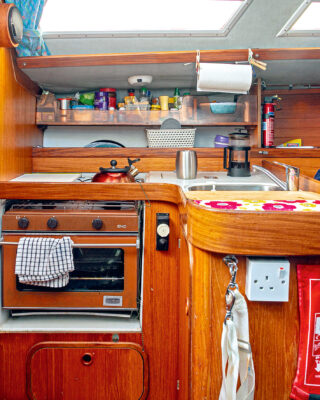
To port by the companionway, the peninsula galley has high, curved fiddles that double as handholds. Photo: David Harding
Sitting comfortably
While you’re getting there, you can enjoy the well-designed cockpit with nicely-angled coamings. They provide a comfortable perch on the high side for the helmsman (or helmswoman in this case, as it was Jo most of the time) and the mainsheet trimmer further forward. The traveller runs on a track just abaft the bridgedeck that’s curved in the vertical plane to help ensure smooth running and to keep the sheet tension constant whatever the car’s position.
Antal 40 self-tailing primary winches – fitted by the previous owner, along with new Spinlock clutches – are on the coamings forward of the tiller. You do see the occasional Gib’Sea 312 with wheel steering, but it really doesn’t belong on a boat with a cockpit like this that was designed around a tiller. The wheel has to be small, to fit between the cockpit seats, so you wouldn’t be able to helm from the coaming. You would also have to climb over the seats to move forward.
A question with nearly all cockpits on performance cruisers of this size is how best to choreograph the crew’s movements during racing tacks. Two headsail trimmers and the mainsheet trimmer have to work in a limited space between the tiller and the forward end of the cockpit at a time when elbows are flying, people are leaping around and a lot has to be done quickly.
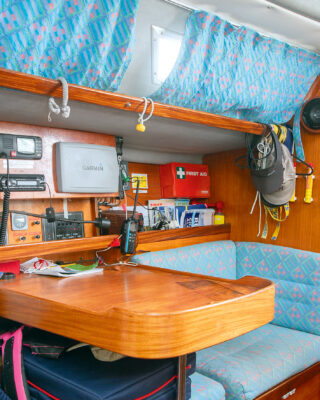
Plenty of instrument and stowage space outboard of the chart table, which straddles the aft end of the starboard settee berth. Photo: David Harding
Some of us have completed hundreds of tacks in cockpits similar to this while racing. It’s all perfectly manageable given a degree of coordination. Tacking tends to be a more leisurely affair
if you’re not racing, when you typically have fewer people and there’s plenty of room.
For a boat of this nature, the Gib’Sea has a very well-designed cockpit that’s roomy, comfortable and efficient. One great advantage of a tiller is that it can be hinged vertically to open up the whole space for lounging or socialising in harbour.
For downwind sailing, Mako is equipped with a range of symmetrical spinnakers.
She also flies an asymmetric from a short removable bowsprit, and that’s what we used for our relatively brief downwind leg. According to the log we peaked at 7.5 knots, though it was undoubtedly much higher.
The loose-footed mainsail allowed a simple ‘letterbox’ drop (between the sail and the boom) when the time came.
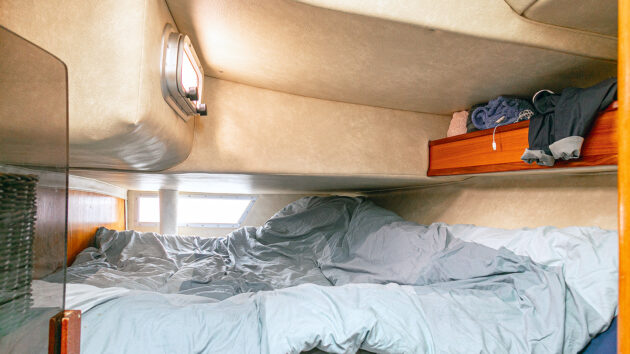
No dark corners in the double aft cabin, thanks to the opening port to the cockpit and the window in the transom. Photo: David Harding
It was interesting to hear that Mako had been re-rigged and given a stiffer mast, from Seldén, in 2017, a few years before Jo and Dan bought her. The more flexible original mast had needed running backstays, which you still see on some examples of the Plus version.
For propulsion when the wind dies, the 312 was fitted with Yanmar’s 18hp 2GM20 that, as you would expect in this case, drives a two-bladed folding prop.
Below decks
It’s easy to imagine that a cruiser from a mainstream French builder would have a rather ‘productionised’ feel down below. That’s not the case with the 312. She’s nicely finished with plenty of timber and, except in the heads, no interior mouldings. Instead, the joinery is bonded directly to the hull (a solid laminate), leading to less wasted space and weight.
Overhead is vinyl headlining. Vinyl does tend to start sagging and peeling over time, but it makes for easy access to the through-bolted fastenings for the deck hardware. Being in the boat-building business, Dan appreciates practical points like this. There’s not much on the Gib’Sea that he wouldn’t be able to repair.
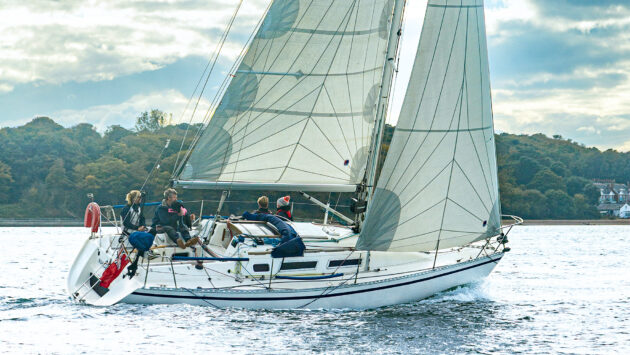
Mako was fitted with a new, stiffer mast in 2017. Gib’Sea 312 Plus models with the original mast are likely to have running backstays. Photo: David Harding
As well as the woodiness and a feeling of hand-crafted solidity, several features set the Gib’Sea apart from many boats that you might otherwise be tempted to place in the same category. One is the abundance of curves in the joinery: nicely rounded corners at the galley and chart table, curved trim on the main bulkhead, and rounded door frames too. Because there’s no moulded headlining, the bulkheads are bonded directly to the deckhead, which is always reassuring.
An unusual feature is a chart table that straddles the aft end of the starboard saloon berth. The berth runs beneath it and continues in the form of a 32in (81cm) long seat abaft the chart table.
In the saloon, the table with its fiddled drop-leaves has useful drawers in its aft end. Other notable points include the hanging space abaft the heads, big enough for four or five sets of waterproofs. Opposite, the aft cabin has a fixed hull port to the sugar-scoop stern.
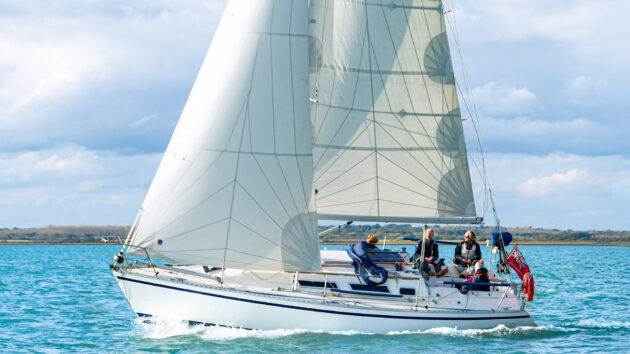
The 312 Plus doesn’t present a particularly sporty profile, but the generous fractional rig is a clue. Photo: David Harding
Gib’Sea 312 Plus specifications
DESIGNER: Rob Humphreys
BUILT: 1988-1991
PRICE: £20,000-£30,000
LOA: 9.30m/30ft 6in
LWL: 7.80m/25ft 7in
BEAM: 3.30m/10ft 10in
DRAUGHT: 1.80m/5ft 11in
DISPLACEMENT: 3,780kg/8,333lb
BALLAST: 1,442kg/3,180lb
SAIL AREA: 44.86m2/483 sq ft
Enjoyed reading this?
A subscription to Yachting Monthly magazine costs around 40% less than the cover price, so you can save money compared to buying single issues.
Print and digital editions are available through Magazines Direct – where you can also find the latest deals.
YM is packed with information to help you get the most from your time on the water.
-
-
- Take your seamanship to the next level with tips, advice and skills from our experts
- Impartial in-depth reviews of the latest yachts and equipment
- Cruising guides to help you reach those dream destinations
-
Follow us on Facebook, Twitter and Instagram.
Note: We may earn a commission when you buy through links on our site, at no extra cost to you. This doesn’t affect our editorial independence.
Verdict
Having met a number of Gib’Seas over the years, I was expecting the 312 Plus to be neither as nicely finished as she is nor as carefully built as she appears to be. Mako’s survey reports give her a remarkably clean bill of health for a 36-year-old boat. I thought she would sail, and she does. She’s fast, close-winded, very nicely balanced, predictable downwind and nicely responsive without being remotely twitchy. The deck layout is efficient and the cockpit is both roomy – for a cruiser of this length – and designed in a way that would allow it to work well for short-handed cruising or fully-crewed racing. Other performance-cruisers of this size are better known, and that’s sometimes reflected in their price. But the Gib’Sea 312 Plus is capable of giving her competitors a run for their money, be it on the race course, as a cruising boat or below decks. The 312 is more widely seen than the 312 Plus. If you’re happy with less sail and a shallower keel, one of those might suit you perfectly well. If, however, you want the fizz that comes from more sail area, deeper draught and greater rig control, it would be worthwhile tracking down a 312 Plus – even though you would be lucky to find one as well maintained and equipped as Mako.