



New innovations mean you have more chance of keeping your boat afloat and avoiding polluting the sea around you. Rob Melotti investigates
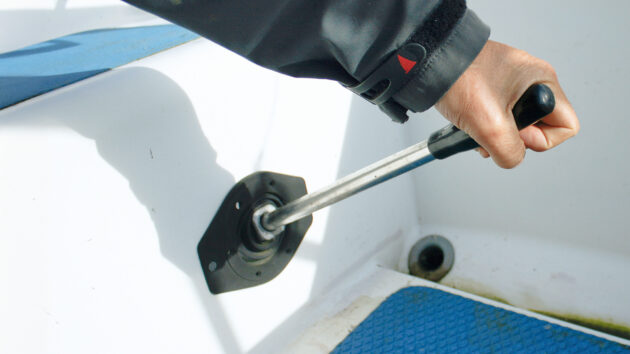
Bilge pumps are such a simple, standard piece of equipment that very little has changed about them in decades, but now their shortcomings are being dealt with by a range of smart new tech.
Digital Yacht’s new intelligent bilge pump controller and monitoring solution, Bilge iQ, was a design award winner at the METS 2025 trade event in Amsterdam, but what does it do that the existing technology doesn’t already do?
And what’s really changed in the 21st century science and technology of pumping water out of the bilge of a boat?
A quick search online for bilge pumps brings up a variety of automatic systems manufactured by companies like Rule, Whale and Jabsco, distributed in the UK by chandleries and marine hardware suppliers. Automatic systems consist of an electric pump that is triggered by a float switch that lives in the bilge.
The switch activates the pump when the water level rises and then disables it when the level goes back down again. If the pump fails to clear the water – either because it is blocked, loses power, or can’t keep up with the amount of water leaking in – it is common to install another float switch attached to an alarm, so that you can take action when the water hits this mark, ideally before anything gets waterlogged.
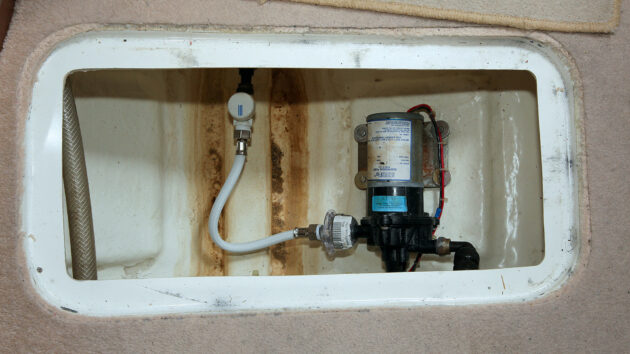
Strum boxes are the industry standard for preventing blockages in the bilge pump
So what can go wrong?
Pump blockages are an obvious weakness, which is where strum boxes come in. The ‘cage’ of the box is designed to keep blockages outside of the suction inlet, making it less likely to completely block the inlet and easier to clear if a blockage happens.
The new X-Yachts Xc47, tested in Yachting Monthly (September 2025), has replaced the traditional strum box with water strainers that have an inspection lid on the top – the sort of thing you’d find on your engine raw water cooling intake. The idea is that the strainer is much less prone to block than a small strum box, as well as being easier to inspect and clear quickly. Editor Theo Stocker wrote: ‘[It’s a] very belt and braces approach, but I liked it a lot.’
Detecting a blockage, or partial blockage, however, relies upon somebody noticing that the pump is straining and producing little output from its through-hull. If there is nobody physically monitoring the output of the pump on board, however, then a float switch connected to an audible alarm could be enough to alert someone, or the alarm could be connected to a device to send a message to the mobile phone of the owner.
Article continues below…

How it works: all about a yacht’s fuel system
A yacht’s fuel system comprises everything from the boat’s fuel tank to the engine’s fuel injector or injectors. There are…

How it works: Yacht stern gear
Astern of a yacht’s gearbox you will find the coupling that connects the power output shaft to the propeller shaft.…
For boats kept on moorings, rather than marina berths, electric power is also an obstacle to face. Solar and wind can keep batteries topped up in order to manage the bilge-water levels, but a blockage could spell disaster, causing the pump to work overtime, depleting the battery to the point where the pump fails and the high-water float switch won’t send an alert either. Even if it doesn’t run the battery down, the motor could burn out if running when the intake is blocked. Nothing beats regular checks for assurance on this front.
An automatic system can, in fact, conceal a problem by dealing with the water without you realising, as the bilge always appears to be dry. An alarm with a text alert that triggers every time the float switch activates the pump might seem like overkill, but if a leak is progressively worsening, a high-water alarm might be the first you know about it. Without either of those systems in place, you are reliant upon someone else noticing and alerting you to the problem. It is this exact case (see overleaf) that led to the design of the BilgeiQ bilge-pump monitoring system.
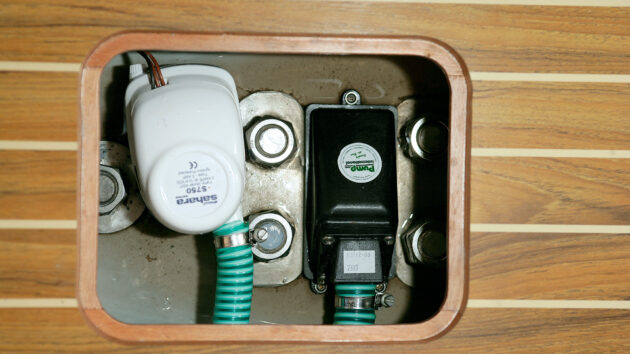
Fitted between keel bolts: a strum box and float switch to keep the bilges dry. Photo: Graham Snook / Yachting Monthly
Boosting pump efficiency
Some boat owners may not know how to identify the necessary capacity of an electric bilge pump, writes Harry Dekkers, former Royal Netherlands Navy sail training officer. In the event of a leak starting from a broken through-hull, hose, transducer, or propeller shaft, there may be an underwater hole with a diameter of anything between 10 to 40mm, which can create an impressive flow of water. Your bilge pump should have sufficient capacity, and therefore similar hose diameter to your largest through-hull to provide you the time to find the source of the leakage and stop the water flow.
But that is only part of the equation. If a pump runs constantly, battery power could be quickly used up.
Specifying pipe
The right kind of pipe is equally important for ensuring your bilge pump can do its job unimpeded, writes Dag Pike. The piping for the bilge pump should have a smooth interior bore so that the water can flow easily and the routing of the piping […] should not have any sharp bends that might restrict the flow through the pipe.
Also, avoid any loops in the piping which can restrict flow. You will find that the bilge pump piping is reinforced either with metal or plastic spirals so that it maintains its shape and doesn’t kink.
Hose type: Clear, steel-spiral PVC hose
Hose requirements: Reinforced for use on external skin-fittings. Smooth internal surface
Replacement: When they’re hard or brittle or every ten years.
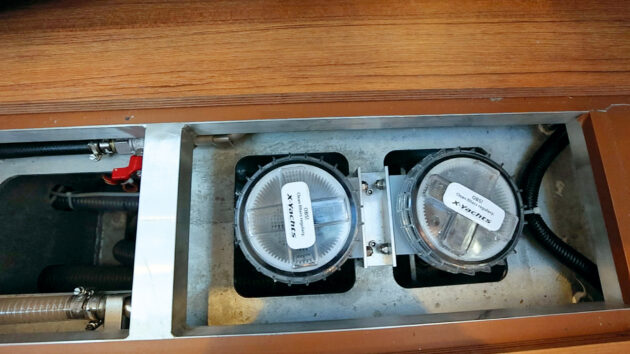
The recently tested Xc47 featured ‘belt and braces’ bilgepump strainers to avoid blockages, and to make spotting and clearing blockages easier
Building in redundancy
Rupert Holmes advises boat owners on how pumping water ‘up and out’ reduces your power: ‘We all know that effective bilge pumping arrangements are essential for safety at sea, yet a surprising number of boats are lacking in this respect.
‘Automatic electric pumps often sound like the ideal solution, but many installations fail to live up to expectations. One of the reasons is that real-life installations are often much less powerful than the pump’s specifications on paper might suggest.
‘A key issue here is that rated performance is often given at the pump outlet, not where the water exits the hull of the boat. If bilge water has to be lifted 3ft to get it out of the boat the flow rate will be reduced by 30%.
‘Equally friction in the pipework, especially where reinforced corrugated pipe is used, can account for a further 20-30% reduction.
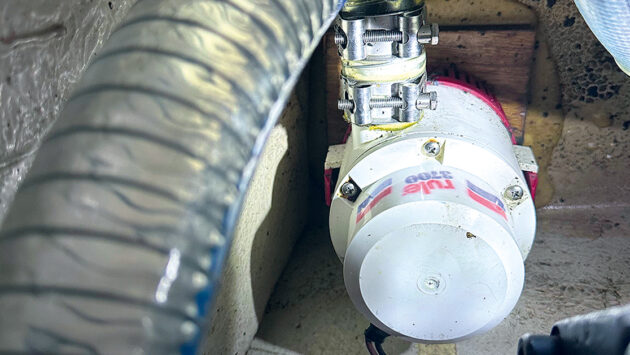
This giant pump can shift 233l per minute – not a standard leisure yacht size
‘In addition, flow rates are often quoted for 13.5V of power reaching the pump, but that’s only likely to happen with the engine running. If the service batteries are half-discharged at around 12.2V there will be a further reduction in flow.
‘When these three factors are added together it’s not unusual to see real-life pump outputs of only 40% of the rated figure, even for good installations.
‘If there are long pipe runs with lots of elbows, or undersized/corroded wiring to the pump, output may not even reach 25% of the rated flow. And if the pump rating is for US (rather than imperial) gallons then flow rates will be even lower than owners on this side of the Atlantic might expect.
‘A second problem with standard leisure automatic pumps is that there’s no warning until something has gone badly wrong. In times gone by we would count the number of strokes needed to empty the bilge with a manual pump at the change of each watch. Any developing problem would therefore come to light at an early stage.
‘However, if an electric pump deals with small ingresses of water without fuss you don’t have advance notice of a problem until the pump can no longer keep up with the ingress, or the vessel’s batteries run flat.
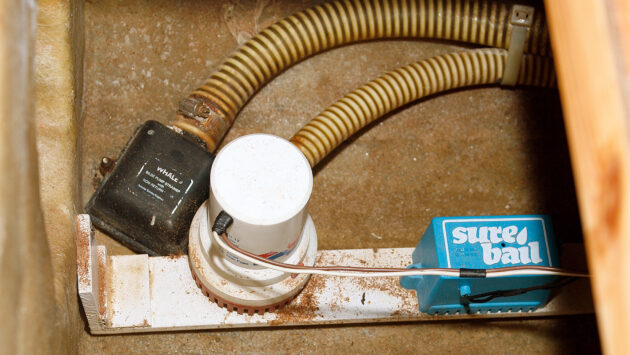
Bilge pumps need to be specified with the horizontal and vertical distance to the throughhull in mind. Photo: Motor Boats Monthly magazine www.motorboatsmonthly.co.uk
Separate alarm system is optimal
‘By contrast, many commercial fishing vessels have been saved thanks to their mandatory bilge alarms.0
‘In many yachts it’s a straightforward enough job to fit an alarm. An existing set-up could be adapted, for instance, by wiring a low-cost buzzer to the float switch so that the alarm sounds when the pump operates.
‘However, a separate alarm system is a better option, as this will function even if the pump’s float switch fails.
‘There are also cost-effective options for sensors, starting at £120, that will automatically ping a message to your mobile phone or email when the alarm is activated.’

When bilge alarms fail and nobody is aboard, boats that are otherwise in perfect working order need. Photo: Andrew Woodley / Alamy Stock Photo rescuing
Case study – ‘Your boat is sinking’
It is the phone call no boat owner ever wants to receive: ‘Your boat is sinking.’
For Nick Heyes, managing director of Digital Yacht, those words came from the harbour master while he was hundreds of miles away from the marina.
Marina staff were instructed to do whatever was necessary to save the vessel. The cause, discovered later, was a small but persistent leak in the shaft seal. Over time, it allowed water into the bilge – water that the pump had been ejecting overboard – without anyone knowing about it. Eventually the pump overloaded and failed, and the boat nearly sank.
‘Digital Yacht creates clever, connected solutions for boaters,’ says Heyes, ‘and yet my own boat nearly sank simply because I didn’t know the bilge pump had failed. There had to be a solution.’
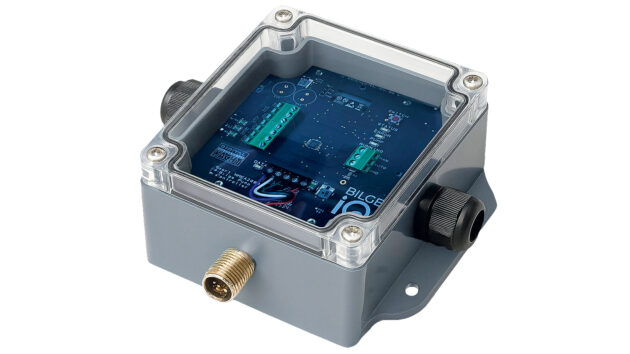
The BilgeiQ connects the bilge pump to NMEA 2000 network, WiFi and more
Digital Yacht Bilge iQ is basically a set of brains – comprising sensors, switches, controllers and monitors – for your existing bilge-pumping system. It’s a black box that installs between a bilge pump and its power supply. It also intercepts the float switch or switches (if those are installed).
Firstly, this enables your boat’s multifunction display (MFD) to become an on-off switch, thanks to NMEA 2000 switching messages. Secondly, Bilge iQ can monitor the current being drawn by the pump and combine that info with the status of the float switches installed.
This means that if the pump is blocked and working overtime, or the switch has been triggered but the pump has no power, a specific alert (again via NMEA 2000) will pop up on the cockpit display. These alerts are defined by Bilge iQ and work on most modern MFDs (but not all):
- Bilge pump running
- Bilge pump running dry
- Bilge pump not running, but float switch on
- Bilge pump float switch failure
- Bilge water at second high water float switch level
- Bilge pump high current
- Bilge pump low voltage
In addition, there is a WiFi connection that enables control and monitoring functions to be managed by phone or tablet devices while you are onboard, plus a connection with Victron’s Cerbo GX systems and VRM cloud monitoring solution so remote monitoring of your boat becomes possible.
Ben Stein was one of the judges of the NMEA’s Best New Product and NMEA Technology Awards at the NMEA annual conference last year in Fort Lauderdale, Florida. ‘This isn’t the first time we’ve seen bilge pump monitoring include current measurement, and I often wonder why it isn’t more common,’ he wrote on his website panbo.com.
‘In many respects, current tells the story of what the pump is doing. If the pump is freewheeling, it will draw relatively little current; if it’s pumping water, it will draw around the rated current, and if it’s jammed with debris or has a locked rotor, then it will draw significantly more than rated current.
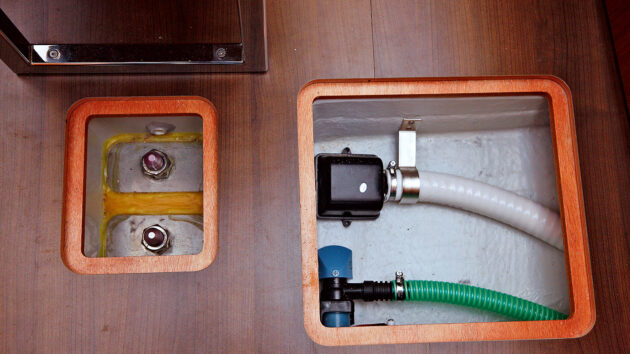
A neat bilge pump installation on board a Bavaria Cruiser 33. Photo: Graham Snook / Yachting Monthly
‘Bilge IQ utilises NMEA 2000’s built-in alerting PGNs to provide onboard notifications of issues. Unfortunately, and as Digital Yacht has highlighted for some time, NMEA 2000 alerts are not well supported, although that is getting better, albeit slowly.
Currently, those alerts will be seen on other Digital Yacht equipment, Garmin and Raymarine chart plotters, Maretron displays, and possibly a few other components. Unfortunately, as of this writing, it is my understanding that Navico and Furuno come up short in alert support.’
Nick Heyes describes the current monitoring as ‘the secret sauce in the device. Basically it makes your bilge pump intelligent through interfacing with NMEA 2000, a wireless interface for consumer devices like iPads and tablets, and it’s also designed to work with any particular bilge pump, so you don’t have to buy a new bilge pump to make it intelligent.’
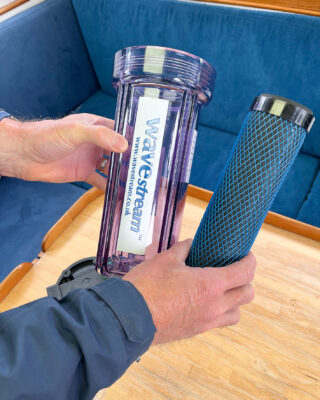
The Wavestream 1 will filter oil and plastics out of bilge water for boats up to 10m
Adding a bilge filter
And there is also an environmental angle that is currently optional in UK waters, but would be mandatory if your boat were to get afloat in Turkish waters, for example.
‘A sinking boat obviously poses major environmental risks,’ Heyes explains, ‘but more importantly, on a day to day basis, unmonitored bilge discharge is a problem. The bilge is where all contaminants collect – fuel and oil spillages, paint flakes, microfibres and microplastics […] creating mindless pollution of the marine environment. We knew we had to take Bilge iQ one step further.’
Digital Yacht approached Wave International, the UK-based manufacturer of Wavestream bilge filters to remove hydrocarbons and contaminants before discharge. Wavestream filters come in various sizes and are fitted in-line between the bilge pump outflow and the through-hull fitting. The housing is fixed in place, but the actual filtration cartridges need to be replaced once a certain volume of contaminant has bonded with the material.
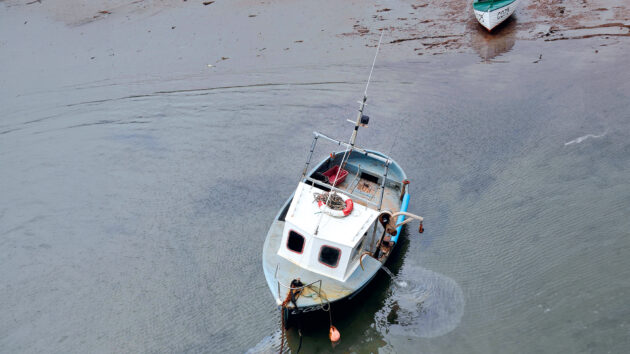
A surface oil slick caused by an automatic bilge pump contaminating the water around a boat. Photo: Adrian Muttitt / Alamy Stock Photo
The smallest unit on the market is the Wavestream Micro (£110), with replacement filters that cost £25. The Wavestream 1 (£130) is suitable for yachts up to 10m in length, for which replacement filters cost £46. And for 40 footers and above the Wavestream 2 costs £250 to purchase and £97 for a replacement cartridge.
Paul Gullett, MD of Wave International, explained to me that he recommends boat owners replace their cartridge every year; however, the Wavestream 2 cartridge can hold one and a half litres of diesel or lube oil, which would be quite a major spillage.
The true test is whether the water exiting the system via the through-hull is oil- and plastic-free. ‘The problem is that it works extremely well until it doesn’t,’ he says, although he stresses that they don’t release the material that has been filtered out previously. Bilge iQ provides pump run-time data, which can build a picture of how much the filter has been used.
Enjoyed reading this?
A subscription to Yachting Monthly magazine costs around 40% less than the cover price, so you can save money compared to buying single issues.
Print and digital editions are available through Magazines Direct – where you can also find the latest deals.
YM is packed with information to help you get the most from your time on the water.
-
-
- Take your seamanship to the next level with tips, advice and skills from our experts
- Impartial in-depth reviews of the latest yachts and equipment
- Cruising guides to help you reach those dream destinations
-
Follow us on Facebook, Twitter and Instagram.
Note: We may earn a commission when you buy through links on our site, at no extra cost to you. This doesn’t affect our editorial independence.