



Why staring at other people’s hulls at the Southampton Boat Show remains a sailor’s greatest pastime
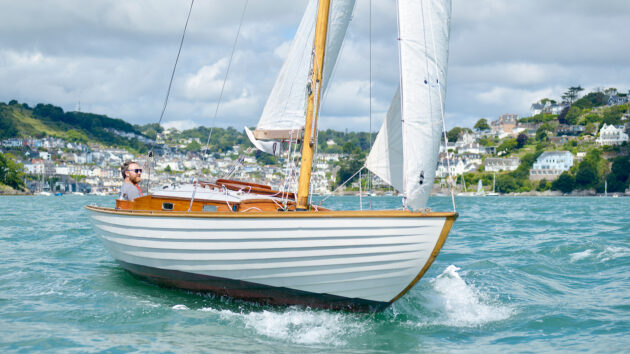
This month sees the Southampton International Boat Show, that end-of-summer opportunity for the great pastime of staring at other boats. Some, of course, focus intensely on equipment, not least because the summer cruises revealed, or reminded them of, which bits of kit really aren’t working. Many an anchor-windlass salesman has rubbed his hands in glee on spotting the approaching hobble of a seriously bad back.
But for me, it’s gazing at other boats that does it. When I first started sailing, wheedling myself onto a series of boats as tyro crew and spending far too much time doodling imaginary yachts in the studio during the duller bits of Radio 4’s Today programme, I was constantly excited by their sheer glamour.
Hull shapes themselves were entrancing, particularly if their lines were elegantly fishlike: low and traditionally racy rather than boxy; it took many a soaking-wet beat to windward before I admitted to myself that there are disadvantages in pretending to be a tuna or dolphin, with dashingly low freeboard and bows designed to fling gallons of salt water back to the cockpit.
It took even longer to accept that a broad, stout stern, as seen on a comfortable breeding sow or a cartoon barmaid, provides a comfortable lift in a following sea. A dashing canoe stern does not.
As to keels, it took me several love affairs with long, heavy ones (Barnacle Goose 1 & 2, Tinkatoo, Ayesha) to persuade me that a mere fin was not flimsy at all.
The centreboard on the Cornish pilot cutter Grace O’Malley I grudgingly accepted as useful through the nursery-parent period: you could dry out on beaches or squat alongside Bridlington quay to get the children ashore by ladder rather than dinghy.
Article continues below…
Forget good company, give me a crew who can fix the head! – Libby Purves
Kindly, tolerant people don’t usually rate their friends according to how useful they are. If they do it’s not so…

Does your boat represent freedom or a is it a floating prison? Libby Purves
While listening to a programme on BBC Radio 4, I heard a historian quoting a medieval mystery play. These 14th-…
But it took a bit of anxious persuasion to get me comfortable with the fin-keeled Wild Song, for all her weighty dignity. Maybe during my early Maurice Griffiths addiction period I just got heavily imprinted with the idea that a keel should start just under the bow, swell out majestically, and form a nice straight line all the way to the rudder.
The lines of boats are an artistic and scientific discipline, and I know little of the maths. But the romance is heady; we actually commissioned, and still own, a half-model of our first joint boat, the Contessa 26 Barnacle Goose. Though irritatingly, eventually a buyer’s surveyor found some fault within her keel-moulding anyway.
But I am still in thrall to romantic lines. There is satisfaction in being the nicest-looking hull in the anchorage, knowing that you are improving the scenery, not ruining it like some of the fat, practical fridge-white dumplings nearby with their comfy double cabins and limitless locker space… bah humbug.
When people row their dinghies round you taking pictures, as with our Rummer yawl Tinkatoo, it feels good. Almost worth dealing with the wet clothes and dubious engine also associated with her.
Anyway, this emotional pull to boat shapes is one of the reasons that the Southampton Boat Show is a treat, because boats have their masts up.
Standout memories include the year when Mike Richey, the great transatlantic singlehander and navigator, was on site with the re-created Jester, built in Aldeburgh. He used to stay with us, supervising it with anxious perfectionist love for the original boat lost in 1988 off Nova Scotia.
She was, of course, pretty: a 25ft Nordic folkboat modified and junk-rigged by her first owner, the Cockleshell-Heroes veteran Blondie Hasler. Mike never much liked being a human exhibit, but that year bravely came to chat to all-comers.
The other Southampton memory is a minor tent collapse. A sudden great wind made the end of the tent beside me start to take off like a rogue spinnaker. Cue racket, concern, haste.
But nobody in sight, stallholders and public, screamed or fled; everyone doggedly hurled themselves at the flapping canvas, taking no nonsense. After all, we reflected, when it had been safely re-pinned and weighted, if there’s one thing sailors do know a bit about, it’s how to tame unruly cloth.
Enjoyed reading this?
A subscription to Yachting Monthly magazine costs around 40% less than the cover price, so you can save money compared to buying single issues.
Print and digital editions are available through Magazines Direct – where you can also find the latest deals.
YM is packed with information to help you get the most from your time on the water.
-
-
- Take your seamanship to the next level with tips, advice and skills from our experts
- Impartial in-depth reviews of the latest yachts and equipment
- Cruising guides to help you reach those dream destinations
-
Follow us on Facebook, Twitter and Instagram.
Note: We may earn a commission when you buy through links on our site, at no extra cost to you. This doesn’t affect our editorial independence.