



Photography onboard has gone from being 'shoot and hope' with expensive equipment to available to all in a fairly short space of time says Pete Goss
Writing will always be something I enjoy but there is no denying that ‘a picture says a thousand words’. With its many moods this seems particularly so when at sea.
As such I have always made an effort to capture that elusive image to be shared for all time. Not so long ago it was equipment and budget that proved to be the greatest impediment. Both have come on leaps and bounds since launching my quest for that one iconic shot.
In the early days waterproof cameras were precluded by price. The answer was home made waterproof bags with crude lens caps. Cameras were mechanical, with film needing to be loaded and then cranked on picture by picture, and focusing never failing to disturb the waterproof bag and distort the final image.
On completion of training for the British Steel Challenge I was given a professional Nikonos diving camera by the crew. Incredibly generous, I treasured it for the sentiment and its rugged engineering.
Sadly, being so specialist it never quite hit the mark. Nothing was truly satisfying.
One of the concerns of the early days was the cost of development with every shot having to be considered and then awaited with bated breath. I still remember being hit on the head by a camera during a knock down on the Vendée Globe.
Grabbing the camera, I put my hand above the coaming and blindly pressed the shutter as the wave rolled on. My gut told me that that was the one and with bated breath I handed over a bag of film in Tasmania when I dropped off Raphael.
It was flown home, developed and made available to the press by Philippe Jeantot, the race organiser. Knowing I was broke, he used an agency and that picture, which I wasn’t to see for another couple of months, kept Tracey and the kids financially supported until my return.
It’s an evocative image that captures the spirit of the southern ocean. To be able to fire away with abandon on a digital camera and look at them as I go remains a thrill. The ability to send them via satellite opened up ocean sailing to the world.
The problem was that to cover a race properly you really needed a professional with time out of the watch system. They came with lots of equipment in awkward waterproof cases. Everything was power hungry so a ton of batteries were called for.
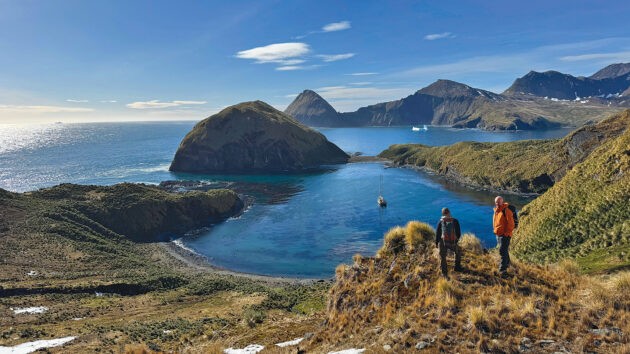
Hercules Bay. Photo: Pete Goss MBE
Changing lenses on a soaking boat with dripping foulies was a nightmare. As it was so vulnerable, back up equipment was required. The whole thing was a headache for all.
My first foray with drones started when my brother set up an aerial photography business using a radio control plane. The camera was built into the wing. Hiding within the subject, he circled the plane and fired off pictures when the wing lined up.
The next project in this vein was a quest for the first aerial footage of a boat in the Southern Ocean. A kite company was roped in to develop a stable kite that could carry a camera. We worked with a wildlife photographer who hand-made the first lenses that were famously put on an eagle’s head for the BBC. To this we attached a tiny microwave transmitter and it worked. I can’t tell you how thrilling it was to see footage emerge on our screen onboard.
When my trip to South Georgia first presented itself, I knew the purchase of decent camera equipment for this once-in-a-lifetime experience would come at a prohibitive cost. In the end Steve, a crew member and keen photographer, came with everything and so it was with a financial sigh of relief that I shared the baggage space on flights south.
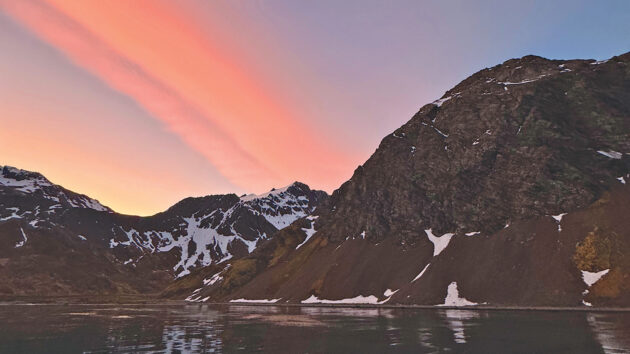
If you read my article on South Georgia you might be surprised to hear that all the pictures were taken on my phone.
Compact, rugged, waterproof and crucially, to hand. It wasn’t long before we realised that Steve’s kit had been quietly shouldered aside. For years the solution has been shoved in my pocket without a thought.
Enjoyed reading this?
A subscription to Yachting Monthly magazine costs around 40% less than the cover price, so you can save money compared to buying single issues.
Print and digital editions are available through Magazines Direct – where you can also find the latest deals.
YM is packed with information to help you get the most from your time on the water.
-
-
- Take your seamanship to the next level with tips, advice and skills from our experts
- Impartial in-depth reviews of the latest yachts and equipment
- Cruising guides to help you reach those dream destinations
-
Follow us on Facebook, Twitter and Instagram.
Note: We may earn a commission when you buy through links on our site, at no extra cost to you. This doesn’t affect our editorial independence.