


Enjoyable, easy sailing and living in comfort is the name of the game for Beneteau’s Oceanis range, but can they pull off another winner with mass-market appeal? Theo Stocker asks the question
Beneteau Oceanis 47 review: Ridiculously easy and enjoyable to sail,
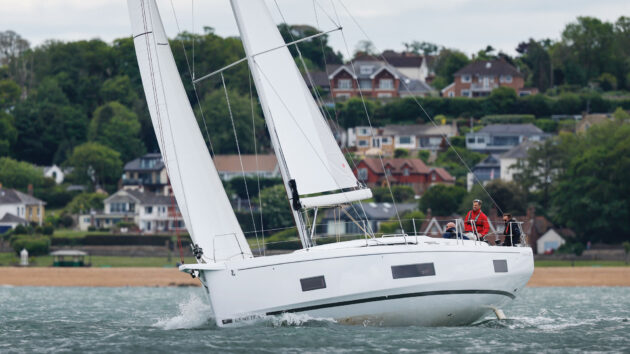
Taking a new boat out of its wrapper and setting sail for the first time is a nerve-wracking moment. Inevitably, the rig needs tuning, lines leading, snags sorting, and plenty of faffing to get the boat sailing well. Having a boat tester on board for that revealing moment must be stressful, but the UK Beneteau dealers Ancasta, with whom I was sailing on a chilly May morning, needn’t have worried.
Furling lines off, the main and genoa spooled out. Full sail. Up on the wind, sheets in, a nudge on the powered winch and we were off.
A smidgen of halyard tension dealt with the luff creases, leeches brought under control with a tweak on the leech lines, and the towable jib car pulled a few inches forward to balance up the tell tales nicely.
That was it. Straight away the helm was balanced, with just a hint of weather helm to let you know things were as they should be. She lacked the sensitivity of a performance cruiser with a single rudder on which you can find the groove upwind by feel alone, but in 12 knots of true wind and at about 32º-35º to the apparent, we were up at 7-7.5 knots, easy peasy.
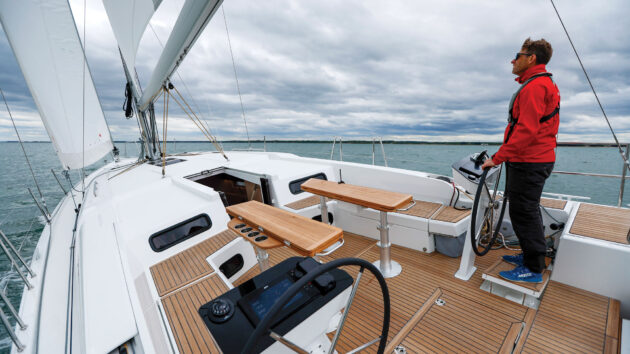
A wider cockpit makes space for split tables, which lower to form large sunpads. Photo: Paul Wyeth
Sure, the battenless furling main lacked a little finesse and the fixed backstays, arguably redundant with the large swept-aft spreaders, couldn’t be adjusted, nor was there a traveller to play with the boom position and sail twist. And that meant that a possible degree or two more of pointing, and fraction of a knot or two, went untapped.
While the purists among you may be wincing, Beneteau reckon that most sailors don’t want the complexity, the hassle and the cost of all those extra bits of string – the faff of it all is a hindrance, rather than a help, to them and their crew enjoying time on the water.
For a boat that is all about simple, easy, and enjoyable sailing, it was clear within five minutes that Beneteau have got this boat pretty much spot on. Of course, if you want a bit more oomph, the First line performance pack will give you a mast a metre taller, hydraulic backstay control, mainsheet traveller, a flatdeck genoa furler and Dyneema running rigging, and an extra 10m2 of upwind sail area (21m2 more than the standard furling main and self-tacking jib).
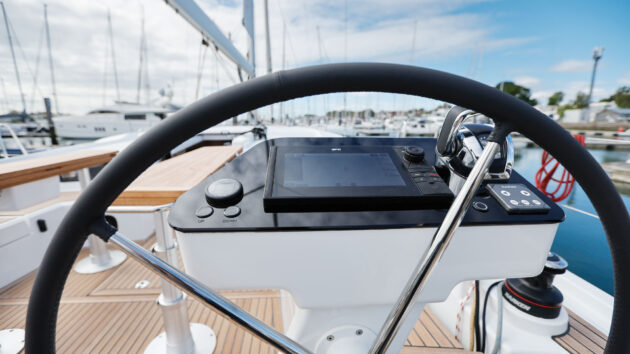
Pedestal controls include an electronic throttle, windlass, and autopilot via the plotter. Photo: Paul Wyeth
You’d hope so, given that there are few yards anywhere in the world that build more boats than Beneteau, or at least the Beneteau Group, which also includes Jeanneau, Lagoon and Excess, and it is this scale that, they claim, gives them a unique insight into how customers actually use their boats.
We may dream of crossing oceans and braving the elements (of which these boats are capable), but in reality most of us want a fun time aboard on a gentle cruise along the coast in pleasant conditions with a few friends or family aboard.
The experience of relaxing on deck, living afloat and enjoying a few creature comforts are far higher up the list than the privations that serious cruising used to entail.
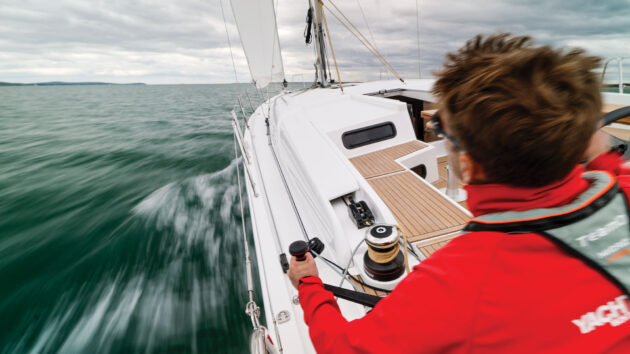
All lines and both winches are brought close outboard of the helm. Photo: Paul Wyeth
Subtle evolution
This is also the eighth generation of the Oceanis range of boats, for which the 47 is the first model to be updated, replacing the hugely popular Oceanis 46.1 in the process. While this is a completely new hull and deck, putting the two boats together in a game of spot the difference will leave even aficionados having to search carefully indeed.
Exactly matched on length over all, maximum beam, engine power and (almost exactly) on tank capacities, the numbers only vary on the lightship displacement – the new boat being marginally heavier by a third of a tonne – while the mast height is slightly lower, and maximum draught has been reduced.
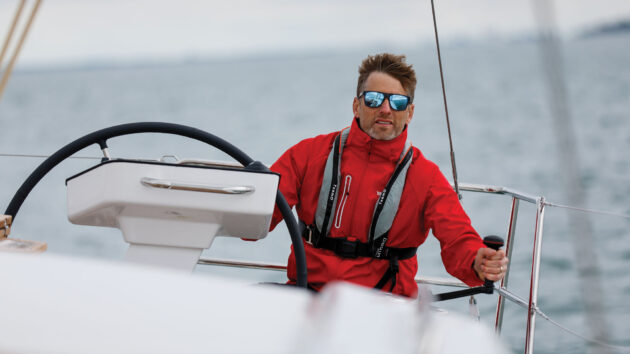
Theo gets to grips with the Oceanis 47. Photo: Paul Wyeth
More subtle differences become evident, however, when you step back and look at the hull. Designed again by Finot-Conq, the maximum beam has this time been taken all the way aft to the stern.
Coupled with pushing the helm positions even further outboard (notice how the side decks narrow right at the quarters), this creates additional space in the cockpit, allowing the L-shaped seating to be expanded, and the central fixed table to be split into two lowering tables that form double sunpads either side and allow easy passage through the cockpit.
This certainly worked well, and offering the option of a closed-off transom looks like a good move, as it increases the feeling of security, as well as providing additional space for an on-deck barbecue (a move that Dufour won’t fail to notice).
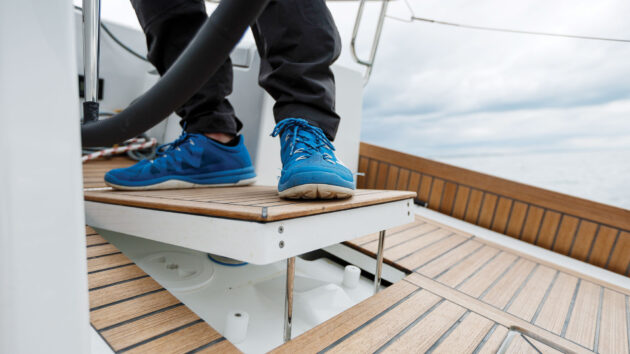
Chocks lift for better footing for the helm at the broad stern. Photo: Paul Wyeth
The only thing I wasn’t sure about was the side deck, which is now so narrow the only practical way forwards is over the saloon seats – a deal less easy than some other boats on the market, notably Jeanneau’s stepless walkthroughs of its Sun Odyssey range.
Sporty and sleek
Hull chines have also been beefed up, both forwards, where the bulging lines are big enough to prove that even flares can come back into fashion, while the aft hull sections have been lifted, and widened, giving the stern a more sporty, sleek look that should also help reduce wetted surface area while boosting power when heeled.
The flat surfaces of the bow flares did slam once or twice in short sharp chop, but we didn’t have the chance to test this in any serious seaway.
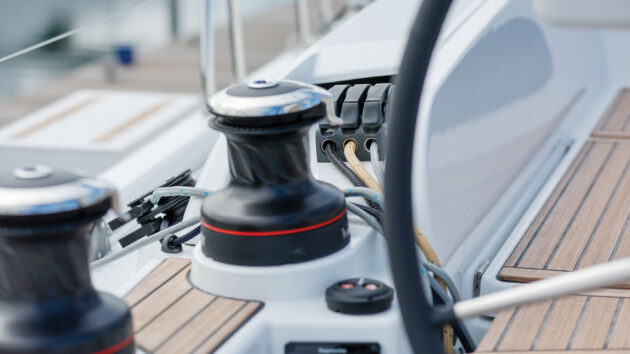
Powered winches are optional, but make sheeting in a big genoa much easier. Photo: Paul Wyeth
The topsides look less bulky thanks to the sizeable chamfer along the deck edge, and they’ve also done a good job of tidying up the coachroof lines, so that the boat looks sleeker and less meaty than her predecessor.
Step aboard and the sheer space in the cockpit spreads impressively before you. The seating works well in harbour, and the split tables enhance the feeling of security for crew on deck underway, though in reality, we didn’t get the boat heeling much past 20°, and a mere 15° of heel is enough to get the boat feeling powered up.
The cockpit sole is high and the coachroof low – ideal for Med cruising, while a sprayhood, or the optional targa arch, would add to both protection and a feeling of security, especially in chillier northern waters.
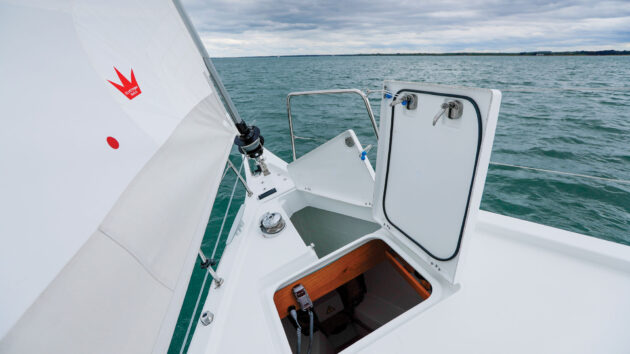
Both anchor locker and forepeak have ample room for plenty of chain and offwind sails and fenders. Photo: Paul Wyeth
Nevertheless, it’s a long way from one wheel to the other, and the optional enclosed transom and extra seating might help make this feel less open. There
are just eight lines to lead aft, two of which are the German mainsheet system, so there isn’t too much rope to play with.
That’s just as well as the winches are both right next to the wheels, so lines have to be handled from behind the wheel, though a person behind each helm was necessary for tacking the genoa; a self tacking jib, and the furling mainsail are standard while genoa and slab reefing are optional.
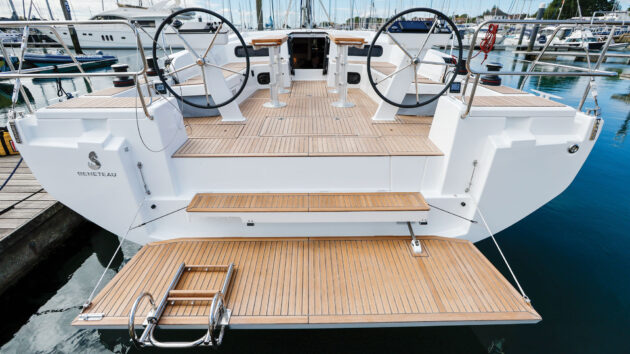
Note the bungees to tuck the bathing platform strops neatly away. A midships seat and grill is an option here. Photo: Paul Wyeth
Handling that defies size
With a boat this easy to sail, it’s easy to forget that at nearly 50ft and over 11 tonnes, she is a sizeable boat. Given the loads involved, the ergonomics of the helm position means that getting your weight over the winch isn’t the easiest (in part due to the narrow side decks aft), so opting for the winches to be powered will, I imagine, be popular.
It was nice to have towable jib cars to get an efficient sailshape and slot. It was less easy to centre the boom, but converting the coachroof-top split purchase to a simple bridle (as per Jeanneau yachts) would improve the sheeting angle on the main for no additional complexity.
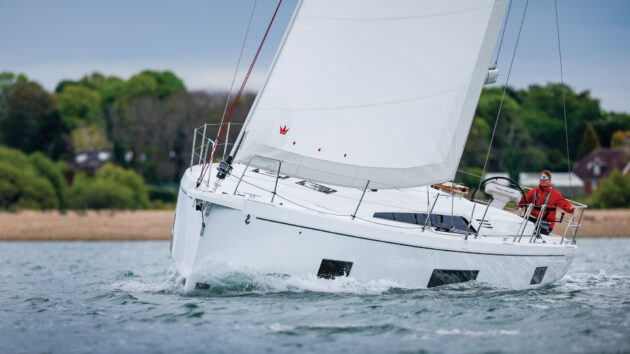
The helming experience is engaging, enjoyable and well balanced. Photo: Paul Wyeth
We didn’t have offwind sails aboard this demo boat, allowing whoever buys it to take their pick, but the boat had been fitted with the optional downwind pack, adding a two-to-one halyard and sheet blocks. I’m sure a lot of owners will be tempted by the self-tacking jib for upwind simplicity, bolstered off the wind by a furling Code Zero.
Heading below, the changes from the previous model are even more subtle. The main things are that the main table now has solid Alpi fiddles around it and a small stowage bin in the middle.
Functionally, the electrical panel for switches, tank and system monitors and the stereo has been moved from outboard of the starboard settee (not easy to reach), to a low unit inboard of the heads bulkhead at the foot of the companionway, bringing the controls to where you need them.
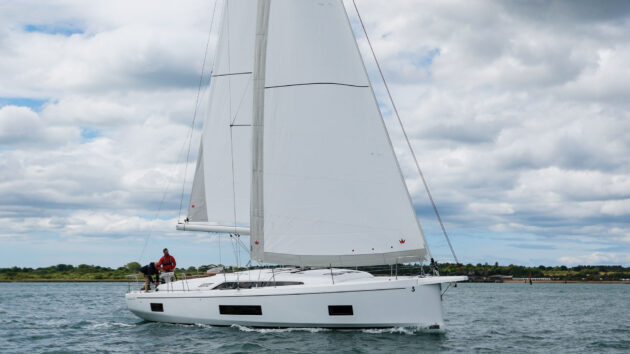
A large bowsprit accommodates offwind sails and anchor. Photo: Paul Wyeth
This incorporates an additional locker below it, with the switches below a lifting lid, keeping them protected, as long as this space doesn’t get used for dumping the usual keys, sunglasses and other clobber.
Capacious interior
The saloon is, as before, amazingly spacious, light and airy, with full-length coachroof windows, two opening deckhead hatches, and four large hull windows.
Headroom throughout is good, with 197cm in the saloon, 192cm in the aft cabin, and 198cm decreasing to 190cm in the forward cabin.
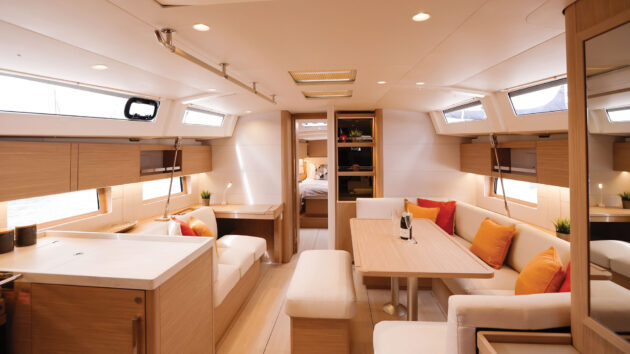
Grabrails, solid fiddles and rounded corners make this a sensible layout underway, although the chart table is forward of the saloon. Photo: Paul Wyeth
A generous galley includes a large front-opening fridge (mounted fore and aft) with a double sink outboard, aft of the two-burner gas hob and oven.
A stowage unit next to the companionway steps provides bracing underway. That’s in the three-cabin, two heads version. Other layouts include four cabins with two heads, four cabins with four heads, or five cabins with three heads.
This is achieved variously by splitting the larger forward cabin in half for two double cabins, each with their own heads, and adding a heads compartment where the galley is on the test boat, which pushes the galley forward to make a linear galley to port, and removing the port settee and chart table.
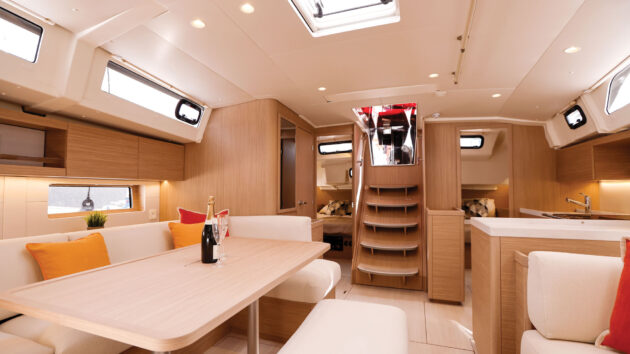
You can opt for a lowering table in the saloon to make an additional double. The Alpi wood fiddles around the edges and stowage tray in the middle of the table are new for this generation of Oceanis. Photo: Paul Wyeth
The extra cabin comes from turning the starboard aft heads into a pullman cabin with two bunk beds. Suffice it to say, you can squeeze in a lot of beds or heads, though there aren’t options for any utility or additional stowage spaces. Most private owners would, I imagine, go for the three cabins and two heads version that we tested.
This gives you the large table and settee to starboard in the saloon (at 220cm long, this would make a good sea berth or drop the table for a large extra double), with nice little touches like the bulkhead bookcase next to the mast support, a short settee (120cm) to port with a nifty lifting arrangement to raise the cushions under your knees and really help you recline in comfort.
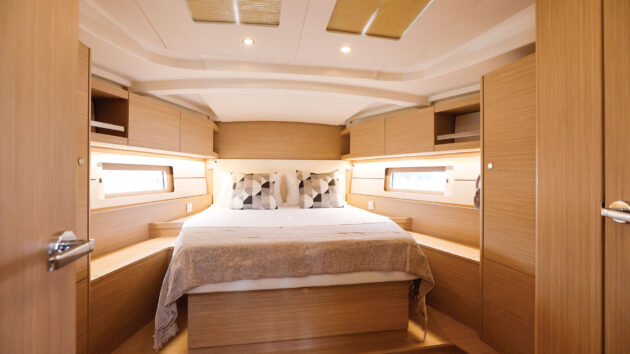
Owners will love the massive forward cabin. It’s big enough to be split into two double cabins in the four- and five-cabin layouts. Photo: Paul Wyeth
The midships bench seat is fixed, but can be adapted to be sliding. I’m glad to see there’s a chart table, though on this boat there were no instruments, and the stowage, though of a good size, was obstructed by the hinges and support strut, reducing to millimetres the depth available for stowing charts.
Moving forward underway was easy, thanks to grabrails either side of the companionway, fiddles large enough to hold onto, and an overhead grabrail above the main walkway.
An extra handhold on the forward end of heads bulkhead would be a nice addition. Bulkheads and fittings are bonded rather than laminated in place, but there was no sign of movement or squeaking thanks to well-secured floorboards with rubber spacers.
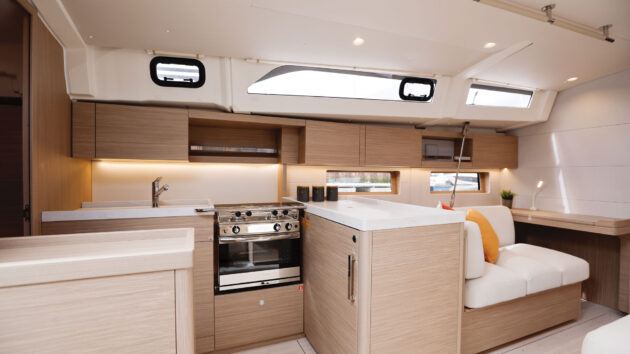
An aft U-shaped galley is only an option in the two heads version. Stowage and refrigeration is good. Photo: Paul Wyeth
Below the lifting floor panels were neat ideas including stowage bins, wine bottle racks, and a lifting pan into which galley mess could be swept and tipped in the bin. Other nice touches include solid corian work-tops, leather covers for the stainless steel grabrails and good quality light fittings.
While we’re in the bilges, construction is standard for Beneteau – hand-laid monolithic fibreglass using polyester resin with no foam core, except for the deck which is vacuum- infused (for weight), with a moulded keel matrix bonded but not laminated into the hull, and joinery bonded in place. The keel, of which two depths are available, is cast iron, bolted to the matrix. Joinery is plywood with Alpi-wood veneers.
The owner’s cabin, if you opt for that layout, is a delight, with oodles of space, a good big double berth (200cm x 150cm), and separate compartments for heads (electric flushing) and shower. Ample stowage is provided by overhead and upright lockers as well as a modest drawer beneath the berth – the forward portion is taken up by the main 370-litre water tank.
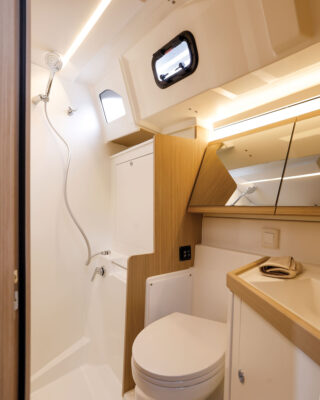
The large aft heads includes space for a separate shower with a folding screen. Photo: Paul Wyeth
Aft cabins are a good size too, with slightly more room in the port cabin due to the lack of heads compartment on this side in this layout; they would be identical in the three-heads layout. The berths are both 205cm by 140cm, with tankage and batteries below them, and upright lockers and shelves outboard.
Both benefit from two opening hatches as well as a large hull window, with some of the headspace above the berth given to the cockpit’s sole-depth lockers.
They also include panels, giving good access to the midships machinery space, with additional cubbyholes for stowage aft if you don’t have a generator.
The engine in this boat was the upgraded 80hp Yanmar saildrive – enough to push us along at a punchy 9.5 knots at full chat, while 7.5-8.5 knots was easily achievable at cruising revs, which came into its own as rain clouds boiled up, finally bursting on us in force as we finished the day motoring into the Lymington river. Only muggins here remained on deck at the helm. Oh, for the sprayhood in that moment!
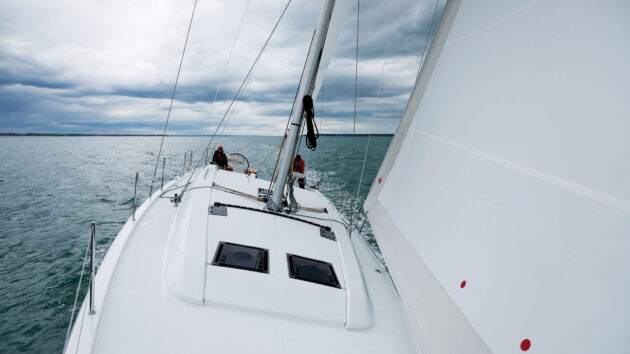
There’s vast space on deck, though there is little need to go forward underway, while side decks narrow aft. Photo: Paul Wyeth
57hp is standard for the Yanmar engine (the same unit minus the turbo on the 80hp), though sailors will want to opt for a folding prop rather than fixed three-blader that’s standard.
Frustratingly, we couldn’t get this to stop spinning once the electric throttle and ignition were switched off, resulting in a whining from the gearbox whenever sailing.
Again, a folding prop would fix this, but it was helpful to have the throttle and bow thruster control up on the steering pedestal. Beneteau have done well to ensure all the main filters and strainers are easy to inspect, clean and change as necessary.
Beneteau Oceanis 47 specifications
Price as tested: £501,240 inc VAT
LOA: 14.60m/47ft 11in
LWL: 13.61m/44ft 8in
Beam: 4.50m/14ft 9in
Draught: 2.47m/ 8ft 1in (Shoal 1.87m / 6ft 2in)
Displacement: 11,572kg/25,505lb
Ballast: 2,699kg/ 5,949lb
Sail area (Furling main and genoa): 96.66m2/1,040sq ft
Engine: 57hp / 80hp Yanmar
Transmission: Saildrive
Water: 370L (+195L) /98gal (+52gal)
Fuel: 195L (+195L) / 52gal (+52gal)
Enjoyed reading this?
A subscription to Yachting Monthly magazine costs around 40% less than the cover price, so you can save money compared to buying single issues.
Print and digital editions are available through Magazines Direct – where you can also find the latest deals.
YM is packed with information to help you get the most from your time on the water.
-
-
- Take your seamanship to the next level with tips, advice and skills from our experts
- Impartial in-depth reviews of the latest yachts and equipment
- Cruising guides to help you reach those dream destinations
-
Follow us on Facebook, Twitter and Instagram.
Note: We may earn a commission when you buy through links on our site, at no extra cost to you. This doesn’t affect our editorial independence.
Verdict
Sailors looking for a spacious boat that is comfortable with good socialising spaces that is ridiculously easy and enjoyable to sail, then the Oceanis 47 will tick all those boxes. I’d be tempted by a higher-spec set of sails for better sail shape, and changing the mainsheet bridle would improve upwind performance. A competitive size for a cruising yacht, it's big enough to offer the comfort that comes from real volume without being so big as to be daunting to sail. In everything other than sheeting in, she sailed and handled like a far smaller boat. Twin rudders mean less feel on the helm, so you’ll rely on visual clues from the telltales, though the steel wheels still deliver a small amount of feedback.