


What does it mean to race offshore on a boat bristling with advanced technology? It can be done for less than you think, as Chris Hanson explains to Theo Stocker
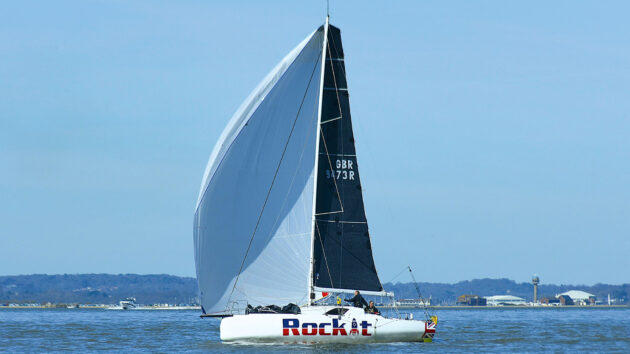
Electronic navigation comes in all shapes and sizes these days, from an app on your phone to a purpose-made top-end marine chartplotting and instrument system costing multiple thousands, and from home-made Raspberry-Pi and Signal-K systems, to some of the more high-end routing software now available.
While the average cruising sailor is unlikely to kit out their yacht so that it looks like they’ve burgled a data centre, the state of the art of electronic navigation demonstrates some incredible tools that cost less than a fancy new chartplotter for both hardware and software combined.
The 2026 Yachting Monthly Celtic Triangle Race was the perfect opportunity to see the variety of how crews navigate, and while it is a Corinthian event (i.e. not professional sailors, but real enthusiasts doing it in their own time and on their own dime), there were some with really quite impressive set-ups aboard.
Talking to some of the skippers before the start, it became clear that Rockit, a relatively new Jeanneau SunFast 3300, had just such a navigation system on board.
More akin to a spaceship than something most cruising sailors would see on a regular basis, the original owners (about whom more in a moment) had clearly put their budget into navigation, instruments and gadgets rather than creature comforts. The absence of running water or permanent cooking facilities other than a Jet Boil, let alone saloon sofa cushions or expertly varnished woodwork, suggested that this boat was all about the sailing, and little else.
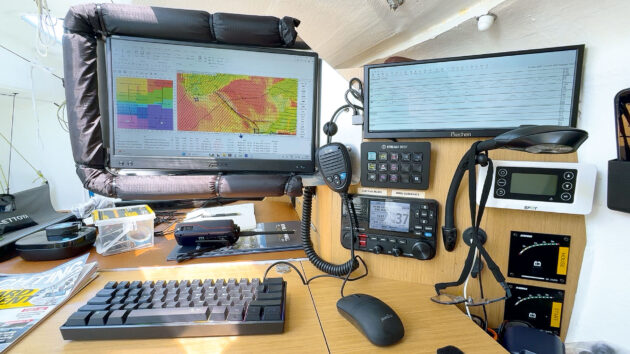
Screens, computers, communications equipment and a host of sensors and software puts this nav station light years ahead, without breaking the bank
Rockit power
Chris Hanson has owned Rockit, a Sun Fast 3300, since December 2025 and has been racing her double-handed since mid-March 2026, including three races to France.
The boat was set up brand-new for Dee Caffari and Shirley Robertson in 2022 for their double-handed campaign building up to that year’s Round Britain and Ireland Race. Both women had competed in double-handed crews in previous years, but Rockit was the first time they had sailed together.
Little expense was spared on the instruments and systems put on board for their campaign, meaning that the boat came highly specced. Chris has since added a number of his own touches, with the help of his technically minded crew, Sam Strover, making this a genuinely unique and fairly ‘state of the art’ navigation set-up.
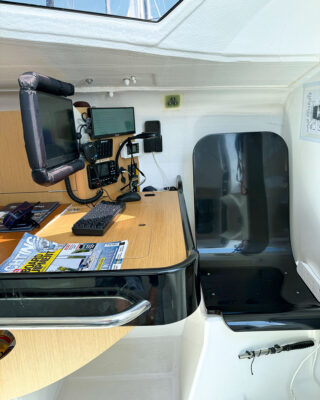
The chart table is much better fitted out than the rather spartan accommodation
I went aboard in Falmouth as Chris was making final preparations for the first leg of the Triangle Race, which would take him and his co-skipper around Land’s End and across the Irish Sea.
Solid foundations
Chris described the boat’s set-up as having been created for her previous owners with ‘unlimited budget’ and reckoned it was only exceeded in technological terms by one other boat in the Triangle Race. His aim in taking part was to finish in podium positions, and as a stepping stone to next season’s Fastnet Race.
In the end, the Yachting Monthly Celtic Triangle Race was shortened to more of a ‘Celtic Sausage’, as one sailor dubbed it, the legs to France having been abandoned in the face of a series of brutal low pressure systems bringing 50-knot winds across the course.
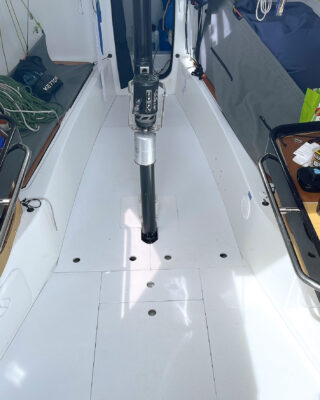
Accommodation is not exactly luxurious
Instead, the fleet raced straight out to Ireland and, after a long stopover, straight back again, giving Rockit the kind of reaching courses it is designed to excel in. Chris ended up winning the overall, as well as claiming a win on Leg 1 and a second on Leg 2.
Clearly, a reaching drag race out and back across the Celtic Sea left little opportunity to depart too wildly from the rhumb line, but all of this electronic wizardry can help give you something of an advantage.
The standard nav kit on board was admittedly at the top end budget wise, but the magic additions Chris made, and that made all the difference, were remarkably affordable as electronics go.
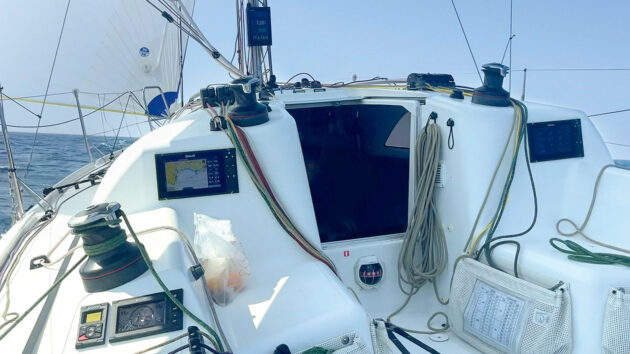
It’s a rare luxury to have plotters, autopilot controls and H5000 displays duplicated on each side, as well as the Nemesis display at the mast
The kit list – Navigation and control
So what does this boat have at the chart table that more standard cruiser-racers wouldn’t have?
Unsurprisingly, B&G is the main brand on display, having specialised in offshore performance electronics since its inception in 1955. The main brains of the system is the B&G Hercules 5000 processor.
This is a black box that can be fed with dozens of inputs using NMEA or Ethernet network connections. It displays that data on deck or down below, performing advanced calculations on course, wind and motion, feeding it to an autopilot or to a PC running other software packages. Almost every aspect of the H5000 can be accessed and fine-tuned via a web interface from a computer.
There are two Zeus multi-function displays/chartplotters on deck (one each side), as well as H5000 displays and separate pilot controls at each helm and a Nemesis 9in customisable display at the mast.
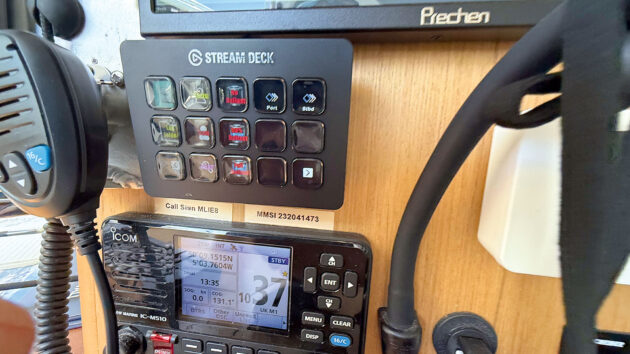
The VHF radio is the most normal bit of kit on board. It has an AIS receiver, but there is also an AIS transceiver on board
Sensors
Then there are the sensors, from a load cell on the forestay to show live rig loads, to rudder angle and feedback sensors, a 9-axis precision compass and a 3D motion sensor. The B&G autopilot is so sensitive to changes in boat speed, pitch, heel and wind angle that it’s essential to interpret the raw data it is being fed in order to avoid drastic and unnecessary rudder-angle changes.
For example, the 3D motion sensor takes the anemometer feed from the masthead and applies the pitch, heel and boat speed numbers to smooth the stream before feeding it to the autopilot and the data logging app.
At the masthead, a vertical mount (carbon, obviously) helps project the wind sensor into a clear airflow, while two flush-mounted through hulls separately provide speed, depth and water temperature data.
At the bow, the forestay loads are measured by a load cell.
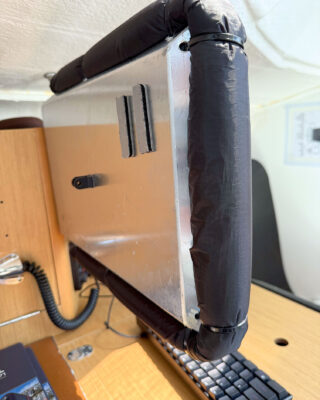
Co-skipper Sam built the aluminium bracket for the screen
Communications
All of the data on Rockit is streamed via a WiFi gateway, making it accessible on mobile devices. As you would expect, the boat has both VHF radio and a separate AIS transceiver fed through a splitter to the masthead antenna.
Data can be downloaded from the internet via mobile phone networks when in range, but the boat also has Starlink for satellite internet communications when out of mobile signal range. This helps with communication ashore, and allows Chris and Sam to download weather data and forecasts.
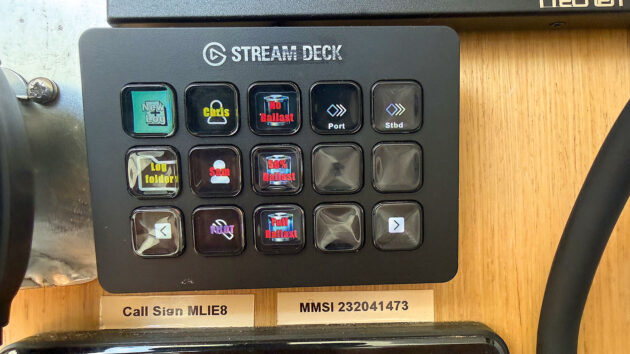
The StreamDeck has programmable multifunction buttons that make navigating the software much faster
Computing
All of this data and information needs to be processed and displayed. Much of this can be done on the B&G Zeus MFDs and Nemesis displays, but for third-party software, such as routing and weather forecasting, this is done on a PC.
Many boats use a laptop, but Chris has opted for a more robust system that includes a permanent ultra-fast mini PC from DreamQuest (£240) that runs on 12V with a draw of just a couple of amps. This is connected to two LCD displays, both also on 12V. One of these is a large screen for his routing software, while a mini widescreen fits the space available and works perfectly for displaying the data logging. Each cost ca. £80.
One of the most unusual features of the set-up, however, is a special keyboard, or control pad known as a Stream Deck (Hanson uses an Elgato, but there are others available) that provides programmable short cuts to the PC (£140).
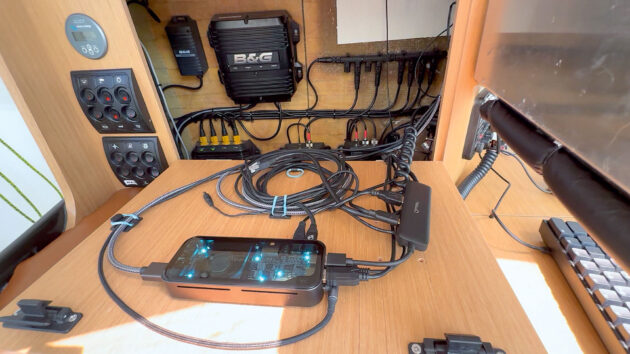
A 12V DreamQuest PC (front) runs all the third-party software and routing
‘The Stream Deck is getting quite popular,’ Chris says. ‘Technically it’s for YouTubers for capturing events and actions while they’re recording but it’s like a mini programmable keyboard.’
For example, Chris has set up the ‘Rockit’ symbol key as a short cut to enable him to jump straight to the data recording screen, while the other buttons on the Stream Deck enable him to log and record who’s driving the boat, or whether it’s the autopilot in control, to show how much water ballast is on board or to bring up data from the deck repeater screens.
Software
The centrepiece of the software running on the PC is Expedition Marine’s routing system (£1,360). ‘Technically it’s a chartplotter, but it does so much more,’ says Chris. ‘It is a full data system with weather forecasting that allows you to look at simulations – all the different predictions and forecasts – to manage the polars of the boat.’
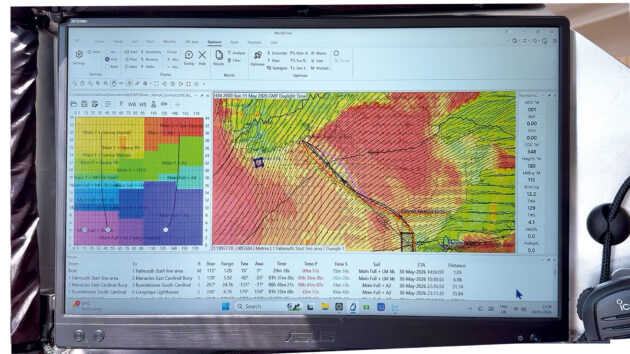
The main screen displays the Expedition forecast and weather routing information. The box on the left shows the boat’s sail crossover chart
Networking
There are plenty of wires to connect all of these disparate systems. NMEA 2000 network cables form the backbone of the navigation system, while Ethernet cables are required for their faster data speeds to facilitate the large amount of data zooming around the boat. A WiFi gateway makes all of this data accessible to mobile devices.
Making sense of the data
The boat’s predicted performance, based on wind angle and wind strength, is displayed visually by a polar diagram, but managed electronically as a more machine-friendly data table.
‘So close-hauled (45° to the wind) you should be targeting about seven knots boat speed, while at 140°, depending on wind strength, you’re targeting 17 knots of boat speed,’ Chris explains.
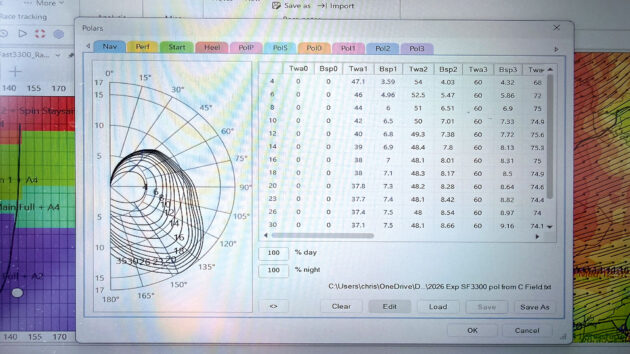
Rockit’s predicted speed for any given course and wind strength, also called its ‘polars’
Expedition factors in these speed predictions, and combines it with the boat’s sail crossover chart to recommend sailplans and routes for the fastest passage between two points, based on the weather forecast.
Multiple algorithms are used, and multiple weather forecast models are accessed, downloaded as GRIB files, displaying as different coloured lines across the chart, demonstrating the possible routes based on the different weather models. For each section of the route, the software displays the boat’s point of sail and optimal sailplan.
During the race, Chris uses a feature to compare his actual position and performance against various simulated routing options, identifying whether the boat is falling behind predicted targets, or which prediction is proving to be the most accurate.
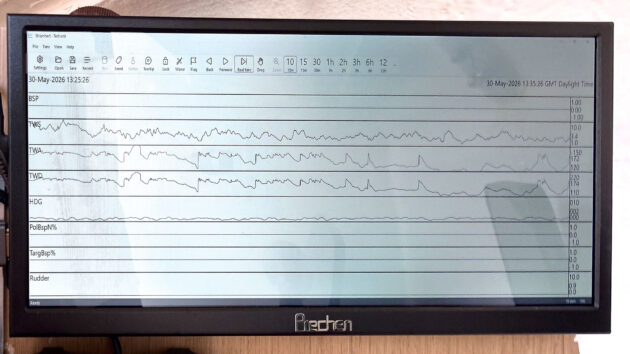
A mini wide screen fits nicely and logs all of the variables while underway as a timeplot
As a means of tracking and identifying what helps the boat sail well, and when things aren’t working quite as well, the data-logging element of Expedition allows Chris to view timeplot graphs of everything from rudder movements (including who is on the helm, so no hiding!), boat speed, rig loads and more. This is displayed on the widescreen strip chart and looks much like a heart monitor readout.
What is a Polar diagram?
A polar diagram is a visual representation of the complex data matrix that expresses how fast a boat goes at different wind strengths and different wind angles.
It is called a polar because it shows courses and speed in relation to a single central point. The angles are the point of sail, or angle relative to the true wind direction, while the distance from the central point indicates speed.
When you plot your own speed on a polar, it should be relatively easy to see how far below the optimal speed it is for that wind speed and direction.
The B&G system, as well as Expedition, can display your boat speed relative to the ‘polars’ as a percentage. 100% is hitting the target, while 90% is below the expected speed. The hard part is knowing what to do about it, from sail trim and rig settings to rudder toe-in angle settings, or even tuning the autopilot.
For less hi-tech boats, even basic chartplotters will let you either download or input some basic speeds for different points of sail and wind conditions. This can help you check you’ve got your boat set up properly, and will improve the accuracy of any auto-routing functions you are using.
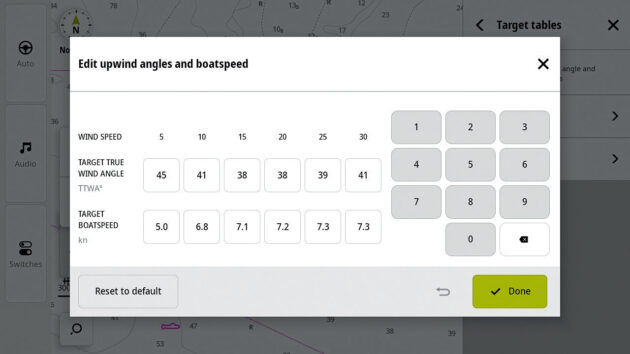
The simplified polar input page on a B&G MFD
Planning for the race
For the upcoming leg to Kinsale, Chris was anticipating a ‘power reach’ that would favour Rockit’s water ballast system and wide, powerful bow sections, likely utilising a medium-heavy jib or Code Zero sail.
‘I can see that to start with the wind’s going to blow quite light in the harbour – 14 to 18 knots – and then it will build and as we get towards Ireland – forecast at 18 knots gusting 24 knots.
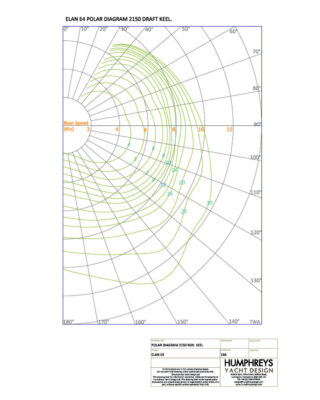
A graphic representation of a boat’s polars
So I can see we’re going to be going probably with the heavy jib and then we’ll figure out whether we use a Code Zero [a large reaching sail] and if so, which Code Zero we’re going to use. At the end it could be a spinnaker, but I think we’ll probably press on and use the Code Zero right through to the end. It’s going to be fast and should be very enjoyable.’
How it worked out
As it turned out Chris and co-owner Sam Strover nailed the east end of the startline on Sunday 31 May, with a small group of other yachts, picking up the tide and breeze first and then quickly opening up a lead.
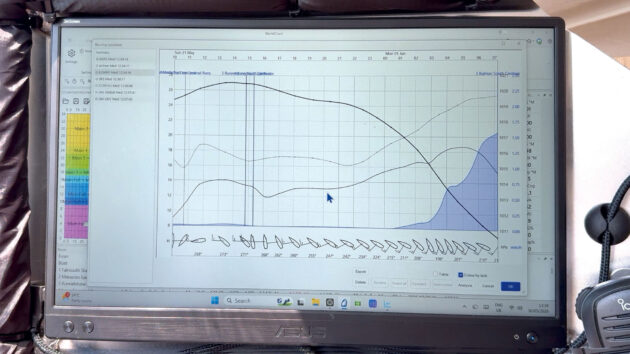
Vertical lines are key race marks, blue is rain, solid black is wind speed, while the others are temperature and pressure. Wind direction and point of sail is shown across the bottom
The course took the fleet on a beat around the Lizard before heading north in between the Traffic Separation Scheme and Land’s End, before setting them loose north-west to Kinsale.
Rockit crossed the Kinsale finish line first at 0850 on Monday morning, covering roughly 200 miles in a corrected time of 23 hours 19 minutes and 59 seconds.
Chris said: ‘Rockit was fortunate to have near perfect conditions, especially after the TSS corner. As the wind built, Rockit took off at frequently greater than 17 knots and rarely less than 11 knots.
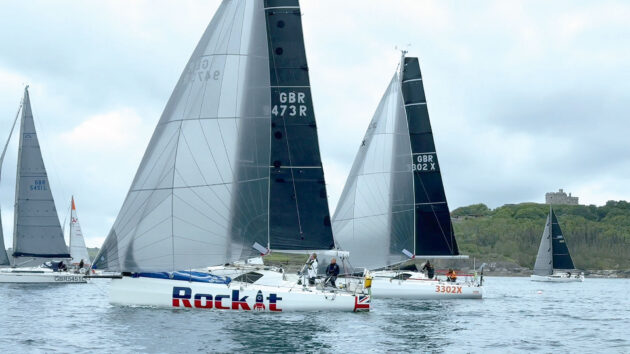
Rockit stayed well out from the shore at the start
‘A battle for line honours with Murphy 2 [Pogo 1250] took place in the night, with us grabbing that with a finish at 0850, crossing the finish line on a gust at 16 knots.
‘Life on board was wet, wet, and wet with little sleep but amazing fun and a great welcome in Kinsale as we pulled in,’ he added.
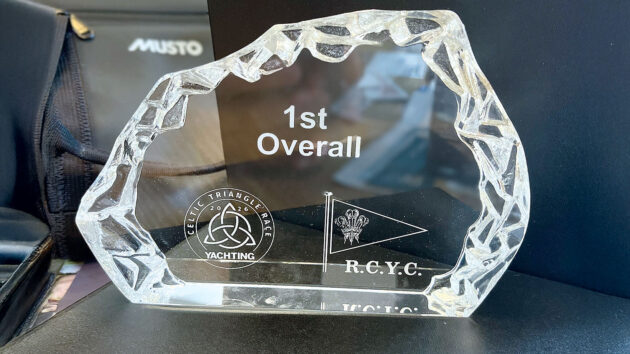
1st on elapsed time, although other boats won their classes based on points
Full list of electronics
B&G H5000 Hercules System Pack
- H5000 pilot including Raymarine Type 2 12V short shaft linear drive pilot ram
- Precision 9 compass
- Rudder reference and feedback unit
- Motion sensor
- 2 x graphic displays, one at each helm
- 2 x pilot controllers, one at each helm
- Flush fit H3000 speed sensor and DST800 depth sensor
- Carbon VMHU (vertical mast head unit- wind sensor) + bracket
- Triple 20/20 HV mast displays and bracket
- NMEA 2000 and Ethernet networking
B&G additional equipment
- 2 x Zeus 9in MFD in cockpit
- Navionics chart 28XG
- Nemesis 9in and mast bracket, plus network expansion cables
- H5000 barometric pressure sensor
- iCOM M10 VHF with DSC and AIS
- Hawk VHF Antenna and Windex
- Go FREE WiFi system
- NAIS 5000 transceiver including GPS + antenna splitter
- Actisense NGT-1-USB for H5000 data into laptop
Added this year
- DreamQuest Ultra Fast Mini PC (12V, 25W, 2.1A)
- 2 x low energy 12V monitors
- Elgato StreamDeck programmable keypad
- Expedition Marine routing software
- C-Map charts integrated with Winning Tides data
- Forestay load cell
- Starlink satellite internet receiver
Enjoyed reading this?
A subscription to Yachting Monthly magazine costs around 40% less than the cover price, so you can save money compared to buying single issues.
Print and digital editions are available through Magazines Direct – where you can also find the latest deals.
YM is packed with information to help you get the most from your time on the water.
-
-
- Take your seamanship to the next level with tips, advice and skills from our experts
- Impartial in-depth reviews of the latest yachts and equipment
- Cruising guides to help you reach those dream destinations
-
Follow us on Facebook, Twitter and Instagram.
Note: We may earn a commission when you buy through links on our site, at no extra cost to you. This doesn’t affect our editorial independence.