


We take a look at the latest blue-water focussed yacht launches this year which are growing in both length and volume with every season
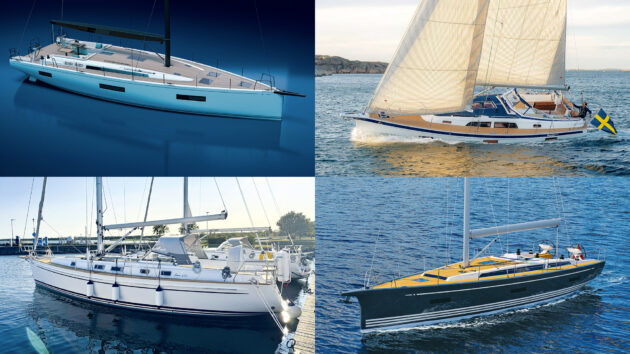
Whether you are looking to cross oceans short-handed or simply demand more space, power, and comfort at anchor, this year’s crop of new yacht launches reveal a clear trend – naval architects are leaning heavily into increased interior volume, intelligent ergonomics, and luxury spec levels once reserved exclusively for much larger craft.
From refined Scandinavian passage-makers to boundary-pushing custom aluminium hulls, shipyards are finding fresh ways to maximise performance without sacrificing crew protection or living space.
Broadly the yachting market is seeing a shift toward powerful, broad-beamed hull shapes carried well aft, balanced by twin rudders and sophisticated sheet-handling systems that put push-button control within reach of a short-handed couple. Offshore capability no longer means spartan living either; high-capacity lithium battery banks, integrated solar decks, custom technical workshops, and island berths are fast becoming the standard for modern blue-water cruising.
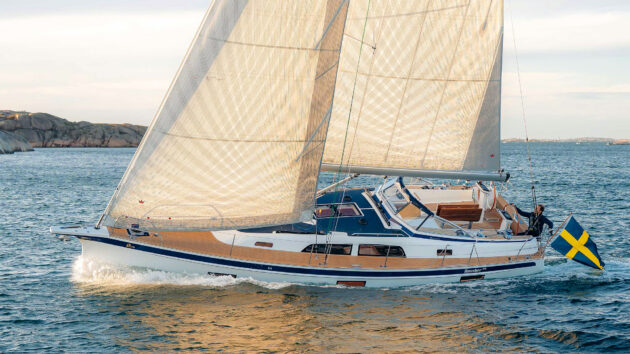
Hallberg-Rassy 37
Now the second smallest model in Hallberg-Rassy’s range, the 370 is a size which the Swedish yard knows works, following its long production runs of the 372, the 37 and the 36 before that.
The world premier at Boot Düsseldorf boat show in January this year revealed the modern Frers hull shape of the HR370. As on the rest of the range, it now carries a vertical stem below a fully integrated, moulded bowspirt, a fine bow quickly leading to full bow sections to keep the bow up and rudders well planted, with the typical rounded forefoot that does a good job of preventing slamming. Maximum beam is wider than before and is carried well after, creating more power when heeled. This is kept under control with twin rudders, well flared out, and twin wheels.
The cockpit is wider, but broken up by a fixed midships table, while the solid windscreen, high coamings and enclosed stern help to maintain crew protection.
A full-width bathing platform lifts to deck height, with its wide top providing a helm seat aft of the wheel, though this is perched on the transom. Outboard seats are atop the coaming.
Sail control is via a German mainsheet system and a traveller ahead of the fixed windscreen, while the genoa is taken to coachroof-top car tracks for fine sheeting angles, with a self-tacking jib as an option. Owners that want solar power can opt for the whole coachroof to be decked with bespoke fitted Solbian panels. Other options include both bow and stern thrusters – a rarity in this size range.
Below deck, she looks every bit the Hallberg Rassy. The additional volume with the new hull shape allows for a full island double berth in the forward cabin (triangular berth is an option), while the saloon can accommodate two armchairs and a drinks cabinet in place of the straight settee to starboard. You’ll be relieved to know that a proper forward-facing chart table makes a return, recognising the fact that those doing any kind of planning or work still need somewhere to sit.
This isn’t going to be a cheap 37-footer (closer to 40ft LOA), but you get a spec and fit out that rivals many much larger boats.
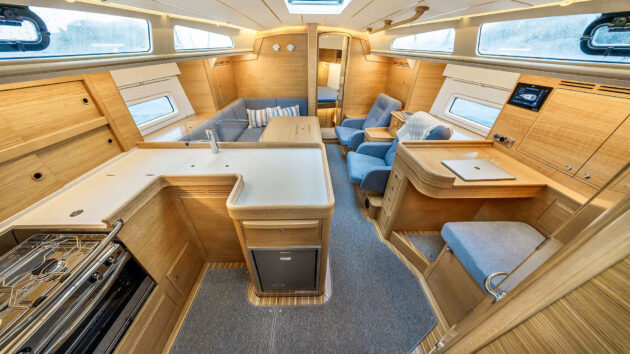
Every inch a traditional boat, chart tables are back and armchairs are an option
Hallberg-Rassy 370
LOA: 12.13m; 39ft 10in
LWL: 10.59m; 34ft 9in
Beam: 3.75m; 12ft 4in
Draught: 2.00m; 6ft 7in
Price: from £370,800 ex VAT
Contact: hallberg-rassy.com
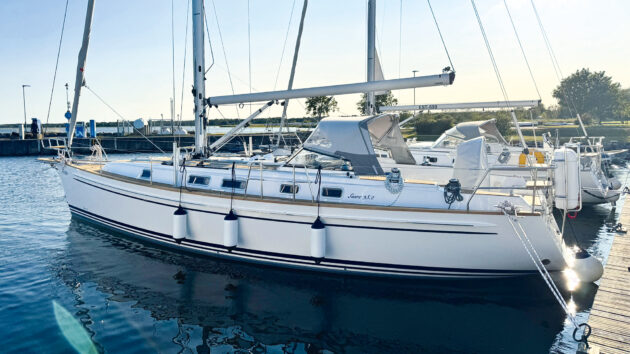
Saare 38.2
The lines for the Saare 38.2 are nothing new, sticking as it does with the lines drawn by Karl-Johan Stråhlmann for the first hull that launched in 2014. Those lines are markedly unfashionable, describing a relatively narrow beam, and easy, fair runs aft to modest stern, with space for just one steering wheel, and slightly restricted aft accommodation.
Having sailed her sister ships the 41.2 and the 47 within the last two years, however, I can vouch for the fact that these lines result in boats that sail beautifully and handle a range of conditions with ease.
As with other model updates, the changes are subtle, but significant. Where the original hulls were solid, hand-laid laminate, Saares are now built with vacuum-infused Divinycell core and vinylester resin, saving significant amounts of weight, improving performance and allowing cruising couples to carry more equipment, water and fuel with impunity.
In 2018, the model was updated to the 38.2 in recognition of the fact that almost all of Saare’s owners sailed as couples with only occasional guests. The design shifted to include a comfortable but not palatial guest cabin, with no option for three cabins, giving the remaining space aft to a formidable technical space, with tool stowage, exceptional machinery space access, a small workbench, and even a washing machine, making this boat a proper long-term, blue-water liveaboard option. Add the enclosed cockpit, fixed windscreen, and the later additional of the mainsheet ‘targa’ arch and this makes a serious cruising boat.
Other new changes include the complete redesign of the boat’s electrics to incorporate 24V as standard which, along with a large lithium battery bank, can power a big inverter and power-hungry systems such as induction cooking, all charged by a high output alternator on the engine.
The steering pedestal has been updated to accommodate larger plotters and more instruments, while the mainsheet is now led to powered winches at the helm. Some stowage has been optimised, while the huge bow locker abaft the anchor locker remains to take offwind sails, folding bikes and more.
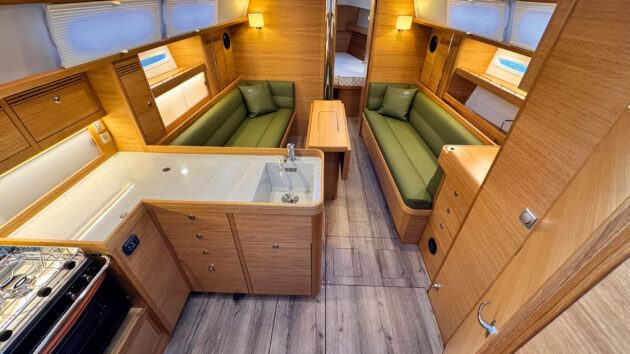
Light oak and mahogany are the main options. 24V power for electrical systems is now standard
Saare 38.2
LOA: 11.40m
LWL: 10.16m
Beam: 3.66m
Draught: 1.95m
Optional depth: 1.80m
Displacement: 8,100kg
Ballast: 3,100kg
Sail area: 74.1m2
Contact: saare-yachts.com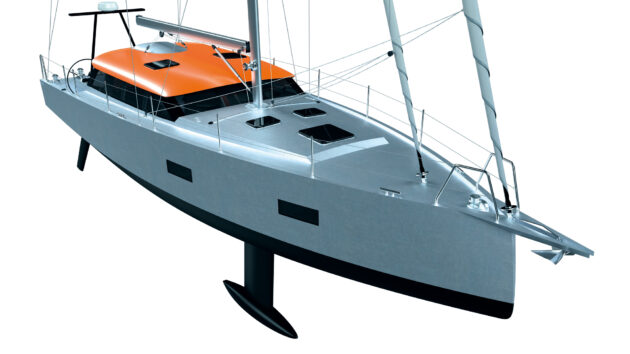
Pure 42
This very interesting model from the board of Berckemeyer Yacht Design is produced by a new German yard aimed at building rugged yet fast custom and semi-custom aluminium yachts. It was founded by three sailors, engineers and craftsmen, Matthias Schernikau, Ivars Linbergs and Urs Kohler, who had teamed up three years earlier to build Schernikau’s oneoff Pure 49, Gorre.
The Pure 42 promises more performance than most shoal draught aluminium yachts.
A lightweight foam composite interior helps keep the weight down (literally), when you consider the hydraulic system for the daggerboard-style lifting keel. It’s a development of a concept introduced by Berckemeyer Yacht Design 10 years ago, which also sets this design apart from the crowd.
The keel fin is slightly angled aft, so the leading edge pops up infront of the mast step when raised, protruding around 80cm above the deck and coachroof. This allows for a deeper draught than most similar systems, where the keel box is typically directly under the mast step.
The Pure 42 therefore has an impressive maximum draught, with a hefty lead bulb 3m (9ft 9in) below the water, but a minimum draught of 1.4m (4ft 0in) with the keel raised. The keel can be locked in any desired draught position and is engineered to enable the boat to dry out standing on the keel bulb and twin rudder blades.
Pure points out this can be a big advantage when cruising off the beaten track, where shallow anchorages or river bars may provide the only options for shelter, or access to interesting cruising grounds. At the same time the arrangement employed for the Pure 42 helps to reduce the boat’s overall displacement, without compromising righting moment, as less ballast is needed.
An unusual, semi-custom interior layout, includes a midships sleeping cabin below a raised saloon. The coachroof opening means large parts of the interior furniture can be prefabricated before being fitted into the hull.
The first example was at the Düsseldorf show having been on the water the previous autumn when it won Best Bluewater Yacht at the European Yacht of the Year Award 2026.
Its high price includes a high spec, such as the hydraulic lift keel, bow thruster, diesel heating and nav equipment.
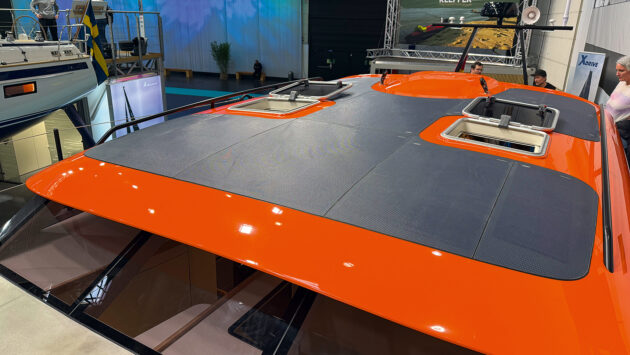
Bespoke solar panels are an option on the coachroof
Pure 42
LOA: 13.80m; 45ft 3in
Hull length: 12.90m; 42ft 3in
LWL: 12.30m; 40ft 4in
Beam: 4.20m; 13ft 8in
Draught: 1.20-3.0m 4ft 0in-9ft 9in
Displacement: 9,800kg; 21,600lb
Ballast: 3,300kg; 7,275lb
Sail area: 99m2; 1,065ft2
Price: ex VAT €947,000
Contact: pure.yachts
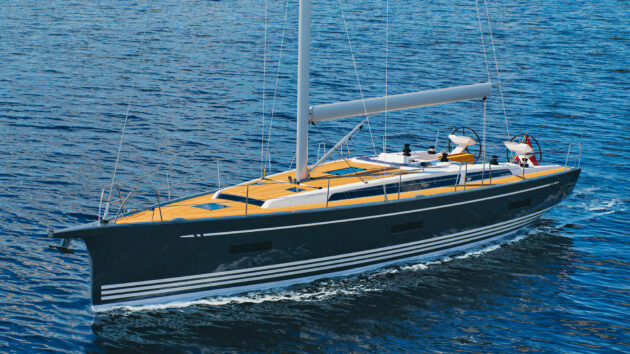
X-Yachts X46 MkII
As with many yachts, the X46 has proved popular but after a few years, a number of possible improvements have been identified, as well as this high-end Danish yard just wanting to bring the design up to date.
Unlike updates to other models where the whole aft end was redrawn, the hull lines drawn by the in house design team at X-Yachts remain the same. Most noticeable on the hull, the bowsprit has been remoulded into a more sinuous shape that is fully integrated into the hull with a new anchor stowage design, adding additional reinforcement where the sprit attaches to the stem. The hull portlights have been enlarged by 35% for more light down below, and the transom has received a few minor tweaks as well.
On deck, the cockpit benches are 15cm longer for more comfortable lounging, with a liferaft locker under the starboard. Aft of this, there is the same full-width traveller, but the mainsheet was previously led direct from the 2:1 purchase, through twin blocks on the traveller car, and up to coaming-top winches.
This arrangement meant that the loaded sheet passed three blocks as the traveller was moved, making fine or quick adjustments cumbersome and prone to friction. The new German mainsheet system sees the line led from the traveller and boom end blocks along the boom, down and back to the coaming-top winches, but without encombering traveller adjustment in the process.
Down below, more of the coachroof windows now open outwards, and the aft cabins each have three openings for ventilation. The split double berth in the port aft cabin is now standard, making two singles with the option of an infill for a large double. When we tested the original X46 in 2019, we found her to be fast, fun and easy to handle, with an amazing speed-to-effort ratio. That boat has just got better in lots of little ways.
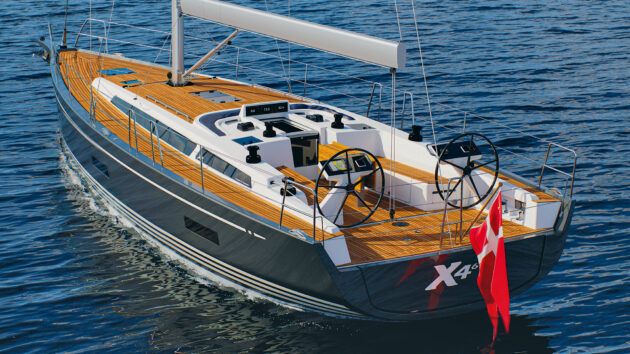
Coamings and bench seats have all been brought further aft, and the mainsheet system has been refined
X-Yachts X46 MkII
LOA: 14.37m; 47ft 2in
Hull Length: 13.50m; 44ft 3in
Waterline Length: 12.33m; 40ft 5in
Beam: 4.27m; 14ft 0in
Draught Std: 2.30m; 7ft 7in – (Deep 2.50m; 8ft 2in)
Ballast: 4,500kg; 9,921Lbs
Displacement: 11,365kg; 25,056Lbs
Sail area (Main + genoa): 116m2; 12,486 sq ft
Contact: x-yachts.com
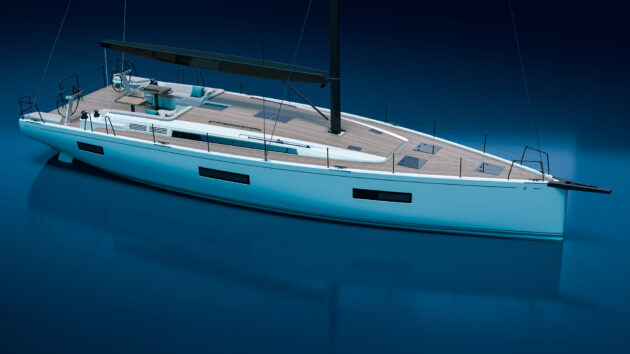
Beneteau First 60
After nearly half a century of First, this performance line of Beneteau continues to gather renewed momentum in its seventh generation with the launch of its largest model to date. Seascape, the Slovenian sportsboat specialists that Beneteau acquired in 2018, has helped transform the First brand.
It took the fun, fast and easy-to-sail qualities found in Seascape’s original 18-27ft Sam Manuard-designed range and applied them to the larger Firsts – readers will know just how impressed we were with the First 30 during our summer 2025 test.
Such is the transformation, co-founder Andraz Mihelin now heads up the entire First range. He sums up First as ‘the joy of dynamic sailing’ and says they are taking Beneteau into a new area of putting this enjoyment of sailing first. This 60 is a big new launch in a tricky time for the production yacht market, the largest sailing yacht premiere this year’s Boot Düsseldorf.
As well as the Slovenian influence, Beneteau has used Italian designers Roberto Biscontini and Lorenzo Argento, who have worked on a number of previous Beneteaus.
Biscontini brings his renowned wide, powerful hull shape, which will be styled inside and out by talented former Brenta designer, Argento. From what we have gleaned, however, the First 60 will be built with a performance cruising focus (as opposed to handicap racing ambitions).
The cockpit is divided into sailing, relaxing and dining zones, and it will sport a captive mainsheet to provide push-button control of the powerful mainsail. A performance version of this mainsail is available, which adds an extra 7m2 sail area if you take the taller carbon rig.
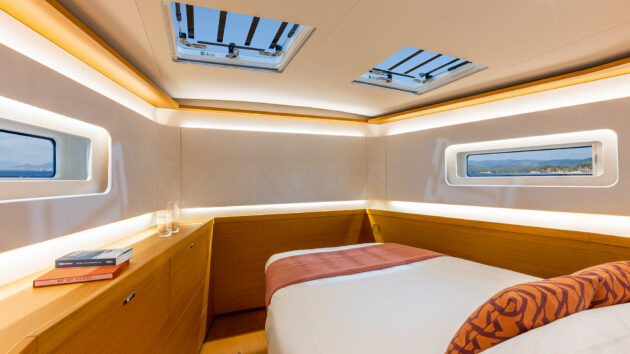
The forward owner’s cabin includes an unusual forward-facing double island berth
Beneteau First 60
LOA: 18.95m 62ft 2in
Hull Length: 17.60m; 57ft 9in
LWL: 17m; 55ft 9in
Beam: 5.30m; 17ft 5in
Draught: 2.63m or 2.88m; 8ft 8in or 9ft 5in
Displacement: 22,280kg; 49,105lb
Sail area (Main + genoa): 189m2; 2,034 sq ft
Contact: beneteau.com
Enjoyed reading this?
A subscription to Yachting Monthly magazine costs around 40% less than the cover price, so you can save money compared to buying single issues.
Print and digital editions are available through Magazines Direct – where you can also find the latest deals.
YM is packed with information to help you get the most from your time on the water.
-
-
- Take your seamanship to the next level with tips, advice and skills from our experts
- Impartial in-depth reviews of the latest yachts and equipment
- Cruising guides to help you reach those dream destinations
-
Follow us on Facebook, Twitter and Instagram.
Note: We may earn a commission when you buy through links on our site, at no extra cost to you. This doesn’t affect our editorial independence.