



Built in the late 1960s, this cruise-oriented Folkboat-influenced Danish design goes to show that a well-looked-after 60-year-old hull can still be a good purchase
Great Dane 28 used boat review: Folkboat-influenced Danish stunner

Stylish. That was my first impression when I climbed on board Solent Breeze. Having already seen Chris and Jacqui Price’s fastidious workmanship on their 13ft 6in clinker rowing boat Betty, I knew that their ‘big boat’ would be just as immaculate.
Sure enough, the Great Dane 28 was pleasingly traditional from the outside, with sweet lines and enough varnish on deck to give the boat a classic feel. The hull shape has echoes of Folkboats, Twisters and a whole gamut of long-keeled yachts of that era. It’s the type of boat that’s been tried and tested and is generally a safe bet if you are after comfort and safety rather than great speed.
What I wasn’t expecting was the characterful 1960s decor down below, with a multitude of curves everywhere, from the large saloon windows to the table corners and even the distinctive half-moon drawer handles. Without being at all ostentatious, it looked every bit like a modish boat interior from the 1960s.
I wasn’t surprised to learn that the boat’s designer was the father of Jørn Utzon, who conceived the Sydney Opera House, along with many other innovative designs.
Chris and Jacqui have added to that retro feel through their choice of upholstery, with pale grey and blue stripey cushion covers and pale blue window blinds – all hand-made by Jacqui. Even the stainless-steel coffee maker and pale blue kettle fit in perfectly with the 1960s/1970s vibe. If you had to ask someone to give your 56-year-old boat a makeover, you’d be in safe hands with Chris and Jacqui.
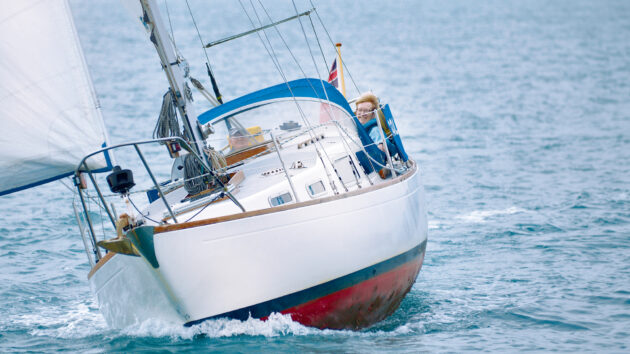
Jacqui Price at the helm in the well sheltered cockpit. Solent Breeze performed well in the flat seas and Force 3 wind. Photo: Nic Compton
And if you think I’m dwelling too much on that nice interior, I’d urge you to think again. My wife and I looked at 18 boats of various shapes and sizes before we bought our current boat (a Freedom 33) and nearly all of them had dreary, predictable interiors that made our hearts sink. We chose Zelda partly because I was intrigued by her unusual rig, but mostly because she had an (American-built) interior that made our hearts sing. After all, you’re going to spend a lot of time sitting down below so you may as well love it.
The legacy
The origins of the Great Dane 28 can be traced back to the 1948 Olympic Games, the first edition of the games after the end of the Second World War. The sailing events were held in Torbay, Devon, where an ambitious young Danish sailor called Klaus Baess won Bronze in the Dragon class.
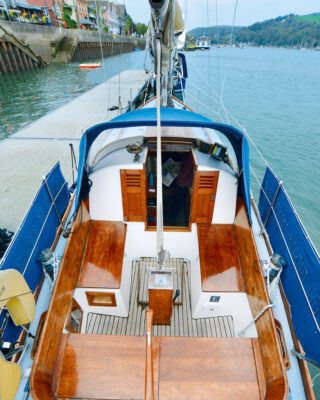
In the cockpit, the raised seat aft is useful for the helm’s viewpoint, but the lack of a full-length fore aft bench is a minus point. Photo: Nic Compton
While he was in Torbay, Baess made some useful contacts in Canada, which helped to kickstart a boat export business to North America. He started by sourcing second-hand Dragons (he was later accused of ‘vacuum cleaning’ the market for these boats in Denmark) before moving on to Folkboats. By 1948, he was building and exporting new boats and the first Great Dane, essentially a Nordic Folkboat, was being exported to the US. That was followed by the prototype Great Dane 28, built of wood with mahogany planking and a yawl rig, in 1960.
By then, it must have been clear that the future lay with fibreglass, so Baess commissioned his first design in the new material. He approached the well-established boatbuilder and designer Aage Utzon (the one whose son designed the Sydney Opera House) who redrew the lines, changed the rig from yawl to cutter, and gave the design his stamp of approval. With its transom stern, heavily raked rudder and cutaway forefoot, the final boat was a beguiling combination of Folkboat and Utzon’s previous design, the double-ended spidsgatter Sisu.
Most of the deck structure and what must have felt like a very contemporary interior were designed by Baess himself. Production of the boat started in 1965, and by 1967 it was being marketed in the UK. There, the design gained valuable publicity when one of the boats, with Baess at the helm, won the 1969 One of a Kind Rally.
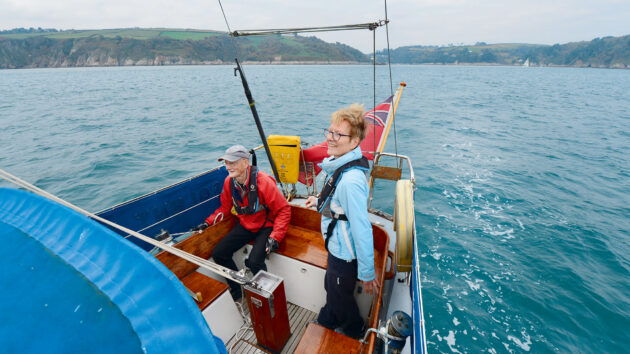
The mainsheet and headsail winches are well positioned for singlehanded sailing. Photo: Nic Compton
The event was organised to assess the ‘suitability for cruising’ of a selection of boats between 25-30ft, and the Great Dane 28 apparently won because she had ‘an air of efficiency and general competence which is rare in a production boat’.
In a subsequent write-up just ahead of the 1970 Earl’s Court boat show, Yachting World came to this surprising conclusion: ‘There is a lot of boat for the length; not only is the displacement high, but the comparatively broad transom also makes her seem a big boat. And, in a sense, with her heavy displacement, short ends and high freeboard, she could be described as a modern Falmouth Quay Punt.’
Folkboat lookalike
I’m not sure Utzon or Baess would have recognised that description, but in any case the Great Dane 28 sold well both in her native Denmark and abroad, eventually notching up some 300 sales.
The Danes weren’t the only ones playing that game, of course, and there were numerous Folkboat lookalikes being built in the 1960s, most notably the Contessa 26 built by Jeremy Rogers from 1965 onwards, and the Twister designed by Kim Holman in 1963. And it’s the Twister that the GD28 is most often compared to.
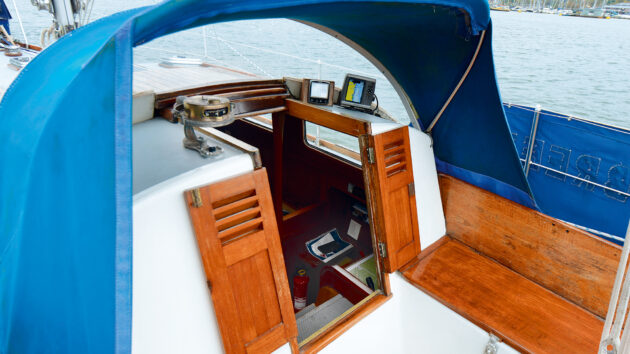
Varnished, louvred doors are an attractive feature. Photo: Nic Compton
The differences are instructive though, with the Danish boat conceived as a heavy displacement cruising yacht, while the Twister was originally designed for racing and subsequently adapted for cruising. The two boats’ specifications are remarkably similar, although the Twister is 1,468lb (667kg) heavier, 6in (0.15m) deeper, a few inches narrower and has a slightly greater sail area than her Scandinavian counterpart.
This difference in ethos is also reflected in the accommodation, with the Great Dane being solidly built with a great deal of oiled teak on display, while Twisters were more lightly built. Or certainly that’s my impression: both Twisters my wife and I viewed to buy had flimsy interiors that clearly had not stood the test of time. Again, it may come down to a choice between comfort and speed.
In commercial terms, around 250 Twisters were built of wood, fibreglass or a mix of the two (ie fibreglass hulls and wooden decks), compared to 300 Great Danes.
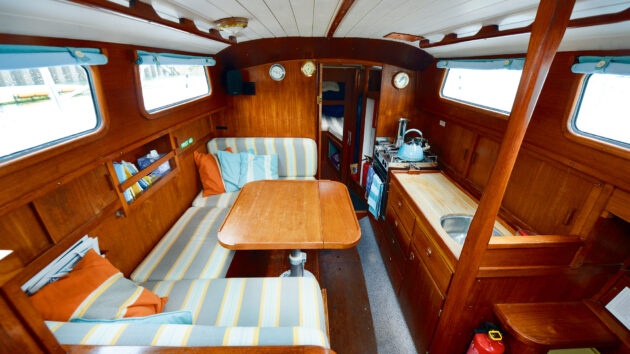
The saloon sports neat white tongue-and-groove headlining, natty striped cushions and plenty of oiled teak fittings. Photo: Nic Compton
A 37-year love affair
Solent Breeze was already 20 years old when Chris and Jacqui bought her in 1989. They had owned several wooden boats previously, starting with a clinker sailing dinghy, followed by a 2.5-tonne Hillyard (which Chris completely reframed) and finally a 27ft Alan Buchanan-designed East Anglian MkII. At this time, the couple were running a successful business making point-of-sale displays – which might explain their skill in interior boat design. Living in Exeter, they originally based their boats on the River Exe, until their children were born and they decided the River Dart would be more suitable.
‘The business was getting busier and the maintenance on the boat was getting more challenging,’ remembers Jacqui. ‘So that was the point that we decided to buy fibreglass. We had an old house that needed renovation, our business premises were in an old building, and we had a wooden boat. It just seemed too much.’
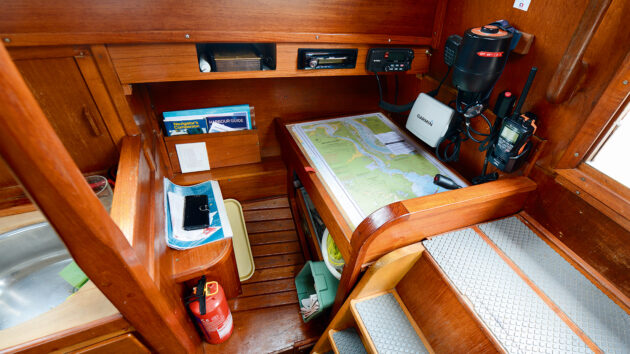
The chart table is neatly situated at the companionway. Photo: Nic Compton
They started off looking at Twisters, but found they were not only more expensive but that the joint between the deck and the hull on the composite boat they looked at was leaking.
‘I think what attracted me to the Great Dane,’ says Chris, ‘was the fact that she obviously was fibreglass, but she had enough wood on her to make me feel as though she was a traditional long-keel boat.’
Below decks, the layout of Great Dane 28 varied over time. The original design was for a dinette to port which converted into a (small) double bunk, with a 6ft long galley on the starboard side. Aft of that was a wet locker to port and chart table to starboard, while forward were the heads to port, storage lockers opposite, and then the foc’s’le, giving a total of five berths.
Later boats had a more conventional layout, with the saloon spread across the whole width of the boat, and a galley aft. Solent Breeze was one of the original designs, although the quarter berth had been blocked off to make way for an enormous radar display. One of the first things Chris and Jacqui did when the rig was down was to remove the radar from the mast and ditch the display screen, though they never bothered to reinstate the quarter berth, as they only ever needed four berths.
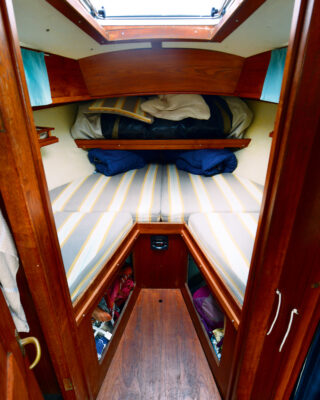
The forepeak aboard Solent Breeze houses the inflatable dinghy when under way. Photo: Nic Compton
Additional modifications
Other changes they’ve made during their 37-year tenure includes replacing the over-spaced main companion steps with closer-spaced steps which their children could navigate with ease. The passageway between the saloon and the foc’s’le had an elaborate double-door arrangement which used to come loose in a seaway and bang annoyingly, so Chris replaced it with a single door.
Chris has also made a heavy-duty shelf above the foc’s’le bunk to store the inflatable dinghy when not in use (which explains why the boat looks slightly down in the bows, to my eyes).
As we’ve seen, Jacqui replaced the ‘sludgy brown’ cushion covers with stripey pale grey/blue to pick up on the 1960s/1970s-style interior (‘Getting the stripes to line up was a nightmare’), while Chris replaced the vinyl headlining with a smart tongue and groove, painted white. He also fitted a holding tank, at the request of his daughter-in-law, who is a marine environmentalist.
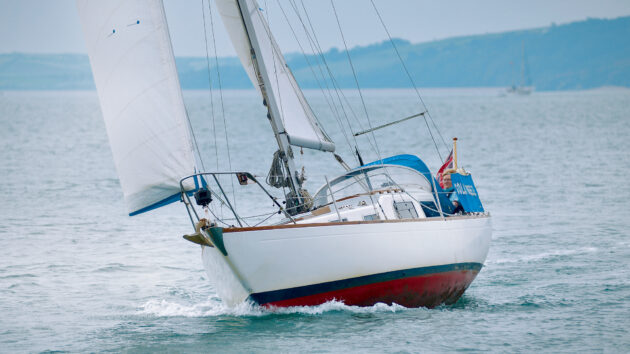
The long keel has a cutaway forefoot, with a keel-hung rudder. Photo: Nic Compton
On deck, the Great Dane 28 has a well thought-out cockpit, with a raised seat aft for the helm, a central pedestal for the engine controls and main sheet, and lockers/benches forward on either side for the crew. It’s a highly efficient sailing layout, though it does mean there are no full-length seats to stretch out on, should the sun decide to shine.
There’s more retro cool in evidence in the (non-original) Perspex windscreen, with a canvas sprayhood attached to the top of it. Why don’t more boats have this?
The Prices also replaced the original hanked-on genoa with a roller-furling arrangement (they are currently on their second system) and installed a detachable inner forestay (on the advice of a certain magazine) which they never use. But probably their biggest upgrade was fitting an electric windlass which, they say, has made ‘a huge difference’.
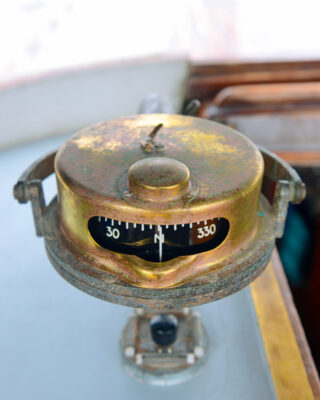
An antique steering compass. Photo: Nic Compton
Despite keeping Solent Breeze in good, seaworthy condition, the couple’s cruising ambitions were modest.
‘For most of our working lives, our holidays were one week a year, until we were into our 50s,’ says Jacqui. ‘Boating was something we did at weekends, when we could. So there was no point having a larger boat.’
Adventures aplenty
Chris has taken the boat to the Isles of Scilly and across the Channel to France, but more often than not he’s done that in the company of friends or his brother-in-law, or on his own. Often, Jacqui will join him at the destination for a few days, and Chris will sail the boat back on his own or with friends.
Since 2010, when Betty was launched, they’ve taken increasingly to dinghy cruising, rowing the boat down three major rivers (the Thames – twice! – the Severn and the Great Ouse), clocking up about 700 miles in the process.
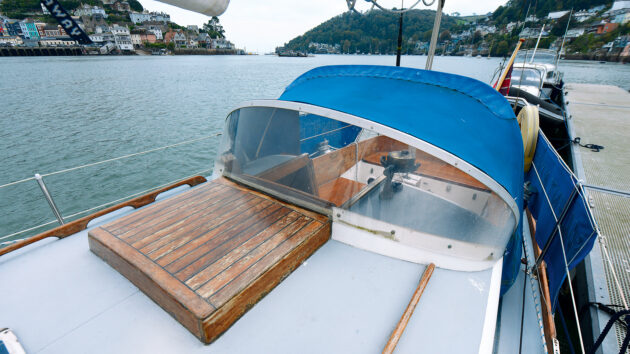
The perspex windscreen is independent of the sprayhood, which attaches to the top of it. Photo: Nic Compton
Often, Solent Breeze is used as a base, while they row up or down the Dart, and Chris is working on a harness to allow them to tow the boat around the coast so they can explore other nearby rivers. ‘Lots of people in our age group are into motorhomes,’ says Chris, ‘and in some ways we use Solent Breeze rather like a base.
‘Our children and their children like using the boat, but they often use her more as a base too, and bring a paddleboard and some dinghies to sail on. But it’s just lovely on the Dart. I mean, we were on board the other night. It was a full moon. It was just so peaceful and quiet.’
Great Dane 28 specifications
DESIGNER: Utzon/Baess
YEARS BUILT: 1965-89
LOA: 28ft/8.53m
LWL: 21ft 4in/6.50m
BEAM: 8ft 2in/2.49m
DRAUGHT: 4ft 6in/1.37m
DISPLACEMENT: 8,500lbs/3,856kg
BALLAST: 3,968lbs/1,800kg
SAIL AREA: 358sq ft/33.26m2
PRICE: £5,000-£15,000
Enjoyed reading this?
A subscription to Yachting Monthly magazine costs around 40% less than the cover price, so you can save money compared to buying single issues.
Print and digital editions are available through Magazines Direct – where you can also find the latest deals.
YM is packed with information to help you get the most from your time on the water.
-
-
- Take your seamanship to the next level with tips, advice and skills from our experts
- Impartial in-depth reviews of the latest yachts and equipment
- Cruising guides to help you reach those dream destinations
-
Follow us on Facebook, Twitter and Instagram.
Note: We may earn a commission when you buy through links on our site, at no extra cost to you. This doesn’t affect our editorial independence.
Verdict
With so much talk about the Great Dane 28 being a slow boat, I was prepared for the worst. But with a fresh Force 3 blowing across flat water, Solent Breeze was responsive and at least as fast as a rather more-acclaimed yacht of the same vintage which I’d sailed a few weeks earlier. She certainly wouldn’t break any records, but she was no slouch either. It no doubt helped that Chris and Jacqui have owned the boat for so long and have her well set up. With a boat of this age, ownership and boat maintenance count almost as much as the original design and construction. It’s something worth bearing in mind when buying any second-hand boat: look at the owners. Do they know what they’re talking about, or have they left behind a minefield of problems which you are going to have to fix? In the case of Solent Breeze, you have a boat which is of sound design, built to a high standard, and which has been well looked after for most (if not all) its life. She’s ideally suited to how Chris and Jacqui use her, and she could no doubt go further afield without any trouble – providing you weren’t in too much of a hurry. What’s more, these boats are surprisingly affordable. So what are you waiting for?