



Legendary round-the-world racer Pete Goss fulfills a dream and sails through the ice floes to the remote, rugged island of South Georgia in the South Atlantic Ocean
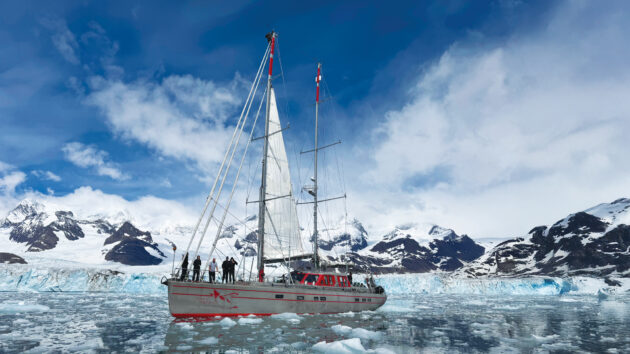
One of David Attenborough’s favourite places on earth is South Georgia. On arrival we soon discover that there is an untouched grandeur that can’t be captured on film. There is such clarity to the atmosphere that distance and scale become hard to judge.
The island, whilst not large, is packed with variety and offers up daily delights throughout our five-week adventure.
Nordenskjöld Glacier is a case in point. We have seen it from on high during a couple of long scrambles in the mountains. Impressive but distant, a captivating focal point that’s tucked into the corner of a victorious group picture.
Its two-mile face, as we subsequently motor towards it, just keeps on growing. Extending beyond our peripheral vision it starts to tower and dominate the senses. Creeping under its spell the ambient temperature plummets and the air stills.
The engine is reduced to tick-over as ice rattles along the aluminium hull. We push through a carpet of bergy bits, occasionally backing up in search of an opening. The hull quivers on contact with larger, more belligerent chunks.
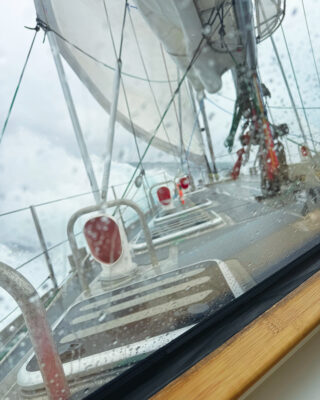
Crashing through the Southern Ocean on the return passage to the Falklands. Photo: Pete Goss MBE
More noticeable, much like jungle cicada, is the background crackling as melting ice releases air pockets compressed by thousands of years of imprisonment. It sounds much like childhood memories of Rice Krispies and the ice is a wonderful addition to that night’s gin and tonic.
In a funny way this trip started 53 years ago when I first read Shackleton’s story. Aged 11, I promised myself an adventurous life and made a childishly naive commitment to visit South Georgia. Perhaps I might get a better sense of the man and what he achieved. Over my lifetime, five serious attempts have been thwarted by circumstances beyond my control. The Falklands War being one of them.
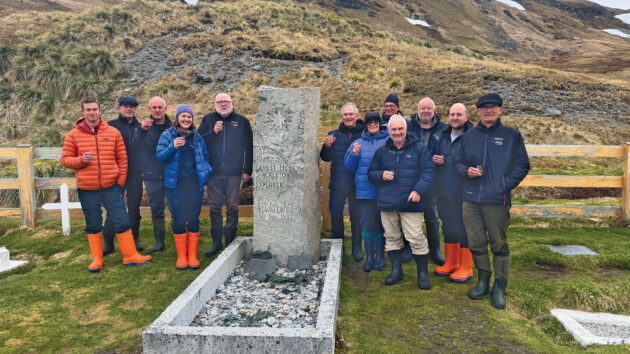
A tot at Shackleton’s grave. L-R: Tor Bovim (Skipper) Mark Johnstone, Simon Hutchinson, Melissa du Toit (First Mate), Dave Calvin, Pete Goss, Tracey Goss, James Getgood, Ian Torrie, Steve Rigby, John de Wet (Engineer), Nigel Race. Photo: Pete Goss MBE
Inspired by Shackleton
Shackleton’s legacy, having inspired countless others like myself, is extraordinary. Not just as an adventurer but also as an exemplar of leadership from clear vision to passion, commitment and loyalty. Old enough to start looking back at both my life and his contribution, it would be even more amazing to share a tot by his grave and offer my thanks.
I hadn’t given up on the dream but after so many failed attempts I had started to accept that this might be the one that would get away. That is, until a call from Dave Calvin who has been part of my projects as far back as the British Steel Challenge.
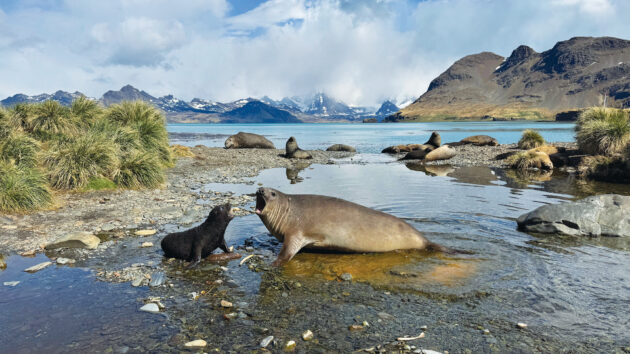
Elephant seal with her pup. Photo: Pete Goss MBE
‘How’re you doing Pete, I’ve sold my company and I’m in need of an adventure, you’re my expert.’
‘That’s wonderful Dave, I’ll pop up for a cuppa so I can tease out what might be best for you and advise accordingly.’
‘Yeah, but what would you do?’
‘It’s not about me Dave…’
Back and forth we went until, to move the conversation forward, I said: ‘Well, if I won the Lotto, I would fly to the Falklands, spend a week exploring, pay my respects to the fallen and charter a vessel to explore South Georgia.’
‘Amazing! We’re doing it!’
Dave has a huge heart and over time it turns out that all along he was fishing for my dream trip. Looking back, he has a number of people on his list who he wants to thank for doing a good turn or having a positive influence. It took a while for this to become apparent and it was hugely humbling to find that I was on his list.
We loosely agree he will choose half the crew with my selection bringing sailing experience and perhaps a military bent – people who have done their bit for Queen and Country and are deserving of something in return.
The boat, normally the hardest part of any such venture, turns out to be the easiest. Skip Novak has poured a lifetime of ocean racing and mountaineering into the Pelagic brand of adventure yachts. The penultimate, built-in collaboration with the visionary Nicolas Ibáñez from Chile, being the mighty 77ft Vinson of Antarctica.
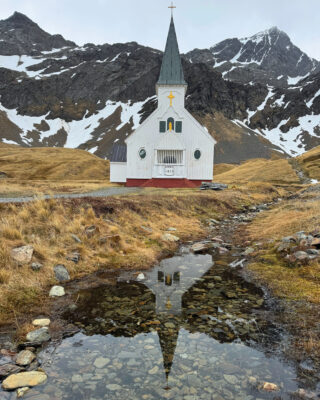
The Norwegian Anglican Church, also known as Grytviken Church. Photo: Pete Goss MBE
I’m staggered to discover that she carries eight tonnes of fuel, more than my Vendée Globe entry displaced! A quick call secures the boat for what he feels is the best time of year to visit South Georgia. A balance between weather and breeding seasons.
The team, self selected through the weft and weave of life are: an Army Brigadier, a Naval Commander, a Royal Marine Lt Colonel, a policeman, a couple of entrepreneurs, a military doctor, Tracey and myself.
A cauldron of characters with five circumnavigations, numerous ocean crossings and many races between us. A mix of fascinating life stories to be shared around what proves to be a very sociable saloon table. Well beyond the facile influence of modern entertainment we start a schedule of lectures. Scrabble comes out and we have a formal but very merry Trafalgar Night. We are to become a close and lasting family.
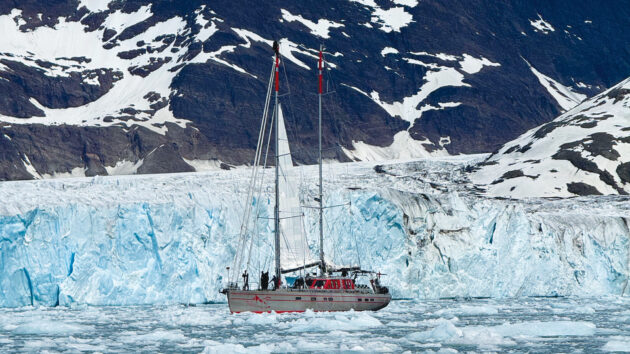
Nordenskjöld Glacier was awe-inspiringly large and surprisingly noisy with cracking ice. Photo: Pete Goss MBE
The ultimate expedition kit
As we venture towards this most hostile of environments the next priority is protective clothing. Needing to perform and enjoy this once-in-a-lifetime foray into nature at its best it could only be Musto.
With little room for error I choose to issue personal kit bags with everything required from thermals to hats, gloves, head torch and a Leatherman. An unusual addition is walking poles, for Skip says they are useful to back off inquisitive fur seals by tickling their nose.
I am not convinced!
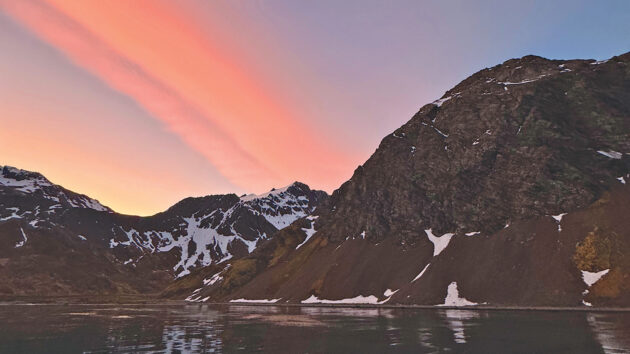
A bright moon and still waters for the night. Photo: Pete Goss MBE
The trip is on but I feel we need a series of stepping stones to ensure that a well equipped team and not a band of merry strangers turn up at the dock. The first is an orientation day in the Solent on Amundsen, the newly launched sister-ship to Vinson of Antarctica coupled with a fitting for Musto sizes.
This is followed by a pilgrimage to Dulwich college to see the original James Caird, the 22ft 6in ship’s boat sailed 800 miles through the Southern Ocean from Elephant Island to South Georgia by Shackleton.
That night we booked a dinner with partners in HMS Belfast’s Officers Mess. There, a Naval and an SBS veteran shared their personal experiences of the Falklands War. It was a fun but humbling evening which ended up with Nigel Race being offered the extra berth.
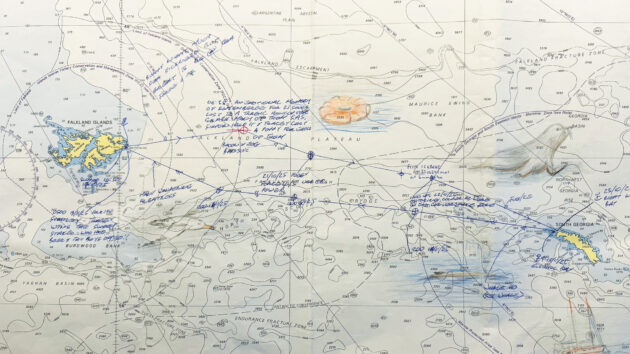
Pete’s detailed chart of the voyage. Photo: Pete Goss MBE
As a fresh Lieutenant he was the gunnery officer on a requisitioned Hull trawler which was converted to a Mine Sweeper. South Georgia was their first port of call; it became a profound and formative experience.
The truth is that I am struggling to capture South Georgia in an article as the magnitude of the experience deserves a book. The best I can do is perhaps share an experience of just one morning and leave the rest to pictures.
Four tonnes of testosterone-infused elephant seal leaves little time for niceties. Some things can’t be unseen so I shall leave it to your imagination: and the thought that Australian foreplay – ‘Brace yourself Sheila’ – would have been a kindness. Love-making it was not.
South Georgia’s climate means life is tenuous, boiled down to the very basics of survival. There is no room for weakness and so it is prayed upon with disdain for the niceties of life. A seal pup’s anus offers safe easy access, and so gore-covered birds take a deep breath, plunge chest deep and rummage in what to them is merely a sack of sustenance. The fact that it might still be barely alive is of no concern. Its weakness is justification enough.
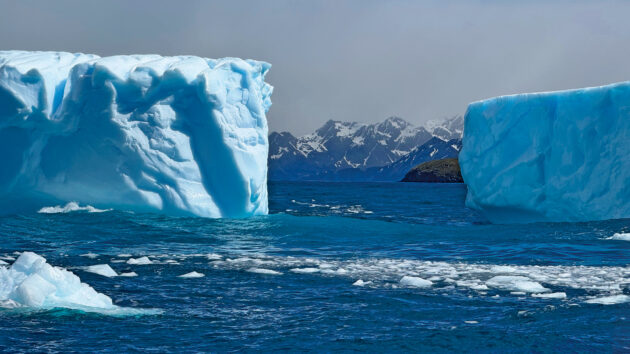
South Georgia is buttressed by icebergs of every hue. Photo: Pete Goss MBE
Barren but beautiful
Nature will never live up to Walt Disney but beauty abounds when you look beyond the battle for survival. Albatross soar the mountainside in courting pairs, inquisitive penguins shimmer in the sun, Arctic Terns flit about on delicate wings and seals frolic in the surf. A nonchalant Pintail duck settles on a gurgling brook to carry it beyond our reach. At the micro level, moss catches the light in a flash of verdant green, its soft texture prompting gentle touch.
If there’s an engine room behind this endless battle it’s the harsh and ever- changing climate. To a newcomer, it’s hard to read. Change seems to come without warning and leave with equal abruptness. A case in point would be this morning’s clear sky, glassy seas and a crisp stillness that carries the clanking of chain as the anchor is drawn from the depths.
There are other vessels here but they are not abundant. Mutual cooperation means that we don’t step on each other’s toes. The planets have lined up; we have been gifted settled weather and a slot at St Andrews Bay, which hosts a vast king penguin colony. The foredeck crew line up on the main halyard to heave like a chain gang. We will need it to steady Vinson of Antarctica as we motor in the swell.
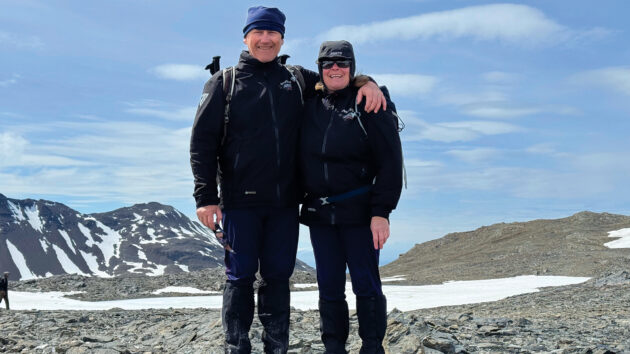
Pete and Tracey Goss on the crest of Shackleton’s walk. Photo: Steve Rigby
Strength in preparation
An intense morning sun slices through the cold of dawn to show every hue of blue reflecting off a new crop of icebergs that have moved in overnight. Sun screen is the order of the day. Alec Hazell, our guide, quietly underlines that we should always be prepared for the worst with poles, extra thermals, a flask of tea and VHF radio. Long refined routines are explained, simple tasks like beaching have become tightly choreographed. There is strength in preparation.
Our landing is a judgement call that nestles between the territorial elephant seal and the swell which is on the kindly side. First up the beach is a safety drum with enough food and equipment for the group to survive should we be caught out by Katabatic winds, known to tear down these valleys without warning.
It’s time to explore a land in which we are the outliers. A passing interest to those that have evolved to survive in this harsh landscape. Words don’t seem adequate, my fellow crew has been reduced to something akin to a space walk. Slow and ponderous with many stops to allow the brain to absorb what feels like full HD on fast forward. There is no focal point, rather numerous focal points which compete for attention.
It’s both overwhelming and invigorating as we drift through groups of marching penguins, bent on some unseen collective mission. We meander around fur and elephant seals who need something in the order of 5m to ignore us without challenge.
The fact that elephant seals smell better dead than alive makes this rule easy to follow. The rule of thumb is that if we change an animal’s behaviour we are intruding and should back off.
Alec Hazel was an inspiring, knowledgeable guide for the group. Photo: Pete Goss MBE
Nature’s spectacle
In the distance eight tonnes of flesh bash it out as a couple of elephant seals square up. Giant petrel scavenge for food, a group of them hunker behind tussock grass, tapping beaks in the fashion of a wayward street gang. Seal pups cry for attention.
Mums either ignore them or roll over to allow access to their elixir of life. Their milk is so rich that they put on a staggering 3-4kg a day. A dominant bull relaxed in sleep spreads like a blancmange to become wider than high. A squealing pup is shoed through the harem, nipped, nudged and growled at in his search for Mum. The odd dead pup tugs at heart strings.
It’s a subtle dance and Alec is a master. Deeply invested in preserving this remote habitat he believes it should be shared but it must be limited. There is a strict protocol, every departure and return to Vinson of Antarctica is preceded by a bio hazard scrub.
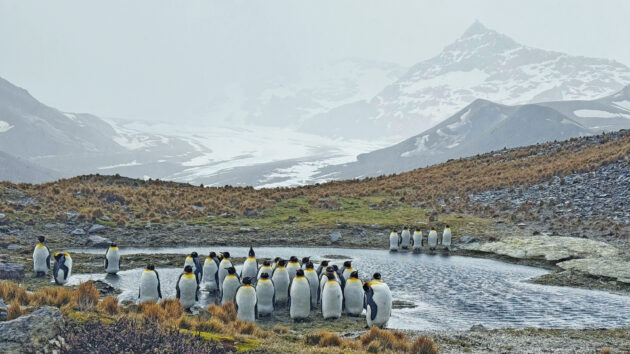
A busy waddle of penguins in St Andrews Bay making for who knows where. Photo: Pete Goss MBE
Thanks to Bird Flu, one bay must be protected from the next. Oddly, it’s the seal population that has been decimated. There are descending layers to this protocol: before departing the Falklands a dog searches the boat for rats; on arrival we are briefed and lined up with shore-going clothes and equipment to be searched. A sailmaker’s needle digging for errant seeds.
As amazing as this spectacle is, we have come to St Andrews Bay to see a colony of king penguins. A glacier of bygone days has conveniently ground out a broad flat alluvial valley. Riven with streams and piles of moraine it makes for an interesting walk as we move towards high ground.
Every nook and cranny houses a waddle of penguins shuffling to who knows where. The odd one stretches its neck to hoot, trumpet-like, for the heavens. Others add to the cacophony of sound as they take up the call.
Under the guiding hand of a rising wind the collective begins to conform. Large colourful beaks weather vane, backs to the wind. Something has shifted.
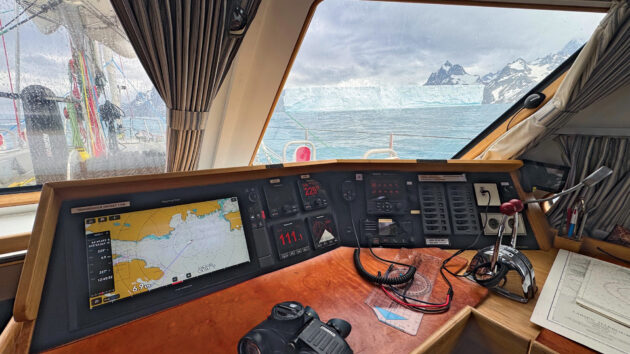
Aweinspiring views from inside the pilothouse. Photo: Pete Goss MBE
Engulfed by a storm
The atmosphere takes on a threatening hue, sunlight fails to cut through and a biting wind sweeps the valley. Freezing rain joins in and starts to hurt.
I grab Tracey as a vicious gust tries to steal her away; surface area becomes our enemy. James, the tallest of our crew is forced to crouch in the human equivalent of a reef. The rain escalates to hail that needle pricks numbed skin.
As the tempest builds we unconsciously mirror the penguins by turning our backs to the wind. Our clothing flaps and rattles like a banshee; we are forced to shout.
Between gusts we push over the crest to be faced by a sea of penguins so large it takes a while to comprehend. Like sentinels, hundreds of thousands patiently stand in the face of their chosen environment. The young distinguished by their fluffy brown coats, stand out against their colourful parents who, despite the flowing effluent, are pristine.
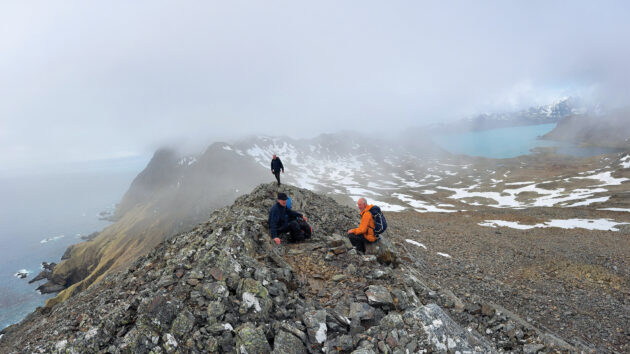
Traversing the ridge above Jason Harbour as we explore ashore. Photo: Pete Goss MBE
Penguins are easy to humanise, and a baby tucked under a mother’s wing evokes thoughts of home.
Glancing back, Vinson of Antarctica is swallowed by a swirling dervish as williwaws tear across the bay. My sailors’ heckles rise as Vinson re-emerges, resolute in her bespoke robustness. A beacon of reassurance that is starting to be challenged. The radio crackles, at 55 knots it’s time to call it a day. In the closing visibility I scope the ground for a mental bearing on the survival drum. This could get interesting.
Urgency can’t be rushed here, wildlife must take precedence for this is one of the last remaining bastions of nature to stand against man’s voracious consumption. Strength lies in its utter remoteness, there are no vapour trails, mobile signals, or detritus on the beach. The air is expansive with a crispness that carries magic, it’s almost spiritual.
We close the beach as the weather gods dial back their brief message of dominance. The sun returns and despite battling 40-knot gusts the dinghy trip feels quite safe. As we bio-wash our boots, Vinson, tugging restlessly at her anchor, rocks, rolls, bobs and weaves her way through the remaining williwaws. Tor Bovim, our skipper, seems relieved to have us aboard; an old head on young shoulders who has seen it all before.
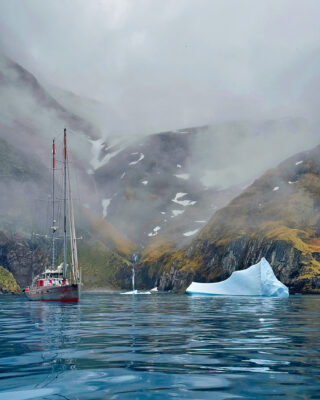
Hercules Bay. Photo: Pete Goss MBE
We motor back to the crucible of Cobblers Cove, the mountainsides reflected in the glassy surface offer a warm embrace. We strip wet-weather gear, thermals and socks to wriggle our toes in the sun. It’s as if we have stepped through a portal to a softer world, the lunch bell rings. Freshly baked bread melts butter, the smell of soup triggers a spasm of hunger.
Did all that really happen in one morning?
Days later, crossing Shackleton’s last ridge to Stromness Whaling Station, it strikes me as ironic that it was petroleum, that great satan of our time, that saved the whales. I am also struck, as I look across South Georgia, that the evidence of long lost glaciers point to something much bigger underlying the climate changes of our lifetime.
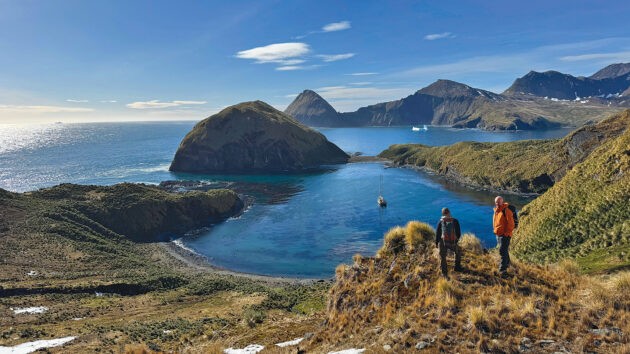
Cobblers Cove was a favourite anchorage. A few hours earlier the crew battled katabatic winds in St Andrews Bay. Photo: Pete Goss MBE
Paying respects to the great man
I’m not a denier, far from it, Tracey and I have lived completely off grid for 12 years now. My sense though, is that there is a bigger cycle, far beyond mankind that is also at play. React we must, but lets not allow hubris to infer that we are both the cause and the only solution. We must do all we can to reduce mankind’s acceleration but wider than that we must adapt and protect nature as best we can.
There are many poignant moments to this trip but top of the list has to be toasting the great man at his grave. A moment far more emotional than I expected. Shackleton’s ghost and free spirit abounds here.
As we scramble through coastal mountains we often glance inland towards mighty snow-clad peaks, boiling weather and glaciers to marvel at what they survived. How did they do it?
Shackleton drew us here and we leave both humbled and reinvigorated.
Enjoyed reading this?
A subscription to Yachting Monthly magazine costs around 40% less than the cover price, so you can save money compared to buying single issues.
Print and digital editions are available through Magazines Direct – where you can also find the latest deals.
YM is packed with information to help you get the most from your time on the water.
-
-
- Take your seamanship to the next level with tips, advice and skills from our experts
- Impartial in-depth reviews of the latest yachts and equipment
- Cruising guides to help you reach those dream destinations
-
Follow us on Facebook, Twitter and Instagram.
Note: We may earn a commission when you buy through links on our site, at no extra cost to you. This doesn’t affect our editorial independence.