


A Californian trailer-sailer that became popular in Europe, the MacGregor 26C is a remarkably lightweight water-ballasted yacht with an ingenious pop-up saloon top
MacGregor 26C: How saving a sinking MacGregor led to a South Devon love affair

The upper reaches of Mill Tail in Totnes isn’t the most glamorous spot in South Devon. Sandwiched between tall converted warehouses and a cluster of trees on the adjacent Vire Island, this offshoot of the River Dart is nearly always dark and shady.
At low tide, it looks like nothing more than a muddy ditch. Yet it was here that Julian Spooner fell in love.
The occasion was the first Covid lockdown of 2020. His friend Martin was confined to his home 90 miles away in Falmouth, and the 26ft boat he had moored up on one of the trot moorings on Mill Tail was filling up with water. Julian offered to go down and bail it out for him.
Not having keys to the boat, he had to cut off the padlock to get in, and then bail with a bucket for an hour to get the water out. Residents stuck in their homes in the overlooking properties cheered him on, apparently delighted to see some activity in the creek. By the time he finished, the boat looked a mess but he had at least saved it from the mud.
Julian had in fact already sailed on Peridot, when the boat was based in Portugal and he and his wife Portia chartered it from Martin in 2014 and 2015. So when his friend later decided to sell the boat, he already had some connection with it. Yet his initial reasons for buying Peridot seem to have been largely pragmatic.
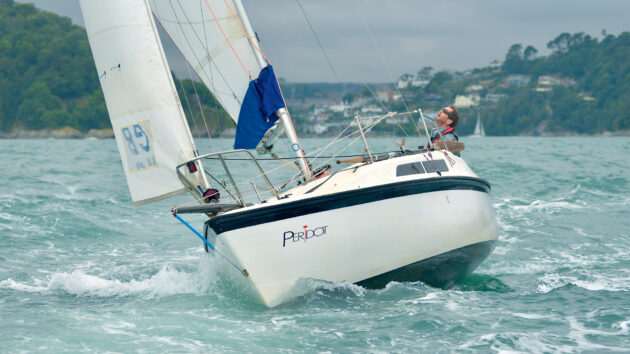
Progress is good thanks to the MacGregor’s simple Bermudan rig and impressive 2m draught with the centreboard down
‘It was location,’ he says. ‘I knew it had quite nice sailing characteristics, and it was moored nearby. From where we live, it’s a five-minute walk to the quay, we push off from the quay with the rubber duck – no paddle, we just push across and get on with it, and we’re off in about 15 minutes. So those were the two main things: location and knowing that it sailed okay.’
A McGregor 26C trailer-sailer was in many ways an unlikely choice for someone who has spent most of his life closely involved, for both work and pleasure, with modern multihulls. Brought up in South Devon, Julian learned about the sea while sailing dinghies out of Noss Mayo and Plymouth, first on an Optimist bought from Bell Woodworking and lovingly painted and varnished by his father, then on Mirrors and Lasers. But when he was 15, he had an epiphany.
‘I was beating out of Plymouth Sound in a Laser Radial,’ he remembers. ‘I was quite light for the boat, so I was really quick downwind, but upwind the fleet sailed away. I was on a pursuit race back to Noss Mayo, when I got overtaken by some big old guy on a Unicorn A-class catamaran. He was just chilling out in his harness, sitting on the side, and going twice as fast as me. I was immediately converted.’
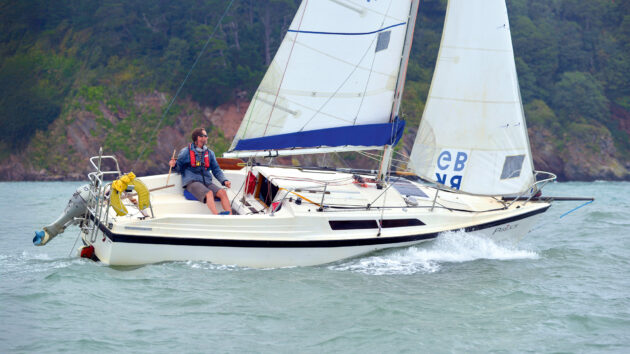
This McGregor predates the rather more boxy outboard motor sailers the brand is better known for
Multihull love affair
Julian ended up buying a Unicorn for himself, eventually followed by a Tornado, and has sailed mainly on multihulls ever since.
He studied naval architecture at the Southampton Institute (now Southampton Solent University) in the same year as Guillaume Verdier (‘the grand fromage of racing foilers’). He went on to carve out a career in composites, working with the likes of Pendennis Shipyard and Princess Yachts, as well as developing a process to build resin-infused wind turbine blades. More recently, he has applied his composites expertise to rarefied fields such as high-altitude unmanned aircraft and nuclear fusion.
Article continues below…
In 2007, Julian launched a 33ft catamaran to his own design which he had spent seven years building using a cheap (free) source of pre-preg carbon fibre. The boat capsized and lost its rig on its maiden voyage off Start Point. Undeterred, he recovered the hulls, rectified the problem (the rudders were too small), and fitted a new (second hand) rig.
He then enjoyed a few years racing off Devon – including sailing from Plymouth to Falmouth in four hours – before selling her to an adventurous spirit in Australia. ‘That was a really quick boat, but not suitable in any way for the kind of sailing I was going to do,’ he says. ‘I needed to focus on family life and I was planning to de-boat or have less boat and do more walking and surfing when I saw Peridot sinking in the creek.’
The MacGregor 26 class (now referred to as the ‘classic’ version, hence the MacGregor 26C) was designed by Roger MacGregor in 1987. Roger and his wife Mary Lou had set up a boatbuilding facility in Costa Mesa, California (near Los Angeles), in the 1960s and produced a range of swing keel boats ranging from 17 to 24ft, sometimes marketed as Venture Boats.
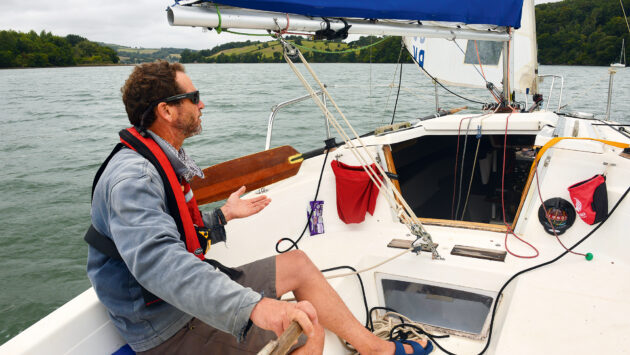
Like the rest of the boat, the cockpit is simple and unpretentious
The Mac 26 was their first water-ballasted design and built on a trend for such boats at that time – no doubt encouraged by the use of water ballast by Philippe Jeantot in the 1983 BOC Around the World Race. Unlike in Jeantot’s boat, however, the ballast in the Mac 26 couldn’t be adjusted and was used purely to lighten the boat when trailering, filling when the boat was launched and emptying when it was taken out of the water.
The result was impressive, with a ‘dry’ MacGregor 26C weighing just 1,650lb (648kg), before the addition of 1,200lb (544kg) of water ballast. Even by modern standards, this is shockingly light for a 26-footer – and ideal for trailer-sailing. The boat was originally available with a daggerboard (known as the 26D), which was later replaced by a conventional centreboard (known as the 26S), giving a minimum draught of 1ft 3in with the board up and 6ft 4in with the board down. The boat was fitted with a simple Bermudan rig which could easily be lowered and raised for trailering.
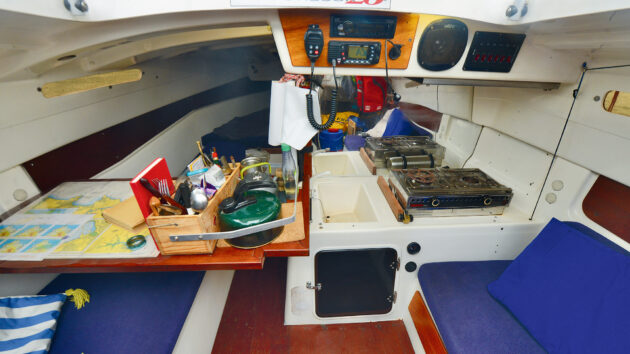
The interior is perhaps reminiscent of camping afloat
Open plan accommodation
Below decks, the boat was simply furnished, with plain plastic mouldings and minimal woodwork, apart from the locker lids, chart table and heads door. There was a double bunk in the foc’s’le, a single berth on the port side, and a large open area under the cockpit which could be used as a huge bed or for storage. The accommodation was entirely open plan, apart from the heads. Headroom was only 4ft 10in, but a clever pop-up hatch increased that to over 6ft in the companionway.
The original Mac 26 proved astonishingly popular, selling more than 6,000 units in ten years, making it one of the most popular trailer-sailers of all time, only beaten by the Catalina 22, which sold 18,000 units.
When I first contacted Julian about writing an article about his boat, he was keen to emphasise his boat was a MacGregor 26C, not any other version, and I can now see why. In 1995, the company introduced the MacGregor 26X, an innovative design which could be fitted with a 50hp outboard and plane at over 20 knots.
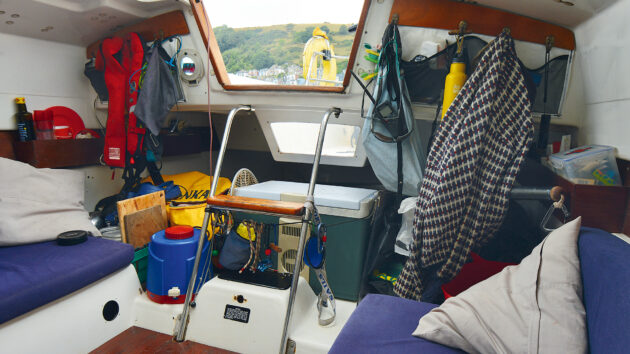
The area beneath the cockpit is completely open and can be used as a bed or for storage
The design was decidedly boxy (read ‘ugly’) though it too proved popular, selling 5,000 units. It was later replaced by the MacGregor 26M which was in turn rebranded as the Tattoo 26 when Roger and Mary Lou retired in 2013 and their daughter Laura took over the business.
Julian doesn’t know the full history of his boat, though he thinks she was built in 1988 and at some point presumably shipped to the UK on her trailer. Since he’s owned her, he’s been slowly upgrading and improving systems, without ever doing a major restoration or pouring lots of money into the boat.
He has minimum electronics: just the obligatory DSC VHF, nav lights and a Navionics app on his phone. He’s improved the centreboard set-up so he can push the board down from inside the boat when the slot fills up with mud, as well as leading the control lines to the cockpit – essential for sailing on the river. And he’s made a new, bigger rudder (he’s not going to get caught out by that again!). His biggest expense so far has been fitting new cap shrouds and a new forestay.
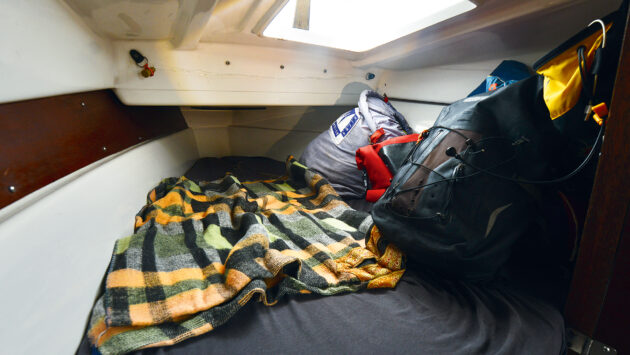
The forepeak cabin has room to sit up on the bunk, but not much else
‘Partly it’s just to do with how much resources I can or am prepared to spend,’ he says. ‘But it’s also part of a desert island boating thing. I’ve done quite a lot of woodwork using wood out of the river and some hardwood off another boat. I’ve got a workshop at home, so I take bits of the boat back there to work on, which is massively more satisfying than just buying a new thing and putting it on the boat. It’s recycling, or wombling. It’s like a wombling boat.’
But the upgrade that had the biggest effect was replacing the sails – not with new sails, given the aforementioned constraints, but a second-hand suit of J/24 racing sails recut to fit Peridot. ‘That’s been a big deal because it totally changes the behaviour of the boat, especially when it gets breezy,’ says Julian. ‘It means you get to keep a decent sail shape, so you’re not bagging out and just heeling over.’
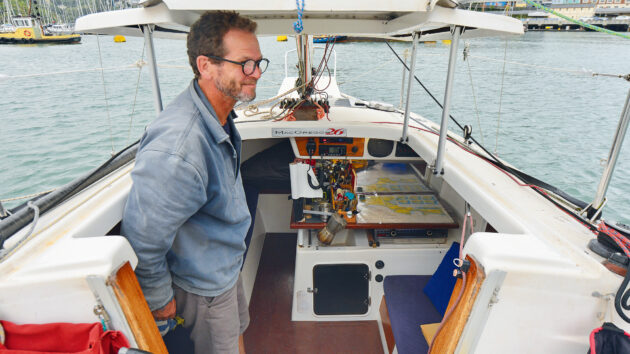
The interior is small compared to more modern 26-footers, but the pop-up coachroof is very clever
Taking her out
It was a suitably breezy day when I met Julian for a test sail on Peridot. There’s no doubt that at nearly 40 years of age, the boat is beginning to show her age – perhaps more so than some more heavily built boats of the same era. The essence of the MacGregor boats was simplicity, lightness and affordability, rather than becoming an heirloom for future generations.
But I notice that Julian has renewed stuff where it matters, mainly in the rigging, with that new standing rigging as well as new blocks, new cordage, ‘newish’ sails, and new-but-homemade stack pack. The boat might look scruffy, but there’s a mean machine purring under that worn-out coat.
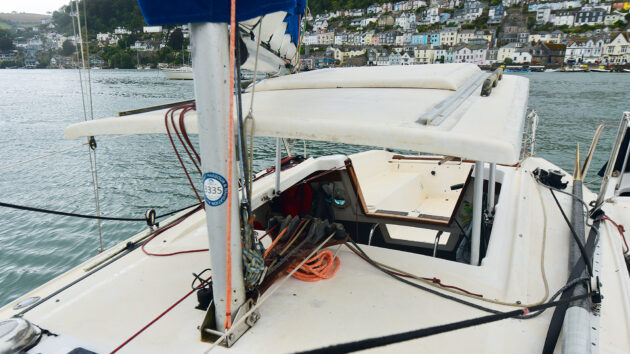
The unusual pop-up coachroof creates standing headroom in the centre of the saloon, but not for use under way
Below decks, the accommodation feels quite small for a 26-footer, due to that low headroom. A modern shoal-draught 26-footer would no doubt contrive to have a more convivial interior, with more beam, more freeboard and more creature comforts. The Mac 26C feels more like camper-sailing than yachting – which suits Julian just fine.
‘There’s been a lot of good stuff in the press about abandoning big boats,’ he says. ‘We’re in this situation where boats are just getting bigger and bigger, and more and more complex. But what’s really interesting to me is this small scale of being on the water and having just enough to stay out of the rain, to make your breakfast in the morning.
‘I’ve got a sculling oar and most of the time I try not to use the motor because the birdsong soundscape on the river is so good. But if you’re motoring, then you’re missing all that. I do use it if I need to get from A to B in a hurry, but whenever possible I let the tide dictate more than a desire to get to a specific spot. Why are we in such a hurry to get to B? How do you know that B is so much better than A?
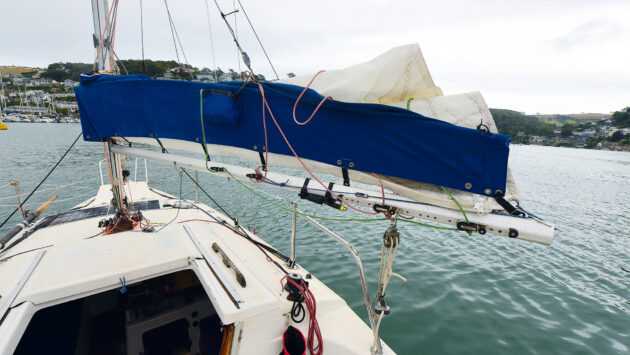
The home-made stack-pack does its job, making solo sailing easy
The cruising you can do in a boat like this means you can always find somewhere where there’s nobody else. You can find some quiet spot, and get up close and personal with the seals and whatever’s happening on the coast. So it’s really about being tied to the coast and enjoying nature, sitting there with a peregrine above your boat.’
Surprising performance
If that sounds boring to you, then the MacGregor 26C’s sailing performance might come as a pleasant surprise.
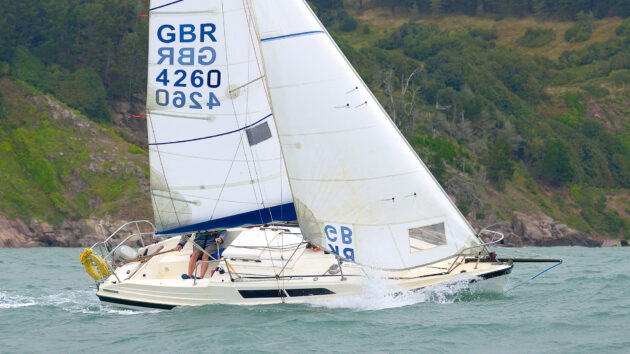
Julian had warned me that Peridot was tender and, with a feisty Force 4-5 easterly blowing off Dartmouth and a big swell rolling in around Froward Point, I wondered if it might be a bit too much for the old girl. But Julian played the sails perfectly, easing off in the gusts and hauling in during the lulls, so the boat stayed as upright as possible, cutting through the waves to windward and surfing down them on the way back. In fact, he sailed the boat ‘just like a dinghy’, just like he sailed that Laser Radial off Plymouth all those years ago.
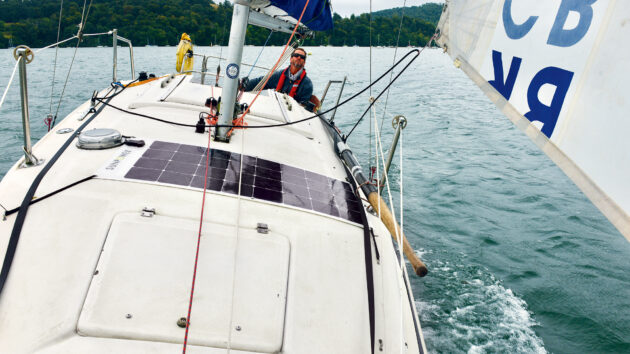
Deck hardware is kept to a minimum for simple unhurried cruising
It was a different case, later, when I took the helm as we tacked back up the river. Although the water was calm, there was still a strong breeze blowing and I couldn’t resist keeping the main in tight to see how far over she would go. She took it stoically, as did her owner, though it didn’t do anything for her speed.
MacGregor 26C specifications
LOA: 25ft 10in / 7.87m
LWL: 23ft 6in / 7.16m
BEAM: 7ft 11in / 2.38m
DRAUGHT: 1ft 4in / 0.38m (c/b up) 5ft 4in / 1.62m (c/b down)
DISPLACEMENT: 1650lbs / 748kg
BALLAST: 1,200lbs / 544kg
SAIL AREA: 235 sq ft / 21.83m2
PRICE: £5,000-£15,000
Enjoyed reading this?
A subscription to Yachting Monthly magazine costs around 40% less than the cover price, so you can save money compared to buying single issues.
Print and digital editions are available through Magazines Direct – where you can also find the latest deals.
YM is packed with information to help you get the most from your time on the water.
-
-
- Take your seamanship to the next level with tips, advice and skills from our experts
- Impartial in-depth reviews of the latest yachts and equipment
- Cruising guides to help you reach those dream destinations
-
Follow us on Facebook, Twitter and Instagram.
Note: We may earn a commission when you buy through links on our site, at no extra cost to you. This doesn’t affect our editorial independence.
Verdict
Buying Peridot may have been ‘an oddball, an aberration’, as Julian describes it, but after five years’ ownership, the boat has clearly grown on him. ‘It’s just an absolute pleasure,’ he says. ‘This little cruising boat that’s on my doorstep actually has crossover for my wife and friends, who don’t necessarily want to come and do leaning over and bouncing over waves, but enjoy the river. You can pop the roof up and have a really nice time on the river. At sea, it’s responsive like a dinghy, and not too sluggish. It’s a really good little boat.’ So it turns out there’s a very good reason MacGregor sold so many 26Cs: it’s a simple, unpretentious craft that gets you on the water with minimum fuss and yet performs surprisingly well. You can pop it on the trailer and save on haul-out fees, or you can choose to head off to new destinations without having to sail all the way. And all for the price of a cheap second-hand car. I know which I’d rather choose to own, and it’s certainly not the car!