


Largest in the range from the well-known Swedish builder, the Maxi 1300 is an easily handled fast cruiser with offshore potential and a nicely-finished interior. David Harding went to meet her...
Maxi 1300 used boat review: Easily handled fast cruiser

When we think of yachts built in Sweden, most of the names that spring to mind are from the west coast: Najad, Malo, Hallberg-Rassy and Regina af Vindö, for example. We tend to think of these as epitomising Scandinavian build quality: boats that are beautifully finished and, perhaps, traditionally erring towards the strong and steady rather than the light and sprightly.
Some west-coast yards, on the other hand, such as Sweden Yachts, Arcona and CR Yachts, have placed more emphasis on performance, so wherever you set your marker on the cruising/racing spectrum you can find a boat that’s dripping with the hand-crafted joinery for which Swedish yards are famous.
Then, of course, there’s Maxi. Based on the opposite side of the country, near Stockholm, Sweden’s biggest boatbuilder adopted more of a production-boat approach, especially in the early days when the styling also set Pelle Petterson’s designs apart from the mainstream. Boats from Petterson’s drawing board always sailed well, however, as you would expect from a man who amassed an impressive collection of world titles and Olympic medals during his sailing career.
With a reputation for being fast and strongly built, Maxis became extremely popular. Over time, the styling and the finish both became more refined, to the point where, in many respects, the later Maxis might be considered capable of giving their more expensive west-coast brethren a run for their money.
One of the later models is the 1300. Launched in 2006, Pelle Patterson’s penultimate Maxi design is undoubtedly one of the finest-looking 41-footers around. Like all Maxis, she’s a performance boat aimed principally at coastal and short-hop cruising. As Peter Bruce put it – and few people speak with greater authority – ‘For ocean sailing I would like a boat with a deeper chest, but this is very fast, and ideal for short trips.
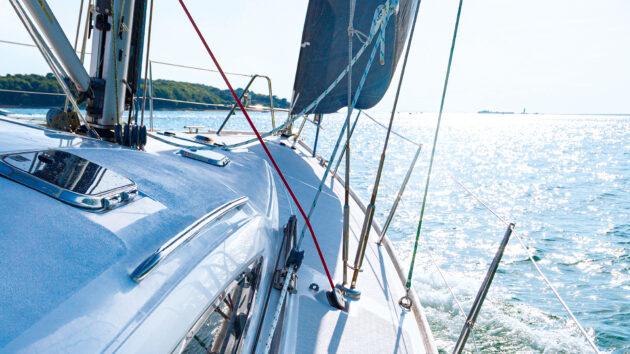
A clean and efficient deck layout. Features include good non-slip, midships spring cleats with chafing strips, and a wooden toerail. Photo: David Harding/Sailing Scenes
You might not want to take her across the Atlantic, though the previous owner did.’ By ‘a deeper chest’, Peter was referring to the canoe body. More weight and a deeper hull below the waterline tend to equate, among other things, to greater comfort in a seaway. ‘She’s on the light side, so quite lively’, he continued, making particular reference to a return trip from Ireland, not quite hard on the wind most of the way against an east-south-easterly Force 6.
Apart from speaking with considerable authority on yacht design in general, Peter was in a good position to comment on the Maxi 1300 in particular: his fifth boat to bear the name of Owl (now sailed by his wife, Sandy, who also continues the publishing business, Boldre Marine) was a Maxi 1300.
His previous boat, which he owned when he and Sandy got married, was a Maxi 1100. Sandy owned a Swan 38 at the time, so there was inevitably some discussion about which of their two boats they should keep. Until the decision was made in favour of the Maxi, they cruised them both together to southern Brittany, which was one of the couple’s favourite sailing grounds.
For all his reservations about the practicality of the Swan, Peter said that, as a good friend of Olin Stephens, he would very much like to have owned one of his designs.
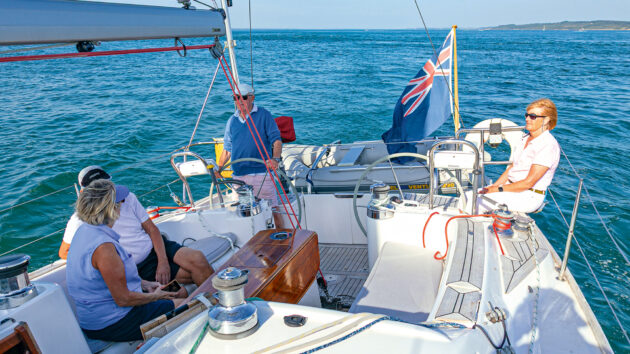
A sturdy central table on a moulded base provides a bracing point in the cockpit. Photo: David Harding/Sailing Scenes
Bigger and easier
Despite her size, the Maxi 1300 makes life surprisingly easy for a short-handed crew. ‘A few years ago’, said Peter, ‘a lot of our friends sold their sailing boats and bought motorboats. We sold our sailing boat and bought a bigger one, though this is actually easier to sail than the smaller one.’
That’s largely because this particular Maxi 1300, built to the original owner’s specification in 2008, came with features designed to make life easier, such as in-mast reefing (with vertical battens to give the mainsail some roach), electric roller-reefing for the headsail, and electric primary and coachroof winches.
Her size also allows a 2.9m (9ft 6in) inflatable to be carried in davits, saving time and effort compared with dragging a dinghy out of a locker.
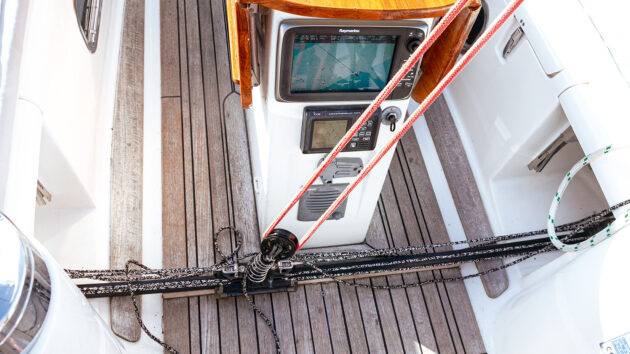
The aftermost sections of the cockpit seats can be removed to allow the mainsheet track’s full width to be used. Photo: David Harding/Sailing Scenes
My sail on Owl with Peter and Sandy was on a glorious day in July. We hadn’t long been discussing the idea of a sail when Peter phoned me and said ‘How about this afternoon?’. So I jumped in the car and drove to Lymington. We were sailing within about two hours of his call.
Although we had a modest amount of breeze – a maximum of 14 knots over the deck – we didn’t need any more because the Maxi is such an easily-driven boat and we still clocked 7 knots on the wind. Our biggest challenge was finding the patches of breeze in the western Solent and then staying in them but, with Peter’s unrivalled local knowledge and plenty of wind-spotting experience on board, we made the most of what there was.
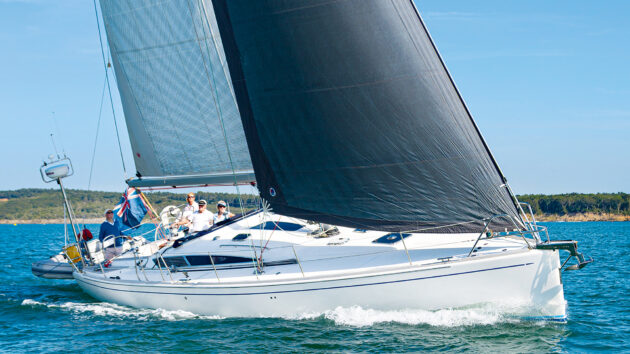
It’s always a pleasure to sail a boat that covers the ground rapidly, smoothly and without effort, and the Maxi certainly did that. When you look at her lines and the numbers, it’s no surprise: she has a light, shallow, slippery hull, an L-bulb keel, modest beam by modern standards, a relatively low wetted area, a generous rig and a keel-stepped mast.
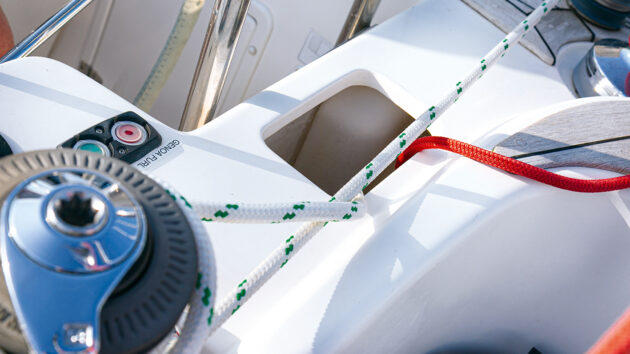
Rope-tidy pockets by the primary winches forward of the wheels… Photo: David Harding/Sailing Scenes
A boat like this doesn’t need to be pushed hard in cruising mode. A conventional mainsail would have added a fraction of a knot to our speed and a degree or two to our pointing at the expense of greater effort by the crew.
The great thing about in-mast reefing, electric winches and electric headsail furling systems is that they allow performance boats like this to be enjoyed long after earlier generations of owners with older, more physically-demanding boats might have been forced to hang up the sail ties.
Beautifully simple
Without such concessions, the 1300 could be a potent weapon on the race course, as the 1100 has proved to be as soon as the breeze picks up.
In cruising mode the 1300 is beautifully simple to handle, and that’s largely due to the well-thought-out ergonomics. At the cockpit’s forward end is a large seating area with a fixed table in the middle. The coamings wrap around the aft end of the seats in an ‘L’ shape each side, effectively dividing the cockpit into working and non-working areas.
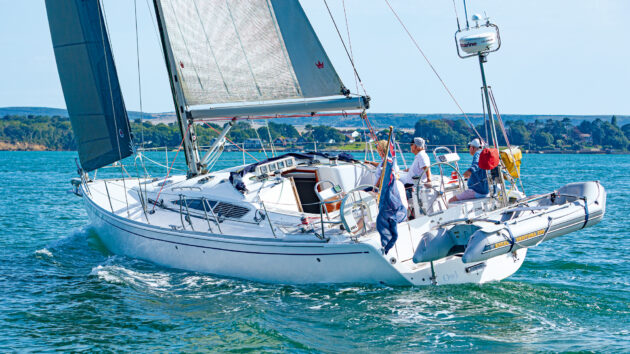
A 2.9m (9ft 6in) tender can be accommodated in davits for easy launching. Photo: David Harding/Sailing Scenes
The twin wheels are mounted on these mouldings, which also accommodate the Lewmar 54 primary winches, furl and un-furl buttons for the headsail reefing, handholds, engine instruments and throttle, a compass, controls for the bow-thruster, and everything else you might need at the helm.
The headsail sheets are led to the winches via jamming footblocks outboard, next to the winches for the German-style mainsheet that runs on a track across the cockpit sole forward of the wheels. When racing, you can lift out the aftermost section of seating each side to make use of the track’s full width.
More instrument space is on the aft end of the moulded base for the table, which incorporates a good amount of stowage under its wooden top.
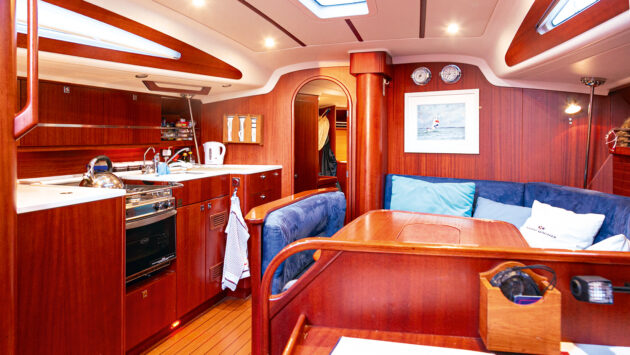
Nicely finished mahogany below decks, where the pale headlining and large window and hatch area keep it surprisingly light. Photo: David Harding/Sailing Scenes
Stowing away
Stowage for larger items is beneath the sole abaft the wheels – here you find the generator and diesel tank – and under the helm seats each side. There’s none below the seating further forward because of the two aft cabins. Lifting the starboard seat opens up the smaller of the two.
Of particular note are the coaming lockers. They’re so rare on modern boats, and these are about the only ones I have ever seen that are big enough to hold a DSLR camera.
As on many boats of this era, the Maxi has a permanent bathing platform, reached via a hinged gate enclosing the aft end of the cockpit. To my mind it’s a far more practical and useable arrangement than today’s hinge-down bathing platforms that builders have been forced to adopt in the interests of ‘marina friendliness.’ Yet more stowage is incorporated within the platform, which is flanked by stainless steel handholds forming part of the stern rail.
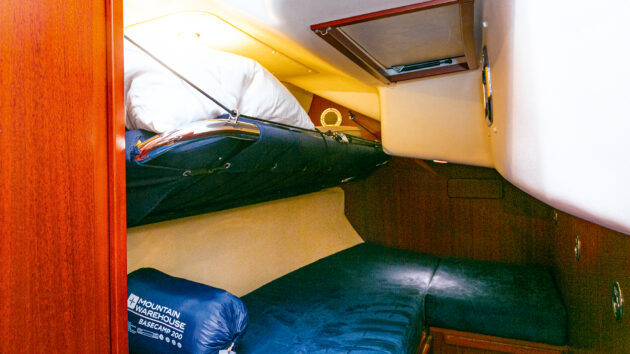
The starboard aft cabin has a single berth that can be extended to a double, plus a pipe cot. Photo: David Harding/Sailing Scenes
Moving forward along the wide side decks you find long genoa tracks that, combined with the inboard rigging, would theoretically allow the use of an overlapping headsail. Right in the bow is a large anchor locker and a short bowsprit to project the anchor from the stem. Peter, who anchored in many places over many years, changed to an Ultra anchor (with 60m of chain) and was very happy with it.
Asymmetric downwind sails can be flown from the bowsprit. Owl has the cruising equivalent of a Code 0 and also a symmetrical spinnaker for deeper angles, flown from a carbon pole. When you have raced as much
as Peter did, at the very highest level, you want a boat that you can still sail fast and efficiently as a cruiser.
For auxiliary propulsion, Owl has a 55hp Volvo D2 diesel. It had been fitted as a replacement for the original engine shortly before Peter and Sandy bought her, and had only 8 hours on the clock. Driving a Darglow Featherstream prop, it needed only 2,300rpm to push us along at 7 knots.
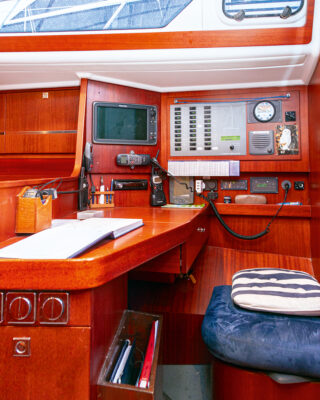
A good chart table, with plenty of space for instruments – and an owl keeping a watchful eye on proceedings. Photo: David Harding/Sailing Scenes
Acres of mahogany
Maxis of the 1300’s generation are beautifully finished in mahogany down below. Like a built-in bathing platform, mahogany is no longer fashionable and it might also be too dark for some tastes, but it’s highly durable and, allied to the pale headlining and good sized windows, it makes the interior surprisingly light. ‘I lightened the effect of the dark mahogany by putting light features on it’, Peter told me.
The most prominent of these is a painting on the bulkhead by his mother, taken from a photograph, of The Goodies approaching the finish line to win the Gold Roman Bowl in the 1978 Round The Island Race. To Peter’s surprise I remembered The Goodies as a half-tonner by Stephen Jones.
It’s a boat on which owner and designer raced together with great success. Peter later considered more of Stephen’s designs in the form of the Starlights when selling the last of his racing Owls (a HOD 35) and moving into cruising. Much as he liked the Starlights, the shorter ends of the Maxi 1100 – a more recent design – swayed him because they meant extra space for the length.
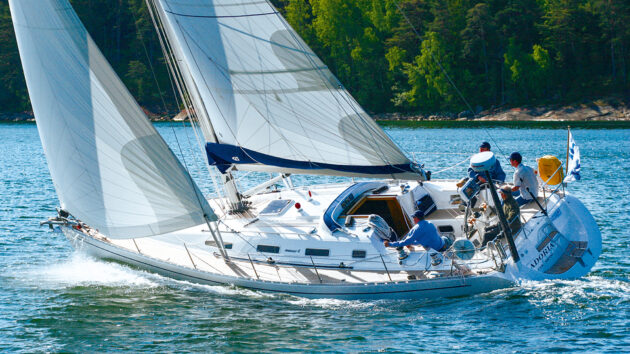
A stern of modest width allows the use of a single wheel. Photo: David Harding/Sailing Scenes
His first racing boat had been one of Bruce Farr’s early 727 quarter-tonners, then came The Goodies, which was followed by the first Owl in the form of a Contessa 27. The all-conquering second Owl – a Contessa 33 – came next, succeeded by a third design by Rob Humphreys in the form of the HOD 35. By that stage in the production, however, the mould had become distorted and lost its rocker, so the boat was only competitive downwind in a blow.
But we digress… Unlike the Maxi 1100, the 1300 has a linear galley to port opposite the saloon, where there’s a bench seat along the centreline. Peter once had 11 people seated around the table including the commodore of the Royal Yacht Squadron, of which he was a long-standing member.
The 1100 actually had a greater capacity: 13 was Peter’s maximum. I happened to be one of a remarkably similar number in a recent gathering aboard another Maxi 1100, so I know first hand just how capacious these boats are.
The 1300’s master cabin is in the bow, together with a heads and shower, making her one of the earlier boats to adopt this approach. In the stern is a double cabin to port, and a single cabin (with a berth that can be converted to a double) plus a pipe cot to starboard. Peter’s ‘admin centre’ – the chart table – is spacious, secure and well equipped.
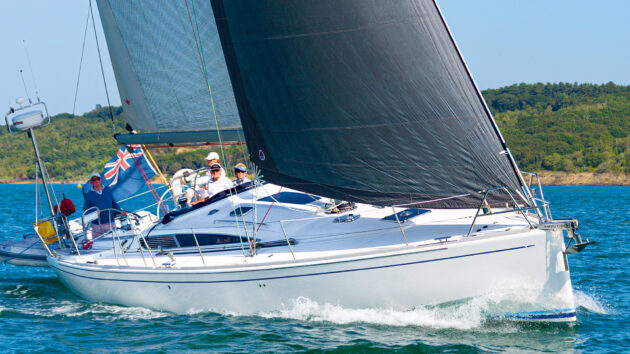
With fine lines and plenty of sail, the Maxi is a quick boat in light conditions. Photo: David Harding/Sailing Scenes
Maxi 1300 specifications
DESIGNER: Pelle Petterson/Danish Marine Design
YEARS BUILT: 2006-2011
LOA: 12.70m/41ft 8in
LWL: 11.32m/37ft 2in
BEAM: 3.80m/12ft 6in
DRAFT: 2.25m/7ft 5in
DISPLACEMENT: 8,300kg/18,298lb
BALLAST: 3,340kg/7,363lb
SAIL AREA: 89.30m2/961sq ft
PRICE: £200,000-£250,000
Enjoyed reading this?
A subscription to Yachting Monthly magazine costs around 40% less than the cover price, so you can save money compared to buying single issues.
Print and digital editions are available through Magazines Direct – where you can also find the latest deals.
YM is packed with information to help you get the most from your time on the water.
-
-
- Take your seamanship to the next level with tips, advice and skills from our experts
- Impartial in-depth reviews of the latest yachts and equipment
- Cruising guides to help you reach those dream destinations
-
Follow us on Facebook, Twitter and Instagram.
Note: We may earn a commission when you buy through links on our site, at no extra cost to you. This doesn’t affect our editorial independence.
Verdict
The Maxi 1300 is just the right age to combine features that make for a very appealing boat. She’s new enough to have short overhangs, a long waterline, a low-centre of gravity keel and a powerful yet easily managed fractional rig. At the same time, she’s old enough to have a built-in bathing platform, a lovely mahogany interior (including a proper chart table) and the sort of attention to detail both above decks and below that’s now rarely seen in boats from builders at any level. If you’re looking for a boat with the features that the Maxi has to offer, you’ll find it hard to do better.